Mr Bradly Mr Martin Hear Us Through The Hole In Thin Air

bradly1.jpg

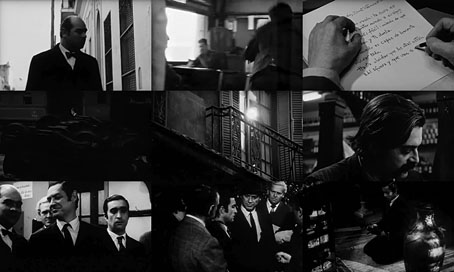
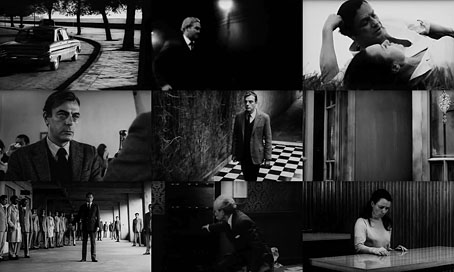
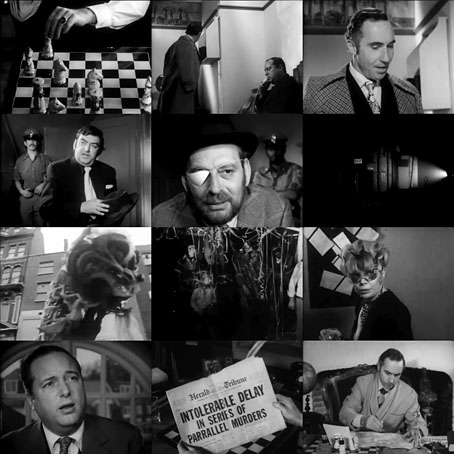
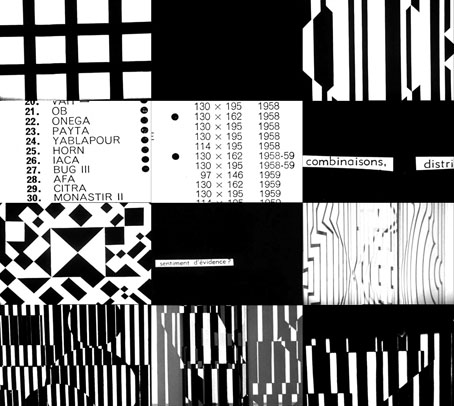
Vimeo swarms with Burroughs-related films, many of which might not have been made had it not been for the profusion of recordings of the author reading his work. This short from 2010 is one of the better examples, a combination of live-action film and animation by Greig Johnson that crams a considerable amount of invention into five minutes. The text is from the mulch of cut-ups that formed Nova Express, the recording being one of the tracks on Burroughs’s first album of readings, Call Me Burroughs (1965). Given the film’s style and short running time it makes a good double-bill with Philip Hunt’s Ah Pook Is Here (1994).

bradly2.jpg

Elsewhere on { feuilleton }
The William Burroughs archive

The Last Words of Dutch Schultz, a film by Gerrit van Dijk

lastwords.jpg

Gerrit van Dijk’s combination of live-action sequences and rotoscoped animation is tangentially related to William Burroughs, it being Burroughs who popularised the deathbed ramblings of New York gangster Arthur “Dutch Schulz” Flegenheimer with a “fiction in the form of a film script” also entitled The Last Words of Dutch Schultz (1970).

Flegenheimer was gunned down in the toilet of the Palace Chop House in Newark, New Jersey, in October 1935. Three of his associates had also been shot but he survived, and he spent two days muttering in his hospital bed while a police stenographer took notes. Burroughs was fascinated by the dissociated stream-of-conscious nature of the transcript which revealed little about his assailants but drifted feverishly through memories and hallucinations. The shooting and the deathbed ramblings were further popularised in 1975 by the publication of the Illuminatus! trilogy by Robert Shea and Robert Anton Wilson in which some of Flegenheimer’s more surreal pronouncements—”A boy has never wept nor dashed a thousand kim”—acquire occult significance. Flegenheimer and his last words also turn up in Exterminator! (1973), and Burroughs further fragmented the transcript in at least one of his own recordings where he reads out the equally strange phrases from transcripts of so-called electronic voice phenomena over an earlier reading of Flegenheimer’s words; the voices of the (supposed) dead wiping out the voice of the dying.

Burroughs’ Last Words of Dutch Schultz is nicely presented in its original form, the pages being laid out like a screenplay interposed with crime-scene photos from the period, Flegenheimer’s mug-shots and Art Deco graphics. The scene descriptions range through Flegenheimer’s life and mob history; whether they would make a good film or not would no doubt depend on the director. A film based on the script would be feature-length, and the narrative is a very fragmented one. Gerrit van Dijk’s film runs for 23 minutes and takes a similar approach, dramatising the shooting from different angles while juxtaposing the live action with animated sequences that are often anachronistic. Rutger Hauer supplies Flegenheimer’s dying voice. The anachronistic moments don’t contribute much unless we’re meant to regard Flegenheimer’s fever as being some kind of precognitive vision. Given the nature of the material—Depression-era gangsters, hallucinations, the Burroughs connection—I’m sure this won’t be the last film we see on the subject.

Elsewhere on { feuilleton }
The William Burroughs archive

Nova Express, a film by Andre Perkowski

nova1.jpg

Andre Perkowski’s Nova Express describes itself as “a 3-hour experimental epic adaptation of the novel by William S. Burroughs… with Allen Ginsberg, Brion Gysin, Phil Proctor, Peter Bergman, Jürgen Ploog, and Anne Waldeman”. The technique is relatively simple, if laborious: a large quantity of copyright-free film & TV footage, animation and visual material is matched to readings of Burroughs’s novel by the author and others. As far as this goes it’s an interesting answer to the question of filming Burroughs’ early works. Ideally this kind of juxtaposition of word and image should create something which isn’t present when word and image are separated, rather than simply operate on the level of what animator Chuck Jones once called “illustrated radio”. The clips on YouTube veer between these two poles. Notable by its absence is this kind of thing:

The naked cadets entered a warehouse of metal – lined cubicles – stood a few inches apart laughing and talking on many levels – Blue light played over their bodies – Projectors flashed the color writing of Hassan i Sabbah on bodies and metal walls – Opened into amusement gardens – Sex Equilibrists perform on tightropes and balancing chairs – Trapeze acts ejaculate in the air – The Sodomite Tumblers doing cartwheels and whirling dances stuck together like dogs – Boys masturbate from scenic railways – Flower floats in the lagoons and canals – Sex cubicles where the acts performed to music project on the tent ceiling a sky of rhythmic copulation – Vast flicker cylinders and projectors sweep the gardens writing explosive bio-advance to neon – Areas of sandwich booths blue movie parlors and transient hotels under ferris wheels and scenic railways – soft water sounds and frogs from the canals  – K9 stood opposite a boy from Norway felt the prickling blue light on his genitals filling with blood touched the other tip and a warm shock went down his spine and he came in spasms of light – Silver writing burst in his brain and went out with a smell of burning metal in empty intersections where boys on roller skates turn slow circles and weeds grow through cracked pavement –

Nova Express isn’t as homoerotic as the other books from this period but the whole of the Smorbrot chapter runs like that, and there are other moments elsewhere. (I should note that there’s no Smorbrot section in the available clips but I expect there will be in the complete film.) This side of Burroughs’ work is still the least represented where adaptations are concerned. Ignore it and you’re ignoring a major component of his fiction. Andre Perkowski talked to Graham Rae at Reality Studio in 2010.

nova2.jpg

Elsewhere on { feuilleton }
The William Burroughs archive

Decoder, a film by Jürgen Muschalek

decoder1.jpg

The Burroughs Centenary approaches, and this month sees the 30th anniversary of this Burroughs-related item. Decoder is a low-budget feature film from 1984 written by Klaus Maeck, and directed by Jürgen Muschalek (aka Muscha). Despite the constraints of budget and casting—many of the actors are amateurs—Decoder is truer to the techno-anarchist strand of Burroughs’ fiction than anything attempted before or since, and it’s arguably truer to the spirit of his works as a whole than David Cronenberg’s Naked Lunch.

decoder2.jpg

Decoder was shot in Hamburg in the early 1980s although the city is never properly identified in order to maximise the film’s near-future qualities. The narrative concerns attempts by FM (played by FM Einheit from Einstürzende Neubauten) to combat the insidious effects of muzak in burger restaurants using tapes created with his home-made electronics. William Burroughs makes a couple of brief appearances as the “Old Man” with a shop full of electronic components. Among the rest of the cast there’s Christiane Felscherinow, dividing her time between peep-show sex-work and languishing in a room filled with her pet frogs; and Genesis P-Orridge in his Psychic TV gear as the head of an underground pirate cult who encourage FM to launch an offensive against the muzak signals. Original music is provided by Dave Ball (from Soft Cell) and FM Einheit. The complete score is very good, featuring additional tracks by Soft Cell, Einstürzende Neubauten and Matt Johnson. Watched today, the narrative seems very much a product of its time, and somewhat outmoded. In 1984 home computing was increasingly prevalent, and cheap sound-sampling was just around the corner; Decoder is the last hurrah of an analogue struggle against the agents of the Control Virus.

decoder3.jpg

It’s a shame Jürgen Muschalek didn’t get to make anything else when he was obviously trying for some kind of cross between Burroughs’s The Electronic Revolution (1970) and Godard’s Alphaville (1965). Low-budget films often suffer visually but this one makes impressive use of vivid lighting and plenty of shadow which helps alleviate some of the weaknesses elsewhere. David Cronenberg has often acknowledged the influence of avant-garde types such as Burroughs and Warhol but his own films tend to be very conservative in their presentation. Muschalek at least tries to parallel some of Burroughs’ fragmented narrative techniques with an abrupt and disjunctive editing style. The film as a whole is much more in tune with the early Industrial Culture ethos than Peter Care’s noir pastiche, Johnny YesNo, but suffered from being more read about than seen in the 1980s. A few copies can be found online. In 2010 it finally appeared on DVD with extra material and a soundtrack disc.

Elsewhere on { feuilleton }
The William Burroughs archive

Weekend links 197

field.jpg

Posters by Jay Shaw for Ben Wheatley’s A Field in England which receives a US release this month.

Alvin Baltrop’s Gay New York: “the clandestine activities taking place under New York piers between 1975 and 1986”. AnOther samples some of the work on display at the Open Eye Gallery, Liverpool. Meanwhile, BUTT has some shots from Texas Porno Road Trip, a photo series by Mike McLeod. Related: HBO will show you anything but a male erection, says Justin Moyer.

• “[Robert] Desnos quickly proved himself to be one of the most gifted in these experiments – eventually known as ‘the period of sleeping fits’. He was capable of writing, speaking, drawing and composing entire fantastical narratives.” Eugene Thacker on the Surrealist séances of the 1920s.

• “It’s history, not a viral feed,” says Sarah Werner. A complaint about the way the ongoing decontextualisation of images is both pernicious and potentially lucrative.

His prose is a palimpsest of echoes, ranging from Eliot’s Preludes and Rhapsody on a Windy Night (lines like “Midnight shakes the memory / As a madman shakes a dead geranium” are Burroughsian before the fact) to Raymond Chandler’s marmoreal wisecracks and Herbert Huncke’s jive. I suspect that few readers have made it all the way through the cut-up novels, but anyone dipping into them may come away humming phrases. His palpable influence on JG Ballard, William Gibson, and Kathy Acker is only the most obvious effect of the kind of inspiration that makes a young writer drop a book and grab a pen, wishing to emulate so sensational a sound. It’s a cold thrill.

Peter Schjeldahl reviews Call Me Burroughs by Barry Miles.

• “Dance music was born in LGBT communities, but has this been forgotten?” Luis-Manuel Garcia on an alternate history of sexuality in club culture.

• Avant-Grade Hallucinogens: the Poetics of Psychedelic Perception in Moving Image Art by Stuart Heaney.

No Condition Is Permanent: weekly radio shows from Count Reeshard at LuxuriaMusic and iTunes.

The Golem: where fact and fiction collide. David Barnett on 100 years of Gustav Meyrink’s novel.

• Don’t Let Harlan Ellison Hear This: Nick Mamatas on a great writer.

• Mix of the week: the Ela Orleans Mix at A Sound Awareness.

Amon Düül II playing live on French TV, 1971 & 1973.

• A soundmap of London canals and minor rivers.

The Peculiar Underworld of Rare-Book Thieves.

• At Pinterest: William Burroughs and Phalluses.

Architecture of Doom

Hallucinations (1967) by Tim Buckley | Phallus Dei (1969) by Amon Düül II | Hallucinations (In Memory of Reinaldo Arenas) (1994) by Paul Schütze