The 7 Spectral Perils of Dorothea Tanning

tanning0.jpg

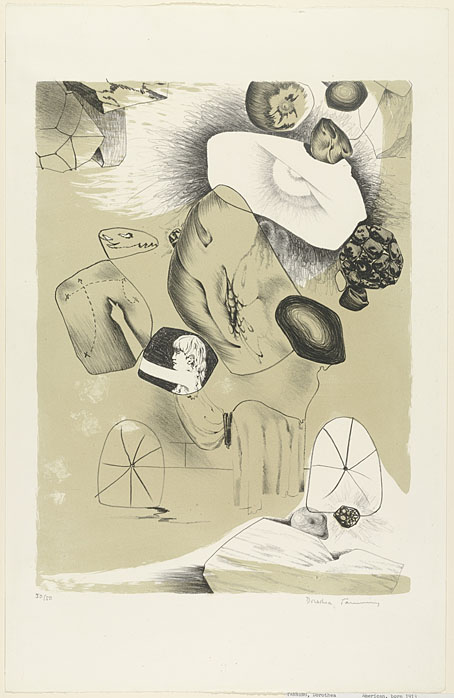
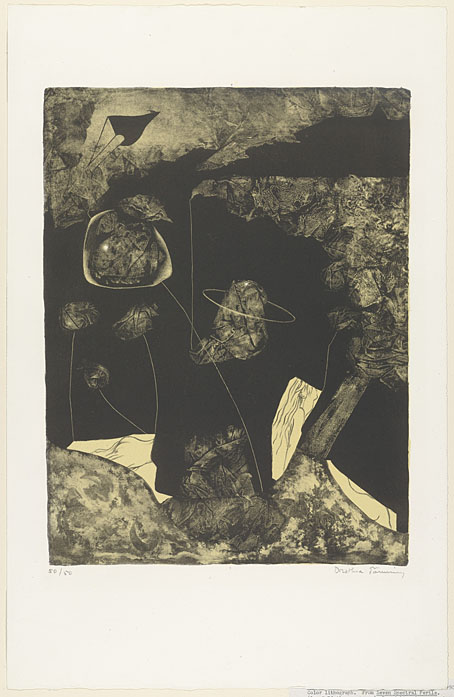
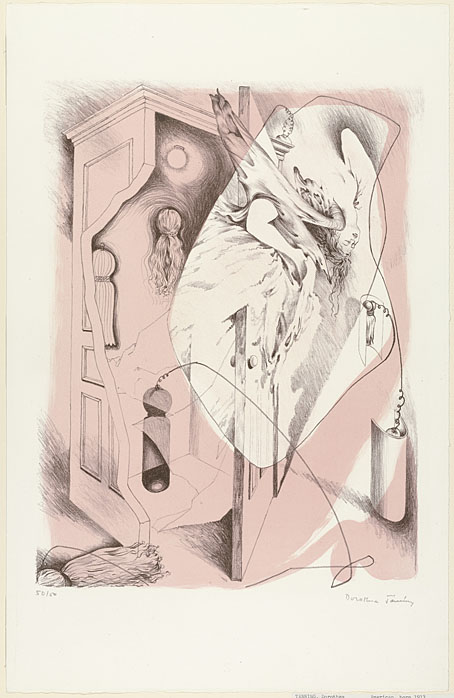
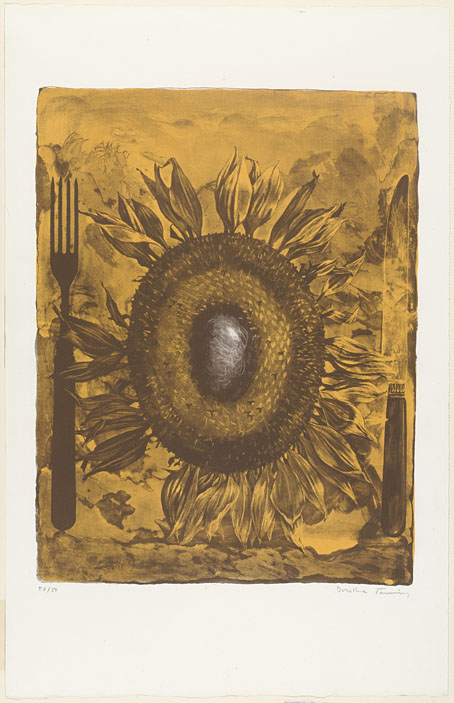
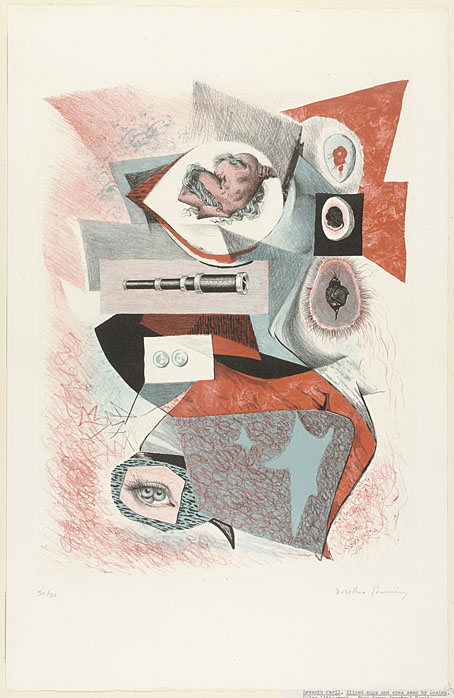
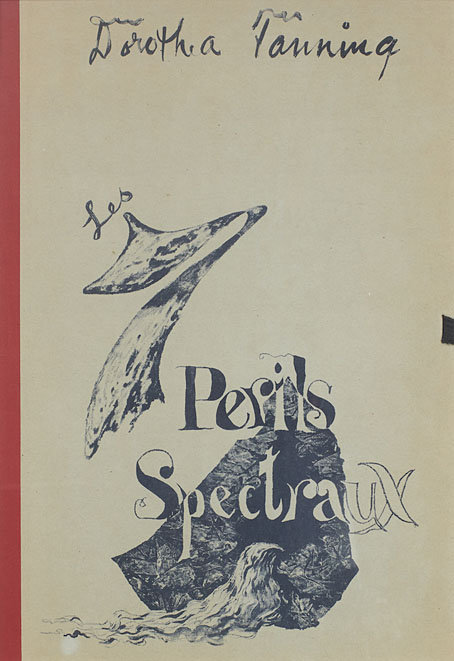
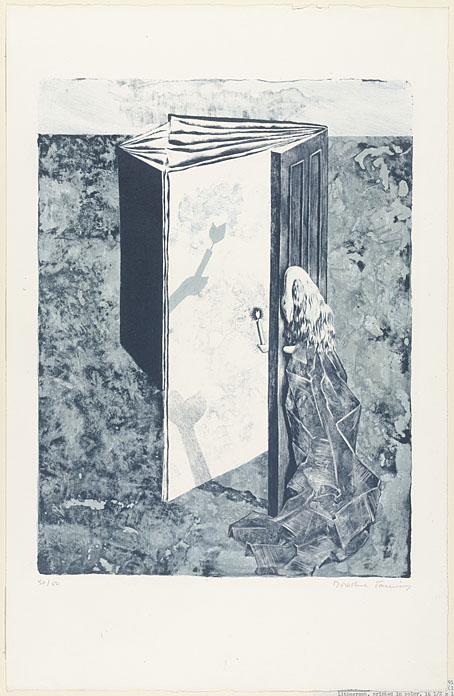
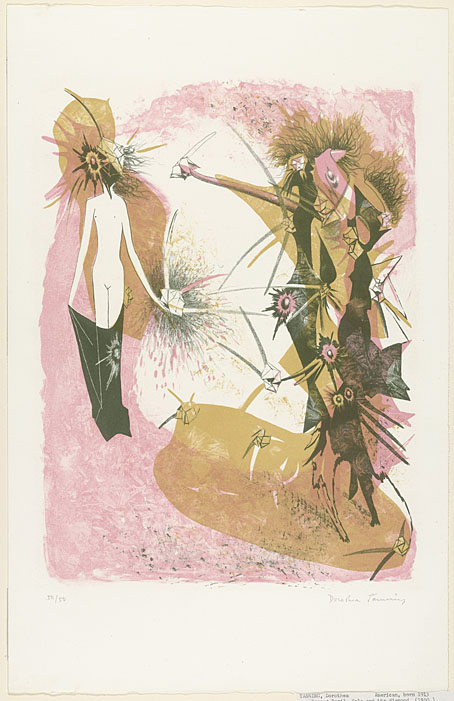
I like a picture series, and this is one I hadn’t encountered before. Dorothea Tanning’s Les 7 périls spectraux (1950) is a portfolio of seven lithograph prints with accompanying text, “Pourquoi Rester Muets?”, by André Pieyre de Mandiargues. Of the series, the artist had this to say:

My first lithograph adventure has become a book. An album with seven perils in it. Because to the seven deadly sins I preferred the seven spectral perils, life being more perilous than sinful.

What we don’t have—or I’ve been unable to find—is a list of perils to go with their respective prints. I’d guess, therefore, that with the perils being replacements for sins there’s a correspondence with the traditional prescriptive list, although this still leaves us to guess which is which. The print that shows a sunflower framed by a knife and fork may be allied to gluttony or it may refer to something entirely different, sunflowers being a recurrent, often enigmatic, feature of Tanning’s paintings.
tanning1.jpg

First Peril.

There’s a further correspondence with Une Semaine de Bonté, the collage novel created by Tanning’s husband, Max Ernst, in the 1930s. Ernst’s “Week of Kindness” comprises seven days, each of which is assigned a “capital element”, only in Ernst’s scheme we have a definite list of elements: mud, water, fire, blood, blackness, sight, and “unknown”. Since Tanning’s perils may also refer to a private mythology we’ll have to assign them to “unknown” as well, unless further information comes to light.
tanning2.jpg

Second Peril.

tanning3.jpg

Third Peril.

tanning4.jpg

Fourth Peril.

tanning5.jpg

Fifth Peril.

tanning6.jpg

Sixth Peril.

tanning7.jpg

Seventh Peril.

Elsewhere on { feuilleton }
The Surrealism archive

Previously on { feuilleton }
Temptations
8 x 8: A Chess Sonata in 8 Movements
Max and Dorothea
Dorothea Tanning, 1910–2012
Dorothea Tanning: Early Designs for the Stage
The Cube by Jim Henson

cube1.jpg

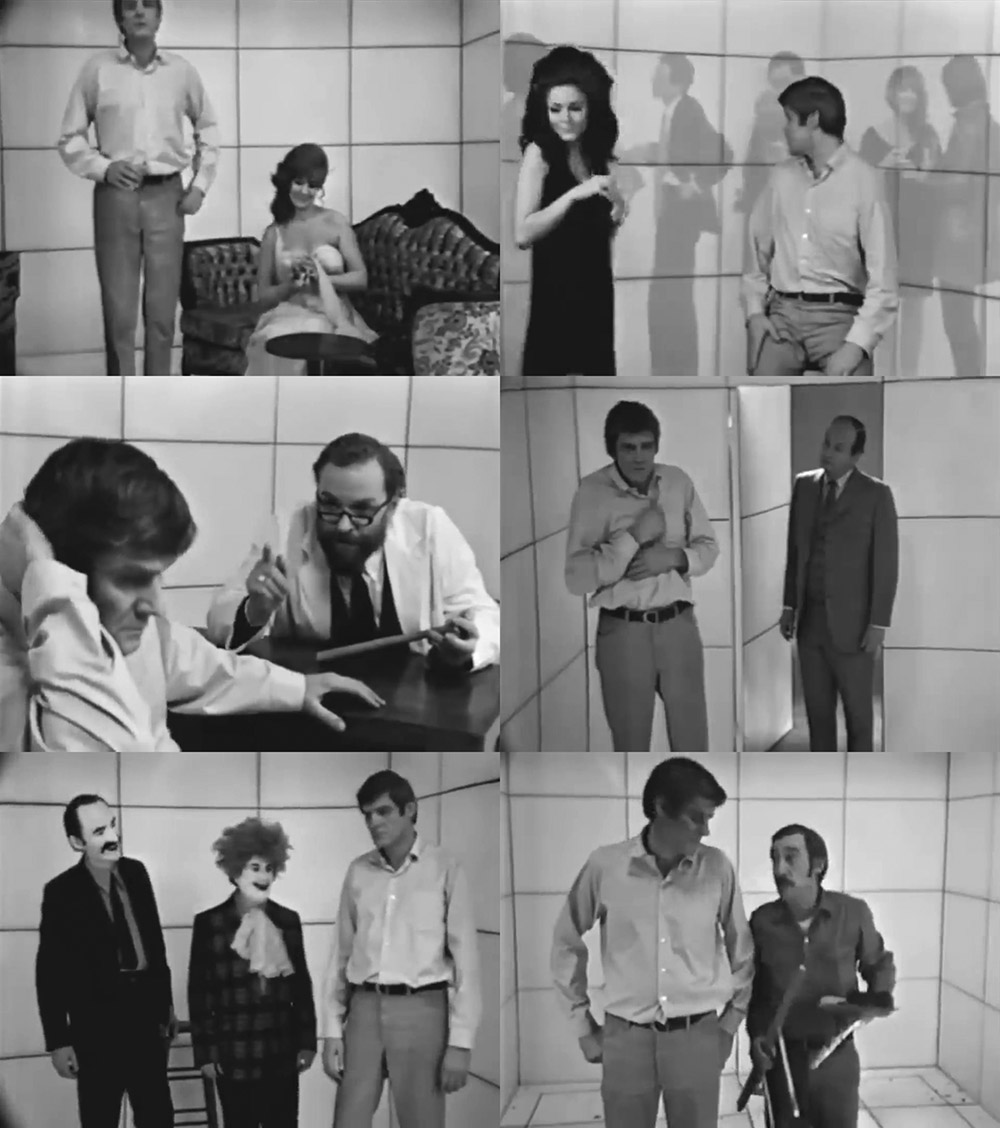
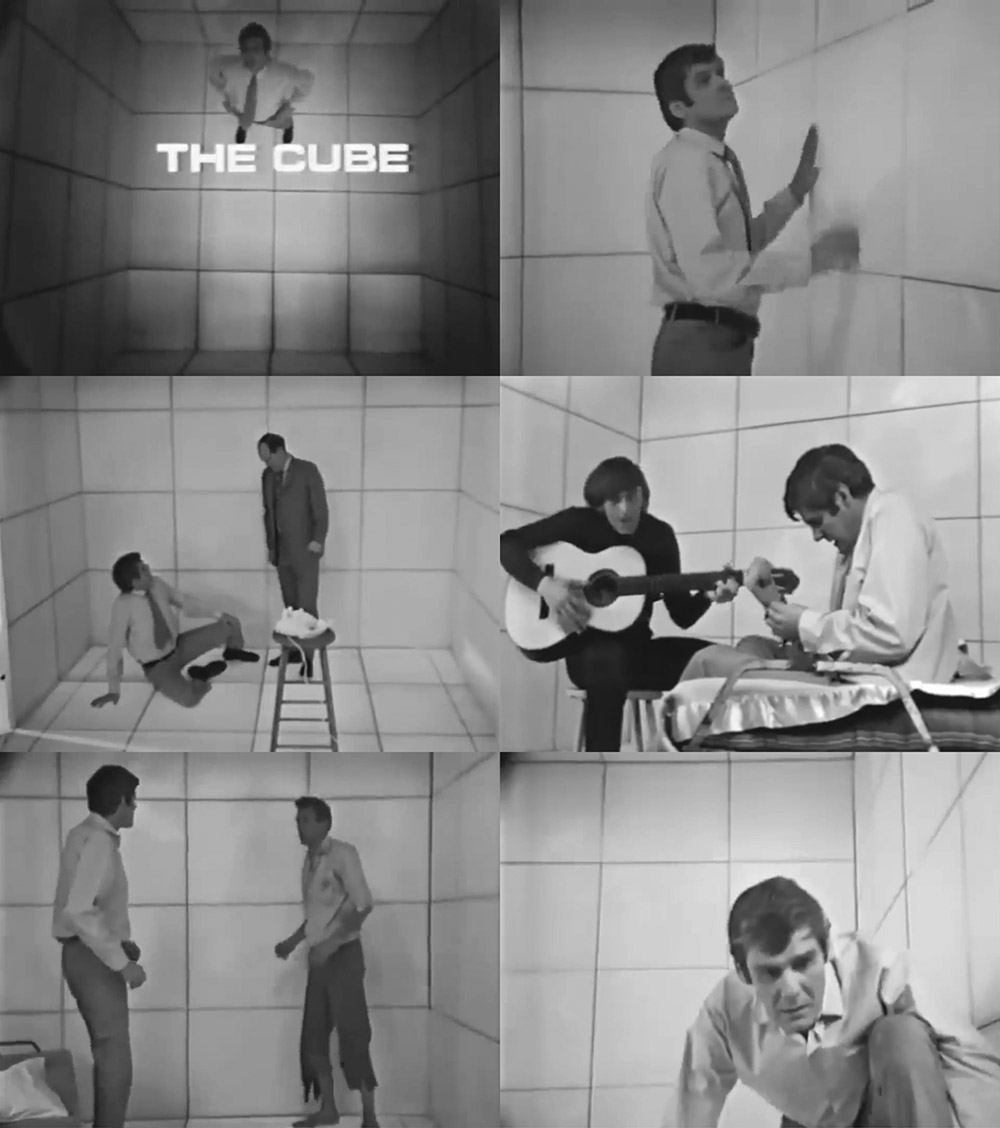
Yes, it’s that Jim Henson but you won’t find any Muppets here. The Cube was an hour-long TV play made in 1969 for NBC Experiment in Television, a series with a contents list that shows the US channel making a break from the conservatism and formula-chasing that’s always dogged the medium. Henson co-wrote The Cube with Jerry Juhl, and directed the play himself.

cube2.jpg

The scenario is the kind of thing you’d be more likely to find in an animated film: an unnamed man (Richard Schaal) inside a room-sized cubic space which he’s unable to leave. Furniture and other objects appear then vanish; doors open in the walls from time to time, other people enter and leave but the man himself is always told his exit through the doors his visitors use is forbidden. Either that or he misses the opportunity to leave when he might have the chance. The visitors range from the helpful (Arnie the repairman) to the annoying and the hostile, especially the latter. While enduring a variety of taunts and insults the man is asked to consider the quantum nature of reality, and the possibility that he may be insane or even dead. Henson and Juhl keep things light for the most part—Juhl was later the head writer for The Muppet Show—but it’s easy to see how their idea might shift into nightmare with only a slight change of emphasis. Vincenzo Natali’s Cube (1997) is only the most obvious example of this.

Previously on { feuilleton }
The Telephone Box

Weekend links 838

amethyst.jpg

Amethyst geode by Sheila Sund.

• RIP Tony Rayns: A Supreme Cinephile Remembered – notes and observations by Geoff Andrew. The remembrance mentions Rayns’ Cinema Rising, a short-lived magazine he was editing in the 1970s. I posted an extract from the first issue here.

• The week in photo competitions: Hasselblad Masters 2026; ZWO Astronomy Photographer of the Year 2026 shortlist; International Aerial Photographer of the Year.

• At Colossal: Veks Van Hillik suspends fish, insects, and other objects in surreal murals.

• New music: The Crystal Suite by Paul Schütze; Vestiges by Olivier Alary.

• At AnOther: Inside James Turrell’s most ambitious Skyspace to date.

Off With His Head: A short story by David Rudkin.

The Cosmic Dope

The Crystal Ship (1967) by The Doors | Among Fields Of Crystal (1980) by Harold Budd / Brian Eno | Crystal Clear (1992) by The Grid

Phantom Canyon, a film by Stacey Steers

phantom1.jpg

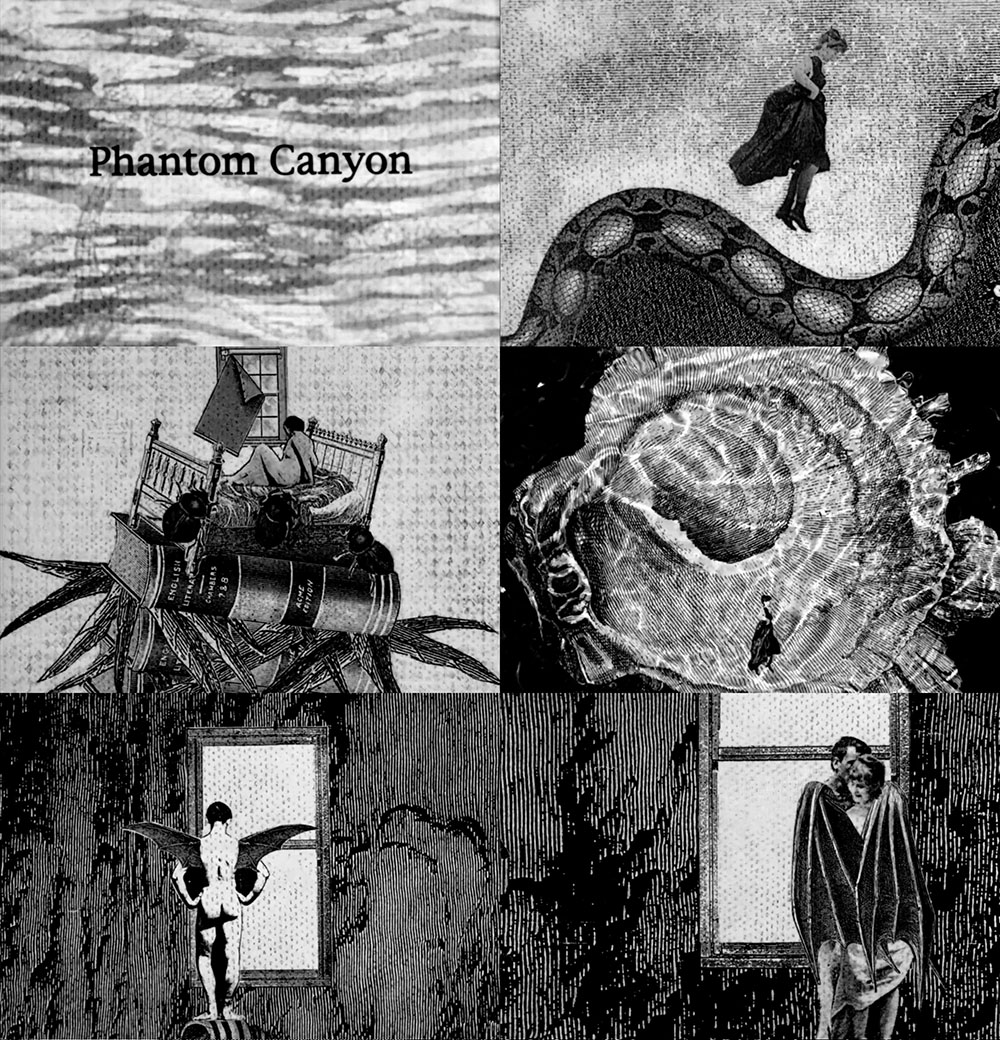
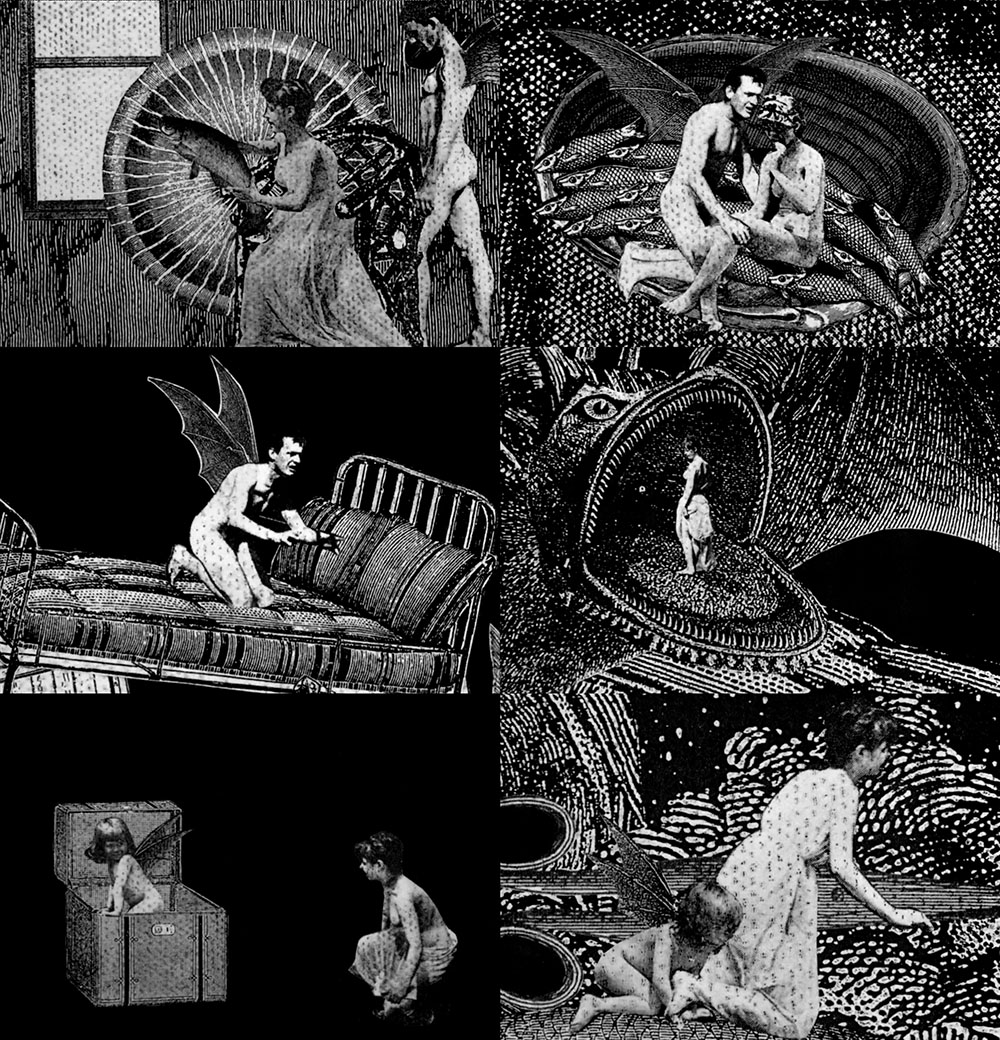
Phantom Canyon (2006) is another short animated film by Stacey Steers where many of the backgrounds and other details are collaged pieces from old engravings. There are so many of these films by Steers and older directors like Lawrence Jordan that I’m starting to think they should be considered a sub-genre inside the general body of film animation, just as engraving collage is almost a separate class of paper collage.

phantom2.jpg

In Stacey Steers’ The Edge of Alchemy the human character was animated from repurposed footage of Janet Gaynor and Mary Pickford. For this earlier film the humans have been borrowed from Eadweard Muybridge’s pioneering motion studies. Muybridge is popular with animators for the obvious reason that his photographs were early forms of film animation (or cinema) in themselves; his photo experiments are even the subject of at least two animated films: Le Cheval de Fer (1984) by Gérald Frydman, and Muybridge’s Strings (2011) by Koji Yamamura. In Phantom Canyon a Muybridge woman travels through a surreal landscape where she’s assailed continually by monstrous insects and other objects while being pursued by a bat-winged Muybridge man. “A true story” says a subtitle, but it’s left to us to decide how much this may be metaphorical.

Previously on { feuilleton }
Cosmic Alchemy, a film by Lawrence Jordan
Edge of Alchemy, a film by Stacey Steers
Still Life, a film by Connor Griffith
Hamfat Asar, a film by Lawrence Jordan
Carabosse, a film by Lawrence Jordan
Labirynt by Jan Lenica
Heaven and Earth Magic by Harry Smith

The art of Katsuyuki Nishijima

nishijima12.jpg

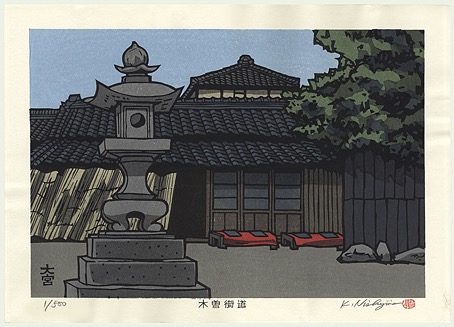
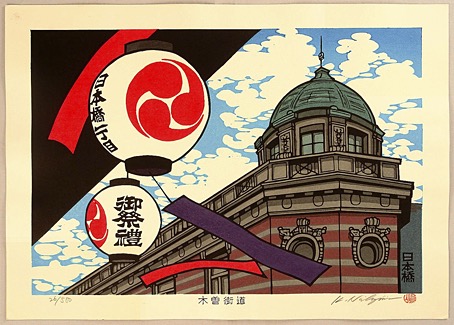
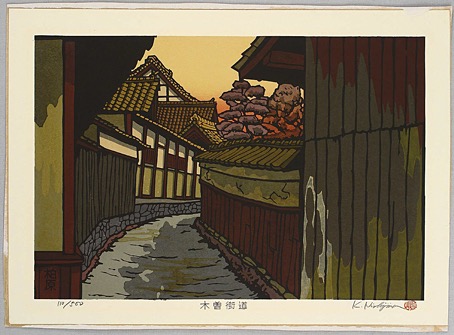
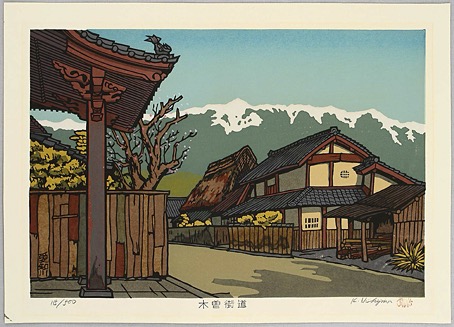
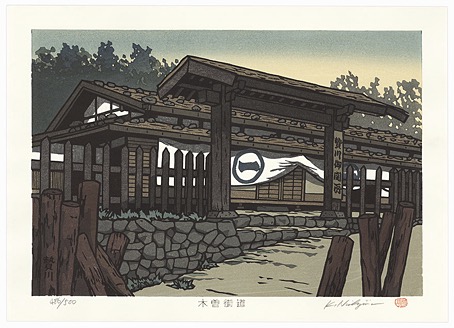
The Sixty-nine Stations of the Kiso Kaidō is a ukiyo-e print series by Keisai Eisen and Utagawa Hiroshige depicting notable places on one of the main roads leading from Edo (Tokyo) to Kyoto. A modern-day version of the series by Katsuyuki Nishijima follows a similar route (as much as it still exists) showing some of the old buildings seen along the way.

nishijima04.jpg

Nishijima’s prints have heavier lines than you find in their 19th-century equivalents but few of his scenes look immediately contemporary. In these and other prints he favours architectural views or details: thatched farmhouses, inns and shops, most of which are traditional timber buildings. What you don’t see in his prints of villages is recent buildings or even modern details like the electricity lines that follow Japanese roads. The Kiso Kaidō series is unusual for including a pre-war brick building, one of a handful still standing in Tokyo’s Nihonbashi district. People are also absent from these scenes. Hiroshige’s views of the Kiso Kaidō all feature groups of travellers but in Nishijima’s pictures any human activity is taking place out of our sight.

Nishijima at Ukiyo-e.org

nishijima01.jpg

nishijima02.jpg

nishijima03.jpg

Continue reading “The art of Katsuyuki Nishijima”