Weekend links 820

davent.jpg

Lust, from the Seven Deadly Sins (circa 1550–55) by Léon Davent, after Luca Penni.

• At Dennis Cooper’s: Bill Hsu presents…High Anxiety: tense, dark films from 2010–2019 (for fans of Robert Aickman and Brian Evenson) (restored).

• New music: Ever No Way by Seefeel; In A Few Places Along The River by Abul Mogard; Displaces by Francesco Fabris.

• At Inconspicuous Consumption: Paul Lukas investigates a Frank Lloyd Wright typographic mystery.

In the late 19th century, Rops created a vast oeuvre of drawings, etchings, prints and paintings of such breathtaking fruitiness—often laced with satanic elements—that even Picasso responded to him in awe (in homage, the Spaniard drew a cartoon of a man in the form of a pig performing cunnilingus on a woman). Rops’ works depicted naked witches riding brooms, voyeurs in top hats and courtesans riding penis-shaped bicycles. The French art critic Félix Fénéon called him an artist “who paints phalluses the way others paint landscapes”.

Christian House on a new exhibition, Laboratory of Lust, showcasing the erotic art of Félicien Rops

• At Public Domain Review: Wayang Kulit: Raden Soelardi’s Illustrations of Javanese Puppets (1919).

• At Criterion Current: David Hudson explores the fantastic realism of Georges Franju.

• At Unquiet Things: The Nocturnal Visions of Nona Limmen.

• Steven Heller’s font of the month is Curve Display.

• RIP TV producer Kenith Trodd.

Exploratorium

Lust (1954) by Les Baxter Featuring Bas Sheva | Monster Lust (1989) by Helios Creed | Keine Lust (2004) by Rammstein

Reversible men and Lipský’s Happy End

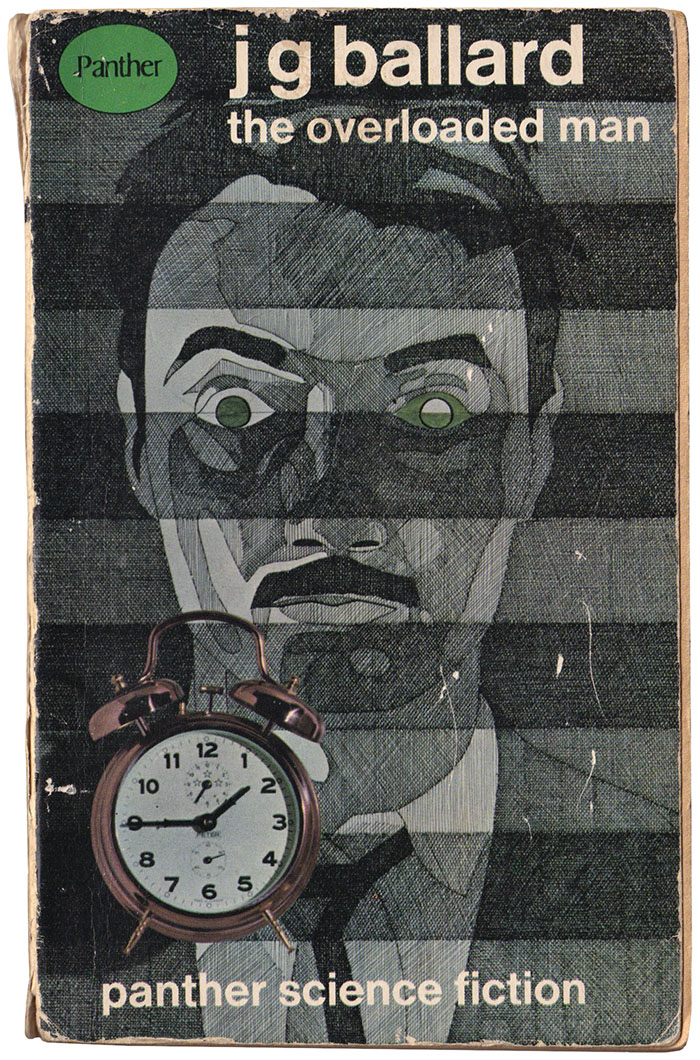
overloaded.jpg

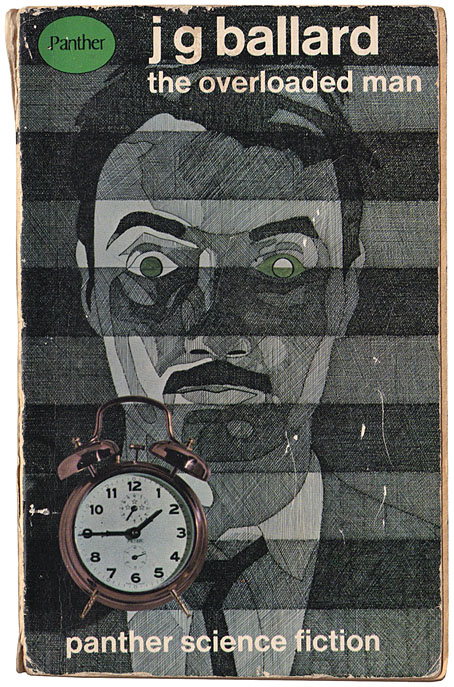
A paperback ravaged by the passage of time. Art by Ray Ginghofer.

Time of Passage, a piece of short fiction by JG Ballard, received its first publication in Science Fantasy magazine in February, 1964. The piece was subsequently collected in two paperbacks, The Impossible Man and Other Stories (Berkley Medallion, 1966), and The Overloaded Man (Panther, 1967). Time of Passage is more of a biographical sketch than a story, describing in reverse the life of a stockbroker, James Falkman, a man “born” in 1963 by being dug out of a grave while surrounded by tearful relatives. Ballard goes on to describe the major events of Falkman’s life, from retirement to career to marriage, charting the man’s gradual descent into youth and eventual infant helplessness. The story ends with Falkman bheing taken to a hospital in 1900 for a final encounter with his mother, his “death” in Ballard’s words.
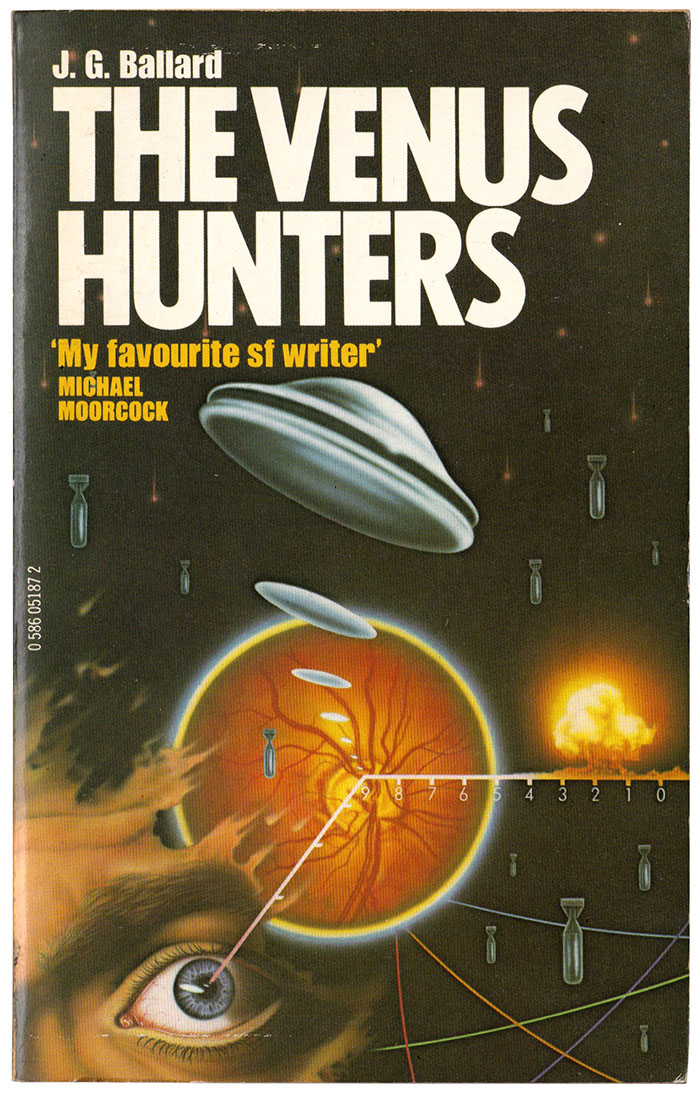
venus.jpg

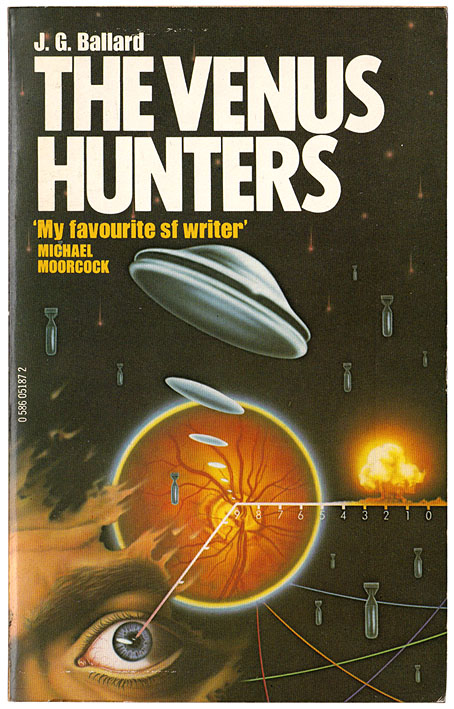
A revised reprint of The Overloaded Man, 1980. The artwork by Peter Gudynas may be the only Ballard cover to feature flying saucers.

There may be earlier literary examples of the life described in reverse but Ballard’s is the earliest one I know of. I’m thinking here of explicit reversals of human circumstance, as opposed to the more common reverse chronology whereby an otherwise forward-flowing story is chopped into episodes which are then presented in a reversed order. Philip K. Dick’s Counter-Clock World (1967) is a novel-length extrapolation of Ballard’s concept, set in a future where time has started to run backwards, and the dead are being born again in cemeteries. The 1960s saw a peculiar spate of fiction along these lines; to paraphrase Charles Fort, it must have been time-reversal time. In an earlier Ballard story, Mr. F is Mr. F, the titular character finds himself aging in reverse while time continues to run forward for his wife and the world outside their home; in An Age (1967) by Brian Aldiss scientific experiments reveal that time is actually moving in reverse despite our perceptions to the contrary.
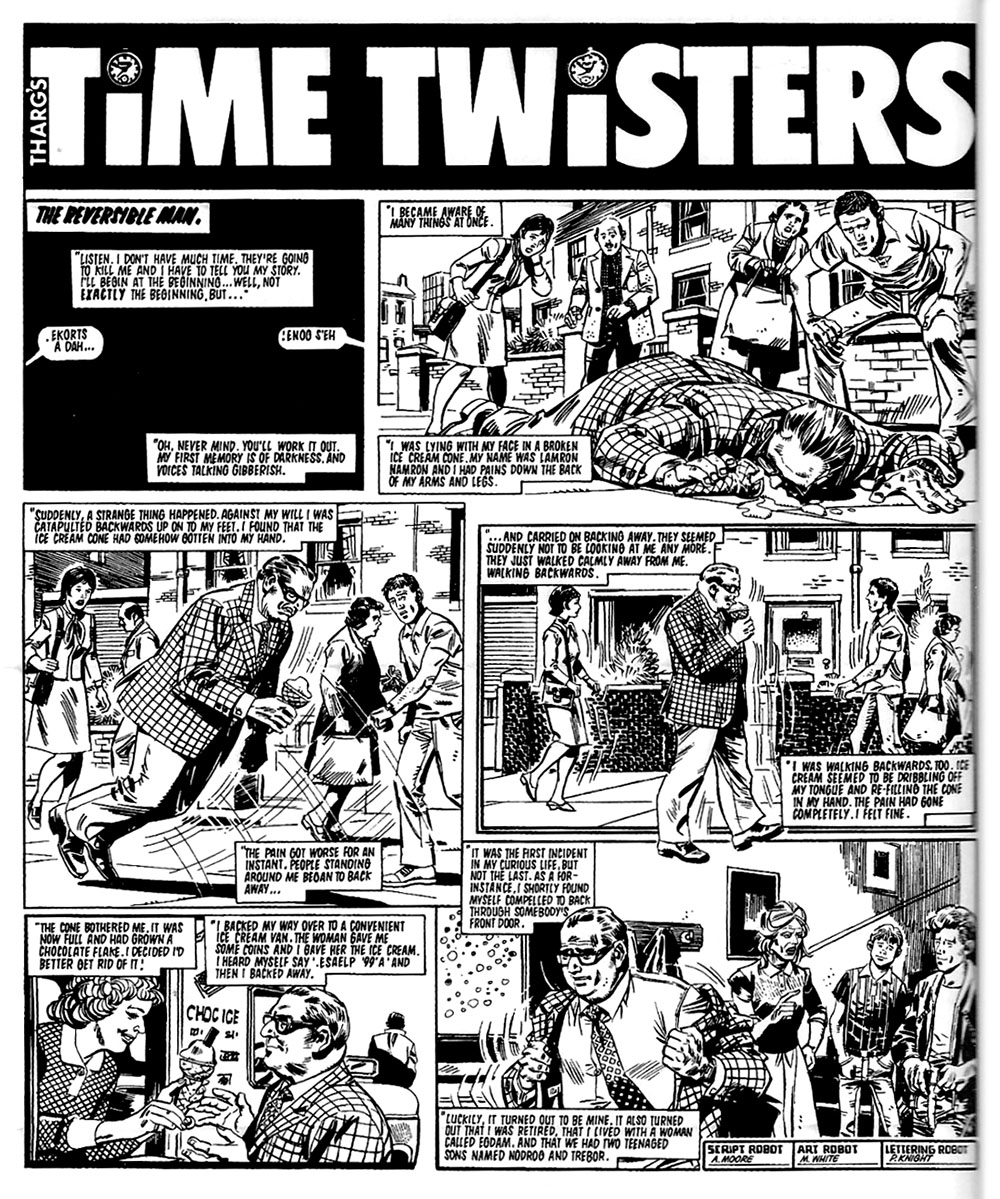
reversible.jpg

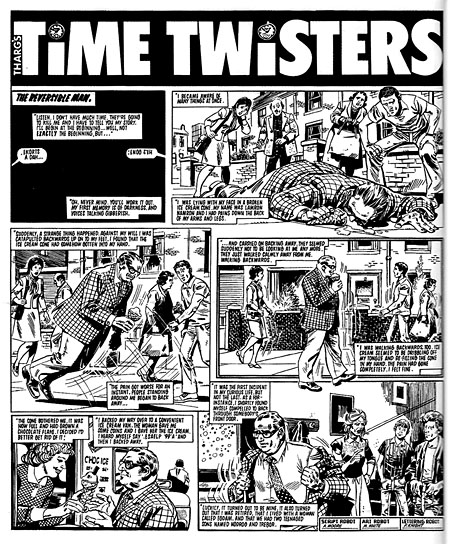
Art by Mike White.

Alan Moore would no doubt have been familiar with one or more of these stories when he wrote The Reversible Man for 2000 AD in 1983, a four-page strip which shows the life of an ordinary man from death to birth. Moore freshens the concept a little by the use of first-person narration. The most well-known treatment of the idea is Time’s Arrow by Martin Amis, a novel whose structure was taken by some reviewers as wholly original even though Amis said he was inspired by a passage in Kurt Vonnegut’s Slaughterhouse-Five. I’ve always felt Amis was being evasive on this point; he was very familiar with Ballard’s fiction, he interviewed Ballard and reviewed his novels on several occasions. Anyone with this much interest in Ballard’s work would have read Time of Passage in one of its many reprintings.
happy-end.jpg

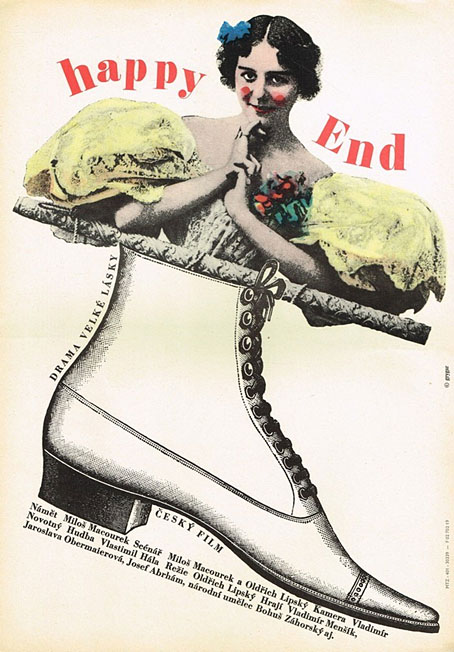
Design by Milan Grygar.

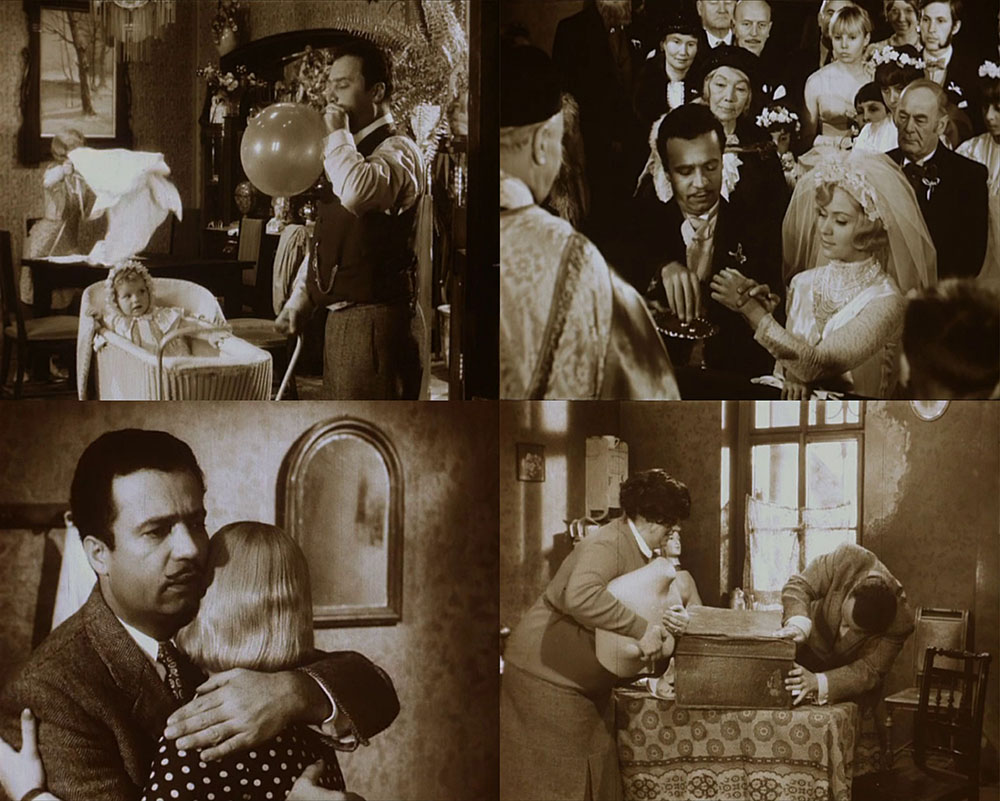
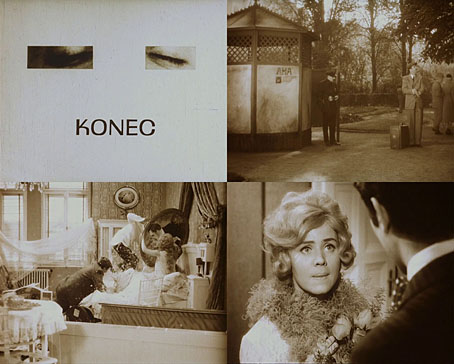
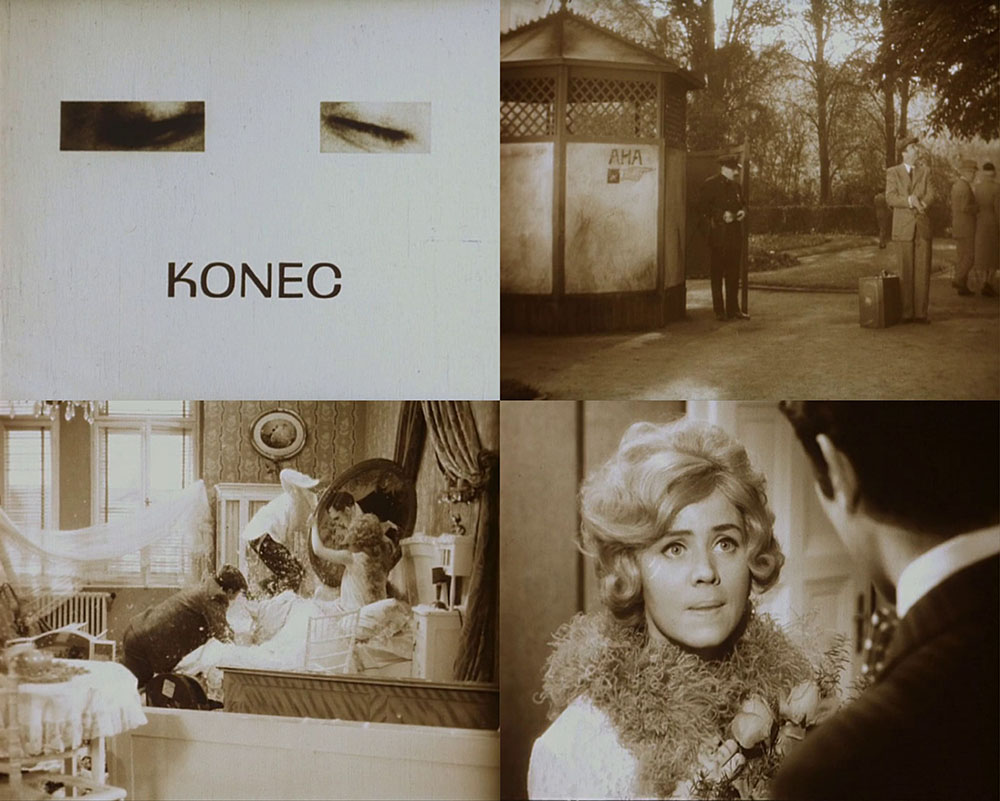
When it comes to authorial influence it seems unlikely that Czech film-maker Oldřich Lipský could have been influenced by Ballard or Dick’s time-reversals, which makes the appearance of Happy End in 1967 all the more remarkable. Lipský’s feature film, which I watched last week, is essentially Ballard’s death-to-life narrative played for its comic potential, with the film itself running in reverse for much of the time. Happy End opens with a title card in Czech—”Konec” (“The End”)—before presenting the “birth” of its protagonist by means of a guillotine. The decapitated head of Bedřich Frydrych (Vladimír Menšík) is attached to his body, after which the guards lead him (backwards) to the place described by his cheerful voiceover as a school (aka prison) where he says he’s being prepared for life in the outside world. Before he sets off to his waiting apartment the police give him a suitcase containing the body of his wife, Julie (Jaroslava Obermaierová), the pieces of which he assembles in the bath in his apartment. Julie is “revived” when Frydrych pulls an axe from her forehead, after which Julie’s lover, Ptáček (Josef Abrhám), makes his first arrival, jumping backwards into the bedroom through the window.
he1.jpg

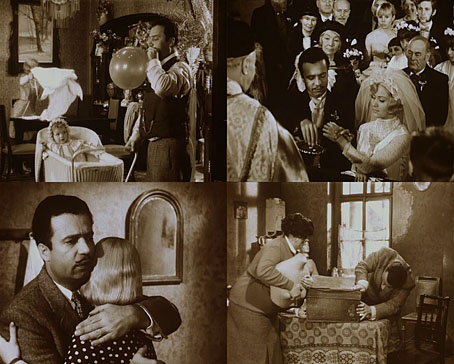
The love-triangle between Frydrych, Julie and Ptáček forms the bulk of the story, and also the basis for much of the film’s black humour. One of the hallmarks of the reversed biography is ironic reinterpretation, something that Amis makes a substantial meal of in his novel. In many cases it’s easier to do this with film than it is with words: a fight between Frydrych and Ptáček becomes an energetic “tidying up” of the apartment, with the cuckolded husband and the wife’s lover reassembling broken furniture and clearing away all the signs of destruction. Happy End is a long procession of these reversals, accompanied by Frydrych’s voiceover narration which persists in giving any tragic and difficult moments a positive gloss. Most of them, anyway. A substantial win at the racetrack becomes a negative incident when the events are played in reverse. But the loss of money is offset by Frydrych and Julie’s young daughter who pulls fresh banknotes out of an impromptu fire on the kitchen floor.
he2.jpg

For non-Czech speakers the humour and invention of Happy End is undermined by the effort required to keep up with the film’s frenetic pace (many of the scenes are speeded-up as well as running in reverse) while reading subtitles which reinterpret everything you’re seeing on the screen. My own viewing was further compromised by amateurish subtitles, but this is all the more reason to watch it again. Second Run have recently released Happy End as a region-free blu-ray with “new and improved English subtitle translation”. This is the second Lipský film I’ve watched to date (thanks, Jay!). I’ll be looking for more.

Previously on { feuilleton }
Art on film: Je t’aime, Je t’aime
Zones on wheels

zones.jpg

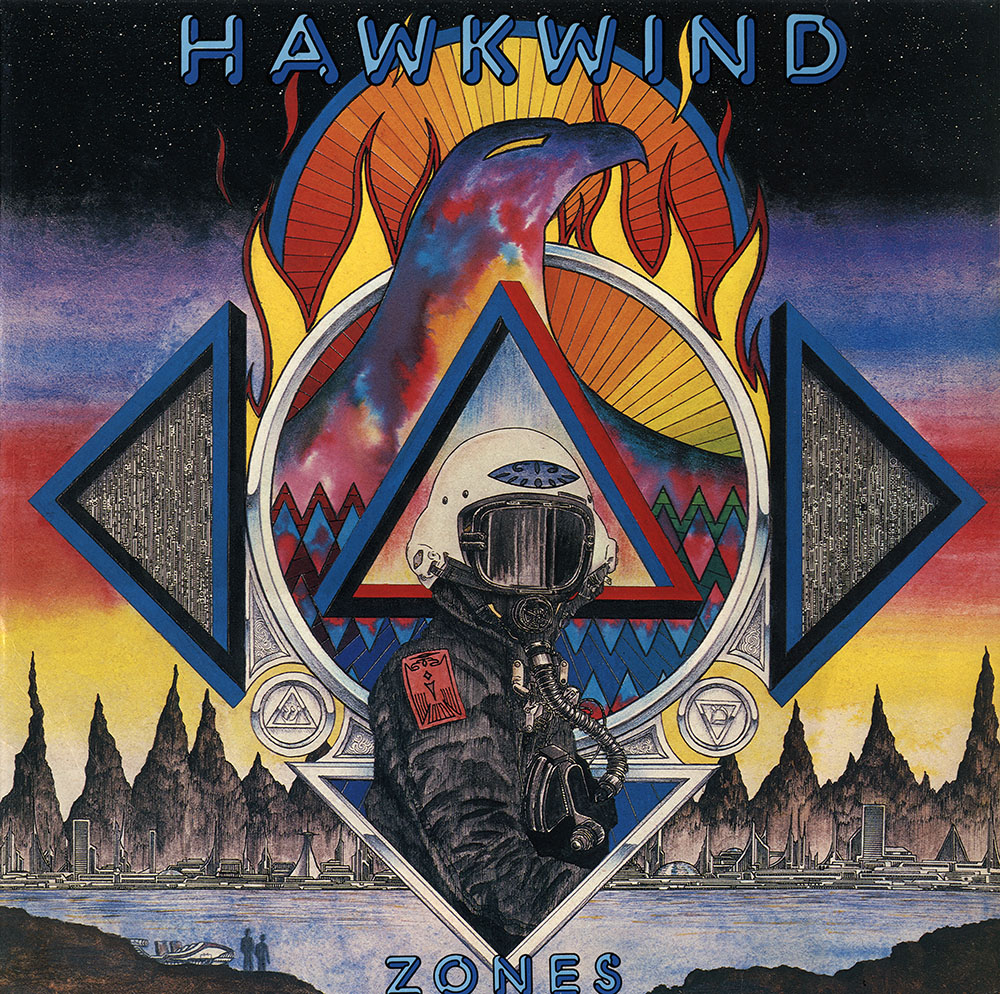
Zones (1983).

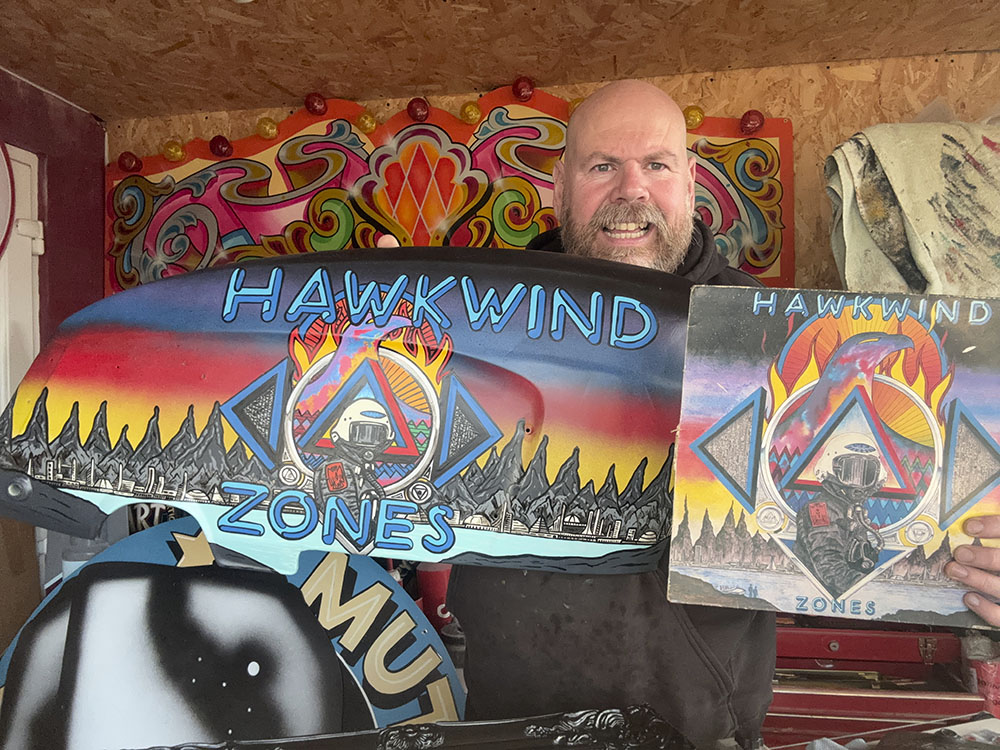
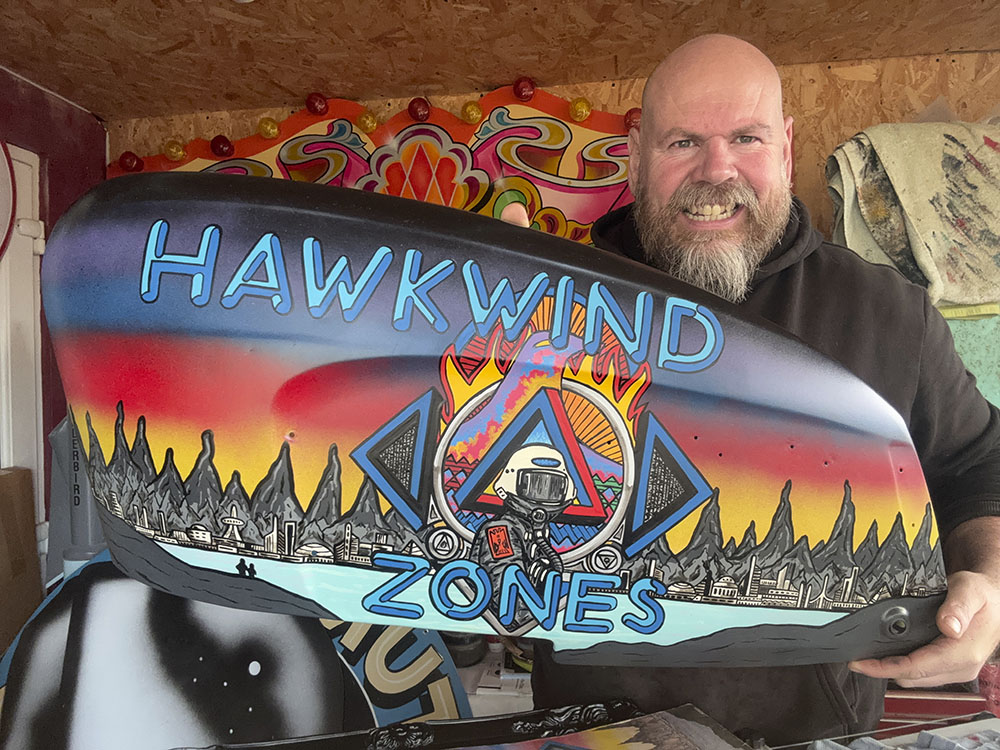
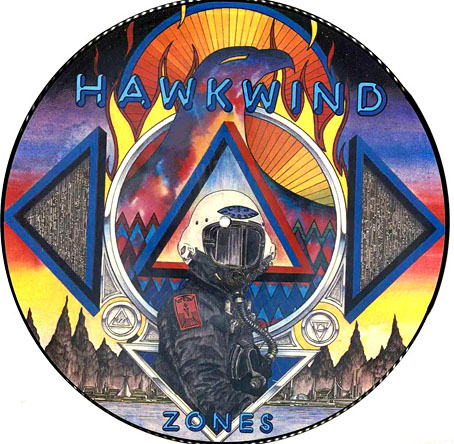
My thanks to Nigel Day for sending me the following photos of the rear end of a Lambretta scooter that he was recently asked to decorate with art based on my cover for Zones by Hawkwind. He’s done a marvellous job, and even improved a little on the colour gradations behind the hawk’s head which in my painting don’t evolve as smoothly as they should. Nigel trades under the name Harry’s Hotrod Shop; there’s a website here as well as pages under the same name at Facebook, Instagram and TikTok.

lambretta1.jpg

lambretta2.jpg

As I’ve no doubt said before, the Zones sleeve is one of the few Hawkwind covers I don’t feel abjectly embarrassed by. The album was released in October 1983, and was my second cover for Hawkwind, following an album released the month before whose terrible artwork was something I sent to Dave Brock that I never intended to have used anywhere. The Zones art was something I’d created on spec the year before, shortly after what would have been my cover for the Church Of Hawkwind album was forced onto the album’s lyric book by an art director at RCA who hated the material he’d been given to work with. This wasn’t the only unpleasant incident from the group’s short tenure at RCA. Zones was released on Flicknife Records, an independent label that proved to be a much better home for the band.

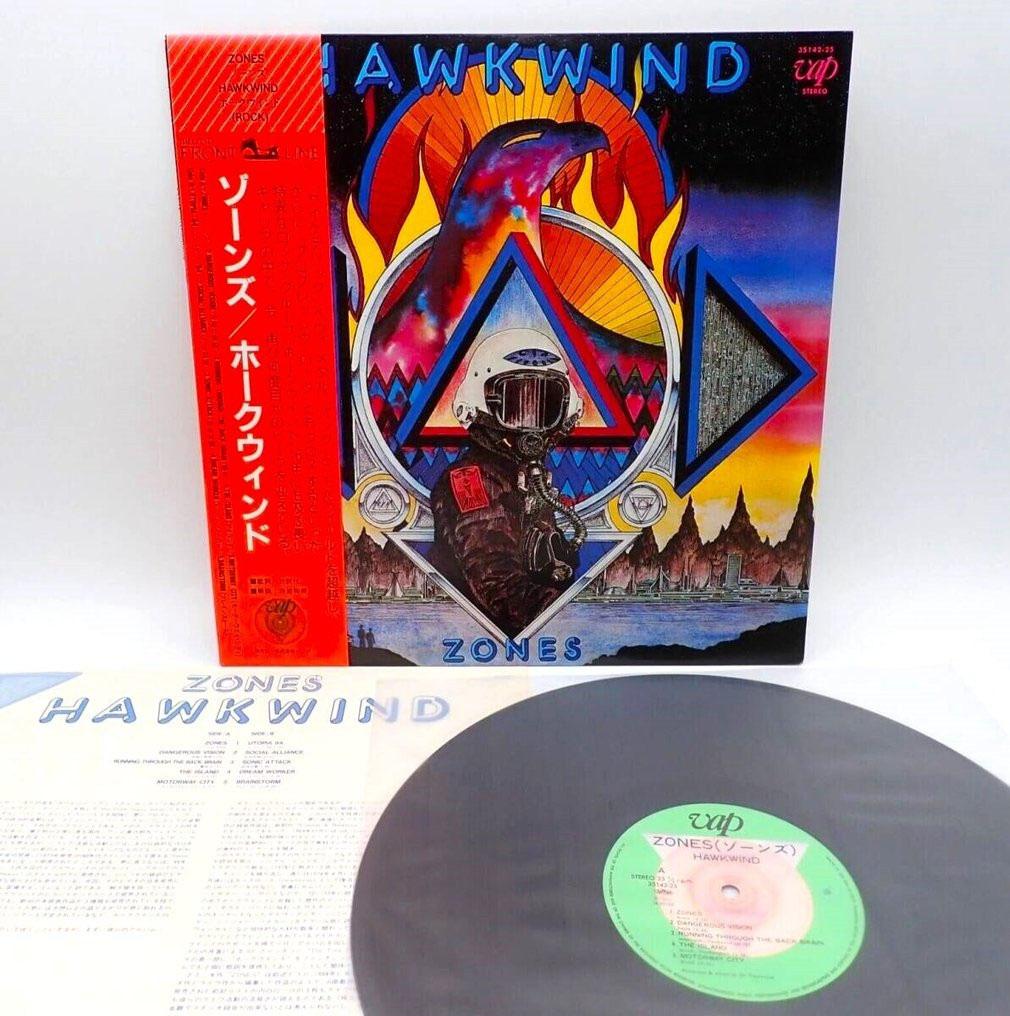
zones-japan.jpg

A rare Japanese vinyl release.

The album itself is a pretty good collection of live recordings from 1980 to 1982, with highlights that include a Michael Moorcock song, Running Through The Backbrain, with Moorcock himself on vocal. This was an exclusive piece until the entire concert (Lewisham, 1980) was released as part of the Levitation box set in 2009. Zones also contains several songs featuring Nik Turner, from the brief period when he returned to the group he’d been expelled from in 1976. And there’s also another live version of Motorway City, a song that first appeared on the Live Seventy Nine album. Having always liked Motorway City I was pleased when the Zones version was released as a single that used another spec piece of mine as the cover art (see this post).

zones-pic-disc.jpg

And a picture-disc.

As I said in the post about the single artwork, I was 18 when I did that drawing. I was only 20 when I painted the Zones cover. Imagine something you’d created when you were 20 years old continually turning up again decades later. It’s gratifying, of course, but it can also be disconcerting. People seem to like it anyway, which is more than can be said for some of my other album covers. The weather here is finally getting warmer; prepare for the summer with a Zones T-shirt!

Previously on { feuilleton }
Space is one trip: the Hawkwind takes off
New Wave Strangeness: Hawkwind’s Calvert years
Twinkle, twinkle little stars
Motorway cities
Reality you can rely on
Silver machines
Notes from the Underground
Hawkwind: Days of the Underground
The Chronicle of the Cursed Sleeve
Rock shirts
The Cosmic Grill
Void City
Hawk things
The Sonic Assassins
Barney Bubbles: artist and designer

Weekend links 819

ohrai.jpg

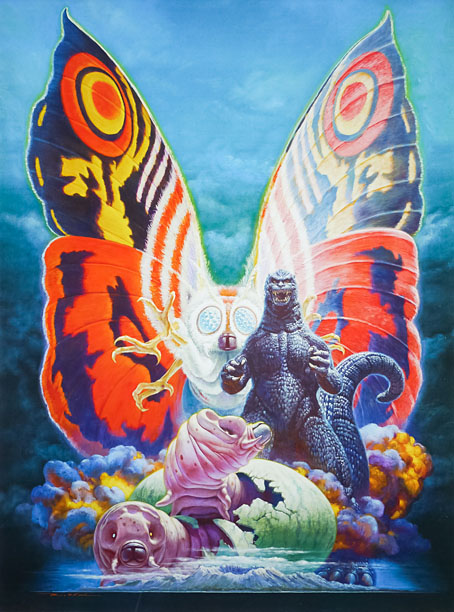
Godzilla vs. Mothra (1992), poster art by Noriyoshi Ohrai.

• At Wormwoodiana: Douglas A. Anderson on the first English translation of The Luminous Fairies and Mothra, a multi-author serial that formed the basis for Ishirō Honda’s film about the giant moth.

• At the Library of Congress: “Lost 19th century film by Méliès discovered at the Library“. 45 seconds of Gugusse and the Automaton (1897).

• At Public Domain Review: The Blinkered Flâneur: Walking with Franz Hessel in 1920s Berlin by Paul Sullivan.

• At Juno Daily: Kevin Richard Martin lists ten albums that shaped his Sub Zero album.

• New music: And All The Clocks Ran Dry by Andreas Voelk & Scott Monteith.

• “Behold Belgium’s beauty in these 15 scenic photographs.”

A Spoon and Tamago Guide to Tohoku.

• The Strange World of…Shane Parish.

• At Dennis Cooper’s: Occults.

• RIP Éliane Radigue.

Mothra’s Song (1961) by Yuji Koseki | Mothra (1984) by Frank Chickens | Mothra (2014) by The 5.6.7.8’s

In A Silent Way

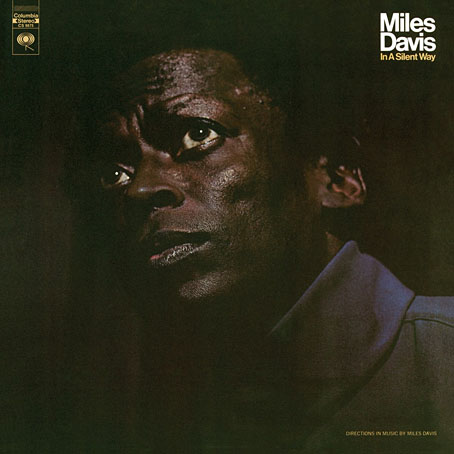
In A Silent Way (1969) by Miles Davis

miles.jpg

In A Silent Way (YT)

In a Silent Way was assembled from various takes from a three-hour session on February 18, 1969, at CBS 30th Street Studio’s Studio B in Manhattan. “Shhh / Peaceful” was composed solely by Davis, while the opening and closing section to “In a Silent Way / It’s About That Time” is based on [Joe] Zawinul’s “In a Silent Way”, which he would record in its original form in 1970 for his third solo album, Zawinul (1971). After Zawinul presented the tune to the group, it was rehearsed as it was originally written, but Davis wished for it to sound more rock-oriented and stripped the various chord changes to leave a more basic melody built around a pedal point. [John] McLaughlin had some difficulty playing in the manner Davis wished of him, but found his way after the trumpeter suggested he play the guitar as if he were a novice. Davis believed that Zawinul was never happy with his adaptation of “In a Silent Way”, but felt that the album would have been less successful had its original arrangement been kept. Zawinul had expressed some dislike of Davis’ arrangement, in particular of two chords that he believed that Davis was wrong to remove. Zawinul claimed that he was responsible for the melodic bass line and descending melody of “It’s About That Time” but was not credited; he blamed [Teo] Macero for this, as he “always put things together so that it came out as if Miles had written it.” (more)


Zawinul (1971) by Joe Zawinul

In A Silent Way (YT)


Celebration (1972) by El Chicano

In A Silent Way (YT)


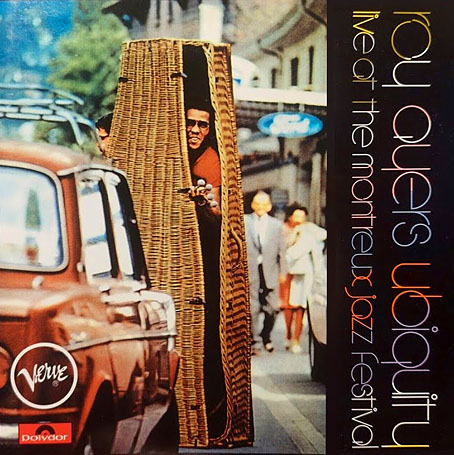
Live At The Montreux Jazz Festival (1972) by Roy Ayers Ubiquity

ayers.jpg

In A Silent Way (Should really be titled It’s About That Time since Ayers is playing the second part of the Davis piece) (YT)


Filmore – The Last Days (1972) by Various Artists

In A Silent Way by Santana (YT)


Double Exposure (1975) by Nat Adderley

In A Silent Way (YT)


Concerto Retitled (1976) by Joe Zawinul

In A Silent Way (YT)


Babel (1978) by Max

D’Una Manera Silenciosa (YT)


Continue reading “In A Silent Way”