The art of Ludwig von Hofmann, 1861–1945

dkd24-01.jpg

Ludwig von Hofmann was a German artist whose work has already appeared via the above example from Deutsche Kunst und Dekoration. Many of Hofmann’s drawings and paintings appeared in that magazine’s rival publication, Pan magazine, for which the artist also provided a cover design for the collected editions, and vignettes for the interiors.
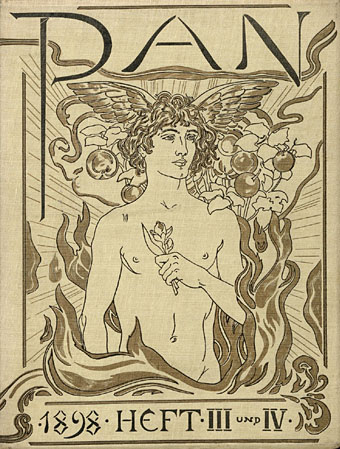
hofmann01.jpg

Hofmann is also of note for those of us who search art history for potentially gay art or artists. A handful of his works turn up continually on forums where homoerotic artwork is posted even though I’ve yet to see any evidence that his desires ran in this direction. It’s true that many of Hofmann’s pictures focus exclusively on the naked male form, but it’s equally true that he painted and drew a large number of naked women. Males and females often appear together in Adam and Eve pictures, a theme which was so common in German art at this time it’s easy to assume that most artists were using the subject as the merest excuse to represent the unclothed figure.
hofmann02.jpg

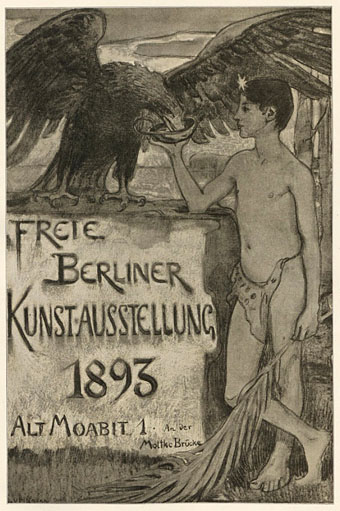
Ganymede poster design from Pan (1895).

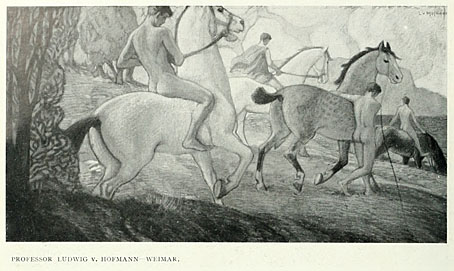
Biographical details state that Hofmann married his cousin in 1899 although he still may have been  bisexual, of course. If I was making a case for a Uranian inclination in his art I’d point to his poster design on the Ganymede theme (a favourite among gay artists with its story of Zeus falling for a beautiful boy), his many drawings of bathing boys and naked riders on horseback (the latter seems an obsession), Thomas Mann’s admiration for his work, and at least one sketch of a boy from Capri, an island with a long history as a favourite holiday resort for the rich and famous homosexuals of Europe. Whatever the truth, many of Hofmann’s pictures remain homoerotic, intentionally or not, and a few further examples are posted here. I should note that two of the pictures have been cropped to focus on the male figures, and that many of them lack verifiable dates.
Continue reading “The art of Ludwig von Hofmann, 1861–1945”

The fantastic and apocalyptic art of Bruce Pennington

pennington-pastel.jpg

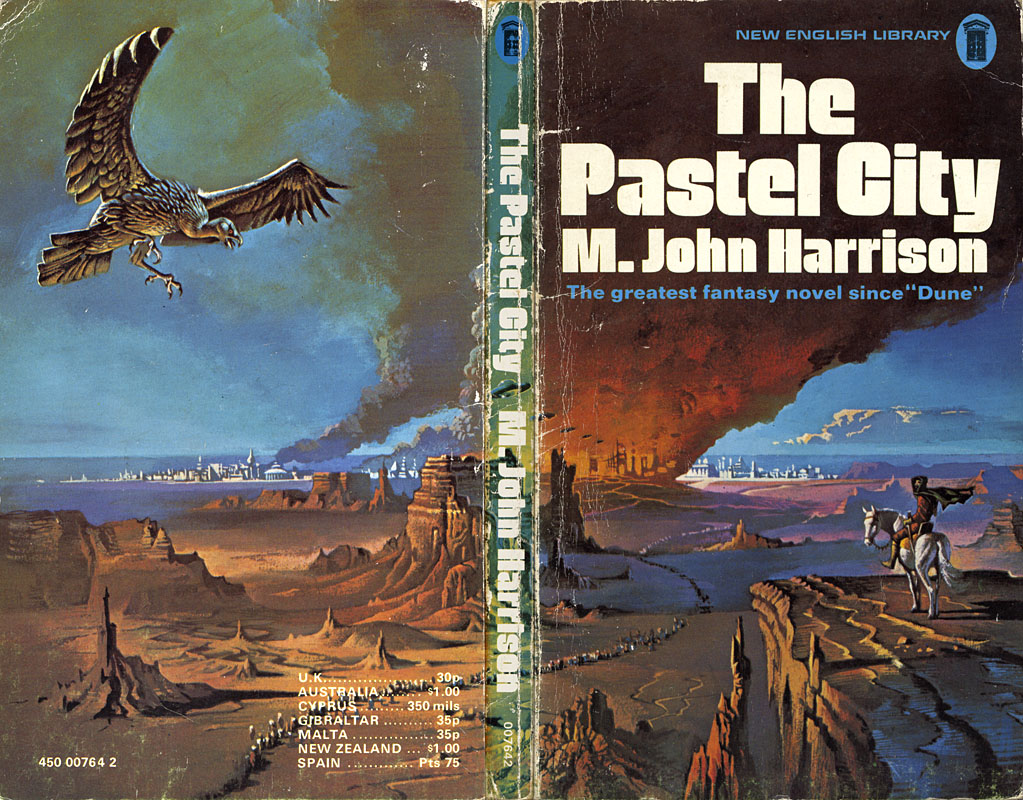
The Pastel City (1971), the first in M. John Harrison’s peerless series of Viriconium books.

Today’s post is another guest entry over at Tor.com. I’d been intending on writing something about Bruce Pennington‘s art for some time, having already covered the work of Ian Miller, my other favourite genre cover artist of the 1970s. (By coincidence both artists have illustrated the work of M. John Harrison and HP Lovecraft.) My hand was forced this month by the news of the first ever exhibition of Pennington’s paintings which is being held at Britain’s foremost occult book emporium, the Atlantis Bookshop in Museum Street, London. There’s a catalogue of the works on display here, many of which will be for sale. If I had the cash I’d consider buying one, Pennington’s work made a big impression on my imagination when I was reading many of the titles he’d illustrated for the first time. His art was unique for me in its occasionally Surrealist overtones, and as a cover artist he was unusual in working across a range of genres. Like Frank Frazetta his imagination and technique were able to suggest a great deal with a minimum of brush strokes.

pennington-cthulhu.jpg

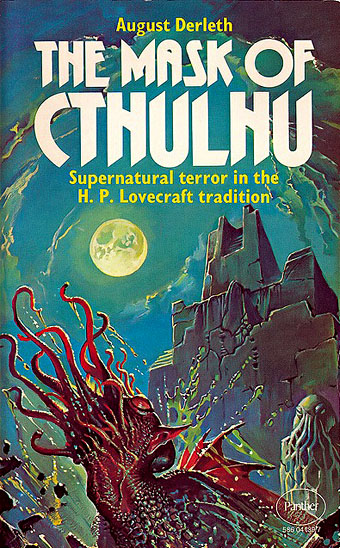
The Mask of Cthulhu (1976).

This post can be taken as an appendix to the Tor one which I didn’t want to overburden with pictures. The Derleth cover is purloined from Jovike’s excellent Flickr collection which includes several Pennington covers. Below are some pages from Pennington’s first book, Eschatus, a large-format collection of paintings interpreting the prophecies of Nostradamus as an apocalyptic science fiction narrative taking place in the 24th century.

Pennington has many examples of his work on his website, and there’s also a feature about his paintings in this month’s Fortean Times. The Atlantis exhibition runs to August 27th.

pennington-eschatus1.jpg

Eschatus (1976).

Continue reading “The fantastic and apocalyptic art of Bruce Pennington”

The art of Leonidas Kryvošej

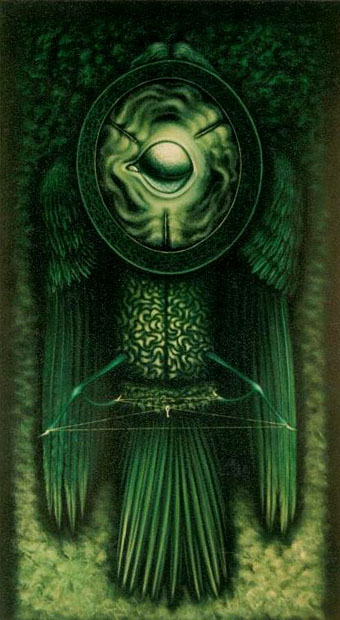
kryvosej1.jpg

Anděl západního okna.

Leonidas Kryvošej is a contemporary Czech Surrealist whose work I’d known for a while from an exhibition catalogue. I’d always wanted to see more so it’s a pleasure to discover a substantial set of paintings on the website he shares with Lucie Hrusková. A biographical note tells us that:

Leonidas Kryvošej was born 14th May, 1957 in Moravská Třebová. He lives in Ondratice near Prostějov. He has been a member of the surrealist group in Sternberk (later A.I.V) since 1986. Since 1997 a member Czech and Slovak surrealist group.

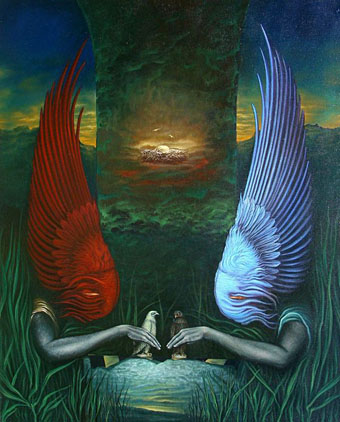
Most of the text on the site is Czech-only but the green painting above was one of the catalogue works whose English title, The Angel of the Western Window, we can no doubt assume is borrowed from Gustav Meyrink’s occult novel about Elizabethan magus John Dee. Occultism and alchemical symbolism seem to fuel Kryvošej’s art, and I like the profusion of wings and mutated bird-like creatures. There’s a lot of work on his gallery pages, all of it worth seeing for anyone who favours this kind of imagery.

kryvosej2.jpg

Ptací hra.

Elsewhere on { feuilleton }
The fantastic art archive

Vrubel’s Demon

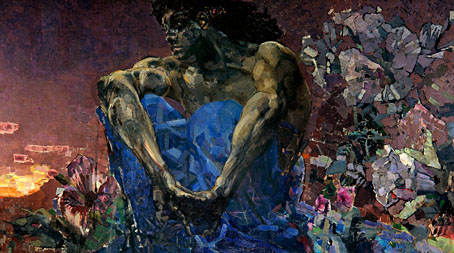
vrubel1.jpg

Demon (sitting) (1890) by Mikhail Vrubel.

Another Symbolist painting ferreted out from the collections at the Google Art Project, this is actually one of a number of demon figures painted by Mikhail Vrubel (1856–1910). The subject marks it as Symbolist but the almost Expressionist style is very 20th century which makes its date of 1890 all the more surprising.

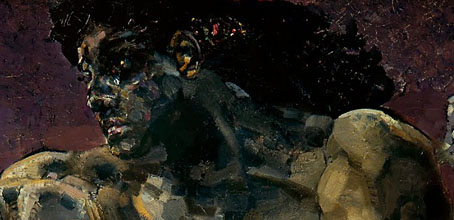
vrubel2.jpg

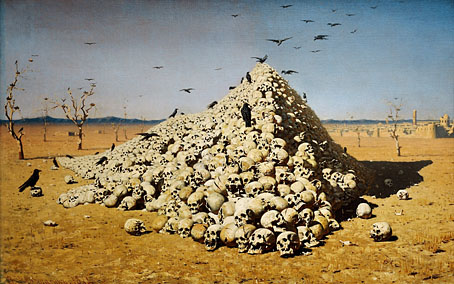
This is one of two Vrubels at the Google page for The State Tretyakov Gallery, Moscow. In the same collection there’s also The Apotheosis of War (1871), Vasily Vereshchagin’s timeless (if heavy-handed) canvas whose yawning skulls can now be explored in detail.

vereshchagin.jpg

Previously on { feuilleton }
Diaghilev’s World of Art

Weekend links 69

evans.jpg

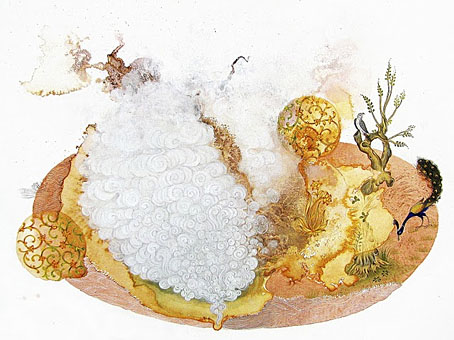
Peacock Apocalypse (detail) by Julie Evans in collaboration with Ajay Sharma.

Here at { feuilleton }, home of the curly bracket affectation, your correspondent is still surprised to find his postings the subject of a critique by Rick Poynor in the latest edition of Eye magazine, the international review of graphic design. I haven’t seen a print copy yet but you can read Mr Poynor’s appraisal here. Meanwhile, over at Design Observer this week there’s another Poynor piece about the collage illustrations of Andrzej Klimowski.

Alan Moore (yes, him again) discusses the moment when the League of Extraordinary Gentlemen gets all swinging and psychedelic. And Iain Sinclair (yes, him again) is still doing the interview rounds promoting his current book, Ghost Milk.

Ayin Acla, a short film by Anna Thew with a soundtrack by Cyclobe. The most recent Cyclobe album, Wounded Galaxies Tap at the Window, was previously vinyl-only but is now available on CD.

• Bones and beads and other things in Wren Britton’s Pure Vile clothing and accessories. Related: Patrick Veillet’s wearable bone sculptures.

Lambshead Cabinet of Curiosities Q&A: Ann & Jeff VanderMeer answer questions about their latest anthology at Fangoria.

• Being a lifelong introvert, I’m sympathetic to Four Ways Technology Can Enable Your Inner Introvert by Philip Bump.

• In an all-too-rare meeting of minds and talents, Roy Harper talks to Joanna Newsom.

Jon Macy’s Teleny and Camille is reviewed at Lambda Literary.

• Author Carol Birch tells us how best to read Finnegans Wake.

Joel Pirela’s Design Classics posters.

Each And Every Word Must Die (1999) by Cyclobe | Brightness Falls From The Air (2001) by Cyclobe | Indulge Yourselves With Our Delicious Monster (2006) by Cyclobe