Weekend links 26

library.jpg

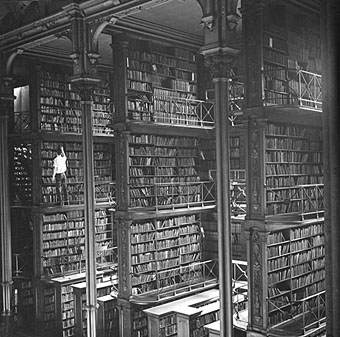
The interior of the Public Library of Cincinnati and Hamilton County “Old Main” Building, 1874. Reblogged over the past few days on numerous Tumblr postings, none of whom had bothered to find out any details about the picture. I’m with Silent Porn Star on the contextless reblogging issue.

Keith Richards et Mick Jagger à Londres, TV interviews with the Glimmer Twins from 1968 with some remarkable footage in the second half of Jagger filming the penultimate shot of Performance. That French video site requires further exploration. Also there is a short film from 1961 with Jacques Lasry demonstrating the Cristal Baschet. Related: Jacques Doyen & Jacques Lasry play their Cristals while Arlette Thomas and others read French poetry. I wrote something about the mystery of the Cristal two years ago this week.

• Two great album cover blogs from Jive Time Records: Project Thirty-Three is “a shrine to circles, dots, squares, rectangles and triangles, and the designers that make them come to life on album covers” while Groove Is In The Art “celebrates the era when psychedelic graphics and pop art met the mainstream”.

• At A Journey Round My Skull: Night Hallucinations: illustrations by Jaroslav Šerých for Tales of the Uncanny (Prague, 1976); Snark, Strangeness and Charm, Mahendra Singh’s illustrations for Lewis Carroll and others.
chaves.jpg

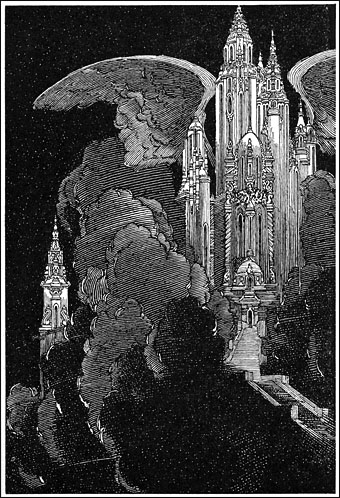
Laurence Chaves illustrates De Quincey’s Confessions of an English Opium-Eater at Golden Age Comic Book Stories.

Austin Osman Spare: Fallen Visionary at the Cuming Museum, Southwark, London in September, “will be the largest showcase of [Spare’s] work in a public museum since his death in 1956.” Jerusalem Press are publishing an expensive monograph to accompany the exhibition.

Freeing “Pale Fire” From Pale Fire; “the next big Nabokov controversy”. Probably not but the thesis is an interesting one.

Quintessential ‘topiary’ in Gandalf’s Garden: Barney Bubbles, head shops and Op Art graphic design.

• Monster Brains discovered some more paintings by Thomas Häfner.

• Spaceweather’s Northern Lights gallery.

The passion of Krzysztof Penderecki.

• More Bookshelf porn.

White peacocks.

Sussan Deyhim: Daylaman | Desert Equations (for Brion Gysin) (with Richard Horowitz) | An interview at WorldStreams.

Several links this week via Adrian Shaughnessy’s Twitter feed. Thanks!
Constantinople, 1900

constantinople1.jpg

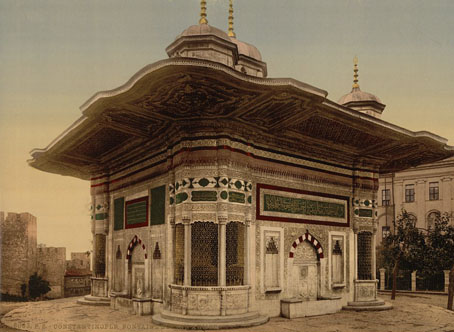
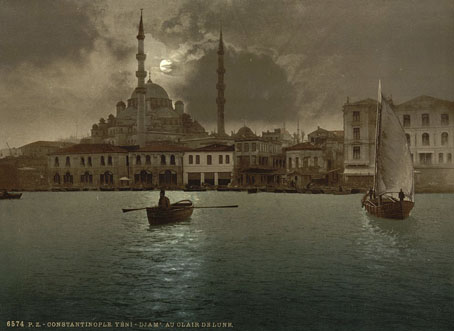
Yeni-Djama (ie, Yeni Cami) by moonlight, Constantinople.

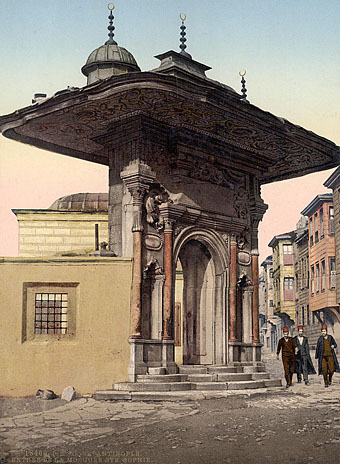
Fascinating views of the Turkish city circa 1890–1900 from the Photochrom collection of the Library of Congress. These are from the LoC Flickr selection; the library website has a lot more.

Published primarily from the 1890s to 1910s, these prints were created by the Photoglob Company in Zürich, Switzerland, and the Detroit Publishing Company in Michigan. The richly colored images look like photographs but are actually ink-based photolithographs, usually 6.5 x 9 inches.

constantinople2.jpg

The fountain of Sultan Ahmed, Constantinople.

constantinople3.jpg

Entrée de la Mosque Ste. Sophie, Constantinople.

Previously on { feuilleton }
Albert Kahn’s Autochromes
The Dawn of the Autochrome

Vintage swordplay #5

vintage.jpg

In honour of the overturning of Prop 8 in California—and because I haven’t posted one of these for a while—another piece of beefy weapon-handling. No idea who this fellow is but he can be seen a lot bigger (if not actually tumescent) at the Haunted Lamp, a place of assorted delights that you really ought to go and browse.

Elsewhere on { feuilleton }
The men with swords archive

Schloss Linderhof

linderhof1.jpg

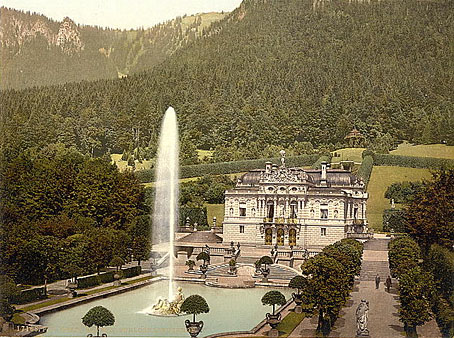
More Ludwigiana. Schloss Linderhof was Ludwig II of Bavaria’s miniature Versailles at Oberammergau and is a key location in Visconti’s film about the King. The house itself is a riot of gilded rococo which isn’t really to my taste but you can make your own judgement by taking a tour at the palace website or browsing the photos at Wikimedia Commons.

linderhof2.jpg

Of greater interest is the Moorish Kiosk in the palace grounds, a small pavilion originally created for the Paris exposition of 1867. The outside is a typical piece of Orientalist architecture while inside there’s some beautiful stained glass and a splendid Peacock Throne. This doesn’t feature in Visconti’s film, unfortunately, but the Venus Grotto does.

linderhof3.jpg

Philippe Jullian’s Dreamers of Decadence (1971) contains some pages about Ludwig and the inspiration he gave to Symbolist artists and poets. Reports of places like the Venus Grotto were among those inspirations, and Jullian recounts a description by actor Joseph Kainz of his first visit to Linderhof. The scene is played out in Visconti’s film almost to the letter:

All of a sudden the rock moved; an opening appeared through which we entered a long corridor, brightly lit with a red light. Along the walls of the grotto the King’s servants stood in line.

Still following the servants who were leading the way, I walked to the end of the corridor, as far as what appeared to be a natural opening in the rock. Through this opening there poured a sea of blue light. The interior of the grotto looked like a huge, dazzling sapphire, whose flickering brilliance spread over the craggy walls, entered every tiny crack, and cast a sort of magic veil over every object. I had stopped on the threshold, behind an overhanging rock, dumbfounded by the grandiose splendour that surrounded me; I was breathless with amazement. The ceiling of the grotto was vaulted, like that of a cathedral. I was inside the Venusberg.

I took a step forward and stopped again. The rock which had concealed me until then. had prevented me from seeing on my right a lake of astonishingly limpid water, lit by a sky-blue light. On it there glided two snow-white swans, while on the shores stood a tall man, all alone, and apparently deep in thought: this was the King.

For a moment I gazed at his fine head, his broad shoulders, his remarkably white hands which were casually tossing pieces of bread to the two swans; I also noticed the bright star made up of sapphires which was fastened to his hat.

He shook me warmly by the hand, releasing me from the feeling of depression which had affected me till then. Then the King took me up a path leading to the top of a hill in front of us. On the top of this hill there was a table made of sea-shells which stood on a large conch supported by crystal feet. Near this table there was a seat made of the same materials, and the servants brought along another. The King invited me to sit down, and supper was served.

Every quarter of an hour the King gave a signal and the lighting of the grotto changed; it turned red, then green, then blue, then gold, and into my imagination came memories of ancient legends and fabulous fairy-tales.

360 Cities has some panoramas of the Linderhof grounds with a view of the palace and one of the entrance to the Moorish Kiosk. As you’d expect, Flickr has a large collection of Linderhof photos while there’s also a pool of over five hundred images devoted to Ludwig II.

Previously on { feuilleton }
Schloss Neuschwanstein

Schloss Neuschwanstein

neuschwanstein1.jpg

This weekend’s film viewing was a DVD of Luchino Visconti’s Ludwig (1972), something I’ve seen in parts before but don’t recall ever having watched all the way through. I enjoyed it on the whole although Visconti’s “hose-piping” camera style and crash zooms are frequently annoying. Helmut Berger was very good as the tragic King of Bavaria and the subject was given additional interest by my reading earlier this year of a number of Philippe Jullian books. Ludwig II was camp enough to have interested Jullian whatever age he lived in but the way his life connects to the Symbolist period lends him a special significance. He can’t quite be described as a Symbolist monarch but his tireless support for Symbolist god Richard Wagner, and his lavish construction projects, made him a hero to Verlaine and others, who saw in the realisation of his fantasies the actions of an artist working on the grandest scale.

neuschwanstein2.jpg

Of all the palaces, Schloss Neuschwanstein at Hohenschwangau is easily the most spectacular, and Wikimedia Commons has a great selection of photos of which the two here are examples. The first picture is a 1900 photochrome print originally from the Library of Congress collection and the large version makes a great desktop picture. The helicopter view shows how the apparent isolation of the castle depends on where you place the camera. Visconti’s film makes use of all the King’s buildings although we never see a full exterior shot of Neuschwanstein possibly because the castle was unfinished at the time of Ludwig’s death in 1886. While he was alive Ludwig’s palaces were regarded as outrageous extravagances by a government dismayed by his patronage of Wagner, his scandalous homosexual behaviour, and his lack of interest in the nation’s political squabbles. Over a century later, Wagner’s music receives endless performances around the world while Schloss Neuschwanstein is the most popular tourist destination in Germany. Bavaria’s wars are long forgotten yet it was the King they declared to be “mad”. There’s a moral there.

The Neuschwanstein pool at Flickr

Previously on { feuilleton }
Temples for Future Religions by François Garas
Willy Pogány’s Lohengrin
Dallamano’s Dorian Gray