Nocturnes

night1.jpg

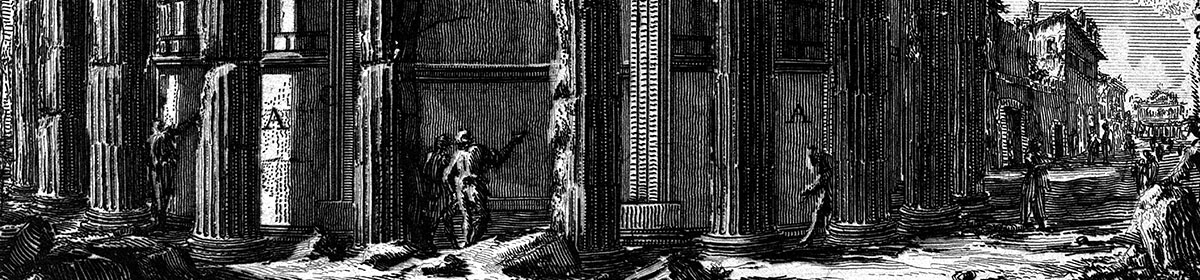
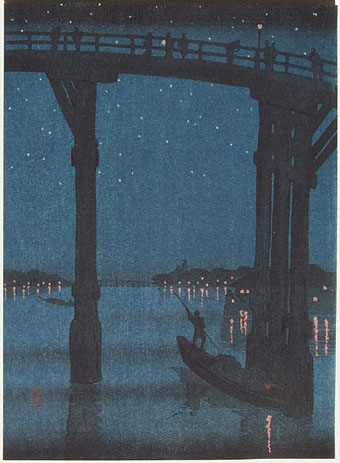
KOBAYASHI, Eijiro–”A High Bridge by Night”

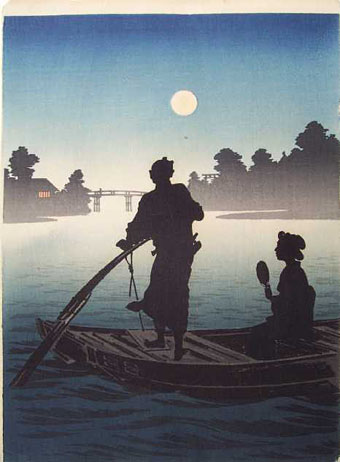
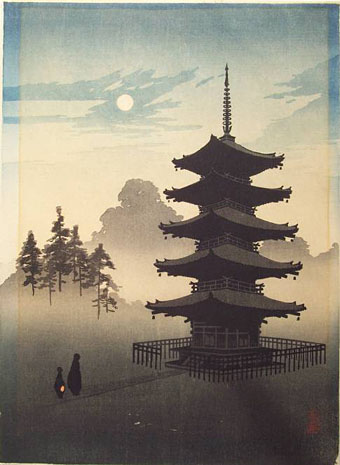
The Night Scenes is a series of 21 woodcut prints by Japanese artists published by Hasegawa/Nishinomiya in the early 1900s. Gorgeous work, and apparently popular enough for the prints to have been reissued many times since. These examples are from a print-selling site with several extensive galleries of 20th-century Japanese prints.

The High Bridge at Night struck me for being remarkably similar to Whistler’s famous painting of Old Battersea Bridge, Nocturne: Blue and Gold (1872–75). Whistler, of course, developed his mature style through looking at Japanese prints, and the Tate’s note for his painting says it may have been derived from a Hiroshige print. The Hiroshige looks nothing like the High Bridge at Night, however; was the latter based on an earlier print which Whistler had seen, or is the High Bridge (which post-dates Whistler’s painting) an example of the Japanese stealing back some of their influence from the West?

(Thanks to Wood s Lot for the prints tip.)

night2.jpg

ARAI, Yoshimune II–”A Ferry Boat”

night3.jpg

KOBAYASHI, Eijiro–”A Pagoda by Moonlight”

Continue reading “Nocturnes”

Sidney Sime paintings

sime1.jpg

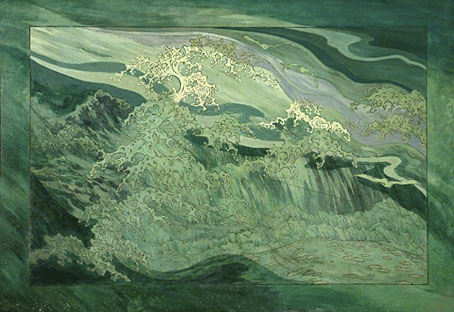
Painting of Waves.

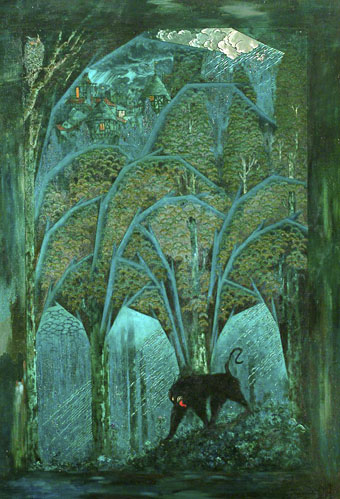
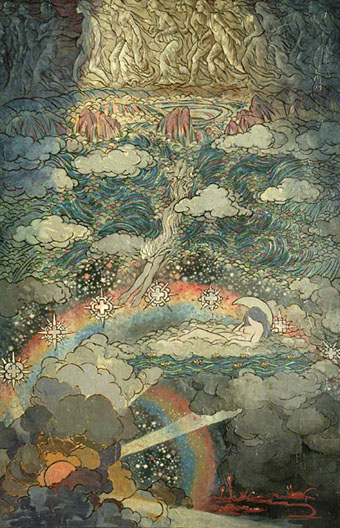
Most of the art for which Sidney Sime (1867–1941) is remembered is black-and-white or monochrome work, in part because he was engaged as a magazine illustrator at a time prior to widespread colour reproduction. All of the reproductions in Sidney Sime—Master of the Mysterious (1980) by Simon Heneage & Henry Ford are monochrome, so it’s good to find 188 of Sime’s paintings on the BBC’s British paintings website. Or it’s good up to a point… Most of the works are small oil sketches and landscape studies which would be of little interest if the artist’s name was unfamiliar. The examples here are some of the few which match the unique imagination which people still value today. Heneage & Ford refer to his painting throughout his career but it seems the best of that work must now be in private collections. All of the paintings on the BBC pages are from the collection at the Sidney H. Sime Memorial Gallery at Worplesdon near Guildford, Surrey, where there’s more of his art to be seen.

sime2.jpg

Woods and Dark Animals.

sime3.jpg

Illustrative.

Continue reading “Sidney Sime paintings”

Weekend links 164

panikanova.jpg

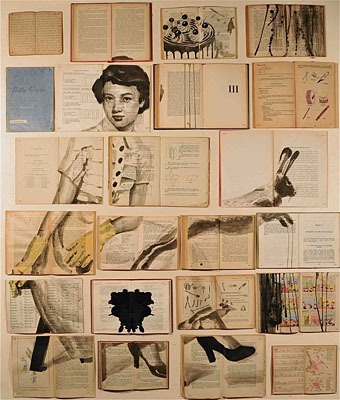
Ekaterina Panikanova paints on books.

Back in 2009 I bought a book of Art Nouveau illustration and design which contained an intriguing drawing by an Austrian artist, Franz Wacik (1883–1938). At the time there was little of Wacik’s other work online so I was delighted by the latest post at 50 Watts which showcases a selection of his illustrations. Wacik was a contemporary of British illustrator Sidney Sime, and both artists share a predilection for the comic and the grotesque.

• “The outlawing of drugs such as cannabis, MDMA and LSD amounts to the ‘the worst case of scientific censorship since the Catholic Church banned the works of Copernicus and Galileo’, the former Government drugs advisor Professor David Nutt has claimed.” Related: “At last, the edifice of drugs prohibition is starting to crumble,” says Amanda Feilding.

Alan Johnston on “A gay island community created by Italy’s Fascists”, and at Another Nickel In The Machine a report on The Gateways Club, one of the few meeting places for London’s lesbians in the 1960s. Alex Park wonders “Why Is Gay Porn So Popular In Pakistan?”

• If it’s June 16th then it must be Bloomsday: The Irish Times has a page of Joyce-related links to mark the anniversary. This year there’s a global reading of Ulysses taking place.

• “Now we can concentrate on album number nine,” says Kraftwerk’s Ralf Hutter. The rest of us will impatiently count the passing seconds.

• After a week in which George Orwell’s Nineteen Eighty-Four has seen an increase in sales, a look at its cover designs old and new.

Aleister Crowley: Wandering the Waste is a 144-page graphic biography of the Great Beast by Martin Hayes and RH Stewart.

Barnbrook Design‘s presentation of Taxidermy, a book by Alexis Turner, is rather splendid.

• FACT Mix 386 is a great collection of dubby grooves compiled by Young Echo.

• From 2001: Michael Wood in the LRB reviewing Apocalypse Now Redux.

• The first recording of Allen Ginsberg reading Howl.

Rejoyce (1967) by Jefferson Airplane | The Sensual World (1989) by Kate Bush | Molly Bloom (2013) by Alan Munde

Lewandowski at Fortune

fortune37.jpg

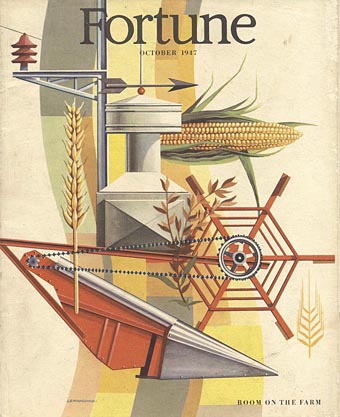
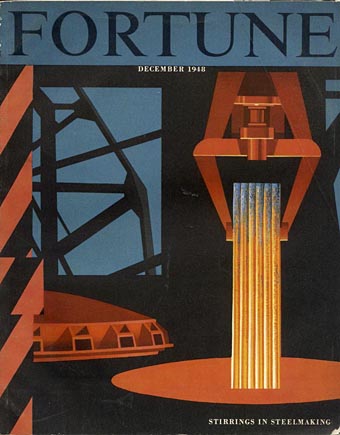
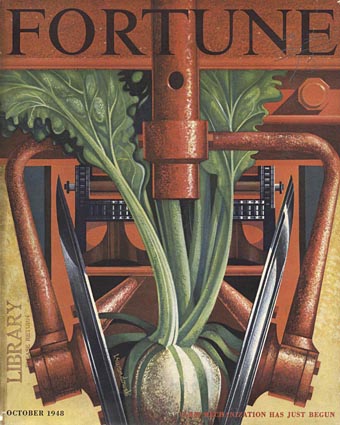
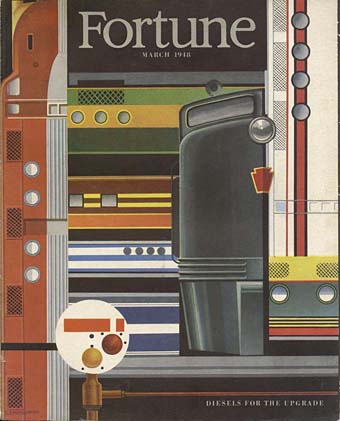
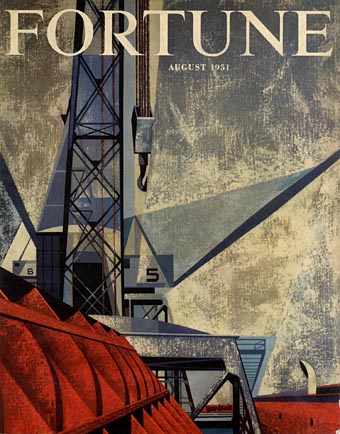
It’s a shame that artist Edmund Lewandowski (1914–1998) didn’t do more covers for Fortune magazine as I enjoy this combination of painting and design a great deal. The cover above shows how well you can illustrate a farming theme without resort to a view of rolling fields and busy tractors; the cover for March 1948 would still be a great solution today, diesel trains presented as an almost abstract pattern. Lewandowski is remembered today for his Precisionist paintings many of which continue the industrial theme.

fortune38.jpg

fortune39.jpg

fortune40.jpg

fortune41.jpg

Previously on { feuilleton }
Petruccelli at Fortune
Fortune illustrators
Fortune in June

Abraxas: The International Journal of Esoteric Studies

abraxas.jpg

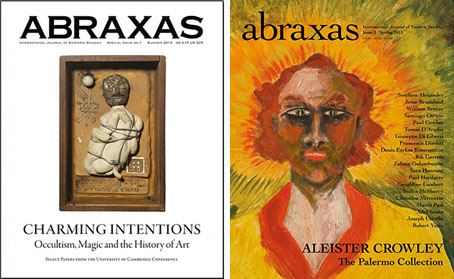
A welcome arrival in the post recently was two issues of Abraxas, the book-format journal of esoteric studies from Fulgur Esoterica. I’ve always observed the contemporary occult scene from a distance, being more interested in cultural spin-offs whether those happen to be music-oriented—as was the late, lamented Coil—or art-oriented. Something I always enjoyed about Kenneth Grant’s books was the amount of unique art material they contained, much of it by his wife, Steffi Grant, or previously unseen work by Austin Osman Spare. Fulgur have for many years continued this artistic focus, starting out by reprinting Spare’s books (and publishing new ones, such as the revelatory Zos Speaks!), and more recently turning their attention to the work of contemporary artists following similar paths.
kostromitin2.jpg

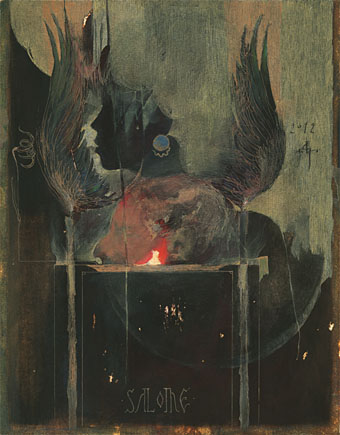
Study for Salome (2012) by Denis Forkas Kostromitin.

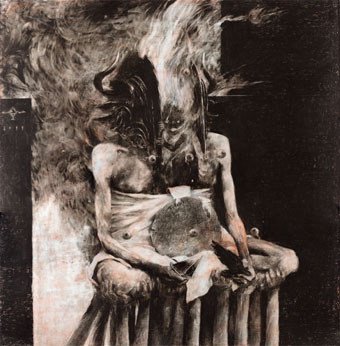
Abraxas is a venue for the latter group, especially in the most recent issue, no. 3, which features a wealth of new art, photography, essays and poetry. In the past I’ve complained about the misunderstandings Austin Spare’s work used to generate among otherwise intelligent and sensitive critics when faced with the artist’s occult obsessions; the usual response would be to lazily dismiss this side of his work as “black magic”, and therefore either kitsch or nonsense. Things have improved in recent years but it’s taken a long time for critics and curators who would show the greatest respect to a minority belief from South America, say, to offer the same respect to equally sincere artists who happen to be working in London or New York. One of the values of Abraxas for artists such as Jesse Bransford and Denis Forkas Kostromitin, both of whom are interviewed here, is that they can have a conversation with someone who won’t treat their work or their interests in a condescending manner. I’m particularly taken with Kostromitin, a Russian artist whose work I only discovered recently.
kostromitin3.jpg

M L K (Moloch) (2011) by Denis Forkas Kostromitin.

Elsewhere in Abraxas 3 there’s a feature on the recent exhibition of Aleister Crowley’s extravagant daubs, an article by Francesco Dimitri about tarantism in southern Italy, a piece about Dada by Adel Souto, and text by Paracelsus with illustrations by Joseph Uccello which is printed on a different paper stock. The production quality is as good as any art book but then that’s standard for a Fulgur publication. Mention should be made of the interior design of this issue which far exceeds the often perfunctory layout of many publications from smaller publishers. Tony Hill is credited on the masthead as Creative Director so I’m assuming he’s the person responsible. Abraxas is an essential purchase for anyone interested in contemporary occult art. The hardback of no. 3 is a limited edition that includes a signed and numbered lithograph by Denis Forkas Kostromitin.

Previously on { feuilleton }
I:MAGE: An Exhibition of Esoteric Artists