Finch posters

finch.jpg

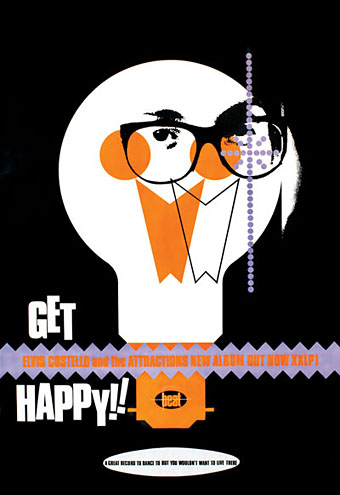
I won’t say this is by popular demand but after persistent requests for posters of my cover art for Jeff VanderMeer’s latest novel, Finch, I’ve opened a new CafePress shop selling exactly that. The largest of these is 58.38cm x 82.55 (22.984″ x 32.5″) which should be big enough for most appetites. There’s also a smaller size 35.03cm x 49.53 (13.7904″ x 19.5″) and I’ve added some cards and postcards.

In Finch, mysterious underground inhabitants known as the gray caps have reconquered the failed fantasy state Ambergris and put it under martial law. They have disbanded House Hoegbotton and are controlling the human inhabitants with strange addictive drugs, internment in camps, and random acts of terror. The rebel resistance is scattered, and the gray caps are using human labor to build two strange towers. Against this backdrop, John Finch, who lives alone with a cat and a lizard, must solve an impossible double murder for his gray cap masters while trying to make contact with the rebels. Nothing is as it seems as Finch and his disintegrating partner Wyte negotiate their way through a landscape of spies, rebels, and deception. Trapped by his job and the city, Finch is about to come face to face with a series of mysteries that will change him and Ambergris forever.

Jeff is currently promoting Finch on his latest book tour, details of which can be found here.

Previously on { feuilleton }
Finch

Drowned worlds

rockman1.jpg

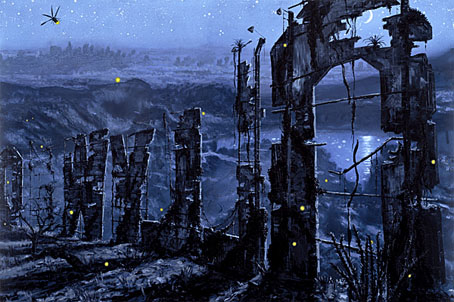
Hollywood at Night (2006).

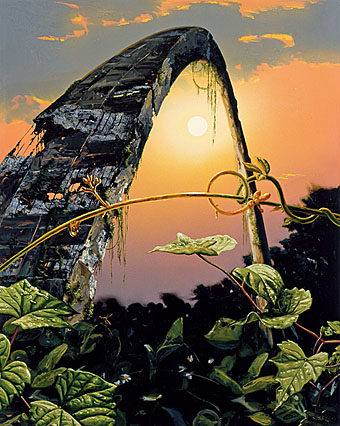
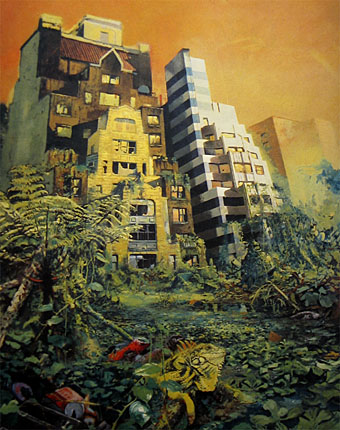
Alexis Rockman‘s paintings of swamped or ruined American landmarks present views which are a novelty in contemporary art galleries whilst being very familiar to science fiction readers. Many of these could well be illustrations for JG Ballard’s 1981 novel, Hello America, which imagined a depopulated United States reclaimed by flora and fauna. Others would suit The Drowned World, of course, and they bear favourable comparison with Dick French’s illustrated edition (below) which was also published in 1981.

rockman2.jpg

Gateway Arch (2005).

Rockman’s hothouse atmospheres remind me of earlier paintings of Brazilian wildlife by another American artist, Martin Johnson Heade (1819–1904), many of whose tropical landscapes only require a distant ruin or two to match Rockman’s work. (Tip via Design Observer.)

french.jpg

The Drowned World by Dick French (1981).

While we’re on the subject, Ballardian has posted the first of three features about my colleagues at Savoy Books, beginning with a Michael Butterworth interview which discusses some of Ballard’s connections with Savoy. One of the subsequent posts should see yours truly discussing the visual dimension of the Savoy world. More about that later.

Previously on { feuilleton }
The coming of the dust
Ballard and the painters

Virtual Alice

alice.jpg

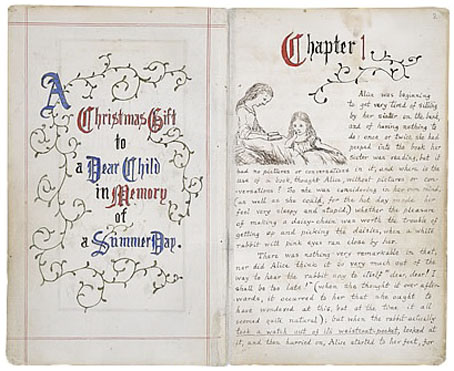
No, I didn’t go searching for this, I had my fill of Alice’s Adventures in Wonderland last month. The British Library website is a lot more amenable than it used to be for the casual browser, and one of its newer sections is a small collection of what they call virtual books which enable you to leaf through some of their exclusive volumes. The pages above are from the original handwritten manuscript, Alice’s Adventures Under Ground, from which the printed book was later adapted. I have this in a small facsimile edition so I don’t need a web version, and the illustrations are often reprinted, but this web copy allows you to see the work in its entirety. They also reproduce the text and have an audio facility. I went through my copy a couple of times whilst working on the calendar in order to see how Dodgson depicted some of his scenes. A few of his conceptions differ from the famous Tenniel illustrations, not least his drawing of Alice herself who closely resembles the real Alice Liddell.

Previously on { feuilleton }
Psychedelic Wonderland: the 2010 calendar
Charles Robinson’s Alice’s Adventures in Wonderland
Humpty Dumpty variations
Alice in Wonderland by Jonathan Miller
The Illustrators of Alice

Booklife by Jeff VanderMeer

booklife.jpg

Yet another of the titles I’ve been working on this year—yes, it’s been a very busy time—Booklife took several months of back and forth on the part of author, editor and designer before we had something that everyone was happy with.

Offering timely advice in an era when the burden of production and publicity frequently falls on authors, this essential reference reflects on methods for being focused, productive, and savvy in the craft of writing. Discussing a wide range of essential topics for self-promoting authors, this important guide explores questions such as How can authors use social media and the internet? How does the new online paradigm affect authors, readers, and the book industry? How can authors find the time to both create and promote their work? and What should never be done? Through good-humored encouragement, practical tips of the trade culled from 25 years of experience as a writer, reviewer, editor, publisher, agent, and blogger are shared. Including topics such as personal space versus public space, deadlines, and networking, the benefits of interacting with readers through new technologies is revealed.

After all the work it’s been good to see the book receiving such a positive reception this week, with a feature spot on Boing Boing and a high placing in Amazon’s book listing. Back in February I wrote a lengthy post about the evolution of the cover design, and that post has been reproduced at the Booklifenow site which serves as an online extension of the book itself. Web designer Luís Rodrigues did a great job of matching the site design to the cover.

Update: The cover at unaccountably large size on Wired.com

Previously on { feuilleton }
Designing Booklife

Psychedelic Wonderland: the 2010 calendar

pw00.jpg

So I had a bright idea at the end of September… Instead of rehashing old work for a CafePress calendar design, I thought I’d try something new. I hadn’t done any artwork for myself all year, everything I’d been working on was a commission of some sort. In addition to that, I’d spent a large portion of the year delving deeper into the psychedelic music of the late Sixties, especially the wealth of obscure British bands to be found on the seemingly endless series of compilations which have trickled out over the past two decades. Everyone is familiar with Jefferson Airplane’s White Rabbit but, as I’ve noted before, themes from, and allusions to, the Alice books run through British psychedelia to an even greater degree. The Beatles put Lewis Carroll in their pantheon of influences on the cover of Sgt. Pepper, and Wonderland’s atmosphere of Victorian surrealism chimed perfectly with a resurgence of interest in Victorian art and design.

So at the end of September, mulling over ideas, I picked up one of my Lewis Carroll volumes and looked at the chapter list: 12 chapters…12 months…I could do a psychedelic Alice in Wonderland! The only drawback was being weighed down by ongoing work which meant that anything I did would have to be created quickly and easily. I reckoned it was manageable if I put a few rules in place first: try and rough out a chapter a day; make copious use of clip art decoration and scanned engravings; keep things bold and florid without worrying too much about fidelity to minor story points. In theory I could do the whole thing in about two weeks if I kept on schedule. As it turns out the whole thing took me three weeks as I got increasingly involved with illustrating the story. You can see the results below and larger copies of the pictures here. Two years ago I was saying I probably wouldn’t ever illustrate Lewis Carroll. That was true at the time since I couldn’t find an approach to the stories that would sustain my interest and (possibly) bring something new to the books. Seeing Alice’s adventures through the psychotropic prism of the late Sixties showed me the way into Wonderland. What’s needed now is to do the same next year for Looking-Glass Land. Watch this space.

Some notes on the pictures follow below.

Update: By popular demand, this calendar is now available again.

Continue reading “Psychedelic Wonderland: the 2010 calendar”