Reworking Kraftwerk (again)

kraftwerk00.jpg

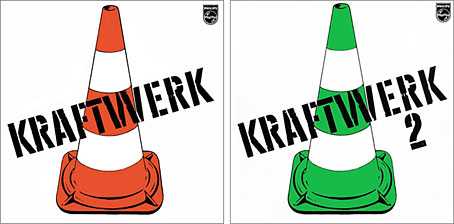
Kraftwerk (1970); Kraftwerk 2 (1972). Design by Ralf Hütter.

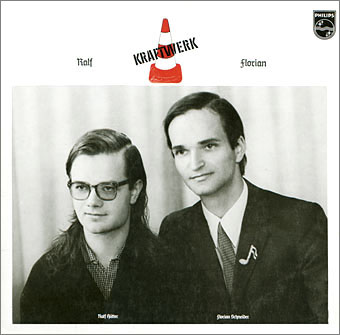
Recent posts about Kraftwerk’s design history had me wondering how the group might present the first three albums if these repudiated works were allowed back into the catalogue. Kraftwerk, Kraftwerk 2, and Ralf and Florian haven’t been officially reissued for decades now, and I remain sceptical that Ralf Hütter (or the recently departed Florian Schneider) are willing to taint their carefully cultivated discography with those awkward, experimental albums. This is highly unusual in the music world where everything by a commercially successful group tends to be reissued on a regular basis.
raf.jpg

Ralf and Florian (1973). Design by Ralf Hütter & Florian Schneider. Photo by Robert Franck.

Kraftwerk are unique in this, and also in subjecting their approved releases to incremental adjustments. This was mostly strikingly seen in 2009 when the 8 albums were reissued in a box as The Catalogue. Not only had further changes been made to the cover art but two of the albums had amended titles: Electric Café was now Techno Pop (as it would have been titled if released earlier in the 1980s), and Tour De France Soundtracks had become Tour De France. The cover art changes had already been previewed in the version of The Catalogue that briefly appeared as a promo set in 2004 only now it was evident that more human traces were being removed from the albums, notably on the cover of The Man-Machine which swapped the band photo for the El Lissitzky-derived graphics. All of this needed to be taken into account when I had the idea last week of roughing out designs for how the first three albums might be reissued in a box set today.
cover1.jpg

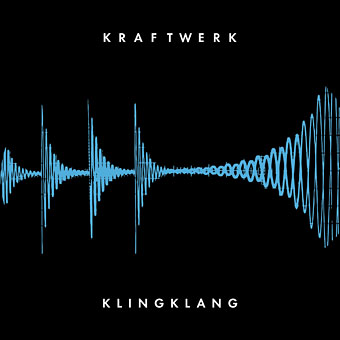
First the title: there’s no way of knowing what Ralf Hütter might call a collected set but mundane choices like Three Albums or Kraftwerk 70–73 seem unlikely. I decided on Klingklang, the name of the first piece of music on the second album, and also the name of Kraftwerk’s studio and publishing company. This would no doubt cause endless (endless) confusion but it still seems apt. The cover design uses Futura, a German typeface that’s been a feature of many Kraftwerk graphics over the years. The oscilloscope wave is taken from the front and back cover of the double-album reissue of Kraftwerk and Kraftwerk 2 on the Vertigo label in 1972. I always liked that cover, and the graphic suits the often raw electronic sound of those albums as well as the minimal nature of the current design.
cover2.jpg

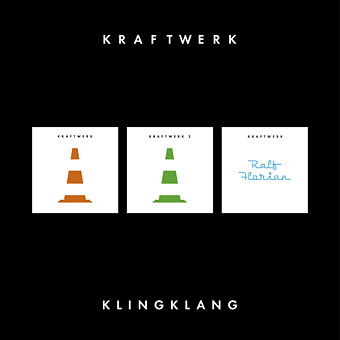
This would be the back of the proposed box, showing the albums within as The Catalogue does.
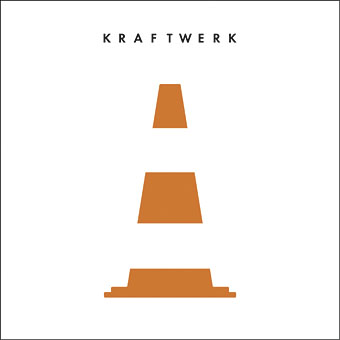
kw1.jpg

All German traffic cones still follow this standard, apparently, so the design hasn’t dated at all. (See this post for Kraftwerk’s cone obsession.) Using negative space for the white bands works well.

Continue reading “Reworking Kraftwerk (again)”

The Fantastic World of MC Escher

escher1.jpg

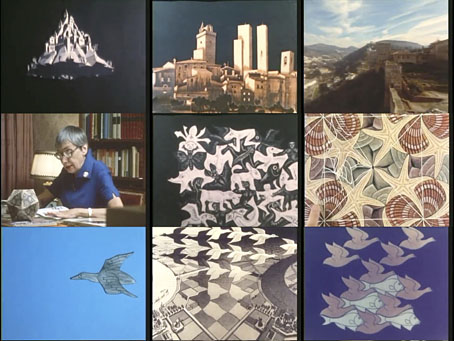
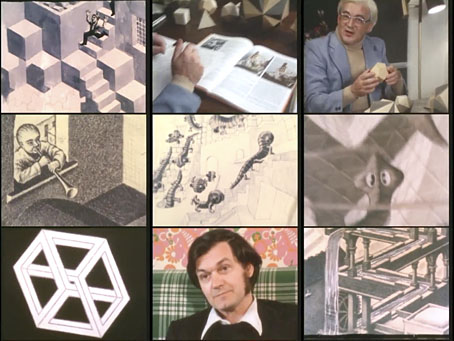
An Italian documentary about the Dutch artist made in 1980 and directed by Michele Emmer. I don’t recall ever seeing a British TV documentary about Escher (although I’d be surprised if there were none) but this resembles the type of thing the BBC used to do so well. Shots of the Italian towns where Escher lived for many years show the influence of the vernacular architecture on Escher’s prints. Elsewhere, animated sequences bring to life his tessellations, while various mathematicians examine some of the structural principles at work in these very familiar images. Of greatest interest for me is mathematician and physicist Roger Penrose discussing his first encounter with Escher’s work, and the development with his father of the Penrose Triangle, an impossible object similar to those that appear in some of Escher’s prints. (I used a Penrose Triangle in my cover art for Zones by Hawkwind.) The Fantastic World of MC Escher runs for 50 minutes, and may be watched here.

escher2.jpg

Previously on { feuilleton }
MC Escher album covers
Escher and Schrofer

Weekend links 244

scarpulla.jpg

MMOB :: Far West (2013) by Alison Scarpulla.

• “…although same-sex love is as old as love itself, the public discourse around it, and the political movement to win rights for it, arose in Germany in the late nineteenth and early twentieth centuries. This message may surprise those who believe that gay identity came of age in London and New York, sometime between the Oscar Wilde trials and the Stonewall riots.” Alex Ross reviewing Robert Beachy’s Gay Berlin: Birthplace of a Modern Identity. Beachy talks about his book here.

• “I was in a room with tube synthesizers, where you had to tune them up to play them. It was unbelievable.” John Carpenter talking to Joseph Stannard about composing with electronics. Carpenter’s album of new music, Lost Themes, may be previewed here.

• From 2010: John Ridpath on Mervyn Peake’s illustrations for Lewis Carroll’s Alice Through the Looking Glass and Alice in Wonderland. Related: “The most twisted version of Alice in Wonderland you’ll ever see.”

I was brought up in a world where art was something owned and insured—usually inherited: but seldom if ever made by anyone one I knew.

I had an early inkling that there was fun to be had over the hill, like the feeling when faced with a sunset that someone’s throwing a mega awesome party just beyond the nearest cloud, and I set off to join the caravan. Let’s just say I was in search of company, headed towards the glow, and I found it.

Tilda Swinton‘s speech at the Rothko Chapel

• “Her art often touches on alchemy and magic; and in her memoir of insanity she writes of misreading an Imperial Chemicals sign as ‘chemistry and alchemy’.” Charlotte Higgins on Leonora Carrington.

Shadows Over Main Street, an anthology of small-town Lovecraftian terror, is out this week from Hazardous Press. 20 stories and poems plus interior illustrations including a contribution of my own.

• “With Fantastic Planet, I felt torn about using it, because it’s…the title of an animated film.” Guitarist Sarah Lipstate, aka Noveller, talks to Ned Raggett about her new album.

Jim Jupp of Belbury Poly and the Ghost Box record label answers 15 questions.

• A DeLorean driving through a Tron cityscape: Retrowave by Florian Renner.

• Powell & Pressburger’s Tales of Hoffmann (1951) has been restored.

Music from Forbidden Planet (1956) by Louis & Bebe Barron | The Four Horsemen (1972) by Aphrodite’s Child | Assault on Precinct 13 (Main Theme) (1976) by John Carpenter

A Mountain Walked

mountain01.jpg

Art by David Ho.

This may be a frustrating post for some since it concerns a limited edition anthology that sold out almost as soon as it was announced a year or so ago. Even though the book was published last year it’s taken a few months for my copies to arrive. A Mountain Walked is a collection of Cthulhu Mythos stories compiled by leading Lovecraft scholar ST Joshi, and published in the US by Centipede Press. Anyone familiar with Centipede’s more luxurious volumes will know that they don’t do things by halves, and this weighty tome is no exception: a large-format hardback (the signed edition is also cased), with heavy paper stock, colour printing, tinted sheets and a bulk that runs to almost 700 pages.

mountain02.jpg

Art by David Ho.

Many of the stories are reprints but there’s also new material from contributors including Thomas Ligotti, Neil Gaiman, Caitlín R. Kiernan, Laird Barron, the late Michael Shea (to whom the book is dedicated), Patrick McGrath, TED Klein, Gemma Files, Ramsey Campbell and many others. The artwork also ranges widely; I’d not seen anything by David Ho before but he’s very good, hence the samples shown here. But there’s also a variety of other work, even a Lovecraftian Peanuts comic strip by Julien Baznet. I was pleased that my Cthulhoid picture was placed with the introduction, it makes up for my never having responded to Mr Joshi when he wrote to me years ago asking if I’d be interested in contributing something to Necronomicon Press.

Since the book was so successful there’s been talk of doing a cheaper reprint. In the meantime, bloated Lovecraftian plutocrats (Yuggothcrats?) will find very expensive copies for sale on eBay. A few more page samples follow.

mountain03.jpg

Continue reading “A Mountain Walked”

Oskar Schlemmer’s Triadic Ballet

schlemmer.jpg

Oskar Schlemmer’s Triadic Ballet of the 1920s is one of the more famous products of the Bauhaus movement, a radical reinvention of the medium which encased the dancers in cumbersome costumes. The outfits and stage designs are familiar from Bauhaus histories but you’re less likely to see an actual performance, something that’s possible with this 30-minute film made in 1970. The ballet is in three acts: yellow, pink and black. Erich Ferstl wrote the music for the filmed reconstruction by Margarete Hasting, the original score by Paul Hindemith being lost.

The ballet has additional interest for me in having influenced part of the Reverbstorm book. Oskar Schlemmer’s Bauhaus logo is reworked in the opening and closing pages together with other Bauhaus-derived graphics, but I also looked at Schlemmer’s ballet costumes when I was planning the final section which required a stylised transformation of Lord Horror. In the end I used a sketch by one of Schlemmer’s pupils, Klaus Barthelmess, for the Horror figure but the Barthelmess drawing was also of a dancer, and is very similar to some of Schlemmer’s designs, especially the silver-headed robot-like figures that appear in the black section of the ballet.

Previously on { feuilleton }
Reverbstorm: Bauhaus Horror