Illustrating Frankenstein

holst.jpg

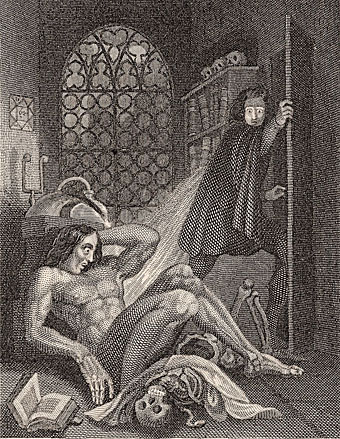
Frontispiece by Theodore Von Holst of the 1831 edition of Frankenstein. The monster in this illustration, which Mary Shelley would no doubt have seen, is closer to the description in the text than the myriad shambling figures that came later.

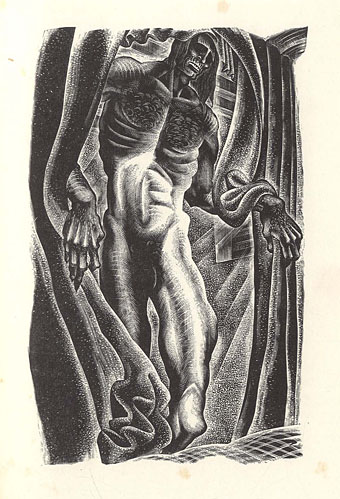
It’s a recurrent feature of commissioned work that you sometimes find yourself illustrating novels or stories you might otherwise have never attempted. Spanish publisher Editorial Alma have just added a new edition of Mary Shelley’s Frankenstein to their series of illustrated classics, convenient timing with this year being the bicentenary of the book’s first publication. Last year I produced 33 illustrations for Alma’s collection of Poe stories, as well as 3 new illustrations for a small Lovecraft collection. For their edition of Frankenstein I’ve created 24 full-page pictures, one for each chapter. (I produced 25 in total, 24 for the chapters and one for the letters at the front, but the Spanish translation is arranged slightly differently so one of the drawings has been omitted.) In the past I’ve given little consideration to illustrating classic books, preferring to look for subjects which were less familiar. Frankenstein is a book that isn’t illustrated as much as some but Lynd Ward in 1934, and Berni Wrightson in 1977/78 both produced sufficiently exceptional sets of drawings for me to regard the novel as almost unassailable. Until last year, that is.
ward1.jpg

Frankenstein by Lynd Ward (1934).

Despite such formidable predecessors, I felt that with this book at least I might be able to offer something new using the blend of collage and drawing that I’ve been evolving recently. There was additional promise in that the story as it’s written is less familiar than the Poe stories, and much less familiar than its fellow horror classic, Dracula. People think they know Frankenstein but what they often know is the manglings the novel has received in various film and TV adaptations. The Ward and Wrightson illustrations stay close to the text, the latter being replete with period detail, and rendered in a style reminiscent of 19th-century wood engravings. Wrightson even copied two of Gustave Dore’s pictures from The Rime of the Ancient Mariner for the opening scenes on the ship, one of which went unused. But Wrightson’s drawings are closer still to Franklin Booth‘s pen-and-ink style which was also derived from wood engraving yet which achieves its effects in a different manner to the engraving process.
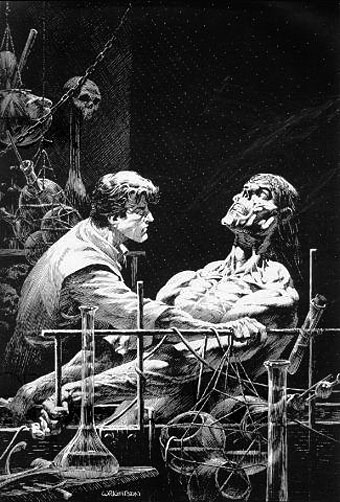
frankenstein2.jpg

Frankenstein by Berni Wrightson (1977/78).

Even when artists follow the text of Frankenstein more closely than the screenplay adapters, personal tastes can’t help manifest themselves. So Ward’s drawings reflect the angular and stylised compositions of his “novels in woodcuts”, while Wrightson’s work still shows evidence of his earlier career as a comic artist. With my illustrations I wanted to reflect the artistic spirit that gave birth to the novel, namely Romanticism. Frankenstein is very much a Romantic tragedy with violent passions set against the overwhelming landscapes of the Swiss Alps, the Rhine valley and the Arctic seas. Three of the illustrations below allude to Caspar David Friedrich’s paintings, while many of the others have had their mundane cloudscapes exchanged for gloom and tumult.

I’ve said before that one of the things I enjoy about the collage technique is being able to use engravings and other graphics from the same period (give or take a few decades) as the story itself. The disadvantage of relying on pre-existing sources is that you’re always limited by the available material, so recently I’ve been pushing the technique further to achieve a hybrid style, something midway between the Ernst/Sätty engraving-collage technique and the very laborious, heavily-shaded pen-and-ink style I used when I was drawing comics. The approach isn’t so different to the one I used in my Lovecraft comics many of whose backgrounds and other details were copied from photographs. The difference is that where I used to spend several days working on a single panel (and two weeks working on a page) I can now create an entire picture in half the time. In these new illustrations I feel the hybrid style is working as I intended, allowing me greater freedom to create the picture I have in mind rather than a picture dictated by the source material. Without incorporating original figures and other drawn elements into the compositions it would have been difficult to illustrate a story with the same characters in so many scenes, a problem I encountered when I was illustrating Lewis Carroll’s Alice books and ran out of pictures of Victorian girls.

The full run of pictures follows below, including the one which was omitted from the print edition. All may be seen at a larger size here. Since the scenes aren’t always self-explanatory I’ve included fragments of text from each chapter.
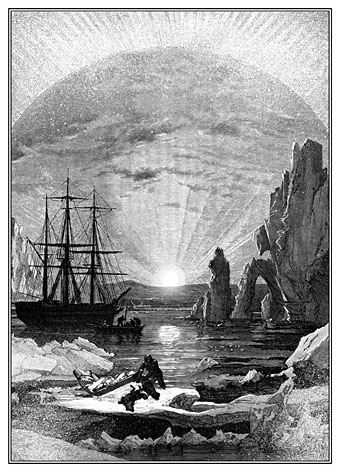
frankenstein00.jpg

“In the morning, however, as soon as it was light, I went upon deck and found all the sailors busy on one side of the vessel, apparently talking to someone in the sea. It was, in fact, a sledge, like that we had seen before, which had drifted towards us in the night on a large fragment of ice.”
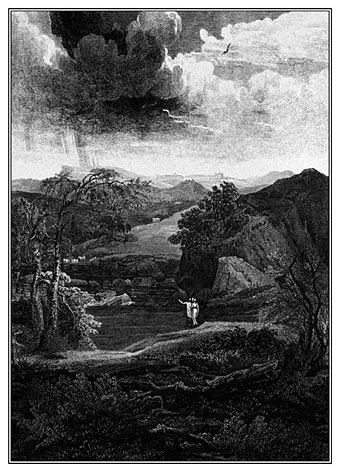
frankenstein01.jpg

“During one of their walks a poor cot in the foldings of a vale attracted their notice as being singularly disconsolate, while the number of half-clothed children gathered about it spoke of penury in its worst shape.”

This one was omitted from the Alma edition. No loss, really, since the scene doesn’t add much to the story.
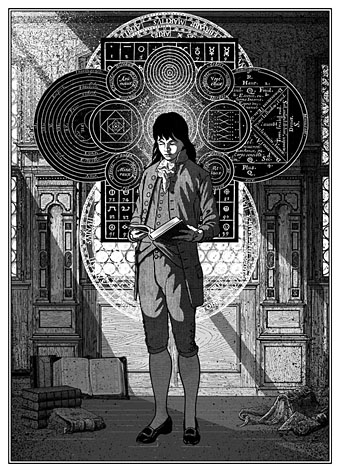
frankenstein02.jpg

“When I returned home my first care was to procure the whole works of this author, and afterwards of Paracelsus and Albertus Magnus. I read and studied the wild fancies of these writers with delight; they appeared to me treasures known to few besides myself.”

The diagrams here are taken from some of the books the young Victor Frankenstein is reading. There’s an allusion to this in the magic square on the wall in the back of Theodore Von Holst’s frontispiece, the square being the kind of thing seen in books like this one by Cornelius Agrippa, one of the occult philosophers mentioned in the novel.

Continue reading “Illustrating Frankenstein”
A view from a hill

f1.jpg

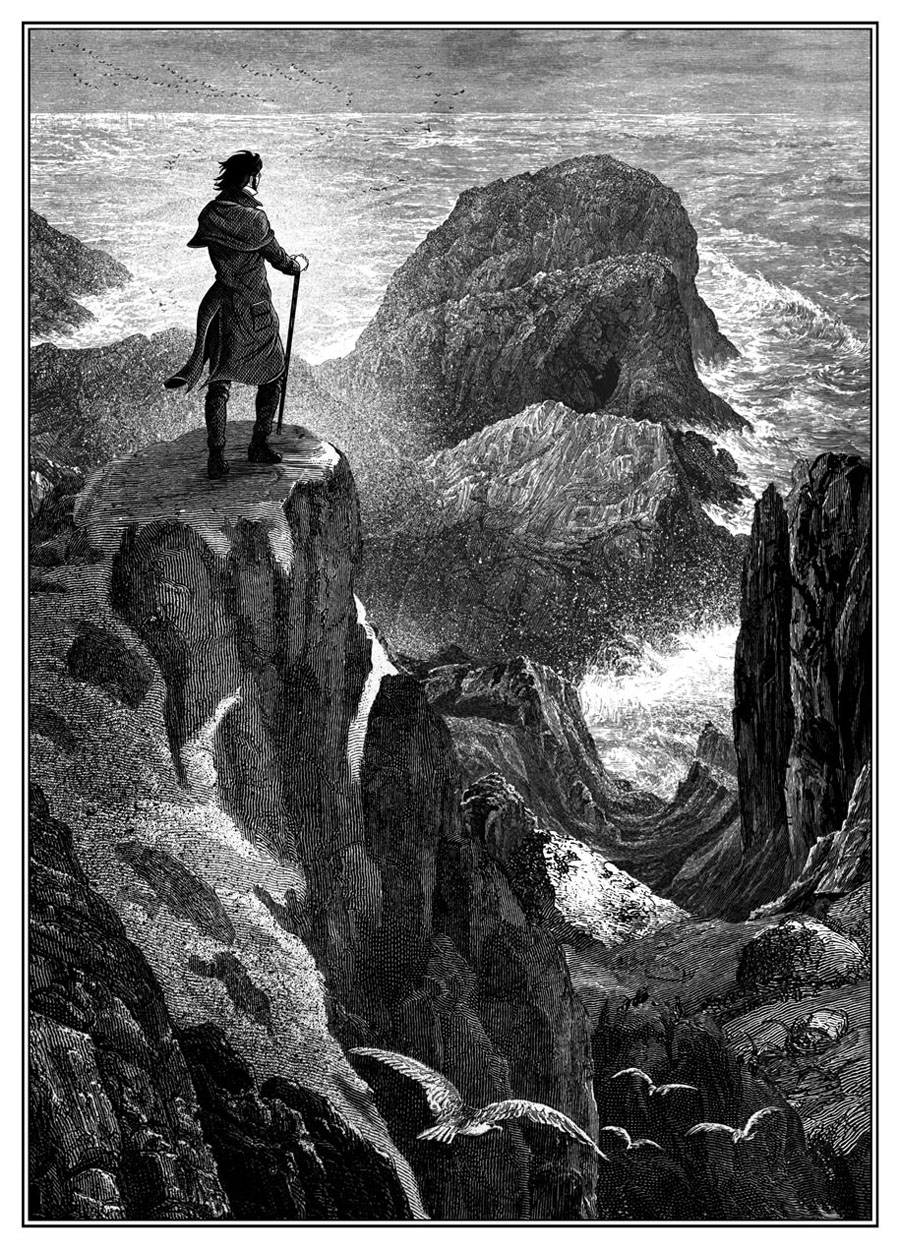
This week I’ve been rushing to complete a series of illustrations so there’s been no time to write the post I had in mind. In its place, here’s a preview of another series I was working on in September which I’m told should be published soon. More about that later, and yes, the similarity to Friedrich’s Wanderer above the Sea of Fog was intentional.

The Mystery of Picasso

picasso1.jpg

I mentioned late last year that I’d written the booklet notes for a forthcoming DVD/blu-ray of The Mystery of Picasso (1956) by Henri-Georges Clouzot, a film receiving its blu-ray premiere this month courtesy of Arrow Academy. The discs are now on sale (UK only, I’m afraid) either online or anywhere that stocks Arrow titles. (Fopp is my preferred outlet.) For those outside the UK, the restored film is also available on iTunes. Clouzot’s film was regarded as an oddity in the 1950s, the director being best known for outstanding thrillers like The Wages of Fear and Les Diaboliques. Today The Mystery of Picasso is regarded as one of the great films about art for the way it successfully captures Picasso in a decade when he was still fervently productive, despite being in his 70s.

picasso2.jpg

Almost all films of this type favour the documentary approach, usually with a camera and interviewer dogging the subject’s footsteps while showing little of the creative process. Picasso wouldn’t have participated in anything like this—he was appalled by a documentary he saw about Matisse—but Clouzot persuaded him that a film could be made showing him drawing and painting in a studio environment. This approach had precedence in Paul Haessarts’ short film from 1949 (included among the disc extras) which showed Picasso in his studio at Vallauris; the film ends with a series of paintings on glass of various animals and human figures. Clouzot expanded on Haessarts’ idea with the full range of film technology: time-lapse, black-and-white stock, colour stock and Cinemascope. The works Picasso creates for the camera aren’t his best—how could they be when they were being produced at speed in sweltering, time-constrained conditions? But the film is a miraculous portrait of an artist whose name is still universally recognised almost fifty years after his death. By chance or design, it’s also a partial portrait of Clouzot himself who appears in several of the shots to discuss new camera setups.

There’s no need for me to say more about the film when I discuss it at length in the booklet. For a review of the disc contents, there’s a substantial appraisal here. For more about Henri-Georges Clouzot I recommend the study by Christopher Lloyd which was invaluable for its details about the film’s production.

Previously on { feuilleton }
Picasso-esque
My pastiches
Cubist Cthulhu

The Demons of King Solomon

demon01.jpg

Abyzou.

Presenting my illustrations for The Demons of King Solomon, a horror anthology edited by Aaron French. This is a follow up to Aaron’s The Gods of HP Lovecraft which was published by JournalStone in 2015. I did 6 illustrations for the Lovecraft volume, covering half the stories whereas the new book has illustrations of mine for every story.

demon02.jpg

Agaras.

The brief for the authors this time was to write a story incorporating a Solomonic demon of their choosing. There are many of these, from the ones described in the Testament of Solomon to the 72 listed in the Ars Goetia (or Lesser Key of Solomon), the latter being familiar to many people via their often comical depictions in De Plancy’s Dictionnaire Infernal. My original intention for the illustrations was to do a series of pictures based on each story. Some of the stories were late in arriving, however, and I only had a month free for the work so I changed the plan to a series of depictions of the demons as they’re described in the grimoires. This makes more sense when many of the stories have the demons masquerading in human guise, so the illustrations not only show something new but also act as a connection back to their infernal history. Agaras (or Agares), for example, is described by the grimoires as an old man riding a crocodile with a hawk on his arm. Most of the seals on each picture are taken from the ones for the demons shown in the Ars Goetia. Not all the demons in the anthology are listed there so I had to invent a few seals to fill out the collection. I’ll let people guess which are genuine and which are inventions. The Demons of King Solomon is out now from JournalStone. Larger copies of the illustrations may be seen here.

demon03.jpg

Amdusias.

demon04.jpg

Asmodeus.

Continue reading “The Demons of King Solomon”

Weekend links 392

images.jpg

Art by Twins of Evil for the forthcoming blu-ray from Arrow Academy.

Images (1972), the film that Robert Altman made between McCabe and Mrs Miller and The Long Goodbye, is the closest the director came to outright horror. A disturbing portrait of mental breakdown, with Susannah York in the lead role, and photography by Vilmos Zsigmond, the film has for years been so difficult to see as to be almost invisible. Arrow Academy will remedy this situation in March next year with a new blu-ray restoration. Related: Geoff Andrew on where to begin with Robert Altman.

• “[Johnson] is a paltry, utterly conventional, upwardly mobile, morally squalid parvenu who yearns to be taken for what he isn’t.” Jonathan Meades‘ vitriol is in a class of its own, here being deployed in a review of Nincompoopolis: The Follies of Boris Johnson by Douglas Murphy.

• “These films, all preserved in the BFI National Archive, are known as Orphan Works. When the rights-holder for a film cannot be found, that film is classified as an Orphan Work.” 170 orphaned films have been added to the BFI’s YouTube channel.

Don’t romanticize science fiction. One of the questions I have been asked so many times I’ve forgotten what my stock answer to it is, ‘Since science fiction is a marginal form of writing, do you think it makes it easier to deal with marginal people?’ Which—no! Why should it be any easier? Dealing with the marginal is always a matter of dealing with the marginal. If anything, science fiction as a marginal genre is more rigid, far more rigid than literature. There are more examples of gay writing in literature than there are in science fiction.

Samuel Delany in a lengthy two-part interview with Adam Fitzgerald

• One of the books I was illustrating this year was The Demons of King Solomon, a horror anthology edited by Aaron French. The collection is out now; I’ll post the illustrations here in the next month or so.

• Mixes of the week: Routledge Dexter Satellite Systems by Moon Wiring Club, No Way Through The Woods: A Conjurer’s Hexmas by SeraphicManta, and FACT mix 632 by Priests.

• Also at the BFI: Adam Scovell on a film adaptation of MR James that predates Jonathan Miller’s Whistle and I’ll Come To You (1968) by 12 years.

• At Weird Fiction Review: Jon Padgett on absurd degenerations and totalitarian decrepitude in The Town Manager by Thomas Ligotti.

• At Larkfall: Electricity & Imagination: Karl von Eckartshausen and Romantic Synaesthesia.

• It’s the end of December so the London Review of Books has Alan Bennett’s diary for the past year.

Aquarium Drunkard‘s review of the year’s best music.

• At Dennis Cooper’s: Lotte Reiniger Day.

Robin Rimbaud is In Wild Air.

• Dream Sequence (Images II) (1976) by George Crumb | Images (1977) by Sun Ra | Mirror Images (1978) by Van Der Graaf