Recovering Bond

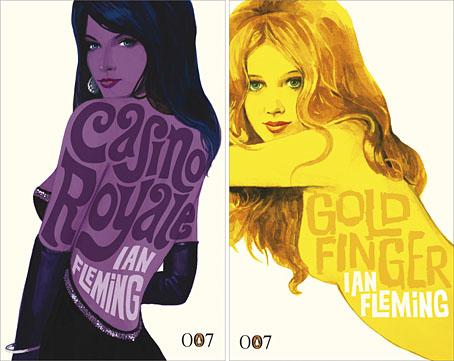
new_bonds.jpg

Penguin is really coming up with the goods these days, living up to their reputation as a house with high standards of cover design, unlike Picador and the shabby way they treated Cormac McCarthy recently.

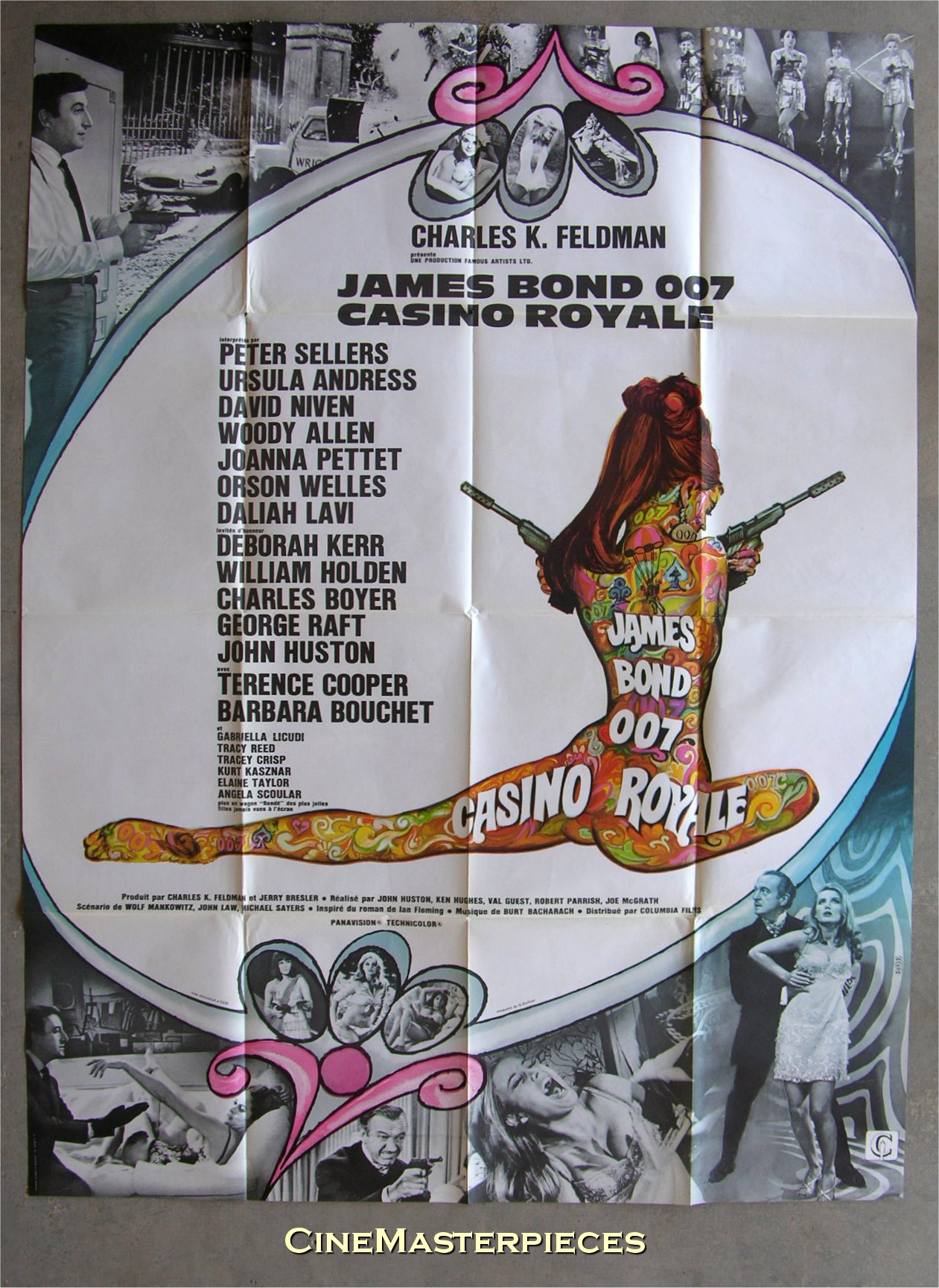
Ian Fleming’s Bond novels are the latest to receive a makeover with some fabulous art from illustrator Michael Gillette. 2008 is Fleming’s centenary so the books have been republished as demi-format hardbacks with these new designs adorning the jackets. Each cover features a different girl matched to the theme of the book (yes, I know they’re women but in Bond’s world women are always girls unless they’re Miss Moneypenny); each cover also features groovy period type which alludes to the hand-drawn elaborations of the Sixties and Seventies. The effect is reminiscent of the poster art for the 1967 film of Casino Royale (below) which used a naked girl as the focal point; all Bond posters before and after this place oo7 himself centre stage. Penguin even dare to push the level of pastiche by making On Her Majesty’s Secret Service look rather like an old romance novel, not such a surprising decision since this is the book where Bond gets married.
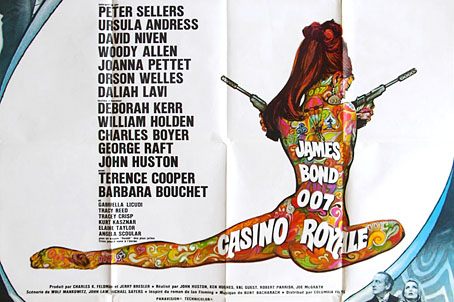
casino.jpg

My favourite Bond covers remain the old Pan paperbacks from 1963 but that’s just me; these look great. There’s been a persistent moan recently from authors and publishers worrying about file sharing as they foresee the publishing world going the same way as the music business. The solution is obvious: you can’t stop texts being copied and distributed but you can make the books themselves desirable objects so make them worth buying and owning. Penguin has numbered the spines of the new Bond books as they did with their recent Sherlock Holmes reprints, a smart appeal to book collectors as well as a tip to read them in the order they were written. “Smart” is the key word here; Picador take note.

Update: The Pan covers mentioned above were designed by Raymond Hawkey. Bond site MI6.co.uk has some details about the designer.

Elsewhere on { feuilleton }
The book covers archive

Previously on { feuilleton }
Repackaging Cormac
The World’s Greatest Detective
James Bond postage stamps
Boys Own Books

Repackaging Cormac

blood_meridian.jpg

left: Vintage International (US), cover design by Susan Mitchell (1993).
right: Picador (UK) reprint (2008).

After the Oscars success of No Country for Old Men it’s understandable that Cormac McCarthy’s publishers would want to reprint all his works. His books still appear under the Picador imprint in the UK where they’ve been reissued recently in uniform editions with new cover designs. A couple of these are an improvement on their lacklustre predecessors, and they don’t look so bad when seen together on a shelf, but on the whole this McCarthy reader is disappointed by the overall blandness they present.

crossing.jpgMy earlier post about McCarthy’s UK covers was critical of the The Road which used a combination of a stock photo and Akzidenz-Grotesk Condensed for the typography. In the case of No Country for Old Men the photo from the American original by Chip Kidd was used but his carefully-judged type layout was dropped. Unfortunately it’s The Road approach which has been continued on the new covers, with variable degrees of success. The Chip Kidd designs that Picador repeated in the 1990s made similar use of suggestive photos but there was at least some attempt made to match form to content; a number of the new designs are vague in the extreme. I assume that the disparate group of objects on the cover of Blood Meridian relate to the character of the Judge when he reveals his intention to catalogue every new object that he comes across. But that’s an incidental detail in one scene of a baroque, ferocious and very violent historical novel. So the image isn’t exactly a misrepresentation but it puts the wrong emphasis on a book that could easily be described as a Western nightmare. And they’ve also dropped the book’s subtitle, an amendment I find especially egregious.

Even more bland is the picture of a shack on the cover of Child of God, McCarthy’s tale of a backwoods psychopath who moves into a cave and murders women so he can have sex with their corpses. Anyone buying the Picador book on the strength of the cover is in for a surprise. And since when did that novel have a definite article in its title? Best of the bunch is probably The Crossing (above) which shows the wolf that provides the impetus for the story. The type works better on this cover while the animal’s reflection in the water is a nice touch that can be read as relating to the various symmetries and reflections in The Border Trilogy, of which this book forms the second part.

Picador set a high standard for paperback design in the Seventies which makes the sight of uninspired and lazy work doubly-dismaying. Susan Mitchell’s covers for the Vintage paperbacks are still the best I’ve seen for McCarthy’s books—and they’re still available—but if these new editions pick up new readers on the strength of the author’s moment in the limelight then that’s no bad thing. It’s the words that count, after all.

Elsewhere on { feuilleton }
The book covers archive

Previously on { feuilleton }
Cormac McCarthy book covers

Ballantine Adult Fantasy covers

baf.jpg

top left: Bob Pepper (1969); right: David Johnston (1974).
bottom left: Mati Klarwein (1972); right: Gervasio Gallardo (1972).

I wrote about the classic line of fantasy paperbacks in the Ballantine Adult Fantasy series last year as part of the post about Bob Pepper’s illustration:

It was the success of the publication of The Lord of the Rings in America which inspired Betty Ballantine to publish a line of fantasy classics in the late Sixties. The series began its run in 1969 and continued until 1974. Lin Carter was commissioned as editor and given free reign to choose any title he thought might be suitable with the result that many of the books in the series—obscurities such as Lud-in-the-mist by Hope Mirrlees—received their first paperback publication. Carter also reprinted personal favourites which frequently shifted from fantasy to outright horror, such as the titles from HP Lovecraft and William Hope Hodgson. The range and scope of this line is what makes the series so notable today and the books have become highly-collectable as a result.

I’m fairly sure this page of cover scans of the BAF series wasn’t there when I was searching for Pepper covers. Whether it was or not, it contains a lot of Bob Pepper artwork I hadn’t seen before at large size, plus a substantial number of the other covers. I was never all that taken with Gervasio Gallardo’s work which took the lion’s share of the illustration duties but the passage of time has lent his paintings and their florid title designs the distinction of being emblematic of the era. And some of the rest are still pretty decent covers.

Elsewhere on { feuilleton }
The illustrators archive
The book covers archive

Previously on { feuilleton }
The art of Bob Pepper
Fantastic art from Pan Books