The art of Leonidas Kryvošej

kryvosej1.jpg

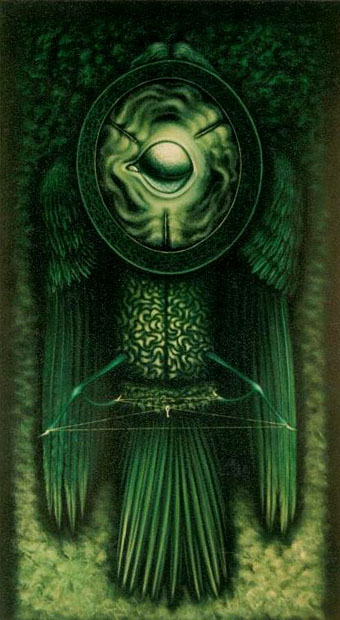
Anděl západního okna.

Leonidas Kryvošej is a contemporary Czech Surrealist whose work I’d known for a while from an exhibition catalogue. I’d always wanted to see more so it’s a pleasure to discover a substantial set of paintings on the website he shares with Lucie Hrusková. A biographical note tells us that:

Leonidas Kryvošej was born 14th May, 1957 in Moravská Třebová. He lives in Ondratice near Prostějov. He has been a member of the surrealist group in Sternberk (later A.I.V) since 1986. Since 1997 a member Czech and Slovak surrealist group.

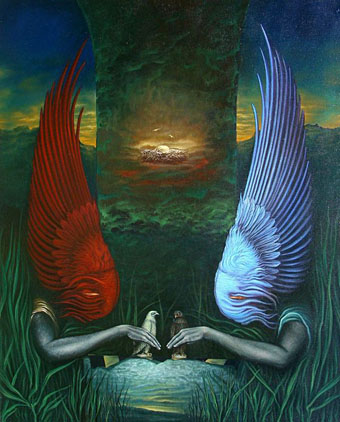
Most of the text on the site is Czech-only but the green painting above was one of the catalogue works whose English title, The Angel of the Western Window, we can no doubt assume is borrowed from Gustav Meyrink’s occult novel about Elizabethan magus John Dee. Occultism and alchemical symbolism seem to fuel Kryvošej’s art, and I like the profusion of wings and mutated bird-like creatures. There’s a lot of work on his gallery pages, all of it worth seeing for anyone who favours this kind of imagery.

kryvosej2.jpg

Ptací hra.

Elsewhere on { feuilleton }
The fantastic art archive

Les Temps Morts by René Laloux

temps1.jpg

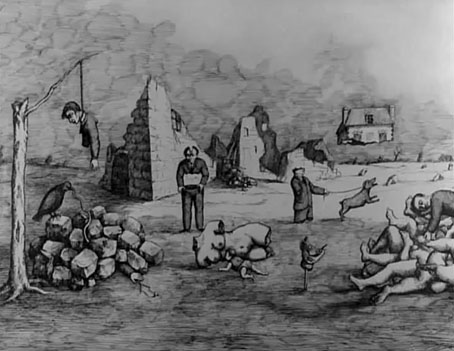
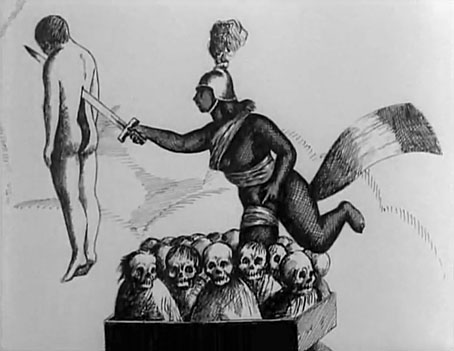
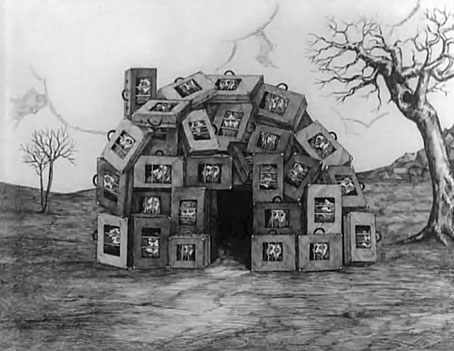
Is Les Temps Morts a French figure of speech? The phrase translates as “idle periods” as well as the more literal “dead times”, so the title of this short film from 1964 may have some punning intent. This was René Laloux’s second film as director, and one I’d not seen before until it turned up on YouTube. It’s an oddly morbid piece not far removed in tone from yesterday’s The Apotheosis of War but a dose of Surrealism courtesy of Roland Topor’s minatory imagination rescues it from Vereshchagin’s moralising.

temps2.jpg

Between some documentary clips of children play-fighting, war scenes, bullfights and bird shoots, Topor’s scratchy ink drawings are brought to life with minimal animation. There’s also some narration in unsubtitled French. Laloux, Topor and soundtrack composer Alain Goraguer followed this with another, lighter short, The Snails (also on YouTube), in 1966, and joined forces again for Laloux’s first animated feature in 1973, the justly-celebrated Fantastic Planet, a science fiction film that’s a lot weirder than the usual Hollywood conceptions of the genre. That’s been on DVD for a while, and is essential viewing for Topor aficionados.

The schizophrenic cinema of René Laloux by Craig Keller.

temps3.jpg

Previously on { feuilleton }
Taxandria, or Raoul Servais meets Paul Delvaux

The art of Johfra Bosschart, 1919–1998

johfra1.jpg

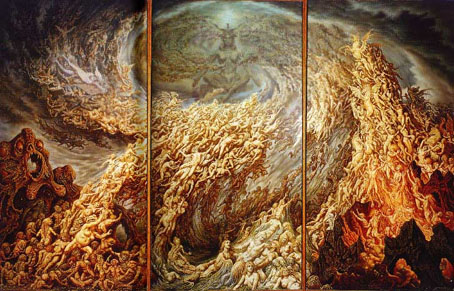
The Adoration of Pan triptych (1979).

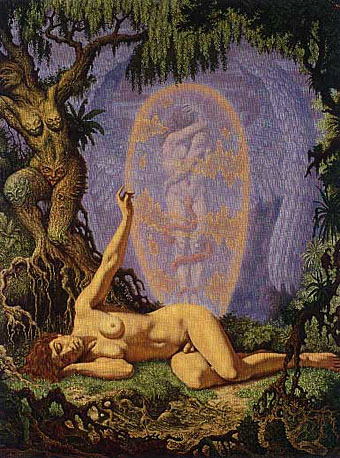
The hyper-detailed paintings of this Dutch artist, who often seems to be referred to by his forename alone, were self-described as “Surrealism based on studies of psychology, religion, the Bible, astrology, antiquity, magic, witchcraft, mythology and occultism”. All bases are covered, in other words, and the work is certainly furious and intense at its best even if it’s not always to my taste. Some of Johfra’s Monsters from the Id are closer to Basil Wolverton than HR Giger which makes for unintentional comedy. As usual with detailed artwork, it’s a shame the reproductions on offer aren’t a larger size.

johfra2.jpg

Moldoror series: The Hermaphrodite (1976).

The pictures here are from one of the online numbers of Visionary Review which a biography and several galleries of work from different periods of Johfra’s career. Thanks to Thom for the reminder about this artist.

Elsewhere on { feuilleton }
The fantastic art archive

Hello Dali!

hellodali.jpg

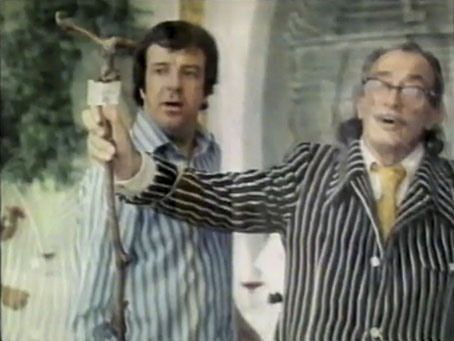
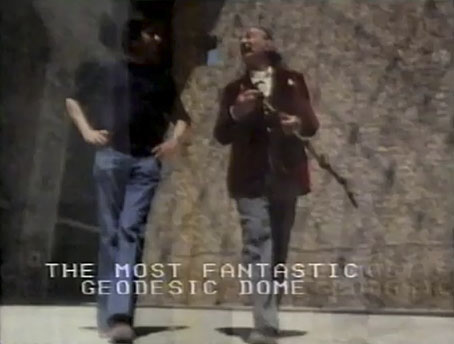
Russell Harty and Salvador Dalí, 1973.

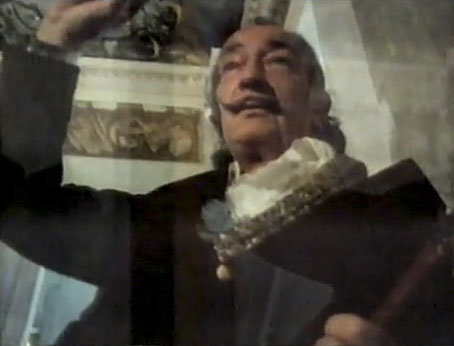
This would have been a real find if the quality wasn’t so poor. Hello Dali! was a 50-minute documentary film about Salvador Dalí broadcast in the UK in 1973 as part of ITV’s Aquarius arts strand. The whole thing is on YouTube chopped into five parts and is unfortunately blighted by severe ghosting throughout. Apart from that it’s perfectly watchable.

hellodali2.jpg

Some conversations are subtitled so viewers are better able to make sense of Dalí’s English/Spanish/French dialect.

Brits who are old enough may remember Aquarius which was replaced in the late 70s by The South Bank Show, a programme using the same format of a short studio introduction followed by a self-contained film. In place of the SBS‘s Melvyn Bragg we have Humphrey Burton introducing a film directed by Bruce Gowers. Russell Harty is the front man, seen here in the days before he achieved greater fame as a gossipy chat-show host. I’d been wanting to see this for a long time, having lost a video tape of it years ago. I never saw the original broadcast but it was screened again after Dalí’s death in 1989, and I remembered it as being particularly good for showing a slightly more human side to the eccentric and occasionally annoying artist. So it is, giving us a brief portrait of Dalí in his 69th year, preoccupied at that time with the construction of his museum in Figueres. The nature of Harty and Gowers coup in getting the artist to allow a film crew into his home can be found in subsequent documentaries many of which use uncredited extracts from these interviews. It’s the brief moments of interview which make this even though they reveal little, it’s refreshing seeing Dalí talking conversationally rather than putting on a performance.

hellodali3.jpg

The early 70s saw the last flare of real interest in Dalí from the world at large. Dalí and Surrealism in general had a resurgence of popularity in the late 60s as a consequence of psychedelic culture: a number of books by or about the artist were published or reprinted, among them Peter Owen’s 1973 revival of the novel Hidden Faces which Dalí had written in 1944. About the same time Alejandro Jodorowsky was circling the Dalí camp trying to inveigle the artist into portraying the Emperor in his planned film adaptation of Dune. One detail worthy of note in the conversation with Russell Harty is mention of a golden toilet, something which Jodorowsky says Dalí wanted as his throne if he was going to be filmed. We never got to see Jodorowsky’s Dune but it’s good to find this documentary available once again. Here’s hoping a better copy turns up eventually.

Hello Dali! Pt 1 | Pt 2 | Pt 3 | Pt 4 | Pt 5

Previously on { feuilleton }
Dalí and the City
Dalí’s Elephant
Dalí in Wonderland
Alejandro Jodorowsky’s Dune
Dirty Dalí
Impressions de la Haute Mongolie revisited
Dalí and Film
Salvador Dalí’s apocalyptic happening
Dalí Atomicus
Impressions de la Haute Mongolie

Weekend links 65

plakhova.jpg

From Light Beyond Sound, a new series of works by Tatiana Plakhova.

“The invasion philosophy of the Olympic Park strikes me as just like the invasion philosophy behind going into Iraq,” he says, “or anywhere else that you blast into, put up the fence, establish the Green Zone, explain everything, put it all into this lovely eco-terminology…” Iain Sinclair

• Iain Sinclair has a new book out, Ghost Milk: Calling Time on the Grand Project, a critique of the tendency of British governments to waste money on white elephant projects. He’s visited this territory before in Sorry Meniscus, the small book/essay about the Millennium Dome. That book grew out of a piece for the London Review of Books which can be read here. Among the current round of interviews there’s this piece in which the title of the book is explained, and a talk with John Walsh at The Independent where he describes how the site for the 2012 Olympics has destroyed his patch of London.

A celebration of the writing and art of Mervyn Peake: “Mervyn Peake, creator of Gormenghast, is now recognised as a brilliant novelist and artist. Michael Moorcock, China Miéville, Hilary Spurling and AL Kennedy celebrate his achievements.”

• Looking like a children’s book invaded by the inhabitants of alchemical engravings, Die Geburtstagsreise (The Birthday Trip, 1976) by Monika Beisner.

• At AnOther mag this week: The ear in Blue Velvet and publisher Peter Owen on Salvador Dalí’s novel Hidden Faces.

Four Days, Four Recordings by Jon Brooks aka The Advisory Circle. Related: The Hauntological Society.

Leaving it to Chance: maverick director Nicolas Roeg on Don’t Look Now.

Brian Eno: “This is my problem with Tracey Emin; who fucking cares?”

• Scans of Max Ernst’s masterwork Une Semaine de Bonté.

Susie Bright: Mapping the Erotic and the Revolutionary.

How to Become a Sensuous Witch, 1971.

The View From Her Room (1982) by Weekend | Weekend live on the OGWT (October, 1982) • Gormenghast Drift (1992) by Irmin Schmidt.