Miró: Theatre of Dreams

miro1.jpg

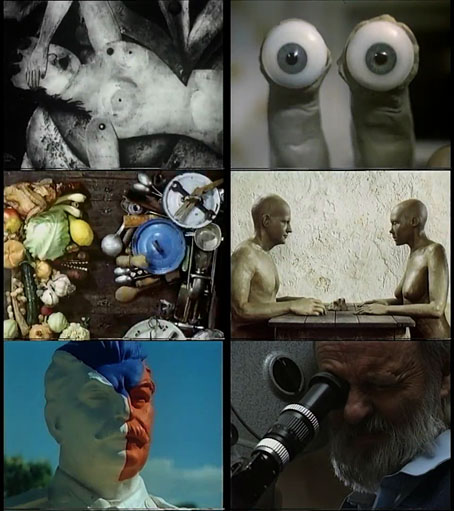
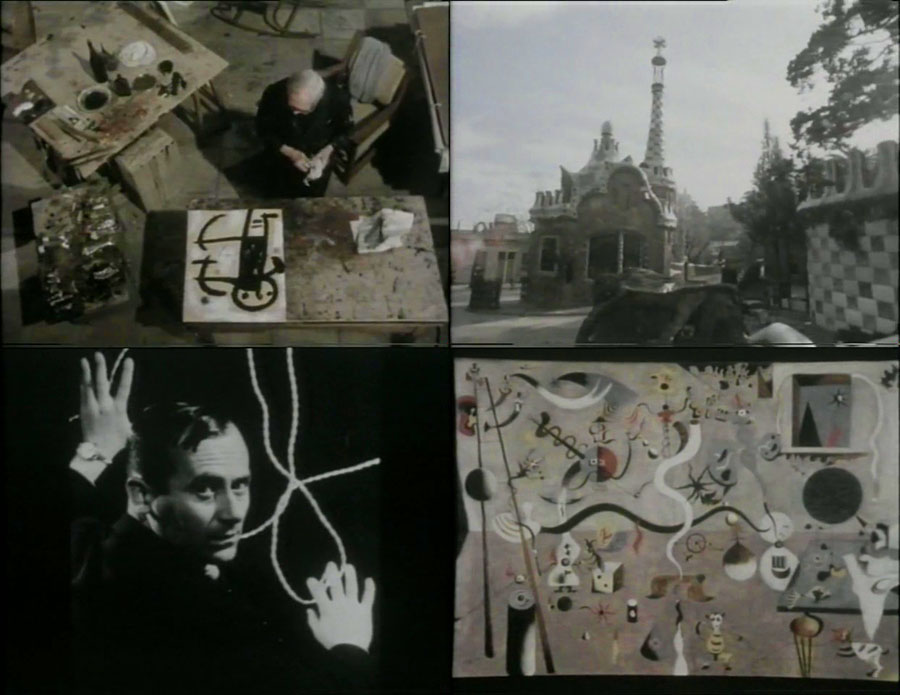
More old TV, and something you might call Portrait of the Artist as an Old Man. Miró: Theatre of Dreams is a documentary about the Spanish (or as he might have preferred, Catalan) artist Joan Miró. This was broadcast by the BBC in 1978, and again in 1984, but it’s one I hadn’t seen until now. Robin Lough’s film was the first television profile of the artist in which Miró talks at length with his British friend, Roland Penrose, an artist and writer who did much to champion Surrealism in its early years. Penrose also narrates the film, describing Miró, who he’d known since the 1930s, as “the last of the great Surrealists”. I can imagine another Catalonian artist, Salvador Dalí, who was still very much alive in 1978, having something to say about this opinion. Between the conversations we see rehearsals for a Miró-designed theatrical performance centred around a monstrous Ubu-like tyrant whose character is part folk-figure, part analogue for Francisco Franco. The latter had only been dead for three years after being in power since the 1930s so performances like these were acts of exorcism as much as entertainment.
miro2.jpg

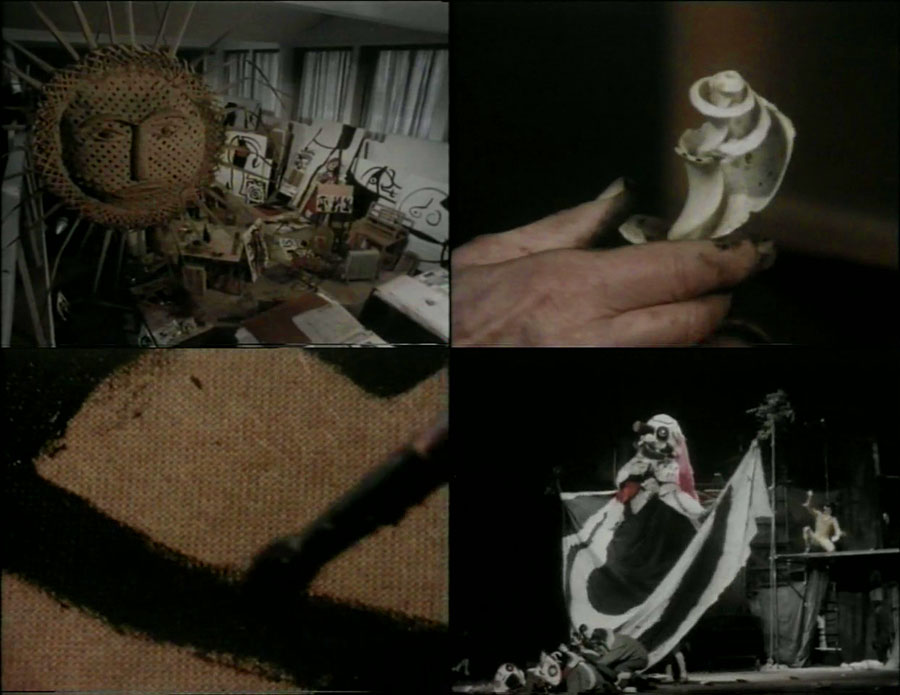
Penrose was a good writer who enjoyed demystifying modern art; I always recommend his book on Picasso as the one to go for if you’re only going to read a single account of Picasso’s life and work. The observations he makes here about Miró’s early love of the amorphous constructions that Antoni Gaudí created for the Parque Güell in Barcelona are reinforced later when Penrose and Miró are examining some of the objects in the artist’s studio. Miró suggests that the spiral form of an eroded seashell might be used as a model for skyscrapers to replace what he calls the matchboxes of New York City, a proposal which doesn’t seem as fanciful today as it did in 1978. We also see Miró painting on the rough side of a sheet of hardboard while enthusing about the textured surface of the material. This is unusual—most artists, if they use hardboard at all, paint on the smooth side—and, for me, a little surprising. There’s no such thing as right or wrong when it comes to art materials, but I’ve painted on the rough side of hardboard on a couple of occasions, and felt guilty about doing so when it always seemed like a cheap and rather crude alternative to using primed canvas. This is the first example I’ve seen of another artist doing the same. That it happens to be Joan Miró makes me feel better about the whole business.

Elsewhere on { feuilleton }
The Surrealism archive

Previously on { feuilleton }
Televisual art
Max Ernst by Peter Schamoni
Leonora Carrington and the House of Fear
The Magic Art of Jan Švankmajer

svankmajer1.jpg

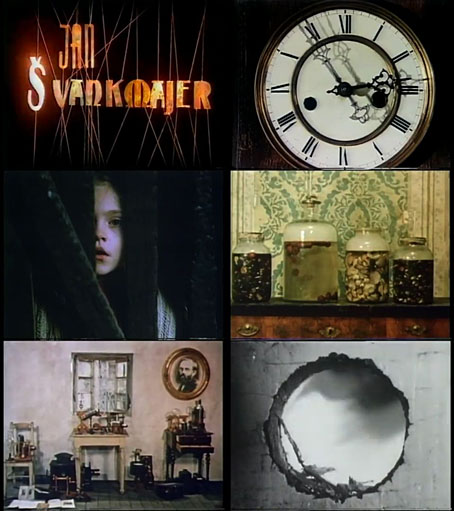
Three years ago I binged on all the Jan Švankmajer feature films after buying the box of blu-rays released by the director’s Athanor company. Once I’d worked my way through that lot, and rewatched the BFI collection of Švankmajer’s short films, I went through all the documentaries I’ve managed to accumulate, including this two-part BBC study which I taped when it was first broadcast in 1992. It’s likely that Švankmajer’s approach to film and to Surrealism no longer requires the kind of introduction that seemed necessary in the 1990s, but for those who do need such a thing this is a good place to start.

svankmajer2.jpg

Ben Fox’s documentary was made to coincide with an exhibition of Švankmajer’s films and artworks being shown at an animation festival in Cardiff. The two installments examine a different aspect of Švankmajer’s cinematic works: “Memories of Mysterious Beings” concerns the films that deal with childhood dreams and fears, while “The Naming of Demons” concentrates on his use of Surrealism as a tool for satire or social critique. In between lengthy extracts from the films the camera prowls around some of the director’s artworks while an actor reads statements Švankmajer has made about his interests and intentions. This last feature isn’t something I enjoy very much, not when the actor’s nasal delivery is so different from Švankmajer’s own voice. It’s a common ploy in documentaries, having someone impersonate an interviewee to avoid using subtitles, but it’s one I find distracting when done like this.

eva.jpg

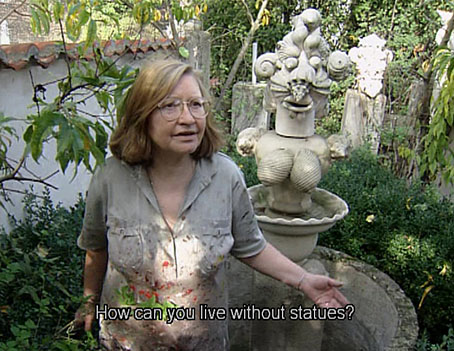
Eva liked statues.

At this point I would have directed your attention once again to Jan Švankmajer, Director, a documentary about Czech cinema which featured the man himself talking at length about his activities in the 1960s, but this has now been removed from YouTube. In its place, however, there’s a more recent upload, Les Chimères des Švankmajer, an 80-minute documentary for French TV by Bertrand Schmitt and Michel Leclerc which is included among the extras on the BFI’s collection of Švankmajer’s short films. The only trouble here is that the YT copy has no subtitles, you’ll need to be a French speaker to understand the voice-overs which run throughout. This is one of the best of all the Švankmajer documentaries since it shows the range of activities conducted by Švankmajer and his late wife, Eva Švankmajerová, as artists and foremost members of the Prague Surrealist Group; film-making, as Švankmajer has often stressed in interviews, was only one outlet for his creativity. (It was also one he was forbidden to practice for several years when the Communist authorities took exception to his work.) In addition to seeing the Švankmajers preparing an exhibition of their creations, Schmidt and Leclerc show us something of their home outside Prague, an artwork in itself that combines the sculpture park and Wunderkammer. Eva Švankmajerová was the creator of many of those sculptures, a celebrated artist in her own right whose contribution to her husband’s films has often been overlooked.

Elsewhere on { feuilleton }
The Surrealism archive

Previously on { feuilleton }
Švankmajer’s cats
Jan Švankmajer: The Animator of Prague
Jan Švankmajer, Director
Don Juan, a film by Jan Švankmajer
The Pendulum, the Pit and Hope
Two sides of Liška

Weekend links 655

brauner.jpg

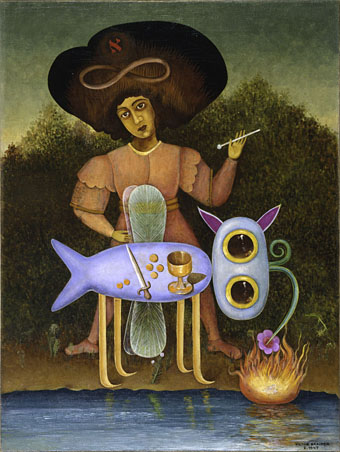
The Surrealist (1947) by Victor Brauner.

• At Dennis Cooper’s: Terry Ratchett presents…18 needlessly obscured avant-garde films by Thomas White, Teinosuke Kinugasa, George Barry, Standish Lauder, Helge Schneider, Dusan Makavejev, Oliver Herrmann, Mauricio Kagel, Mamoru Oshii, Gian Carlo Menotti, Pat O’Neill, Vera Chytilová, Shozin Fukui, Willard Maas, Djouhra Abouda and Alain Bonnamy, Juraj Herz, and Jay Schlossberg-Cohen.

• “When I’m convinced that a certain type of book is completely beyond the capacities of my temperament and my technical skills, I sit down at my desk and start writing it.” Italo Calvino discussing his approach to writing in 1983. The essay, The Written World and the Unwritten World, gives its title to a collection of previously unavailable Calvino pieces translated by Ann Goldstein. John Self reviewed the book.

• New music: Komplett Kollaps (A Dedication To Jóhann Jóhannsson) by Rúnar Magnússon, and Composition 1 by Deathprod.

Brann’s new book sweeps across the vast range of things that hold her interest. It thus invites us to enjoy the life of the mind and to live from our highest selves. A thoughtful encounter with this book will make you, I swear, a better person. The book includes chapters on Thing-Love, the Aztecs, Athens, Jane Austen, Plato, Wisdom, the Idea of the Good. The first half provides an on-ramp to the chapter titled “On Being Interested,” which falls in the dead centre of the book. This central chapter serves as more than a cog in the wheel: it is an ars poetica. Addressing issues of attention, focus, and interest itself, as well as how and where to deploy these functions throughout our lives, “Being Interested” offers a solution for any seeker intrigued by the notion that happiness is not an accident but a vocation. Brann characterizes the pursuit of happiness as “ontological optimism […] to be maintained in the face of reality’s recalcitrance.”

Peggy Ellsberg reviewing The Habit of Interestedness by Eva Brann

• “God told me I should take more LSD.” Sari Soininen on her acid-induced photographs.

• At Public Domain Review: The Procession of the Months by Walter Crane.

• At Smithsonian Magazine: See the chilling beauty of winter on Mars.

• Steven Heller’s font of the month is Edie & Eddy Slab.

• RIP Michael Snow, film-maker and musician.

Kollaps (1981) by Einstürzende Neubauten | Feed The Collapse (1992) by Main | Collapsing Inwards (2014) by Jóhann Jóhannsson

The Midnight Parasites by Yoji Kuri

kuri.jpg

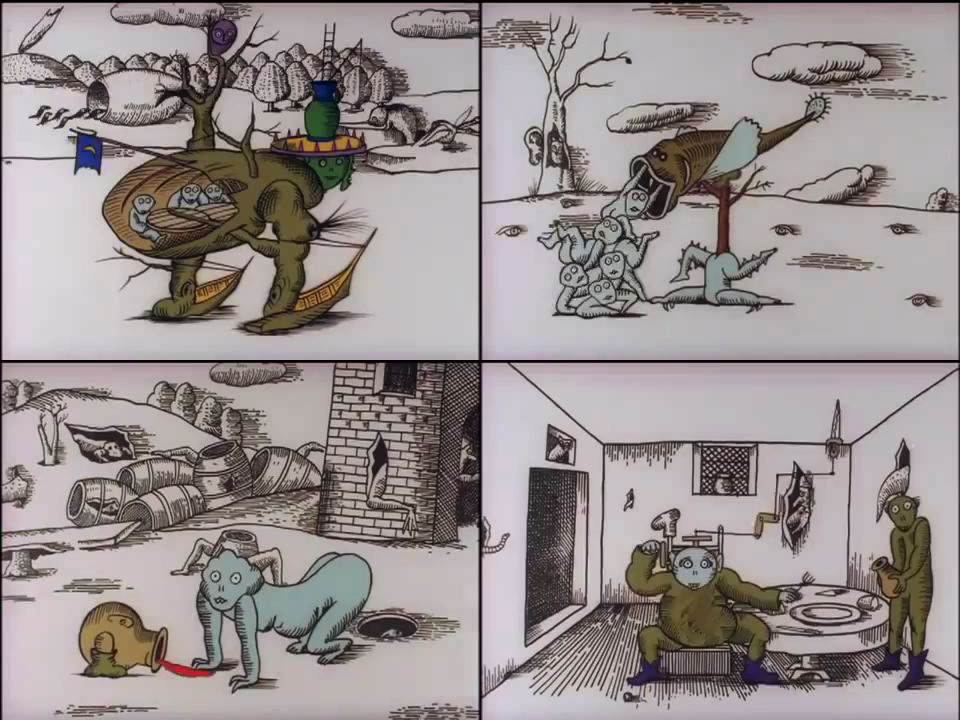
The Midnight Parasites (1972) is a good example of the kind of animation I’m often searching for: strange and grotesque yet with its own internal logic. Yoji Kuri populates a Surrealist landscape with infernal creatures borrowed from Hieronymus Bosch, a succession of humanoids and predatory monsters whose struggles for survival are overlaid with an uncredited electronic score. I can imagine Roland Topor enjoying this one, it belongs in the same solar system as Fantastic Planet. Watch it here.

Elsewhere on { feuilleton }
The Surrealism archive

Previously on { feuilleton }
Bosch details

Fuzz Against Junk & The Hero Maker

rubington1.jpg

This is another of those posts in which I brag about finding an old book in a charity shop for a lot less than you’d have to pay for it online. But it does give me the opportunity to say something about American writer/artist Norman Rubington and his alter ego Akbar Del Piombo, something I was sure I’d done already. One of the weekend posts linked to an article about Rubington’s work but my discussion of his collages is in the essay I wrote about Wilfried Sätty for the Strange Attractor Journal, a piece which isn’t available here.

rubington8.jpg

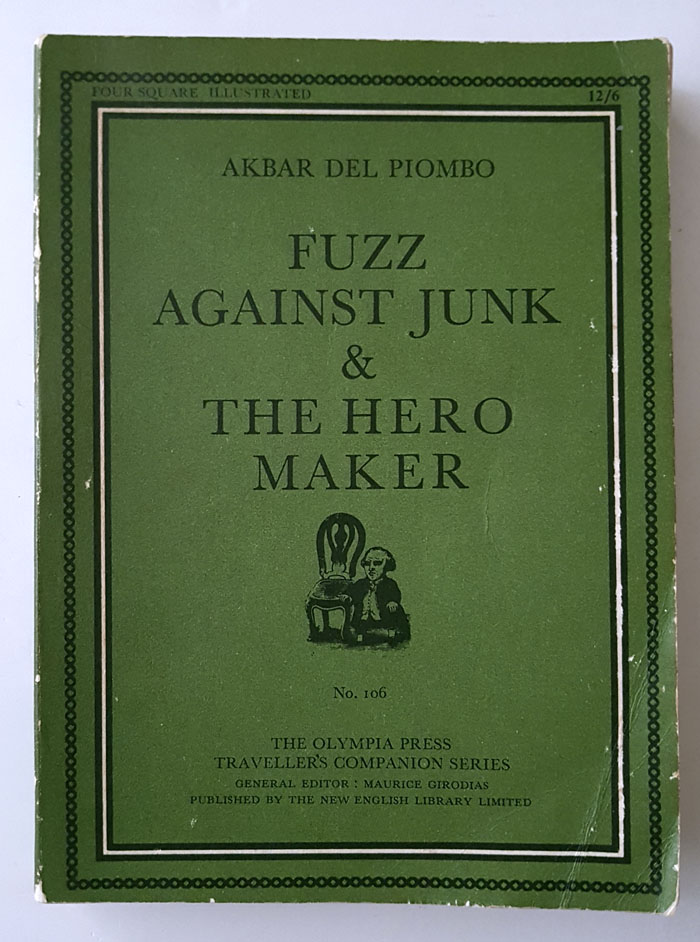
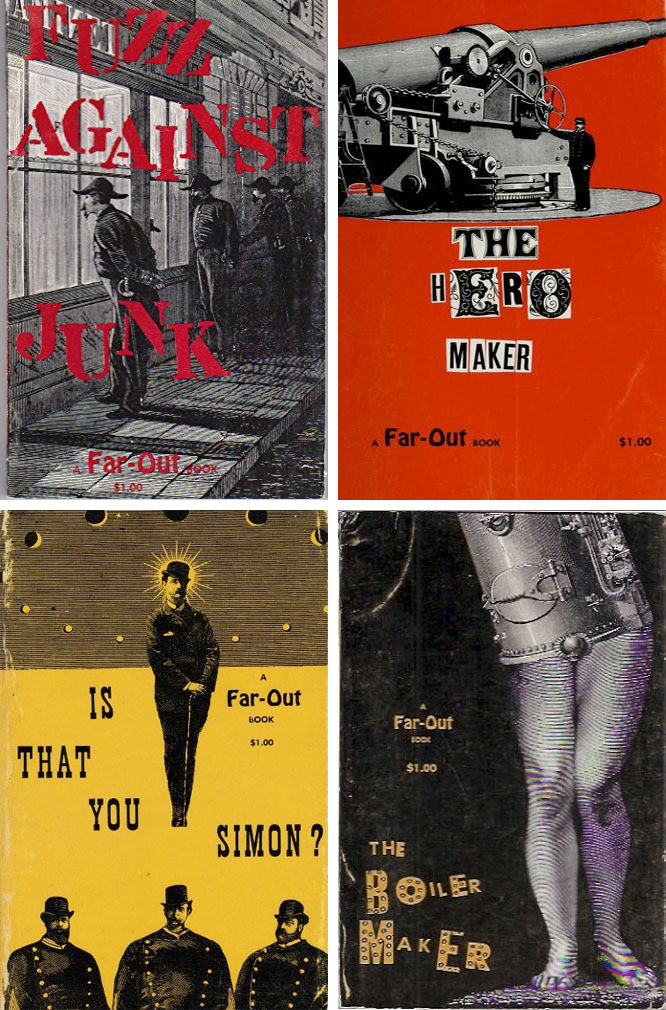
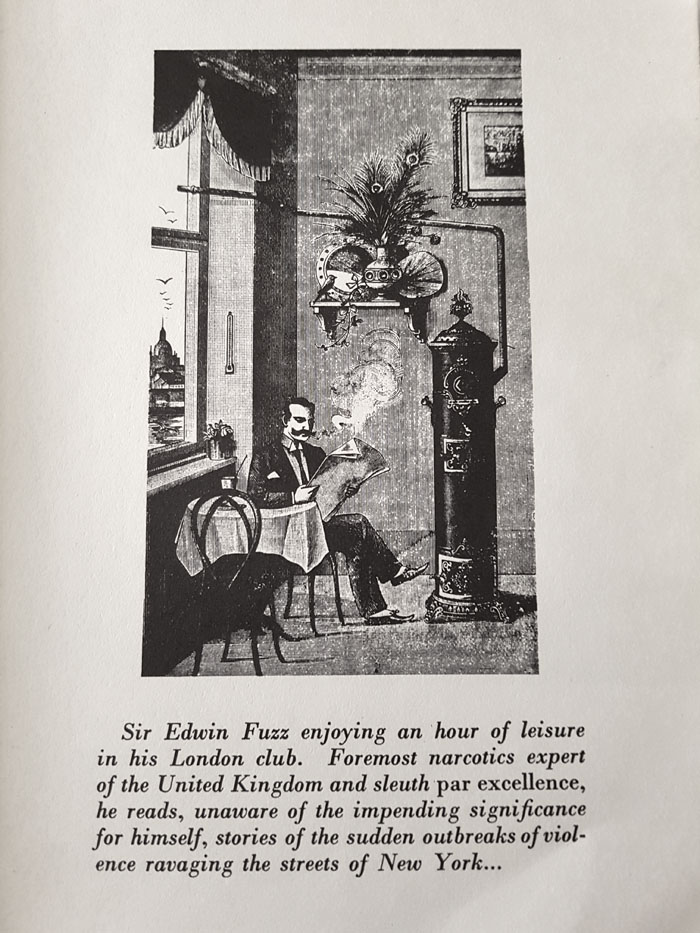
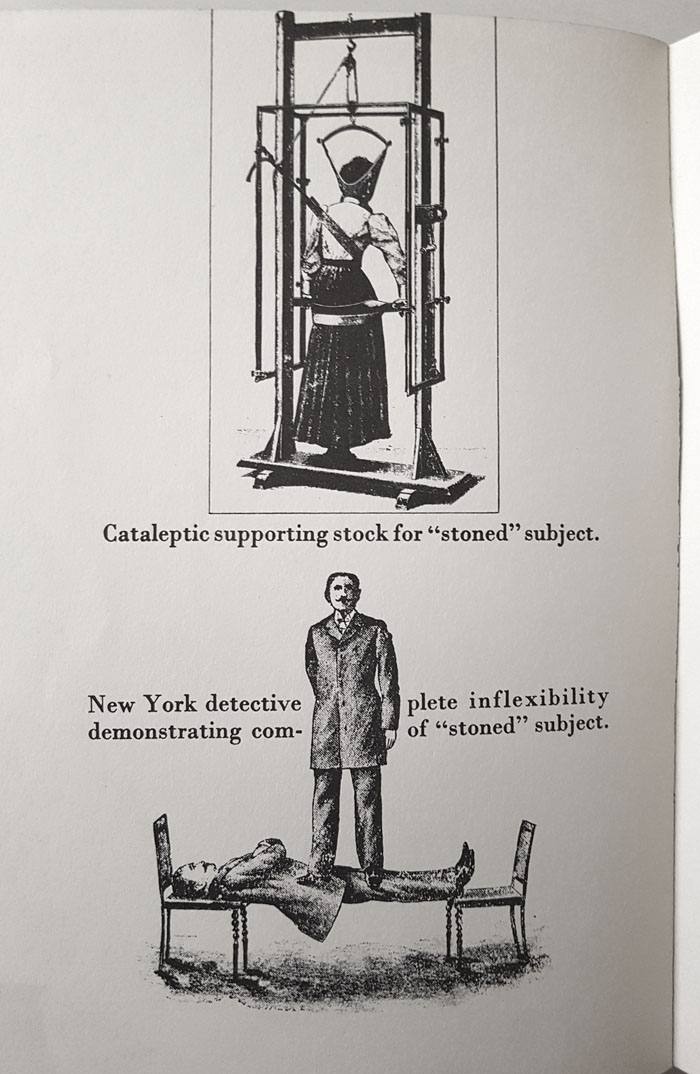
The engraving collages of Norman Rubington (1921–1991) were probably the first to use the form developed by Max Ernst for explicitly humorous purposes. They’re certainly among the earliest to take the lead from Ernst while aiming themselves at an audience outside the art world. There is humour in some of Ernst’s collages, of course, but it tends to be the black variety favoured by the Surrealists (and actually defined by them; André Breton’s 1940 Anthology of Black Humour was a pioneering study). Rubington’s small books exploit the comic potential of antique illustrations by repurposing them as the primary content in a series of absurd narratives; these aren’t “graphic novels”, they’re more like heavily-illustrated comedy routines. There were four books in the original series—Fuzz Against Junk (1959), The Hero Maker (1959), Is That You Simon? (1961) and The Boiler Maker (1961)—with a fifth title, Moonglow, appearing in 1969. Olympia Press published the books in France, with US editions appearing around the same time under the Far-Out imprint used by Citadel Press. My charity purchase is the 1966 New English Library reprint of an Olympia Press collection of the first two volumes. The olive-green Olympia covers always provoke a Pavlovian grab response when I see one on a shelf although I’ve yet to find a copy that wasn’t an NEL reprint.

rubington2.jpg

rubington3.jpg

rubington4.jpg

Continue reading “Fuzz Against Junk & The Hero Maker”