Weekend links 179

tomaselli.jpg

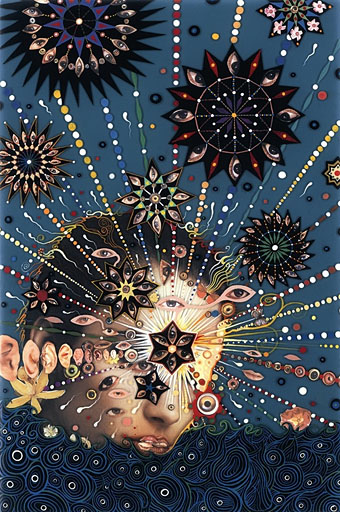
Summer Swell (2007) by Fred Tomaselli. The artist is interviewed at AnOther.

• Mixes of the week for the season of mists and mellow fruitfulness: Forever Autumn Mixtape by The Outer Church, and celebrating what would have been Trish Keenan’s 45th birthday: Trish’s Toys & Techniques Birthday Tape (with cover art by Julian House).

Jirí Kolár: His Life, Work and Cultural Significance to the Czech Republic. Leah Cowan looks into the life and work of this influential Czech artist. Related: Jirí Kolár: poet and collage artist, and collages, rollages and prollages by Jirí Kolár.

• “Name any well-known poet from any age, any country. He or she wrote at least one poem about death, most likely several poems.” Russ Kick introduces his new book, Death Poems.

[M]any pictures in the splendid exhibition at the British Museum show men having sex with men. One of the earliest erotic handscrolls, from the 15th century, shows a Buddhist priest casting longing glances at his young acolyte. Indeed, among some samurai, male love was considered superior to the heterosexual kind. Women were necessary to produce children, but male love was purer, more refined.

The question is why were Japanese – compared not just with Europeans, but other Asians, too – so much more open to depicting sex? One reason might be found in the nature of Japanese religion. The oldest native ritual tradition, Shinto, was, like most ancient cults, a form of nature worship, to do with fertility, mother goddesses, and so forth. This sometimes took the form of worshipping genitals, male as well as female.

Ian Buruma on The joy of art: why Japan embraced sex with a passion. Shunga: Sex and Pleasure in Japanese Art is a forthcoming exhibition at the British Museum.

Harold Offeh on how the cosmic life and music of Sun Ra inspired the artwork decorating the Bethnal Green, Notting Hill Gate and Ladbroke Grove Tube stations in London.

• Fearful symmetry: Roger Penrose’s tiling by Philip Ball. Related: Penrose Tiles Visualizer, and lots more Penrose tiling links at The Geometry Junkyard.

Masculine / Masculine. The Nude Man in Art from 1800 to the Present Day, a new exhibition at the Musée d’Orsay.

• Into the Croation Zone: more derives from Christina Scholz here, here, and here.

Stephen Eskilson on Heteronormative Design Discourse.

Applied Ballardianism

The Zero of the Signified (1980) by Robert Fripp | The League of Gentlemen (Fripp/Lee/Andrews/Toobad, 1981): Minor Man (with Danielle Dax) | Heptaparaparshinokh

Weekend links 176

dlouhy.jpg

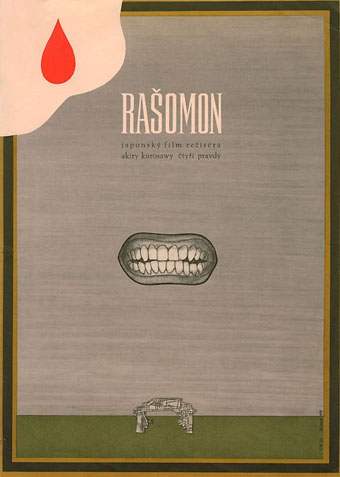
This week PingMag was looking at Czech film posters. This one by Bedrich Dlouhy is for the belated 1970 release of Kurosawa’s Rashomon.

• In October Alison Goldfrapp curates an exhibition for The Lowry, Salford, featuring her favourite art. Examples will include work by Leonora Carrington, Lotte Reiniger and Henry Darger so I’ll definitely be seeing this one. The new Goldfrapp album, Tales of Us, is released this week. Alison Goldfrapp & Lisa Gunning’s film for Annabel is here.

Michael Glover profiles artist Tom Phillips who has a new show of his paintings at the Flowers Gallery, London. The indefatigable Phillips also talked to Tracy McVeigh about his design for the new 50 pence coin which celebrates the centenary of Benjamin Britten.

Get Carter director Mike Hodges remembers re-teaming with Michael Caine for the island-set crime thriller Pulp, and shares a letter that JG Ballard wrote to him in admiration of the film.

Dismantling the surveillance state won’t be easy. Has any country that engaged in mass surveillance of its own citizens voluntarily given up that capability? Has any mass surveillance country avoided becoming totalitarian? Whatever happens, we’re going to be breaking new ground.

Bruce Schneier on how to deal with the total surveillance state.

• Babel/Salvage presents The Midnight Channel, the newest montage of poetry by Evan J. Peterson, inspired by cinema of the horrific, fantastic and bizarre.

• Mixes of the week are from composer Amanda Feery at The Outer Church, and Pinkcourtesyphone (Richard Chartier) at Secret Thirteen.

• At Dangerous Minds: Kimberly J. Bright on the psychedelic poster art of Hapshash and the Coloured Coat. Related: LSD may not be bad for you, says study.

Queer Zines: a 400-page study edited by AA Bronson & Philip Aarons.

• Justin Abraham Linds on The Walt Whitman of gay porn.

• Designs for theatre and print by Oskar Schlemmer.

Beautiful Mars: a Tumblr.

Catleidoscope!

• Goldfrapp: Lovely Head (2000) | Strict Machine (2003) | Caravan Girl (2008)

Prominences

sun0.jpg

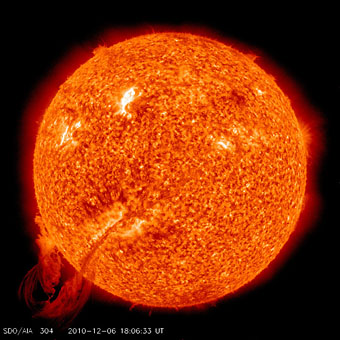
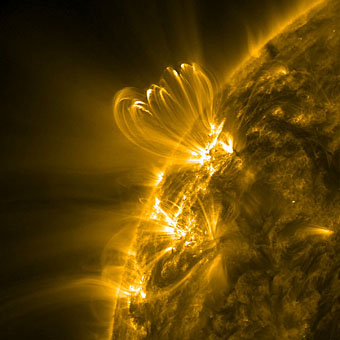
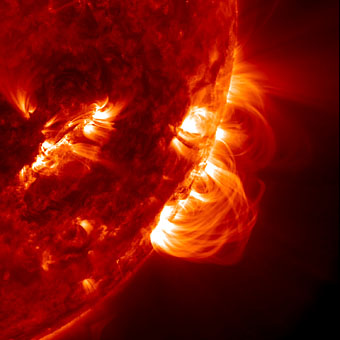
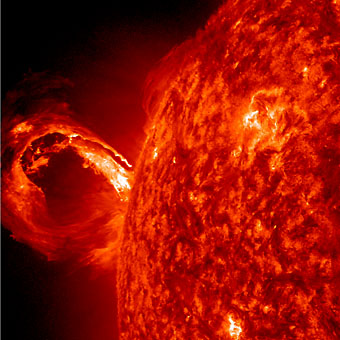
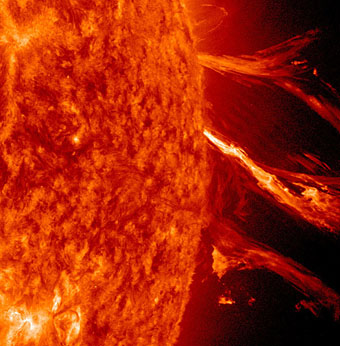
Work-related searches this week has led me to the gallery pages of NASA’s Solar Dynamics Observatory. The SDO is an observational satellite in a geostationary orbit that monitors the Sun with a variety of cameras and other imaging equipment. Some of the recent spectacular photos of solar prominences have been captured by the SDO, examples of which may be found in the project’s gallery where you can also see short movies of solar eruptions and other events. (There’s also an SDO YouTube channel. For a start try “Fiery Looping Rain on the Sun“.) I always find the Sun to be a combination of the incredible, the weird and the terrifying: many of those coronal mass ejections dwarf the Earth. Pictures such as these make you reconsider how much we take our local star for granted.

sun1.jpg

sun2.jpg

sun3.jpg

sun5.jpg

Les Terres du Ciel

lesterres01.jpg

Frederic Thompson’s amusement ride attempted to give exposition visitors in 1901 the experience of a journey to the Moon; Camille Flammarion’s Les Terres du Ciel (1884) is a pictorial voyage around the solar system which includes the Moon among its ports of call. Subtitled Voyage Astronomique sur les Autres Mondes et Description des Conditions Actuelles de la Vie sur les Diverses Planètes du Système Solaire Flammarion’s study presented the science of the time but complemented this with a strange selection of illustrations ranging from serious attempts to show the surface of the other planets together with scenes of outright fantasy. Serious or not, the engraved plates are pretty good. A few of these illustrations turn up in books on the history of astronomy so—once again—I’m pleased to find their source. Flammarion’s book may be browsed here or downloaded here.

lesterres02.jpg

lesterres03.jpg

lesterres04.jpg

Continue reading “Les Terres du Ciel”

Astronomiae Instauratae Mechanica

tycho01.jpg

Let there be no complaints about lack of variety: fetish photography one day, 17th-century astronomical instruments the next. Tycho Brahe’s Astronomiae Instauratae Mechanica (1602) is a description of the astronomical devices used at Brahe’s Stjerneborg (Star Castle) on the island of Ven in Oresund, Denmark. One of the plates below shows the layout of the Star Castle while the others detail various sextants, armillary spheres and the like. A number of these are familiar from their more recent use as book illustrations so it’s good to once again find the source volume.

The concept of an observatory garden is very reminiscent of the Peking Observatory, and the much more impressive structures at Jaipur. Brahe wrote: “My purpose was partly to have placed some of the most important instruments securely and firmly in order that they should not be exposed to the disturbing influence of the wind, and should be easier to use, partly to separate my collaborators when there were several with me at the same time, and have some of them make observations in the castle itself, others in these cellars, in order that they should not get in the way of each other or compare their observations before I wanted this.”

Browse the rest of the book here or download it here. Tip via this tweet which linked to coloured copies of the plates.

tycho02.jpg

tycho03.jpg

tycho04.jpg

tycho06.jpg

Continue reading “Astronomiae Instauratae Mechanica”