On the silver disc

zulawski.jpg

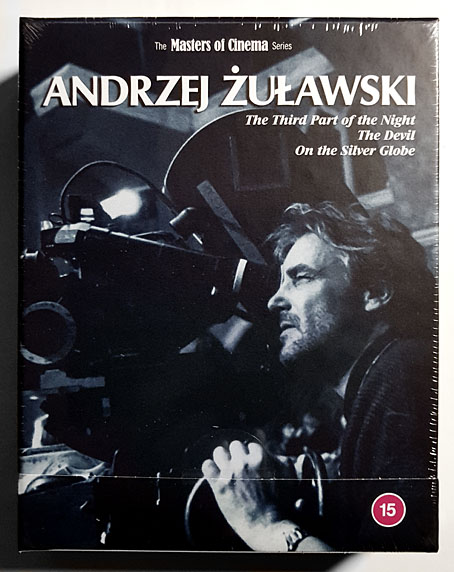
In today’s post…finally. I ordered this at the end of February but production problems delayed the May release so it’s taken this long to make its way into the world. It’s worth the wait, of course, these films have been difficult to see for years, although the recent resurrection of On the Silver Globe has given the film a revitalised existence in bootleg circles. Zulawski’s unfinished science-fiction epic is the main attraction here—most of the substantial extras are devoted to it—but I’m looking forward to seeing The Devil again after only having watched it as a low-grade digital copy.

An uncompromising visionary and a true maverick of European cinema, the Masters of Cinema Series is proud to present three films by Andrzej Zulawski, all making their UK debuts on Blu-ray from definitive restorations.

Rich with multilayered symbolism and apocalyptic imagery, The Third Part of the Night is Zulawski’s highly influential debut feature film. After his whole family is slaughtered during the Nazi-occupation of Poland, Michal (Leszek Teleszynski) decides to join the resistance but descends into madness after encountering a doppelgänger of his murdered wife.

The Devil is a violent tale of Satanic seduction during the Prussian invasion of Poland in the 17th century, which proved so controversial upon release that it was banned for 16 years.

And finally, On the Silver Globe, Zulawski’s masterpiece about a team of astronauts who land on a desolate planet and start a new society. When filming was 80% complete, the Polish government ordered the production to be shut down and all the negatives be destroyed. Miraculously, the original film reels were preserved and ten years later the film was presented at the Cannes Film Festival to great acclaim.

If any of this sounds interesting then I also recommend Zulawski’s fourth feature, Possession. The less said about that one, the better. It’s a wild ride.
Weekend links 686

bickus.jpg

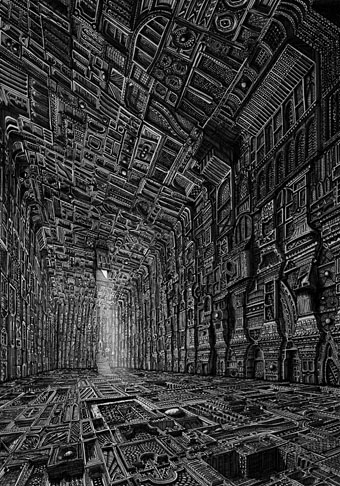
The Great Lab (2020); speculative architecture by Gytis Bickus. “This room is where the majority of the hallucinogenic substances are archived, within the walls & floors. It seems as though the architecture itself is being affected by the hallucinogenic substances stored within its fabric.”

• “They ran the recording through a vocoder, so it sounded staticky, like a voice infused with white noise, and put it at the end of the song. Then they went home.” Mark Dent on Change The Beat by Beside (aka Bee-side or Beeside), a song produced by Bill Laswell & Michael Beinhorn that includes one of the most sampled vocal lines in hip-hop. A great piece of audio-archaeology: I knew the sample but had no idea this song was its source. I only got to hear the Change The Beat very recently when I found a copy of Materialism, a collection of early Laswell productions, in a charity shop.

• At Unquiet Things: Artist, Chemist, Goofball: Catching Up With Tyler Thrasher.

• DJ Food looks at psychedelic posters created for London’s Middle Earth club.

His last commissioned work for Radio Berlin was a fantastical play he had composed himself. The transcript, titled “Lichtenberg: A Cross-Section,” ranks among the strangest things that he ever wrote. Beings who live on the moon are charged with the task of investigating the career of Georg Christoph Lichtenberg, a prominent physicist of the German Enlightenment. The moon beings have uncanny names—Labu, Quikko, Sofanti, and Peka—and they convene as the Moon Committee for Earth Research, which deploys odd contraptions for its work, each of them “easier to use than a coffee grinder.” There is a “Spectrophone,” which permits them to hear and see everything that happens on Earth; a “Parlamonium” that translates human speech into music; and an “Oneiroscope” that allows the researchers to observe human dreams. With the aid of these devices, the moon beings seek to understand why humans are so afflicted with misery. Their investigations finally reach the tentative conclusion that even if humans are unhappy, “perhaps it is their unhappiness that allows them to advance.” To honour the scientific achievements of Herr Lichtenberg, they conclude by naming a crater in his honour, a crater from which shines a “magical light that illumines the millennium.”

Peter E. Gordon on Walter Benjamin’s radio years

• At Dennis Cooper’s: Spotlight on…Brigid Brophy In Transit (1968).

15 lighthouses from the Smithsonian Magazine Photo Contest.

Sathnam Sanghera’s favourite songs.

• RIP William Friedkin and Jamie Reid.

• New music: The Long Song by Drøne.

Lighthouse (1978) by Tim Blake | Walk To The Lighthouse (1980) by John Carpenter | The Lighthouse (1994) by Hector Zazou ft. Siouxsie

Expositiana

expo09.jpg

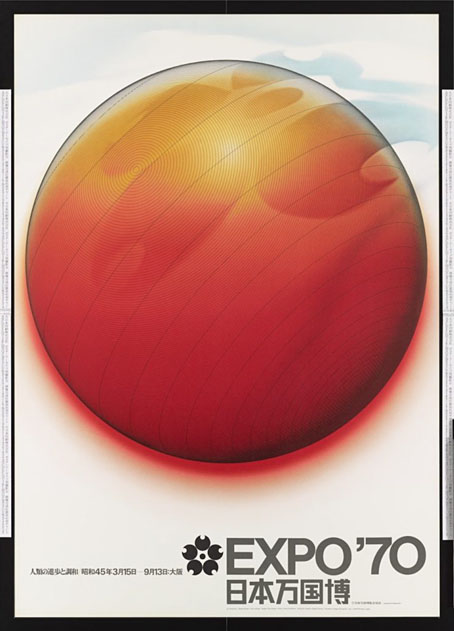
Poster design by Eiko Ishioka.

After writing about Expo 2000 I went looking for films of some of the other world expositions. In previous posts I’d managed to exhaust the Paris Exposition Universelle of 1900 as a subject but never really followed up on my intention to explore the 20th-century events. The 1900 exposition was the first for which a quantity of film footage exists; it was also the one where motion pictures were presented as a new invention among others, like electric light, that would dominate the coming century. The ephemerality of these big events is part of their fascination, and a reason to look for films that document them. Expositions are like temporary theme parks, where the emphasis, since 1939 at least, has tended towards the way things might look in the future. Architects and designers aren’t exactly given free reign at an exposition but they’re also not having to tailor their designs to the requirements of urban planning committees. The events provide a concentrated dose of futurity for a short time in a small geographical space. It ought to be noted that “world exposition” has a specific meaning (see this list), referring to large, general events which run for six months or more. Smaller expositions devoted to single subjects also exist, although “small” here is relative, these can still be sizeable affairs.

Most of the footage that follows is from American expositions. Americans seem to prefer the term “World’s Fair”, although not exclusively—there was a Brussels World’s Fair—and not consistently: the Seattle event in 1962 was the Century 21 Exposition. There’s a lot more footage out there, of course, but I was looking for official films and documentaries rather than home movies.


The New York World’s Fair, 1939

expo01.jpg

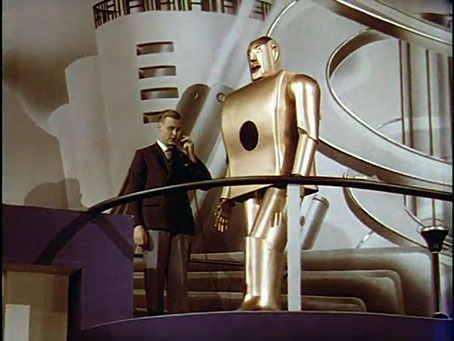
The Middleton Family at the New York World’s Fair

This drama illustrates the contribution of free enterprise, technology, and Westinghouse products to the American way of life. The Middleton Family at the New York World’s Fair pits an anti-capitalist bohemian artist boyfriend against an all-American electrical engineer who believes in improving society by working through corporations. The Middletons experience Westinghouse’s technological marvels at the Fair and win back their daughter from her leftist boyfriend.

Memorable moments: the dishwashing contest between Mrs. Modern and Mrs. Drudge; Electro, the smoking robot; and the Westinghouse time capsule.

Too much drama in this one, and not enough expo, but the 1939 world’s fair is where the preoccupation with the future begins. The Middletons were a promotional device, also seen in newspaper and magazine ads. This is the world’s fair that gave us the word “Futurama”. A shame, then, that Electro, the cigarette-smoking robot, doesn’t tell the All-American Family to bite his shiny metal ass.

expo05.jpg

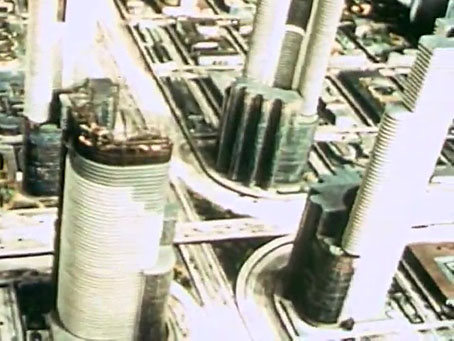
To New Horizons
The Hugh Ferriss view of the future (sponsored by General Motors), all skyscrapers and superhighways. Pedestrians? What are they?


The Brussels World’s Fair, 1958

expo04.jpg

L’Expo 58, il y a un an
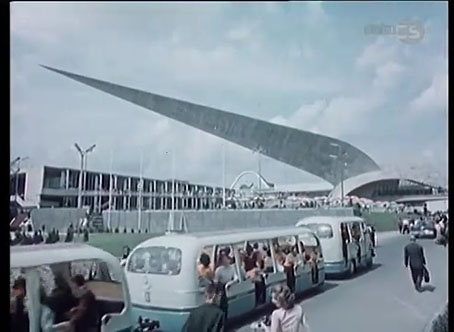
A retrospective view of the Brussels event in murky monochrome. The Czech film below is better value although the second half is mostly concerned with the Czech pavilion.

expo08.jpg

Ceskoslovensky pavilon – Expo 58


The Century 21 Exposition, 1962

expo03.jpg

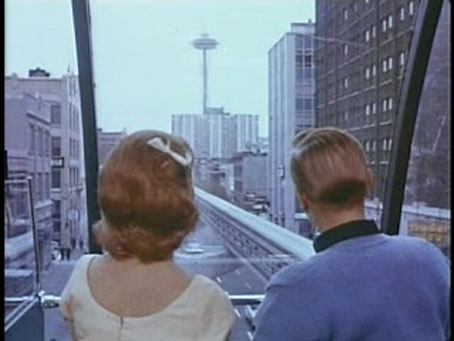
• Century 21 Calling
A trip to the Seattle exposition in which our guides are a hyperactive teen couple who look like the squares from Hairspray after they’ve been dosed with bop pills. For a generation of Brits “Century 21” will always mean Gerry Anderson’s Space-Age imagination.

Continue reading “Expositiana”

Weekend links 685

katoh.jpg

Art by Naoyuki Katoh, 1982.

• RIP Paul Reubens. Here’s Steven Heller on Pee-wee Herman and his clinically hyperactive playhouse (not forgetting Gary Panter’s involvement); Bruce Handy on Paul Reubens’ preposterous grace; and David Hudson on Paul Reubens before and after Pee-wee.

Three Thousand (2017), a short film by Asinnajaq in which “a riveting collage portrays a century of Inuit history, and envisions a vibrant future”.

• New music: Velocity Of Water by Suki Sou; The Blue Beyond by Jana Winderen; and Jäi mieleen by Aki Yli-Salomäki.

DJ Food posted a handful of psychedelic LP sleeves for non-psychedelic artists. There’s a lot more to be found.

• “We had no rules. Song structure didn’t exist. It was nihilistic.” It’s Bush Tetras again.

• “Infrared light reveals hidden portrait beneath 1943 René Magritte painting.”

• At Dennis Cooper’s: Gakuryu Ishii Day.

Tequila (1958) by The Champs | Tequila (1958) by Perez Prado | Tequila (1972) by Hot Butter

Biblio-hauntology

hauntology.jpg

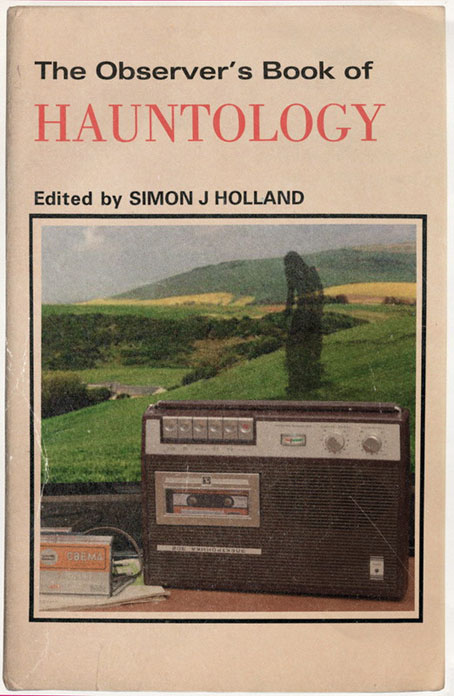
An invented book cover from the latest post at blissblog. Since I like fakes of this nature, especially when they’re carefully done, I had to go in search of the creator. Rachel Laine is the person responsible, and there’s more along these lines at her Flickr pages, together with many similar items from the universe next door. (I know someone who’ll appreciate all those faded magazine covers combining soft-porn photos with headlines for stories about analogue synths.) Another of the book covers is a guide to “Witches and Witch Craft”, a title whose real-life counterparts included books such as the Hamlyn guide to witchcraft and black magic from 1971. As I’m often saying, the 1970s was the witchiest decade of the 20th century.

uncanny.jpg

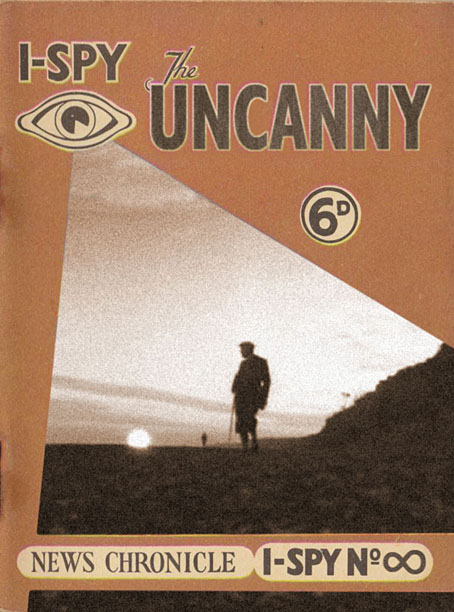
All of which reminded me of a couple of recent inventions of my own. One of the advantages of writing here is that I can retrieve from obscurity some of the things I’d previously cast into the Malebolge formerly known as Twitter. This impromptu creation is something I threw together after Callum J posted the cover of an old I-Spy book dedicated to “The Unusual”. (If you don’t know what the I-Spy books were—and still are—Wikipedia has the history.) The screen-grab from Whistle and I’ll Come to You is a lazy choice but I wanted to surprise Callum by reworking his cover as quickly as possible.

quatermass-stamps.jpg

A little more considered is this proposal for a set of British postage stamps dedicated to Nigel Kneale and his works. This one came about after a comment from Kim Newman that such a thing was overdue from the Royal Mail. Since I agreed I thought I could at least fake them into existence. They’re still a little incomplete—actual stamps would have a mention of Kneale on each one—but they look plausible. The artwork was swiped from a series of Quatermass book covers created by the prolific Karel Thole for Mondadori in the late 1970s. The images for the first Quatermass and Quatermass and the Pit work very well, I think, the fourth one less so. If I was doing these myself I’d try some combination of a radio telescope and a stone circle. Windows into another world; in the universe next door Quatermass is bigger than Star Wars. But we live here, not there.

Previously on { feuilleton }
Disciples of the Scorpion
Ghost Box and The Infinity Box
Llewellyn occult magazine and book catalogue, 1971
Typefaces of the occult revival
The Book of the Lost
Books Borges never wrote
Forbidden volumes