The coming of the dust

sydney1.jpg

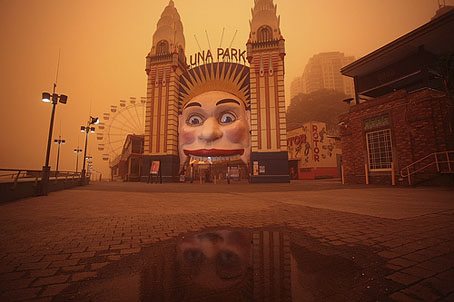
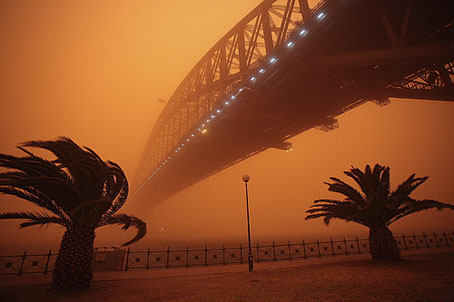
Impossible to avoid thoughts of either JG Ballard or various apocalyptic horror and science fiction scenarios when looking at these photos of Sydney, Australia, taken a few hours ago. A cloud of red dust passed over the city in the early morning and the depopulated views only add to the eerie atmosphere. These are from a Red Dust Flickr gallery. The Other Andrew writes about the inundation on his blog. I’m looking forward now to the reaction of another Sydney Melbourne resident, Simon Sellars, who runs Ballardian.

Update: The Red Sydney Project—Dust Storm Days

sydney2.jpg

Previously on { feuilleton }
Apocalypse now

Alejandro Jodorowsky’s Dune

dune1.jpg

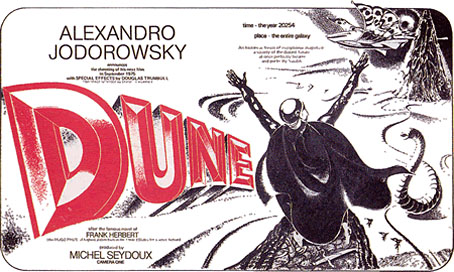
Fortunate Londoners can get to see a new exhibition, Alejandro Jodorowsky’s ‘Dune’: An exhibition of a film of a book that never was, which runs at The Drawing Room until October 25, 2009. As well as production designs from concept artists Moebius, HR Giger and Chris Foss, there’s newly commissioned work by artists Steven Claydon, Matthew Day Jackson and Vidya Gastaldon.

Jodorowsky’s proposed 1976 adaptation of the Frank Herbert novel is now the stuff of legend, and it’s possible that his outrageously ambitious plans are more fun to dream about than they would have been on the screen. But it remains a tantalising prospect that Jodorowsky might well have pulled off a science fiction equivalent of Fellini’s Satyricon. Either way, along with Stanley Kubrick’s unmade Napoleon, it’s one of the great lost films of the 1970s.

Among Jodorowsky’s proposed cast were Orson Welles, Mick Jagger and Salvador Dali, the last of whom was to play the Emperor of the Universe, who ruled from a golden toilet-cum-throne in the shape of two intertwined dolphins. Unable to secure the money from Hollywood to create the ‘Dune’ of his imagination, Jodorowsky abandoned the film before a single frame was shot. All that survives of this project is Jodorowsky’s extensive notes, and the production drawings of Moebius, Giger and Foss. These reveal a potential future for sci-fi movie making that eschewed the conservative, technology-based approach of American filmmakers in favour of something closer to a metaphysical fever-dream.
dune2.jpg

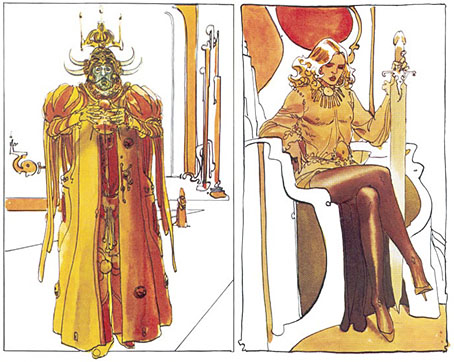
left: Emperor Shaddam IV; right: Feyd Rautha.

Moebius’s designs are wildly different from those used in David Lynch’s 1984 adaptation (which I like nonetheless). His sketch of the Emperor on the left gives some idea of how Salvador Dalí might have appeared in the film, while the figure on the right is Baron Harkonnen’s effete nephew, Feyd, a far more radical conception than the grinning fool played by Sting in the Lynch version. There’s a lot more of Moebius’s sketches at the excellent Dune.info site.

Previously on { feuilleton }
Dalí and Film
Jodorowsky on DVD

Echoes of the Cities

echo1.jpg

Mysterieux retour du Capitaine Nemo.

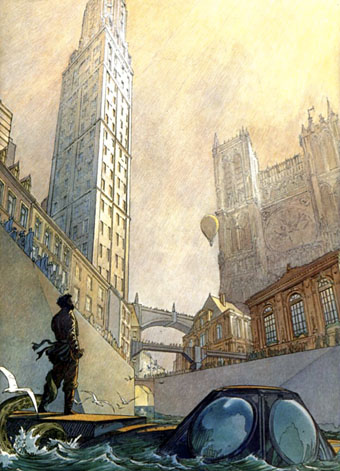
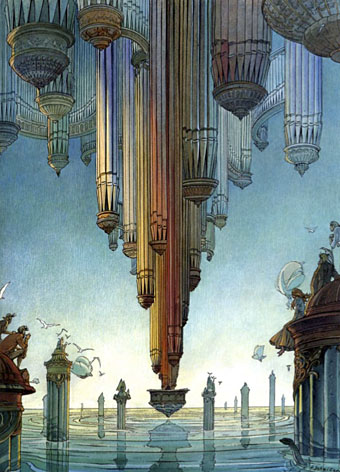
This week has been incredibly hectic work-wise but I’ve managed to keep these posts going, so here’s the last one devoted to an appreciation of the Cités Obscures of François Schuiten and Benoît Peeters. A week of posts barely scratches the surface of their vast and involved creation of alternate worlds, fantasy design and architecture, and Borges-like metaphysical speculation. When I try to explain my disaffection with the popular end of American comics, it’s works such as these which I offer as an alternative. The problem, of course, is that only a handful of the books have been translated into English, a detail which tells you all you need to know about English-speaking comics publishers and—since demand fuels the market—their readers.

This final set of pictures is a selection from Schuiten and Peeters’ L’Echo des Cités (1993), a facsimile edition of the main newspaper which serves the cities of the Obscure World. Unfortunately, this remains untranslated but the bulk of the book is full-page illustrations, many of which are among Schuiten’s best. A number of these were later reprinted as limited lithograph prints.

echo2.jpg

Les rêves engloutis d’Oscar Frobelius.

Continue reading “Echoes of the Cities”

Further tales from the Obscure World

penchee1.jpg

L’enfant penchée.

We’re at the penultimate post in this week-long tribute to the Cités Obscures series of François Schuiten and Benoît Peeters, and there isn’t enough space left to cover some of the more recent volumes in detail. What follows is a quick skate through three more major works.

penchee2.jpg

L’enfant penchée.

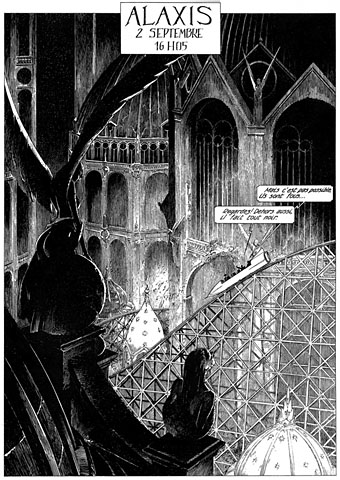
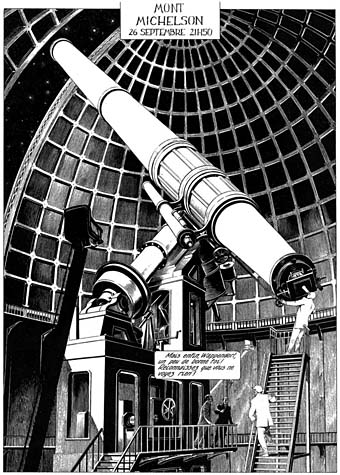
L’enfant penchée (1996), or The Leaning Child, is an expanded version of a 1995 children’s story by Schuiten and Peeters, Mary la penchée. Mary is the young daughter of wealthy industrialists from Mylos struck down one day by some cosmic calamity which shifts her centre of gravity, causing her to permanently lean at an apparently impossible angle. When she’s bullied at school she runs away and joins a circus. A meeting with scientists and astronomers leads to a resolving of her affliction, and the repairing of her ruined life. This is a fascinating story for a number of reasons, not least the existence of a parallel narrative taking place in our world which is conveyed using photographs, and which unveils some of the metaphysical aspects of the Obscure World. The story of Mary is also flawlessly drawn. Schuiten uses a black-and-white style modelled on the work of old magazine illustrators like Franklin Booth, and there are further references to Winsor McCay and Jules Verne.

Continue reading “Further tales from the Obscure World”