The écorché saint

bartholomew1.jpg

An addendum to the previous post after Daniel in the comments reminded me of Saint Bartholomew who is often depicted in paintings and sculptures carrying his flayed skin. Having suffered considerable torture, Bartholomew spends eternity as the patron saint of tanners and leatherworkers. This sounds like a cruel joke on the part of medieval martyrologists but the history of the Christian church contains many such ironies, along with some equally surprising imagery. The luckier saints, like Lucy and Agatha of Sicily, are shown in paintings with their gouged eyes and lopped breasts restored in Heaven, the original (miraculously unbloody) articles being proffered to the viewer on plates; Peter of Verona, meanwhile, offers benedictions to the faithful with the hatchet that killed him still protruding from his head. The sculpture of Bartholomew by Marco d’Agrate in Milan Cathedral dates from 1562, and is more écorché than saint, a marvellous exercise in anatomical fidelity that just happens to double as a religious icon.

bartholomew2.jpg

Previously on { feuilleton }
Écorché
Cephalophores

Weekend links 514

kircher.jpg

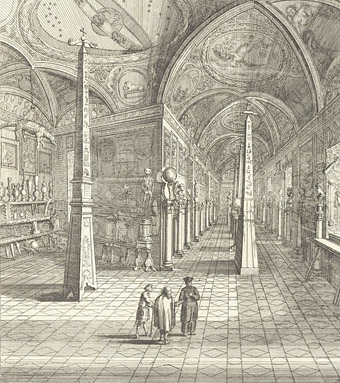
Athanasius Kircher welcoming two guests to the Collegio Romano, a detail from the frontispiece to his Romani Collegii Societatis Jesu Musaeum celeberrimum (1678).

Opium (1919) by Robert Reinert: “A Chinese opium dealer takes revenge on Westerners who have corrupted his wife.” With Werner Krauss and Conrad Veidt a year before their pairing in The Cabinet of Doctor Caligari.

Aubrey Beardsley at Tate Britain: in which the gallery thinks that 7 minutes is enough to give us a taste of a major exhibition that we can’t otherwise see.

Joe Pulver (RIP): His Highness in Yellow. A memorial piece that includes artist Michael Hutter talking about his paintings of Carcosa.

Court Mann on the strange history of Robert Smithson’s Spiral Jetty, 50 years old this month.

• “Invisible Little Worms”: Athanasius Kircher’s Study of the Plague by John Glassie.

Sophie Monks Kaufman on why literary lesbians are having a moment on screen.

• Photographer Ryan McGinley: “I was taught to believe in Satan. It scared me.”

• At Dennis Cooper’s: Ellen Burstyn Day, and the ghostly novels of WG Sebald.

Dorian Lynskey on where to start with Nina Simone’s back catalogue.

• Wie funktioniert ein Synthesizer? (1972). Bruno Spoerri explains.

• Banham avec Ballard: On style and violence by Mark Dorrian.

John Boardley on the most dangerous book in the world.

Improvisation for Sonic Cure by Ryuichi Sakamoto.

• The Strange World of…JG Thirlwell.

Diet Of Worms (1979) by This Heat | Stomach Worm (1992) by Stereolab | Heartworms (1998) by Coil

Weekend links 485

jansson.jpg

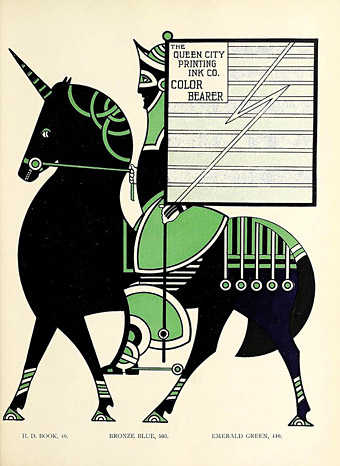
Art by Augustus Jansson for the Queen City Printing Ink Company (c.1906).

• Much of my music listening for the past couple of weeks has been the compositions and soundtracks of the late Jóhann Jóhannsson, so these links are pertinent: Jóhannsson and ensemble live at KEXP in 2010, and a memorial performance of Virdulegu Forsetar from last year.

• “[Her] approach to making electronic music was hard work, too, but it was less about controlling sounds and more about surrendering to them.” Geeta Dayal on Éliane Radigue whose Chry-Ptus has been reisssued by Important Records.

• Safe From Harm: Tim Murray on how Coil helped AIDS awareness on VHS. The video in question, The Gay Man’s Guide to Safer Sex, may be viewed at the Internet Archive.

• In the LRB podcast Ian Penman and Jennifer Hodgson discuss Penman’s new collection of essays, It Gets Me Home, This Curving Track.

• “A land of fog and emotional nightmares.” Oliver Wainwright on why Britain booted out the Bauhaus.

• Mapping Scotland’s Grim History of Witch-Hunting by Feargus O’Sullivan.

• Long-Haired Stars & the End of the World: John Boardley on comets.

My Will by Minimal Compact, a new version of an old song.

• La Danse Des Comètes (1970) by Nino Nardini | Kohoutek-Kometenmelodie 1 & 2 (1973) by Kraftwerk | Cometary Wailing (Valley Plateau) (1981) by Bernard Xolotl

Weekend links 482

pacheco.jpg

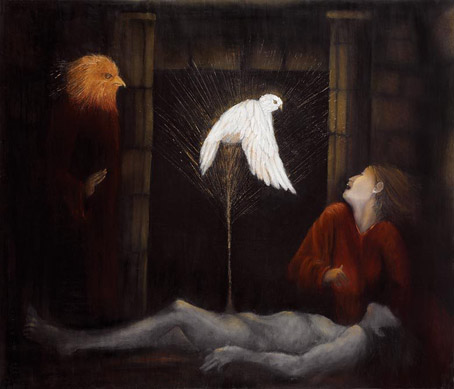
Hades II (2004) by Ana Maria Pacheco.

• I’ve been reading a lot of Angela Carter over the past few weeks so the news of her house in Clapham being awarded a blue plaque was coincidental but also timely. Related: Angela Carter Online, and The Holy Family Album (1991), “a sacrilegious take on the history of Christian painting and iconography” written and narrated by Carter. Also, we’re still some distance from Halloween but take this as a precursor: Vampirella (1976), Angela Carter’s first radio play for the BBC, starring Anna Massey as a vampire countess.

• In May this year the Dark Entries record label announced the discovery of more tapes from Patrick Cowley’s pre-disco years in the 1970s. A selection from the archive, Mechanical Fantasy Box, will be released next month, together with a book of the same name reprinting Cowley’s homoerotic journal from the period.

• More Magma (there’s always more Magma): Warren Hatter on 7 essential albums from their sprawling discography. Related: Magma on film in 1972, appearing in Moi y’en a vouloir des sous, a short but typically intense performance.

• Out in November: Paul Wegener’s adaptation of Gustav Meyrink, Der Golem, wie er in die Welt kam (1920), receives a substantial blu-ray release from Eureka.

• Joe Banks’ forthcoming space-rock exegesis, Hawkwind: Days of the Underground, now has its own website.

• Mix of the week: The Stations Of Summer by Cafe Kaput.

Photos of London’s abandoned Underground stations.

• At Dennis Cooper’s: Alan Boyce grows invisible.

Gudrun Gut‘s favourite albums.

Tanz Der Vampire (1969) by The Vampires Of Dartmoore | Ketch Vampire (1976) by Devon Irons | Vampires (1999) by Pet Shop Boys

Weekend links 447

exercise.jpg

Physical Training for Business Men (1917).

• At Expanding Mind: Erik Davis concludes his discussion with religious scholar Diana Pasulka about anomalous cognition, 2001 monoliths, disclosure, future truths, absurd Christianity, and her book American Cosmic.

• This year the LRB wouldn’t let non-subscribers read Alan Bennett’s 2018 diary but they have a recording of Bennett reading entries here.

• “Glen thought it was very good PR for us to be heavily involved in the druids.” Tom Pinnock talks to the Third Ear Band.

• Rebecca Fasman on the forgotten legacy of gay photographer George Platt Lynes.

• Laura Leavitt on John Cleves Symmes Jr.‘s obsession with a hollow Earth.

• David Parkinson recommends 12 essential Laurel and Hardy films.

• Paul Grimstad on the beautiful mind-bending of Stanisław Lem.

• Mix of the week: Secret Thirteen Mix 277 by Sigillum S.

• The endlessly photogenic Chrysler Building.

Energy Flow by Ryuichi Sakamoto.

195 Gigapixel Shanghai

Solaris: Ocean (1972) by Edward Artemyev | The Sea Named Solaris (1977) by Isao Tomita | Simulacra II (2011) by Ben Frost & Daníel Bjarnason