Weekend links 813

bruenchenhein.jpg

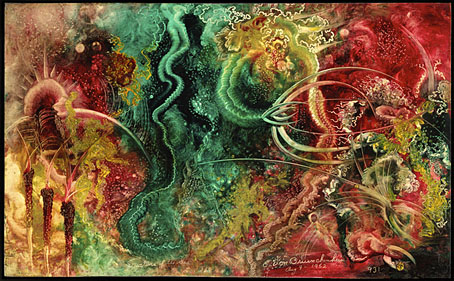
Dwellers of the Sea (1962) by Eugene Von Bruenchenhein.

• Among the new titles at Standard Ebooks, the home of free, high-quality, public-domain texts: Conan Stories by Robert E. Howard.

• At Colossal: “Uncanny personalities appear from nature in Malene Hartmann Rasmussen’s ceramics.”

• New music: Glory Black by Sunn O))); Through Lands Of Ghosts by Foster Neville; Sirenoscape by NIMF.

If we insist that art functions as a tool for promoting a limited set of political principles, what happens when an ideology that doesn’t share our values sweeps into power? Learning to engage with complexity is a necessary skill if we are ever to drag ourselves out of the puerile swamp of the culture wars. But if we continue to reduce art to moralistic soundbites, we will only succeed in stripping it of its capacity to transform us, which would be a huge loss. Art can help us to better understand ourselves, and the world we live in, by expressing those things that words cannot. It exposes us to a vast range of experiences, and asks us to sit with the fundamental ambivalences, moral complexities and conflicting emotions that are a part and parcel of being human.

Rosanna McLaughlin on attempts to make art of the past reflect the moral platitudes of the present

Strange Attractor is having a winter sale with 30% off all its available titles.

• At the BFI: Miriam Balanescu selects 10 great filmmaker biopics.

• Mix of the week: DreamScenes – January 2026 at Ambientblog.

• The Strange World of…Free Jazz & Improvised Music.

Free (1991) by Mazzy Star | The Free Design (1999) by Stereolab | Everything Is Free (2001) by Gillian Welch

Weekend links 808

kometen.jpg

Comets from Meyers Konversationslexikon (1885–90).

• At The Daily Heller: Steven Heller reviews A Life in Ink, a new monograph about the art of Ralph Steadman. Heller is full of praise for Steadman, and discusses commissioning his work for The New York Times. But in his bewilderment at Steadman’s lack of a knighthood he seems unaware of the degree to which state honours are frequently refused by Britons, especially those who position themselves in opposition to the established order. Americans are obsessed with awards and “halls of fame”, and appear to regard Britain’s state honours as something like the Oscars with a royal seal, rather than what JG Ballard once described as “a Ruritanian charade that helps to prop up the top-heavy monarchy.” If Steadman has deliberately shunned the honours list he’d be joining a venerable company.

• “In mid-19th century Italy, two eccentric aristocrats set forth on parallel projects: constructing ostentatious castles in a Moorish Revival style. Iván Moure Pazos tours the psychedelic chambers of Rochetta Mattei, optimised for electrohomeopathic healing, and Castello di Sammezzano, an immersive, orientalist fever dream.”

• New music: Ithaqua by Cryo Chamber Collaboration is this year’s installment in the Lovecraft-themed album series (previously) from Cryo Chamber. Also this week: Analog 2025 by Various Artists; and Flux (music for a performance by still still / Marta & Kim) by Rutger Zuydervelt and Lucija Gregov.

For all their bravura and maximalism, Powell and Pressburger understood the power of leaving things out, building into their films chasms that the mind must leap, gaps that the imagination must fill. Like Joan Webster, we discover that we don’t want things to be made too easy. We want to catch our own fish rather than have them delivered, to swim in the ocean rather than in a pool.

Imogen Sara Smith on I Know Where I’m Going, one of the films from Michael Powell and Emeric Pressburger’s golden decade, the 1940s

• Among the new titles at Standard Ebooks, the home of free, high-quality, public-domain texts: In the Days of the Comet by HG Wells.

• At the BFI: David Parkinson selects 10 great Sherlock Holmes films and TV adaptations.

• Winning entries for the Capture The Atlas Northern Lights Photographer of the Year.

• Books and original drawings by Austin Osman Spare on sale at Gerrish Fine Art.

• At Unquiet Things: The art of Chie Yoshii.

Kohoutek-Kometenmelodie (1973) by Kraftwerk | Cometary Wailing (1981) by Bernard Xolotl | Kometenmelodie Part 1 (1994) by 300,000 VK

Weekend links 806

wilson.jpg

Cover art by George Wilson for The Twilight Zone #45, September 1972. Via.

• At Public Domain Review: Thea Applebaum Licht on the history of art within art, or cabinets of curiosity and paintings within paintings.

• The final 2025 catalogue of lots for the After Dark: Gay Art and Culture online auction. Homoerotic art, photos, historic porn. etc.

• At Smithsonian Mag: See the “Mona Lisa of Illuminated Manuscripts,” a 600-Year-Old Bible covered in intricate illustrations.

It’s amazing, the number of people out there who love everything about queer life except for queer sex, who would prefer that sex and sexual orientation live in entirely different zip codes, that they exist as non-overlapping magisteria; it’s so much safer that way. Who wants gay sex polluting their enjoyment of the abstraction that is Being Gay?

That is what gay love is, now, in the collective imagination of American commerce: a set of identity relations projected onto bored and indifferent celebrities who will half-heartedly play along with the idea because doing so moves units and, anyway, what does it cost them? The more that sexual orientation slouches to the point of pure abstraction, the less effort it takes. Anyone and anything can be gay, now, because gay is just a set of pompous liberal cultural signifiers that have no earthly material relation to homosexuals.

“I miss when homoeroticism was erotic,” says Freddie deBoer. I’ve made similar complaints myself over the years. For some genuinely erotic homoeroticism, see the latest auction link above.

• At Ultrawolveunderthefullmoon: Illustrations for Edmund Weiss’s Bilderatlas der Sternenwelt.

• DJ Food’s latest harvestings of psychedelic ephemera may be seen here.

• At Dennis Cooper’s: Bruce Connor’s Day.

• The Strange World of…David Lynch.

• RIP Udo Kier and Tom Stoppard.

Atlanta Surrealist Group

Menergy (1981) by Patrick Cowley | Eros Arriving (1982) by Bill Nelson | Erotic City (“Make Love Not War Erotic City Come Alive”) (1984) by Prince & The Revolution

The Hand, a film by Jiří Trnka

hand1.jpg

Regular readers may have noticed that Jiří Trnka’s name has been written here with all the Czech accents intact, something that hadn’t been possible until a few days ago thanks to a database coding fault. This had long been the case with accents like those used in Czech, Polish, Turkish, Japanese, and other languages, to my endless frustration. I’ll spare you the technical details but the solution, which I resolved at the weekend, turned out to be easier than I expected, as a result of which I’ve been going back through posts adding accents to names which until now had been incomplete.

hand2.jpg

Jiří Trnka (1912–1969) came to mind while I was restoring the accents for Jiří Barta; both men are Czech animators, with Barta having been mentioned here on many occasions. Trnka was one of the founders of the Czech animation industry whose puppet films aren’t always to my taste but I thought I might have mentioned The Hand (1965) before now. This was Trnka’s final film, and one of his most celebrated for its wordless presentation of a universal theme: the freedom of the artist in the face of authoritarian demands. Many of Trnka’s previous films had been stop-motion puppet adaptations of fairy tales which lends The Hand a subversive quality when the scenario seems at first to be pitched in a similar direction. The artist character is a typical Trnka puppet with a persistently smiling face who spends his time in a single room making flowerpots with a potter’s wheel. “The hand” in this context refers both to the manual nature of the potter’s craft as well as to the huge gloved appendage that forces its way into the room demanding that the pots be abandoned in favour of hand-shaped sculptures. The resulting battle of wills shows the strengths of animation in delivering a potent visual metaphor.

hand3.jpg

Trnka’s message at the time of the film’s release was especially pertinent for the Soviet satellite nations where the promise of post-war Communism had been corrupted by decades of repressive governments, a situation that Jan Švankmajer bitterly addressed in The Death of Stalinism in Bohemia. Trnka isn’t as savage as Švankmajer but his message is still an ironic one, and may have been fuelled by an equivalent bitterness. Trnka’s career was bookended by films showing the struggle of assertive individuals against authoritarian oppression, but in the first of these, The Springman and the SS (1946), the contest is between a Czech chimney-sweep and the Nazi occupiers. The Hand could only be taken by Czech viewers as being aimed at their own oppressive government, and as such may be seen as Trnka’s contribution to the Czech New Wave, especially those films (Daisies, The Cremator) that the same government regarded as politically subversive or otherwise harmful. The Hand, like The Cremator, was withdrawn from distribution a few years after its release. Jiří Barta is a very different director to Trnka but Barta’s The Vanished World of Gloves (1982) features a dystopian sequence showing a fascist world of marching hands which looks like a homage to Trnka’s film. Watch The Hand here.

Previously on { feuilleton }
Jiří Barta: Labyrinth of Darkness
Jiří Barta’s Pied Piper

Weekend links 777

sevenwonders.jpg

The Seven Wonders of the World (1886). 1: Lighthouse on the Island of Pharos, Alexandria; 2: Statue of the Olympian Jupiter; 3: The Colossus at Rhodes; 4: The Temple of Diana at Ephesus; 5: The Mausoleum of Artemisia; 6: The Pyramids of Egypt; 7: The Walls and Hanging Gardens of Babylon.

• “The space of possible languages is vast, and full of exotic languages that are much weirder and stranger than any we have yet imagined.” Nikhil Mahant on the many possible forms of alien language.

• Among the new titles at Standard Ebooks, the home of free, high-quality, public-domain texts: Steppenwolf by Hermann Hesse (translated by Basil Creighton).

• At Alan Moore World: A new interview with Mr Moore about Long London, magic and the future of humanity.

• New music: The Reverent Sky by Steve Roach; and Contrary Motion by Scanner & Nurse With Wound.

• At Public Domain Review: Tangled Dürer: The Six Knots (ca. before 1521).

• At The Daily Heller: A Typographer’s Mother Goose by Louise Fili.

• At Colossal: Woodblock prints by Utagawa Hiroshige.

• At Dennis Cooper’s: Jud Yalkut’s Day.

• The Strange World of…Steve Aylett.

Seven And Seven Is (1966) by Love | Seven By Seven (1973) by Hawkwind | Seven, Seven, Seven (1995) by Money Mark