Avebury panoramas

avebury1.jpg

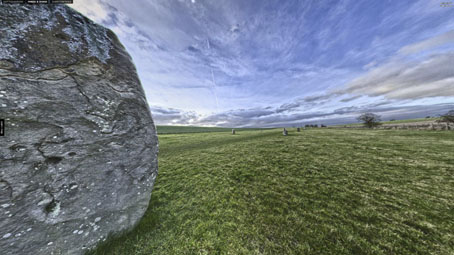
The Avenue, Avebury. Photo by Sophie Morse.

I’ve been a little surprised that there aren’t more photo panoramas of stone circles, their shape being optimal for the 360-degree view. The stones at Avebury in Wiltshire are too widely situated to be seen effectively from a single viewpoint so the view above shows the West Kennet Avenue that leads towards the circles. The same photographer also has a view of the entrance to the West Kennet Long Barrow.

avebury2.jpg

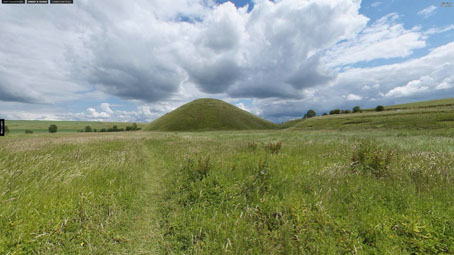
Silbury Hill, Avebury. Photo by Matthew Kaye.

Close to Avebury village is Silbury Hill, one of the largest artificial mounds in the world and—since its purpose is still contested—a good contender for Britain’s most mysterious creation. The hill and Avebury stones (not to mention Stonehenge) are only the most spectacular landmarks in a remarkable county that’s scored all over with prehistoric remains. It’s this area of England—Wiltshire and Somerset—I always regard as the true ancient heart of the country, not London which was founded by Roman invaders thousands of years after these structures were raised.

Elsewhere on { feuilleton }
The panoramas archive

Stonehenge

stonehenge1.jpg

The trilithons of Stonehenge as they appear in Google Earth, a view that few people these days are allowed to experience since visitors are kept to a small path that runs around the monument. Thirty years ago this week, on the day of the Summer Solstice, I was fortunate to be present at the small Stonehenge Free Festival that was taking place in a field across the road. English Heritage always opened up the stones for the Solstice so I got to stand in the centre of the circle and watch a couple of improvised hippie weddings taking place. (Every now and then I wonder whether those couples are still together.) The festival had been staged annually since 1972 and, unlike the walled and ticketed Glastonbury Festival, was a thoroughly anarchist affair: people simply turned up, stayed for a week or so then left. That changed in 1985 when someone at English Heritage decided that the festival wasn’t going to happen; police cordoned off the area and the resulting conflict put an end to the festival for good.

stonehenge2.jpg

One of Google Earth’s army of diligent model-makers, Tom Harvey, is responsible for the 3D view of the stones. These work better than many of the 3D buildings in Google Earth which often look painfully isolated in otherwise flattened cityscapes. Stonehenge also suits this treatment better than most of Britain’s other ancient monuments which tend to be smaller stone circles or mounds of earth. There is a Silbury Hill but nothing for nearby Avebury as yet.

Previously on { feuilleton }
Stonehenge panorama
Born again pagans

Recovering Viriconium

viriconium01.jpg

Detail from Assassination in the Night (c. 1600?) by Monsù Desiderio.

Yesterday’s post looked at some of the past cover designs for M. John Harrison’s Viriconium books. This post makes a few suggestions for how they might be presented in the future. Since these are mostly covers that I’d like to see they’re not necessarily ideal for the audience a publisher might be aiming at, cover design is usually a three-way process involving designer, author and publisher. In the end I’ve resisted the temptation to draft a range of original cover proposals—writing these posts has taken long enough—so almost everything here uses pre-existing art. If I was designing covers for all four Viriconium books, however, and the brief was to orient them towards a fantasy readership, the first thing I’d try would be a series of four imaginary Tarot designs. A peculiar pack of Tarot cards is a recurrent feature of the books so I’d create four emblematic cards that featured significant elements and characters from each. The characters wouldn’t be too well defined, they’d be stylised, maybe even silhouettes. Each card would feature a dominant presence: offhand these would be one of the geteit chemosit for The Pastel City, a locust for A Storm of Wings, the Barley Brothers for In Viriconium and a Mari Lwyd horse skull for Viriconium Nights. These presences together with the human characters would loom over a silhouette city at the foot of each card whose outlines would change appearance from book to book, evolving gradually from a fantastic outline of domes and towers to something that resembles a contemporary city. The colours and treatments would show a similar evolution from the bright and bold styles of the Pamela Colman Smith Tarot deck to something more photographic, collaged from elements closer to our world. Maybe.

That’s an idea for the four individual books. All the examples here use the convenience of the omnibus edition so a single image (or pair of images) has to somehow represent the entire series. To save time and effort I’ve taken the liberty of hijacking a couple of Penguin Books layouts. I hope Penguin doesn’t mind, and I should also apologise to Harrison’s UK publishers, Gollancz, for making one of their authors jump ship. The Viriconium omnibus is certainly good enough to be considered a modern classic. Penguin’s recent template for its Modern Classics series happens to be very easy to apply to a wide range of artwork.

viriconium04.jpg

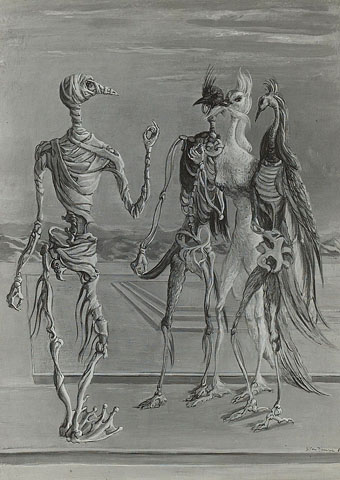
The Anti-Pope (1942) by Max Ernst.

Penguin has a long tradition of using pre-existing art on its covers, especially on those in its Penguin Classics series. You can almost make this into a parlour game: match your favourite novel with the best choice of painting. The tradition was extended to its science fiction titles in the early 1960s when the art of Max Ernst was featured several times along with the work of other Surrealists. Max Ernst is a favourite artist of mine so this is one I can’t resist. Many of Ernst’s decalcomania paintings of the 1940s would suit Viriconium but The Anti-Pope with its horse heads seems especially suitable.

Also on the Penguin sf covers was a picture by the mysterious “Monsù Desiderio” one of whose works can be seen at the top of this post. Desiderio was a 17th-century painter with a vague enough presence—works have been attributed to both François de Nomé and Didier Barra—and a line in gloomy architectural fantasias to make him an ideal Viriconium artist.

Continue reading “Recovering Viriconium”

Weekend links 112

venus.jpg

“Venus moves across the Sun in this image captured by Japan’s satellite Hinode, on June 6, 2012.” Via.

The imagery in Ah Pook covered a wide range of ideas. A train full of Mayan Gods for instance travelled through various time zones to end up alongside a carnival in a red brick town outside St Louis. Then they got out…out of the books Mr. Hart was reading on the train. Fact also alternated with fiction. We could be chugging along with Lizard boys in a Mayan City one moment then switch to a history of Immigration Laws in the US or the development of tape recorders and Speech Scramblers. Then switch to a bright red Shrew boy with a hard-on on a bicycle in Palm Beach at the end of the world. Time was what the book was about: defining it, controlling it and moving back and forth within it.

Malcolm McNeill

Malcolm McNeill talks to The White Review about working with William Burroughs on Ah Pook Is Here. Related: Jan Herman as Publisher of Nova Broadcast Press. Reality Studio has all the Nova Broadcast publications as downloadable PDFs.

• More Graphic Canon news: design historian Steven Heller reports on the project while at Nashville Scene editor Russ Kick talks to Joe Nolan about the books.

• There’s still a couple of days left to hear Martyn Wade’s Blue Veils and Golden Sands, a BBC radio drama about electronic composer Delia Derbyshire.

venus2.jpg

“Venus in silhouette, seen between the Earth and Sun, from NASA’s orbiting Solar Dynamics Observatory, on June 5, 2012.” Via.

• From 2010: Video of an hour-long lecture by Alberto Manguel at Yale University on “Borges and the Impossibility of Writing”.

• Bauhaus reflections: Frank Whitford on the design school and the exhibition currently running at the Barbican, London.

• “It’s easier to be gay in the US army than it is to be gay in hip-hop.” Zebra Katz, Mykki Blanco and the rise of queer rap.

• Back at the event site: Another extract from M. John Harrison’s forthcoming novel Empty Space.

• Rare 1959 audio: Flannery O’Connor reads A Good Man is Hard to Find.

Venus Transit 2012 – Ultra-high Definition View (NASA/ESA).

• The kitties just don’t care: Indifferent cats in amateur porn.

What happened to Dorothy Parker’s ashes?

Space Teriyaki 5 at 50 Watts.

Venus/Upper Egypt (1991) by Sonny Sharrock | Venus (1996) by Funki Porcini | Venus (2003) by Air

Jacques d’Adelswärd-Fersen revisited

fersen1.jpg

Messes Noires. Lord Lyllian (1905).

An email earlier this week from French bookdealer Chez les libraires associés contained a link to an online catalogue of books by or related to that disreputable Uranian Jacques d’Adelswärd-Fersen, the subject of this earlier post. The catalogue describes the poet as “l’Oscar Wilde français” which isn’t strictly true since Wilde had (and has) a far higher literary reputation. And when it came to homosexual scandal Fersen didn’t suffer anything like Wilde’s appalling treatment, he simply decamped (so to speak) to Capri with his boyfriend, Nino Cesarini. The latter is the subject of another document linked in the same email, Nino et son jumeau, an investigation (in French) concerning “Faces and legends of the friend of Jacques d’Adelswärd-Fersen. What is known of the appearance of Nino, are there pictures of him by von Gloeden, von Plüschow or Vincenzo Galdi?” A number of the pictures in question show Nino and others in various states of undress so those wishing to view the pages will need to be registered at Issuu first.

A couple more covers from the catalogue follow. All these publications are rare and correspondingly expensive but I still find it fascinating seeing any of this material at all when it’s been proscribed and ignored for so long. While we’re on the subject, I’ve only just noticed that Fersen’s Le Baiser de Narcisse (with illustrations by Ernest Brisset) can be viewed complete at Gallica.

fersen2.jpg

Notre-Dame des mers mortes (1902).

fersen3.jpg

Paradinya (1911).

Elsewhere on { feuilleton }
The gay artists archive

Previously on { feuilleton }
Le Baiser de Narcisse