Derek Jarman’s landscapes

jarman01.jpg

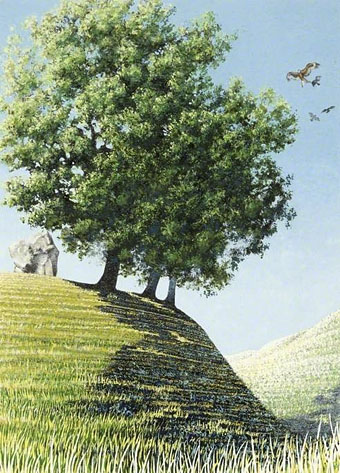
Landscape with Marble Mountain (1967).

1968 – The Lisson Gallery

I have been painting landscapes fairly consistently since I left school, and during that time they’ve changed a great deal. At first they were sparked off by holidays with Aunt Isobel at Kilve in North Somerset. I painted the red-brown earth and dark green of the Quantock Hills, which are at their brightest under the stormy grey skies which blow up over the Bristol Channel. In these paintings there are megaliths and standing stones and clumps of beech trees. By 1965 this has all changed. Oil paint is out. Aquatec, the new acrylic paint, in. The canvas is no longer rough brown flax, but a smooth white cotton duck. The use of rulers and masking tape produces a metrical precision, and replaces improvisation.

I began a series of landscapes which were larger—you have to paint large at the Slade or nobody notices. They have flat red grounds, blue skies, above eye-tricking imagery: Trompe l’oeil water, real taps, classical statues. The largest of these canvases, nine feet by seven, wins the Peter Stuyvesant award for painting at the Young Contemporaries show at the Tate in May 1967.

Since then things have changed again, and at my one-man show, my first one-man show at the Lisson, the canvases have become linear and perfectly balanced. There are no longer any figures or objects, and definitely no jokes. The canvases which are left raw resemble marble through which a grid of lines has been scored.

Derek Jarman, Dancing Ledge (1991)

I don’t have a book of Derek Jarman’s paintings so the pictures featured here—taken from the BBC’s collection of public artworks in Britain—are the only examples I’ve seen of his landscapes. These are surprisingly minimal compared to the richly textured Super-8 films he started making in the early 1970s, but then his painting—which is only one facet of his artistic output—went through several distinct periods. It’s notable that he mentions painting standing stones from an early age given their presence in the Avebury series below, and in his beguiling short, A Journey to Avebury (1971).

(Note: Landscape with Marble Mountain is shown on the BBC site as a portrait picture which would appear to be an error. I’ve taken the liberty of rotating the image anti-clockwise.)

jarman02.jpg

Landscape with a Blue Pool (1967).

jarman04.jpg

Landscape (no date).

jarman03.jpg

Landscape II (no date).

jarman05.jpg

Avebury Series No.2 (1973).

jarman06.jpg

Avebury Series No.4 (1973).

Previously on { feuilleton }
Derek Jarman album covers
Ostia, a film by Julian Cole
Derek Jarman In The Key Of Blue
The Dream Machine
Jarman (all this maddening beauty)
Sebastiane by Derek Jarman
A Journey to Avebury by Derek Jarman
Derek Jarman’s music videos
Derek Jarman’s Neutron
Mister Jarman, Mister Moore and Doctor Dee
The Tempest illustrated
In the Shadow of the Sun by Derek Jarman
Derek Jarman at the Serpentine
The Angelic Conversation
The life and work of Derek Jarman

Trois peintres visionnaires, a film by Fabienne Strouvé

threepainters.jpg

Another gem of an arts documentary, Trois peintres visionnaires is a companion film to Mati Klarwein, peintre Américain: both films feature Klarwein and Ernst Fuchs, while this one also includes another artist, Austrian Arik Brauer (credited as Eric in the titles). As with yesterday’s film there’s a small extract from Popol Vuh’s Hosianna Mantra on the soundtrack plus one of the Cluster and Eno recordings. The three painters are shown performing an impromptu Tibetan (?) chant inside Mati Klarwein’s Aleph Sanctuary then talking together inside Fuchs’ resplendent museum where the Aleph Sanctuary was housed for several years. As before, the conversation is in French but you also get to see Fuchs at work, and there’s a roaming closeup of one of his jewelled paintings.

Elsewhere on { feuilleton }
The fantastic art archive

Previously on { feuilleton }
Mati Klarwein, peintre Américain, a film by Fabienne Strouvé
Ernst Fuchs, 1977
The art of Mati Klarwein, 1932–2002

Mati Klarwein, peintre Américain, a film by Fabienne Strouvé

mati1.jpg

And speaking of the 1970s and Ernst Fuchs and Mati Klarwein… Fabienne Strouvé’s Mati Klarwein, peintre Américain is a 25-minute portrait of Mati Klarwein and family made in 1979. Despite being filmed in New York City most of the conversation is in French—the Klarweins being fluent speakers—but if you like Klarwein’s art this is still a wonderfully insightful film. I always wonder about the size of paintings and other technical details so it’s good to see that, yes, many of Klarwein’s later works are larger than you might expect from reproductions, and it’s also instructive to see him at work with a portion of his painting covered by masking tape. Ernst Fuchs makes a couple of appearances (speaking French—“psychédélique!”), and you get a brief Mati guide to some of the paintings that comprise the incredible Aleph Sanctuary.

mati2.jpg

(Video link updated.)

Elsewhere on { feuilleton }
The fantastic art archive

Previously on { feuilleton }
Ernst Fuchs, 1977
The art of Mati Klarwein, 1932–2002

Weekend links 285

graphic.jpg

Some of the art from my collage adaptation of The Picture of Dorian Gray appears on the cover of The Graphic Canon: Volume 2, published this month in a German edition by Verlag Galiani. Out next month (although possibly available now) is the same book in a Brazilian edition from Boitempo Editorial. One of the disappointments this year was having to abandon plans to contribute to Russ Kick’s forthcoming graphic canon of crime fiction. I was overstretched during the summer, and what with projects slipping their deadlines and the trip to Providence there wasn’t any time left for other things.

• For those who missed the first edition, a second and final expanded edition of the Penda’s Fen study/celebration The Edge Is Where The Centre Is.

• Whipping up a storm: how Robert Mapplethorpe shocked America; Kevin Moore on the photographer’s Perfect Moment exhibition.

In the best scenario, metaphysical art distributes the work of understanding among cultural traditions and symbolic systems, and it is along these lines that Carrington’s work has been described as a productive combination of Mexican, Egyptian, Hebrew, Celtic, Greek, and Mesopotamian elements. Her paintings, plays, and stories mix the symbols of alchemy, astrology, Tarot, herbalism, magic, witchcraft, and a personal iconography.

Leif Schenstead-Harris on the life, art and fiction of Leonora Carrington

• Mixes of the week: Hieroglyphic Being collects favourite cosmic jazz of the 1970s; NTS Radio presents an hour of Annette Peacock.

• At Kill Your Darlings: Alexandra Heller-Nicholas enthuses about Dario Argento’s delirious masterwork, Suspiria.

Pye Corner Audio releases a new album (only limited vinyl at the moment—boooo!) and remixes Stealing Sheep.

• The Trip Planners: Emily Witt meets the founders behind Erowid, the online drug encyclopedia.

Woven Processional (1985), music on the Long String Instrument by Ellen Fullman.

• “The Paris attacks prove Charlie Hebdo’s critics wrong,” says Dorian Lynskey.

• Photographs by Danila Tkachenko of abandoned Soviet technology.

Come Wander With Me / Deliverance by Anna von Hausswolff.

• The collages of Guy Maddin.

CAN HALEN

Let’s Take A Trip (1965) by Godfrey | Trip On An Orange Bicycle (1968) by The Orange Bicycle | Last Trip (1968) by We Who Are