The art of Leonidas Kryvošej

kryvosej1.jpg

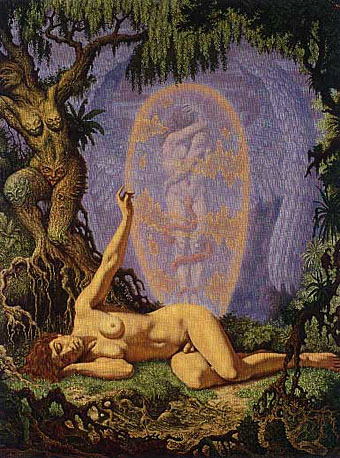
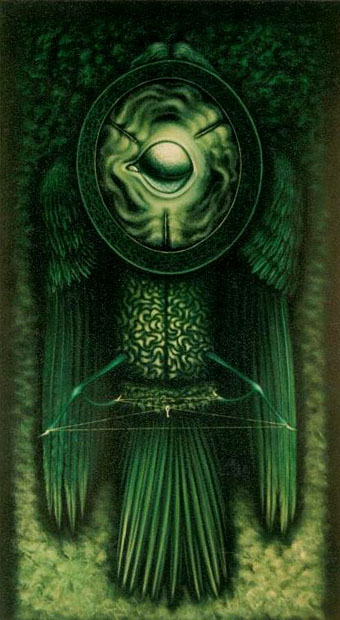
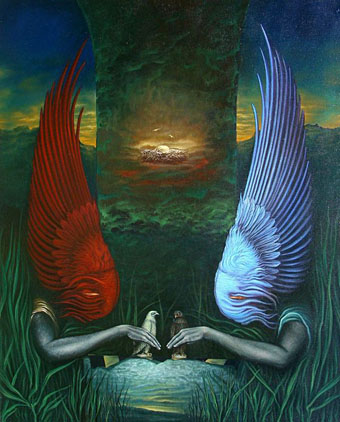
Anděl západního okna.

Leonidas Kryvošej is a contemporary Czech Surrealist whose work I’d known for a while from an exhibition catalogue. I’d always wanted to see more so it’s a pleasure to discover a substantial set of paintings on the website he shares with Lucie Hrusková. A biographical note tells us that:

Leonidas Kryvošej was born 14th May, 1957 in Moravská Třebová. He lives in Ondratice near Prostějov. He has been a member of the surrealist group in Sternberk (later A.I.V) since 1986. Since 1997 a member Czech and Slovak surrealist group.

Most of the text on the site is Czech-only but the green painting above was one of the catalogue works whose English title, The Angel of the Western Window, we can no doubt assume is borrowed from Gustav Meyrink’s occult novel about Elizabethan magus John Dee. Occultism and alchemical symbolism seem to fuel Kryvošej’s art, and I like the profusion of wings and mutated bird-like creatures. There’s a lot of work on his gallery pages, all of it worth seeing for anyone who favours this kind of imagery.
kryvosej2.jpg

Ptací hra.

Elsewhere on { feuilleton }
The fantastic art archive

The art of Johfra Bosschart, 1919–1998

johfra1.jpg

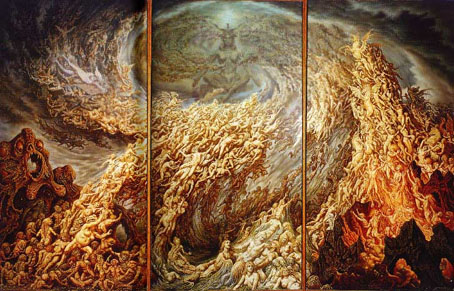
The Adoration of Pan triptych (1979).

The hyper-detailed paintings of this Dutch artist, who often seems to be referred to by his forename alone, were self-described as “Surrealism based on studies of psychology, religion, the Bible, astrology, antiquity, magic, witchcraft, mythology and occultism”. All bases are covered, in other words, and the work is certainly furious and intense at its best even if it’s not always to my taste. Some of Johfra’s Monsters from the Id are closer to Basil Wolverton than HR Giger which makes for unintentional comedy. As usual with detailed artwork, it’s a shame the reproductions on offer aren’t a larger size.

johfra2.jpg

Moldoror series: The Hermaphrodite (1976).

The pictures here are from one of the online numbers of Visionary Review which a biography and several galleries of work from different periods of Johfra’s career. Thanks to Thom for the reminder about this artist.

Elsewhere on { feuilleton }
The fantastic art archive

John Dee’s Monas Hieroglyphica

monas1.jpg

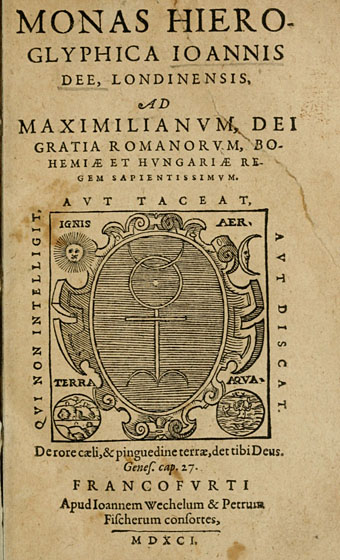
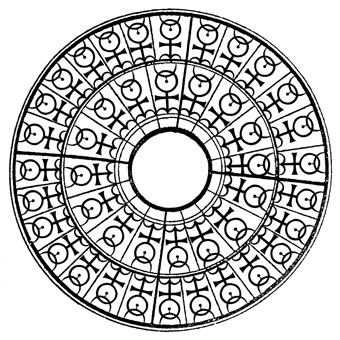
I swear I didn’t go hunting for this. Among the various library collections at the Internet Archive one can find The Getty Alchemy Collection, a substantial gathering of very old alchemical texts scanned in a variety of formats. John Dee’s Monas Hieroglyphica caught my eye during a random search, a third edition of his treatise from 1564 in which he describes his Monas Hieroglyphica, a glyph designed to combine symbols of the Sun, the Moon, the Elements and Fire in a single figure.

monas2.jpg

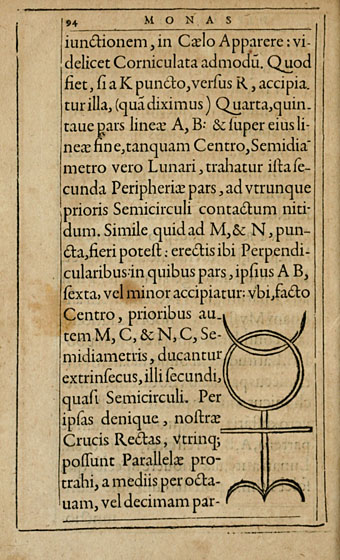
The glyph also intentionally resembles a human form, and Dee relates its individual parts to various astrological and chemical symbols. I’ve mentioned before that Dee scholar Derek Jarman deliberately based Prospero on John Dee in his 1979 film of The Tempest, giving the magus a scrying wand shaped to resemble the Monas Hieroglyphica.

monas3.jpg

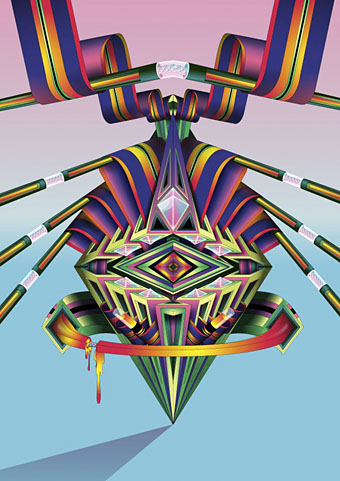
I produced my own variations on the glyph in 2009 when working on the cover of Jeff VanderMeer’s novel, Finch. The symbol recurs in Jeff’s fictional city of Ambergris and I seem to recall there being some discussion about including this doorway design somewhere in the book. In the end it was incorporated into the cover design in a rather subtle fashion. I think this is the first time the design alone has appeared in public.

The Internet Archive has a few other Dee-related items, including Lists of manuscripts formerly owned by Dr. John Dee; with preface and identifications (1921), a 500-page book by antiquarian and ghost story writer MR James.

Previously on { feuilleton }
Mister Jarman, Mister Moore and Doctor Dee
Alchemically Yours
Laurie Lipton’s Splendor Solis
The Arms of the Art
Splendor Solis
Amphitheatrum Sapientiae Aeternae
The Tempest illustrated
Cabala, Speculum Artis Et Naturae In Alchymia
Digital alchemy
Designs on Doctor Dee

Weekend links 67

hofstatter.jpg

Neutron Drip (2011) by Amrei Hofstätter.

The Lavender Scare is “the first feature-length documentary film to tell the story of the U.S. government’s ruthless campaign in the 1950s and ’60s to hunt down and fire every Federal employee it suspected was gay”. A film by Josh Howard based on the book by David K Johnson which the author has made a free download here.

• “Annette Peacock, the avant garde American composer, collaborator with Salvador Dalí, friend of Albert Ayler and Moog-synth pioneer, brought this seismically influential session out in 1972…” John Fordham reviews Annette Peacock’s I’m The One which can be purchased here.

• Writer and graphic design historian Steven Heller looks at The Steampunk Bible (edited by SJ Chambers & Jeff VanderMeer) in his column for The Atlantic. He also talks to Galen Smith about the book’s design.

M John Harrison reveals more about his forthcoming sf novel Pearlent, a partial sequel to Light and Nova Swing. I just re-read Light, and I’m currently In The Event Zone with the follow-up, so I’m looking forward to this one.

The Raven, a book by Lou Reed & Lorenzo Mattotti (and Edgar Allan Poe). A Journey Round My Skull previewed this in 2009.

Orson Welles’ Falstaff film, Chimes at Midnight, emerges into the light once more. When do we get a decent DVD release?

• More of the usual concerns: Iain Sinclair’s struggles with the city of London and Erik Davis talks to Alan Moore about psychogeography, John Dee, comic gods, and the art of magic.

Eddie Campbell takes a tip from Jim Steranko. Related: “Hey! A Jim Steranko effect!

Lambshead Cabinet: Win Jake von Slatt’s Mooney & Finch Somnotrope!

• Tilda Swinton is The Woman Who Fell to Earth.

XXth Century Avantgarde [sic] Books at Flickr.

Sound sculptures & installations by Zimoun.

I’m The One (1972) by Annette Peacock.

Wonders of the Invisible World

hartsoeker.jpg

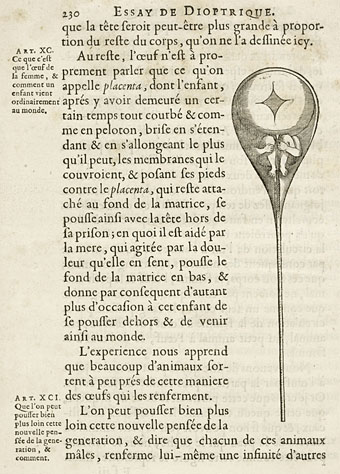
Nicolaas Hartsoeker’s drawing of a spermatozoon from 1695 is on display in Sunderland as part of the Wonders of the Invisible World exhibition at the Northern Gallery for Contemporary Art. The exhibition takes its title from a treatise on witchcraft by Cotton Mather, and the notes for the show must be one of the few places where quotes from Prince Charles and Dadaist Hugo Ball have been used together.

The artists here have coaxed objects to levitate, facilitated autosuggestion, photographed apparitions, or foretold the future. Though echoing pre-scientific ideas, their approaches are curiously timely, and might collectively be described as ones of ‘irrational exuberance’. For many of the artists, their works are allegories for the workings of an intangible and mysterious world propelled by illusions and suspension of disbelief: those of the economic marketplace. As here, much of the material world seems to defy the laws of gravity, as though objects were suspended ‘in a bubble’, or else held aloft by a so-called ‘invisible hand’.

Given the intriguing nature of the exhibition it’s a shame that more of the works on view aren’t shown on the gallery site. There’s a preview of the show this Wednesday after which it will run until October 9th, 2011. See gallery details and a list of the artists here.