Yule

molesworth.jpg

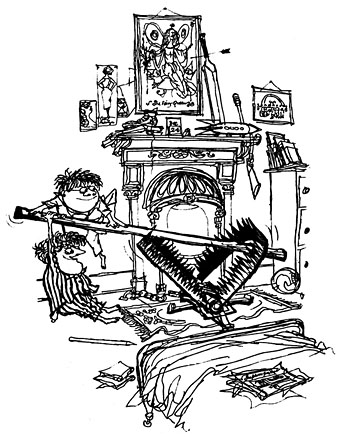
“A trap for dere Santa”. From How to be Topp by
Geoffrey Willans and Ronald Searle (1954).

That time of year again. Here at { feuilleton } we prefer to acknowledge the solstice-based traditions that pre-date the usurping rituals of Middle Eastern sky gods. The old pagan business of lighting fires and creating artificial light and warmth still makes sense when you’re in the depths of another dreary English winter, with seemingly permanent grey skies and a smear of daylight that vanishes at half past three in the afternoon. Christmas used to agitate me too much and too often until the year the TV finally gave up the ghost. I realised a lot of the prior aggravation had been caused by the deluge of trivia that popular media creates at the end of the year; keep away from TV, avoid the crowds and the collective hysteria become a lot more manageable.

This page will be quiet while I visit the family for a few days but the archive feature will be active should you be seized by a sudden desire to read my words or look at some pictures. If you’re sat in front of a monitor over the coming week—and for some this may be a necessary escape—I’d suggest looking over some of the mp3 blogs that have been coming online in the past year. These are from people (usually anonymous for good reason) posting whole albums for download, many of which still haven’t made it onto CD. Hard to say how long this phenomenon will be allowed to continue in its current form—a lot of these places are using Blogger, so may be shut down by Google eventually—but for now its an encouraging trend. A by-no-means-definitive list follows below. These are only the ones I’ve run across recently, liked and bookmarked; if you know of any other good ones, feel free to leave a tip in the comments.

Fauni Gena Music Webbernet. Mainly ambient or quiet electronic releases.

À bientôt j’espère. Er…hard to describe, you’ll just have to go and look.

Lost-In-Tyme. Obscure psychedelia for the most part.

Swen’s blog – Artists mentioned in The Wire. What it says on the tin. Very useful if you’re a Wire reader.

Improvisie. Improvised music with an emphasis on the jazz spectrum. Not much there yet but may be worth watching and worth a visit solely for the insane Paul Bley synth album. (Thanks to Gav for the tip!)

Grown So Ugly. “A home for musical gems from the past fifty years, decidedly biased in favor of acoustic instrumentation. From the easily accessible to the challenging listen, quality is the sole requirement for our sharity. We encourage community participation.” (Thanks to Jay for pointing me to this one.)

Krautrockteam. Best of the lot where my tastes are concerned. More obscure (that word again…) German music than you can shake an Archangel’s Thunderbird at.

Previously on { feuilleton }
• The music of The Wicker Man

Angels 6: Paradise stands in the shadow of swords

stuck_angel.jpg

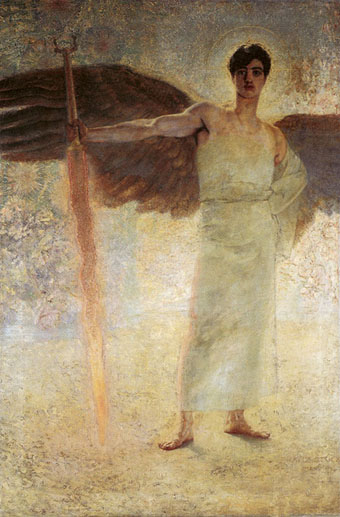
The Guardian of Paradise by Franz Stuck (1889).

We’ll let Coil have the final word on the angel theme, the post title being taken from their Cathedral In Flames. Those words recognise—as does the painting above—that the Christian concept of Heaven is of a gated community guarded by warriors to keep the undesirable at bay.

Symbolist painter Franz Stuck was (as far as we know) robustly heterosexual but his angel isn’t far removed from the work of contemporary photographers like Anthony Gayton who specialise in teasing out the erotic undercurrents in this kind of imagery. Which brings us full circle, seeing as we started with Caravaggio and his distinct brand of religious subversion. The irony is that some of the more vocal elements of Christianity can’t help subverting themselves or their own messages, as John Patterson notes in his Guardian piece today, alluding not only to the Ted Haggard debacle but also to Haggard’s favourite artist, Thomas Blackshear, both of whom were discussed here in November. Patterson writes that the recent brand of bigoted fervour that’s swept America seems to have abated, or at least retreated, after threatening to become a mainstream force. Europe often seems a haven of healthy heathen sanity by comparison, a part of the undesirable world being kept outside the American Paradise. St. Peter now demands retinal scans, fingerprints and a biometric passport. Continual rumbles from Pope Maledict and his closeted cardinals are an increasing irrelevance, the background static of a dying regime. Paradise may be guarded by attractive angels but we can only look and never touch. As Patterson says, the devil has all the best tunes. And the best books and movies and games. And sex and fun. I know which side of the fence I’d rather be on.

Elsewhere on { feuilleton }
• The gay artists archive
• The men with swords archive

Previously on { feuilleton }
• Gay for God

Tiger Mountain Strategies

tiger_mountain.jpgTaking Tiger Mountain (By Strategy) is familiar to those of us in the decadent west as the title of Brian Eno’s second solo album, released in 1974. Eno borrowed the title from a set of Chinese postcards depicting a performance of a Maoist opera, and you can now see a copy of those very postcards here.

“The modern revolutionary Peking opera Taking Tiger Mountain by Strategy, carefully revised, perfected and polished to the last detail with our great leader Chairman Mao’s loving care, now glitters with surpassing splendour.

“Taking Tiger Mountain by Strategy is one of the outstanding model theatrical works. It describes an episode in the great Chinese People’s War of Liberation, a battle in which a pursuit detachment of the Chinese People’s Liberation Army wiped out a Kuomintang die-hard gang in northeast China. The opera creates the brilliant images of Yan Tzu-jung and other proletarian heroes by the method of combining revolutionary realism with revolutionary romanticism, and eulogizes Chairman Mao’s great thought on people’s war. The successful creation of the modern revolutionary Peking opera Taking Tiger Mountain by Strategy is a splendid victory for Chairman Mao’s revolutionary line on literature and art.”

Eno produced his own set of strategic cards with artist Peter Schmidt (who painted the cover of Tiger Mountain) a year later, Oblique Strategies, “Over one hundred worthwhile dilemmas.” Originally an expensive limited edition, these are now available in a variety of freeware applications or online versions. Best one if you’re among the 17% of Mac-users visiting this site is probably the Dashboard widget, the latest version of which includes the texts of all three editions. The instant access nature of OS X’s Dashboard is especially suited to small information systems such as this.

Previously on { feuilleton }
• Exodus art and Plague Songs
• Generative culture
• My Life in the Bush of Ghosts

Salvador Dalí’s apocalyptic happening

666.jpg

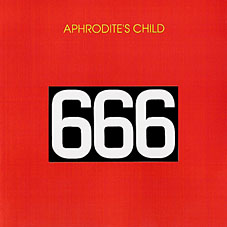
The oft-despised concept album of the 1970s doesn’t come more demented than 666, a double disc set by Greek group Aphrodite’s Child released in 1972. The group featured Vangelis and Demis Roussos among their number (Roussos later turned up on Vangelis’s score for Blade Runner) and this is about the only thing they’re now remembered for, a post-psychedelic fantasy based on the Book of Revelations. So far, so heavy. Searching for information about the album turned up a proposal by Salvador Dalí for a celebratory “happening” to be staged in Barcelona for the album’s world premiere (lyricist Costas Ferris having met Dalí in Paris shortly after the recording):

The main concept:

1. Martial Law shall be ordered on a Sunday, in Barcelona. No one shall be allowed to walk in the streets, or watch the event. No cameras, no TV. Only a young couple of shepherds will have the privilege to witness the event. So, they can later describe it to the people, by oral speech.

2. Giant loudspeakers shall be put in the streets, playing all day the work 666, by Vangelis, Ferris and the Aphrodite’s Child. No live performance.

3. Soldiers dressed in Nazi uniforms, will walk in military march in the streets of Barcelona, arresting who-ever wants to break the law.

4. Hundreds of swans will be left to move in front of the Sagrada Famiglia, with pieces of dynamite in their bellies, which will explode in slow motion by special effects. (real living swans, that should be operated for putting the dynamite inside their belly).

5. Giant Navy planes, will fly all day in the sky of Barcelona, provoking big noise.

6. At 12:00 sharp, in the mid-day, those planes will start the bombardment of the great church, throwing all of their munitions.

7. Instead of bombs, they shall throw Elephants, Hippopotami, Whales and Archbishops carrying umbrellas.

No, it didn’t happen, but if you do hear the album try and think of swans exploding in slow motion while elephants and archbishops rain down from the sky.

Previously on { feuilleton }
• The apocalyptic art of Francis Danby
• The music of Igor Wakhévitch
• Dalí Atomicus

Metabolist: Goatmanauts, Drömm-heads and the Zuehl Axis

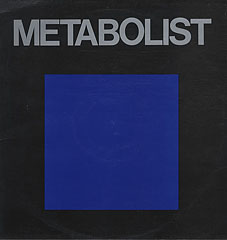
metabolist.jpgNo, not the school of Japanese architecture, we’re concerning ourselves here with a UK band from the early 1980s. There’s still a number of important albums from this period that remain caught in a curious limbo between the end of the time when vinyl was the prime carrier for new music and the start of the CD era. A few groups such as Metabolist expired before CDs became something commonly used by smaller labels and their recordings have tended to evade reissue. In addition, what recordings there are were often released in small quantities through obscure independent labels (the origin of the now thoroughly disreputable term “indie”) which means that the original works can be hard to find.

Metabolist were Malcolm Lane (guitar, synth, vocals), Simon Millward (bass, vocals, synth) and Mark Rowlatt (drums, percussion), with Jacqueline Bailey designing the covers in a Suprematist style that would no doubt have pleased Kazimir Malevich. All Metabolist covers feature variations on the same line of Helvetica plus a coloured (or black) square. As to the music, here’s my good friend Gav (who carefully digitised his Metabolist collection for me) on an old forum posting:

Initially very underrated and now just unknown, Metabolist were reviewed in the UK music press (NME & Sounds specifically) alongside The Pop Group, Cabaret Voltaire, Throbbing Gristle & This Heat as part of a brief vanguard of new UK experimental music, and for a little while it looked like fractured noise and Europe-inspired riffing might become an important part of the independent (as opposed to indie) mainstream…but alas…

According to “Eurock” magazine in 1980:

“gladiators of independent music, Metabolist have existed in one form or another for 3 or 4 years, the present group consisting of Malcolm Lane, Anton Loach, Simon Millward and Mark Rowlatt. The group is run along co-operative lines to include Jacqueline Bailey who handles publicity promotion, etc. The five of us have all reached the decision to work outside of the large companies in the music business and have therefore formed our own company – Drömm Records. So far we have released 1 EP, 15 minutes of music incl. “Drömm”, “Slaves” and “Eulam’s Beat”, plus a cassette tape of first take rehearsal material called “Goatmanaut”, also containing 3 tracks “Zordan Returns”, “Chained” and “Thru the Black Hole”. The groups first album “Hansten Klork is released in January 1980, closely followed by a single, “I Can’t Identify”. All these recordings have been made at the group’s studio with members of the group being responsible for recording, mixing and editing. We feel that this is the only way, apart from having unlimited cash, that Metabolist can have control over their musical output at every stage. All artwork and sleeve design are also handled within the group. Thanks to the growth of alternative distribution networks in recent years our records can now become available worldwide, so we consider independence to be both viable and desirable. Musically the group has been through many changes, Metabolist refuse to be dictated to by fashion, or by establishing a Metabolist “sound” and sticking to it for ever after. You can therefore find that you love the album, but hate the EP and so on. You will have to trust us as we do not intend to have 10 versions of a hit sound on our LP’s.”

Metabolist only released one full-length vinyl LP, 2 cassettes, a 7″ EP and a single, and their entire oeuvre, including peripheral compilation contributions, would fit onto a nice double CD comp, but none of it has ever been re-released – DURTRO were rumoured to be interested at one time, but as all original members were either untraceable or uninterested, it remains up to original fans (like myself – for the record I bought all their releases directly from the band) to champion their cause – and a worthy cause it is: imagine a lo-fi garageband Magma rehearsing & recording in a gents’ toilet, minus the chorale but compensating with the intensity of ‘Metal Box’ PiL or ‘Monster Movie’ Can, grunted vocals in a kind of proto-Kobaïan neo-dialect (‘Chained’, ‘King Quack’), or short bursts of bleeping and burping feedback and electronics like a lost ‘Faust Tapes’ outtake (‘Racing Poodles’, ‘Zordan Returns’)…and at a time when ‘Krautrock’ was just the first track on ‘Faust IV’ and ‘Mekanïk Destruktïw Kommandöh’ was a quid in any and every secondhand record shop, Metabolist were citing Der Kosmische Music and Magma as major influences, not a good starting point for a suspicious post-punk record-buying public…I’ve always loved this band because they did it their way, they rocked hard, and they then just disappeared, leaving a small but perfectly-formed Ur-Cosmic body of work that will be rediscovered at some point…surely…

Surely, but not yet. My summation of the Metabolist sound would be something like “Magma’s Christian Vander jamming with This Heat”, but seeing them as a poor man’s This Heat is rather unfair since they have their own distinct personality beyond the few areas of sound and production (This Heat also had their own studio) that overlap with Brixton’s finest. In place of This Heat’s familiar post-punk concerns, Metabolist are often fiercer and weirder, deliberately plugging themselves into a post-Magma “Zeuhl” axis as they growl many of their songs in an invented (?) tongue. Little wonder, then, that they remain beyond the pale. Other bands from the period such as Wire, The Gang of Four—even The Fire Engines!—have been resurrected, reissued and even reformed, with younger groups declaring them as influences. We’re currently lacking any enterprising Drömm-heads prepared to take this formidable sound as the starting point for something new. If they’re out there, they’ll need to be hardy souls with little expectation of reward; Franz Ferdinand wouldn’t have graced the charts shouting incoherently into an echo chamber while heavy bass rumbles and drums pound and ricochet in the background.

Thanks to Gav for permission to re-use his words. And for the music, of course…

The recordings:
Dromm (7″) (Drömm Records, 1979).
Goatmanaut (cassette) (Drömm Records, 1979).
Hansten Klork (LP) (Drömm Records, 1980).
Identify (7″) (Drömm Records, 1980).
Split (7″) (Bain Total, 1981).
Stagmanaut! (cassette) (Cassette King, 1981).
Tracks appear on:
Compilation Internationale No.1 (LP) Le Grand Prique, Chained (Scopa Invisible, 1980).
Miniatures (LP) Racing Poodles (Pipe, 1980).

Elsewhere on { feuilleton }
• The album covers archive

Previously on { feuilleton }
• Maximum Heaviosity
• The music of Igor Wakhévitch
• This Heat