Der Orchideengarten illustrated

orchid_01.jpg

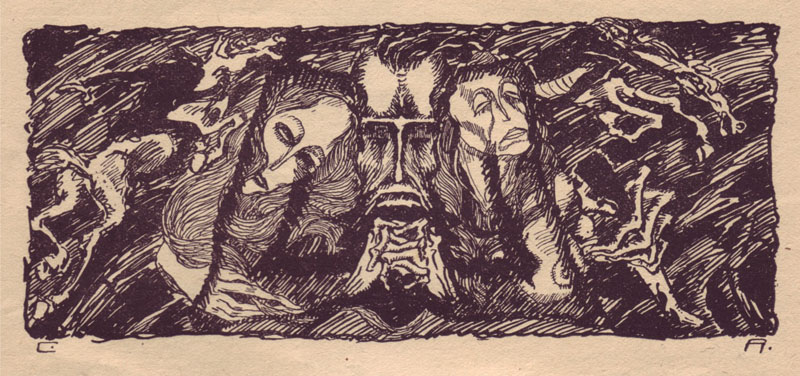
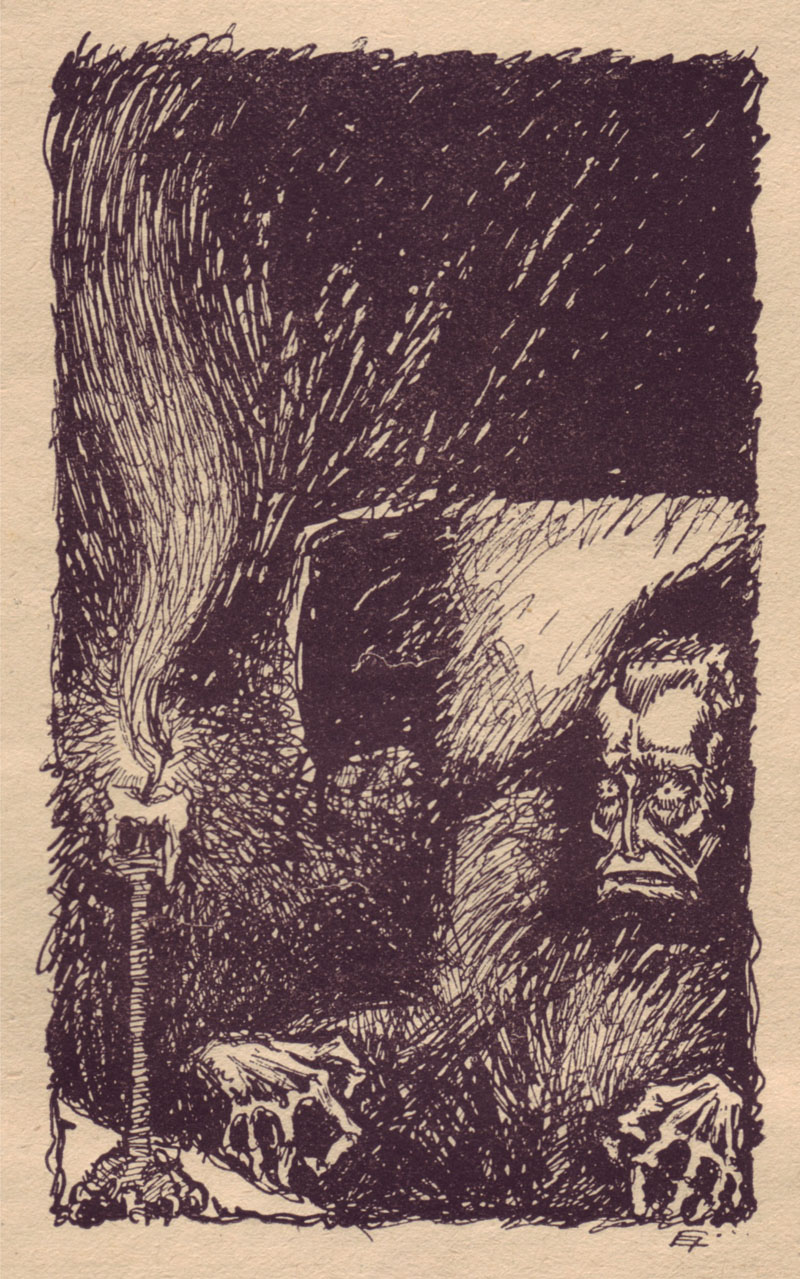
Halloween approaches and as a precursor it’s a great pleasure to be able to post a selection of interior illustrations from Der Orchideengarten, courtesy of Will at A Journey Round My Skull. Der Orchideengarten was a German magazine of weird fiction which ran for 51 issues from 1919 to 1921 and whose existence today is rarely acknowledged despite being credited as the world’s first fantasy magazine. Information is scarce and these scans come from Will’s own copies which is why I’ve posted fifteen more below the fold; you can’t see this stuff anywhere else. A Journey Round My Skull featured some covers and a different set of interior illustrations earlier this year, and there should be a new post complementing this one with more of the magazine’s stunning cover designs.
orchid_02.jpg

What strikes me about these black-and-white drawings is how different they are in tone to the pulp magazines which followed shortly after in America and elsewhere. They’re at once far more adult and frequently more original than the Gothic clichés which padded out Weird Tales and lesser titles for many years. Some are almost Expressionist in style, while the Wild Hunt series below shows a distinct Goya influence. I’d love to know how the written content matches the illustrations; I suspect there’s the same difference of atmosphere and emphasis to American weird fiction as there is in the drawings.

Update: Will’s new post is Watering the Toxic Garden which will be followed on Thursday by the results of his Evil Orchid Bookplate Contest.

Click on any of these pictures for a larger version.
Continue reading “Der Orchideengarten illustrated”

Emil Cadoo

cadoo.jpg

Untitled (1963).

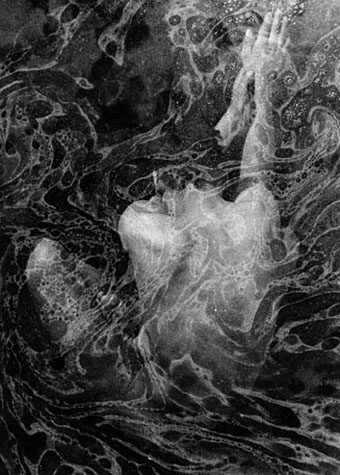
One of a small number of pictures from a recent exhibition of work by American photographer Emil Cadoo (1926–2002) whose nude studies and often homoerotic themes were controversial in America of the Fifties and Sixties but welcomed in France, as was often the case at that time.

In April 1964, all 21,000 copies of the April/May issue no.32 of the American magazine Evergreen Review – containing (among others) texts by Norman Mailer, Jean Genet, William Burroughs, Bryon Gysin, Michael McClure, Karl Shapiro (a who’s who of the day’s practitioners of perceived outrage), and an erotic photo-essay by Cadoo – was seized by the police whilst it was still being bound. The edition had been deemed ‘obscene’ by the county’s district Attorney, whose particular disapproval was leveled at Cadoo. It took the special intermission of Edward Steichen, who compared the images to the work of Auguste Rodin “the greatest living sculptor of our time”, to obtain the condemnation of three judges of this action as ‘unconstitutional’, and to return the magazine to the public domain. (More.)

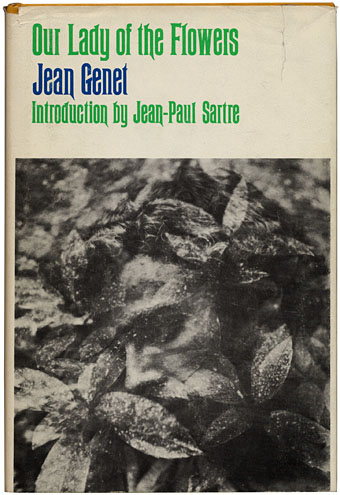
Cadoo favoured the double-exposure to achieve painterly or (for want of a better word) “poetic” effects, and some of these photos were used on book jackets by Grove Press (also the publishers of Evergreen Review), among them this Genet title which I posted a couple of years ago. More of Cadoo’s work can be found on various gallery sites but there’s no dedicated site unfortunately.

genet2.jpg

Photo by Emil Cadoo; design by Roy Kuhlman (1963).

Previously on { feuilleton }
Penguin Labyrinths and the Thief’s Journal
Un Chant d’Amour by Jean Genet

Blast

blast.jpg

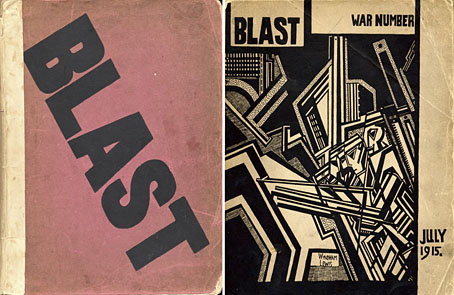
Both issues of Wyndham Lewis’s avant garde art and literature journal can be found in a collection of similar publications from the Modernist years at Brown University here and here. I’ve always liked the bold graphics of Lewis and his fellow Vorticists, and BLAST 2, “the War Number”, is especially good in that regard. The MJP site reminds us that BLAST is still under copyright control outside the US and is also available in facsimile editions from Gingko Press.

BLAST was the quintessential modernist little magazine. Founded by Wyndham Lewis, with the assistance of Ezra Pound, it ran for just two issues, published in 1914 and 1915. The First World War killed it, along with some of its key contributors. Its purpose was to promote a new movement in literature and visual art, christened Vorticism by Pound and Lewis. Unlike its immediate predecessors and rivals, Vorticism was English, rather than French or Italian, but its dogmas emerged from Imagism in literature and Cubism plus Futurism in visual art.

The original BLAST was published by Aubrey Beardsley’s first publisher, John Lane, and it’s fascinating to see Lane advertising back issues of The Yellow Book in pages which include Lewis’s anti-Victorian polemic. Meanwhile I’m still waiting for copies of the Art Nouveau journal Ver Sacrum to turn up somewhere. If anyone runs across quality scans, please leave a comment.

Via Things Magazine.

Previously on { feuilleton }
Wyndham Lewis: Portraits

Technology, then and now

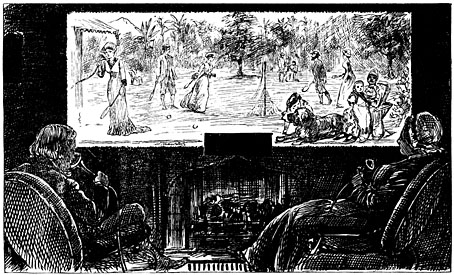
A recent book purchase was A Century of Punch (1956), a weighty collection of drawings from the humour magazine edited by RE Williams. While much of the comedy is now very dated, many of the illustrations and cartoons yield other pleasures, not least by being a fascinating snapshot of the times and their attitudes. Some of those attitudes remain with us, and the handful of drawings below struck me for their resonance with current discussions about the impact of new technology. But first, here’s a far-sighted prediction from 1878 (note: Ceylon is now Sri Lanka):

punch1.jpg

EDISON’S TELEPHONOSCOPE (Artist unknown)
Paterfamilias (in Wilton Place): “Beatrice, come closer, I want to whisper.”
Beatrice (from Ceylon): “Yes, Papa Dear.”
Paterfamilias: “Who is that charming young lady playing on Charlie’s side?”
Beatrice: “She’s just come over from England, Papa. I’ll introduce you to her as soon as the game’s over.”

Continue reading “Technology, then and now”

Uranian inspirations

gloeden2.jpg

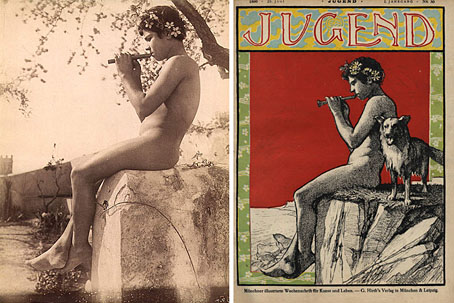
left: Sicilian boy by Wilhelm von Gloeden (no date); right: Jugend cover by Hans Christiansen (1896).

My current reading is The Secret Life of Oscar Wilde (2003), a long and fascinating study by Neil McKenna which attempts to disentangle the true nature of Wilde’s sex life from the myths and evasions of his biography and biographers. Among the pictures in the book, McKenna shows a couple of the “Uranian” photographs by Wilhelm von Gloeden (1856–1931) which Wilde owned. Von Gloeden’s views of naked Sicilian boys were described as “Classical” in a barely-believable subterfuge familiar during the 19th century, and it’s understandable why Wilde, who’d been praising the attractions of Mediterranean youth for most of his adult life, would have found these pictures worthy of purchase. Wikimedia Commons has a substantial set of the photos, although it should be noted that provenance is often uncertain; there were other photographers active in Taormina at the time who catered to a similar market. One photo in particular stood out recently when I recognised it as the possible source for the figure on a Hans Christiansen cover for Jugend magazine of 1896. The cover above has appeared here before but this is the first time I made the photographic connection.

gloeden1.jpg

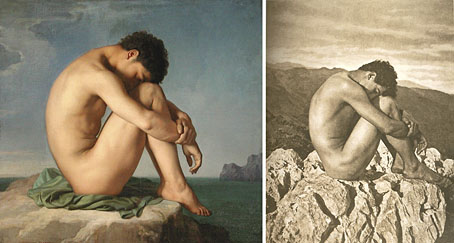
left: Jeune homme assis au bord de la mer by Jean Hippolyte Flandrin (1836); right: Cain by Wilhelm von Gloeden (c. 1902).

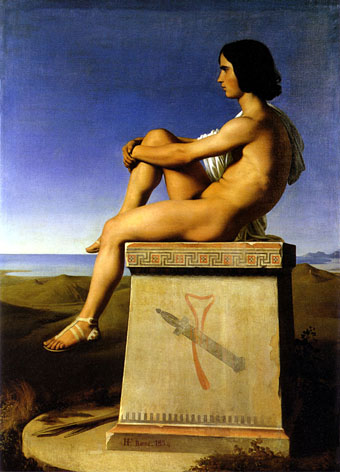
Gloeden, of course, was one of the first people to use the Flandrin pose, as I noted in the original post on that theme. I wonder if he knew he’d been copied in turn? That Jugend cover and its inspiration reminds me a little of Flandrin’s other depiction of Classical youth, his portrait of Polites, a painting which Oscar would no doubt have enjoyed.

polites.jpg

Polites, Son of Priam, Observes the Movements of the Greeks by Jean Hippolyte Flandrin (1834).

Elsewhere on { feuilleton }
The recurrent pose archive
The Oscar Wilde archive

Previously on { feuilleton }
Forbidden Colours
Jugend Magazine
Evolution of an icon