Macabre mixes

lurch.jpg

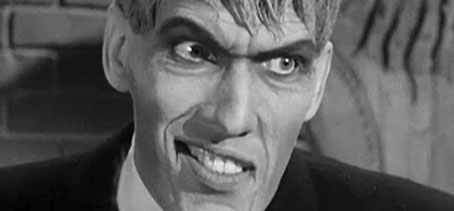
Lurch approves.

It’s that time of year again but I’ve been so busy for the past few months that I haven’t had time to think about a Halloween mix, never mind piece one together. So rather than an original work I’m returning to the previous policy of recommending those by other people.

First up is a multi-set offering at No Condition Is Permanent. I did have a vague idea earlier this year to do a mix of horror-themed rock’n’roll but it’s a good job I didn’t since this collection is much more wide-ranging and original than anything I would have compiled.

bleep.jpg

For Bleep.com there’s a new mix by the very adept DJ Food who blends the Death Waltz Originals electronica catalogue with samples of an interview about nightmares, phantasms and other sinister anomalies.
eyes.jpg

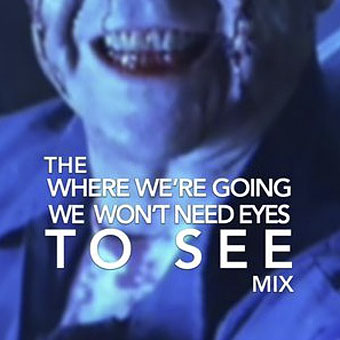
And the “Where We’re Going, We Won’t Need Eyes To See” Mix by The Curiosity Pipe covers all points in between, being “an unpleasant mix of noise, drone, metal, jazz, dark ambient, soundtracks, field recordings and electronica (with a few popular horror film snippets thrown in for good measure).”

Happy Halloween!

Previously on { feuilleton }
A mix for Halloween: Analogue Spectres
A mix for Halloween: Teatro Grottesco
A mix for Halloween: Unheimlich Manoeuvres
A mix for Halloween: Ectoplasm Forming
A playlist for Halloween: Hauntology
A playlist for Halloween: Orchestral and electro-acoustic
A playlist for Halloween: Drones and atmospheres
A playlist for Halloween: Voodoo!
Dead on the Dancefloor
Another playlist for Halloween
A playlist for Halloween

Weekend links 384

muljat.jpg

Sultans of Swing by Samantha Muljat.

• Pain & Pleasure, Indivisible: Mat Colegate talks to Stephen Thrower (Coil, Cyclobe) about the meeting between Coil and Clive Barker that would have led to Coil scoring Barker’s Hellraiser if the studio hadn’t rejected the music.

• “From Arsedestroyer to Zoogz Rift: 50 underground albums you’ve never heard of” The usual presumption—I’ve been listening to The Groundhogs since the mid-1980s—but it’s a good list.

• More magazines at the Internet Archive: an incomplete run of British science-fiction monthly Interzone; and a complete (?) run of the film magazine for horror (and gore) obsessives, Fangoria.

• “…it’s background music, is what it is. But there’s nothing wrong with that. I’m very proud of it.” John Carpenter discussing his soundtrack music and his new album, Anthology.

• Mixes of the week: Aral Mix 05 by Ellen Arkbro, Secret Thirteen Mix 234 by FOQL, and Samhain Séance Six: Triffid Witch by The Ephemeral Man.

• Dallas Killers Club: Nicholson Baker reads a stack of books about the Kennedy assassinations then draws his own conclusions.

Michael Flanagan on searching for LGB histories of Neopaganism, the paranormal and the occult in San Francisco.

• At Lounge Books: author Amelia Mangan on horror, old and new, and her favourite things.

• At Monoskop: the (almost) complete works of James Joyce in one convenient epub.

Jillian Steinhauer on Duchamp’s last riddle.

Hell Raiser (1973) by Sweet | Hell’s Bells (1989) by Rhythm Devils | Hell’s Winter (2011) by Earth

Psychotronic Video

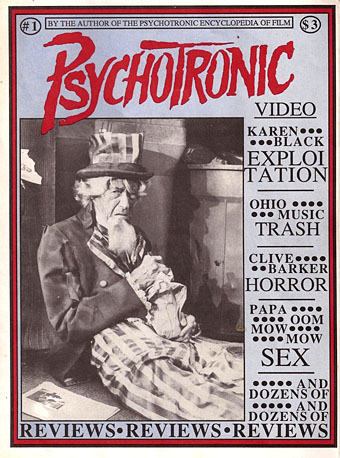
pv1.jpg

I was going to wait until the weekend to mention this but it’s too good to be lodged in a collection of links. Michael J. Weldon’s Psychotronic Encyclopedia of Film (1983) has long been one of my favourite film books, a collection of reviews by Weldon and friends written for Weldon’s NYC fanzine, Psychotronic TV. “Psychotronic” was Weldon’s umbrella label for the low-budget fare that would usually be avoided by other reviewers: “horror, exploitation, action, science fiction, and movies that used to play in drive-ins or inner city grindhouses.” A small handful of actors were considered psychotronic enough (on account of their appearing in many psychotronic films) that Weldon claimed their presence in any film made it psychotronic even if it contained no overt genre or exploitation content. So the Encyclopedia lists Fellini’s 8 1/2, for example, simply because Barbara Steele appears in it. Likewise, Casablanca is psychotronic because of Peter Lorre. As I recall, the other psychotronic actors were John Carradine (“the greatest PSYCHOTRONIC star of all time”), Vincent Price, Boris Karloff and Bela Lugosi.

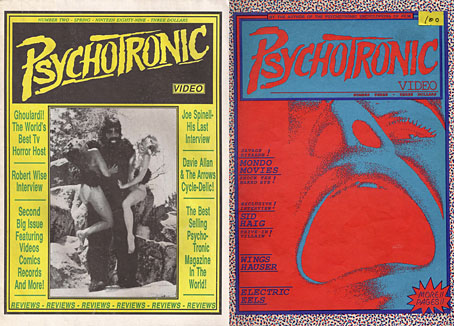
pv2.jpg

The trouble with books of film reviews is that the passage of time makes them increasingly subject to omissions, so I was delighted when Weldon launched Psychotronic Video magazine in 1989. Not only was this a continuation of the encyclopedia’s film listings it was also filled with related features: interviews with character actors, cult figures and interesting stars (Karen Black, James Coburn); a regular music column which mostly covered the kinds of bands who would watch psychotronic films; a regular obituary feature; and pages crammed with bizarre and curious graphics: film ephemera, ads from old magazines, headers by comic artist Drew Friedman, and mermaid drawings by Weldon’s girlfriend, Mia. One of my favourite features, which ran from the first issue, concerned Weldon’s obsession with The Rivingtons’ Papa Oom Mow Mow and The Trashmen’s Surfin’ Bird, an ideé fixe which had Weldon cataloguing as many cover versions or film inclusions of the songs as he could find.

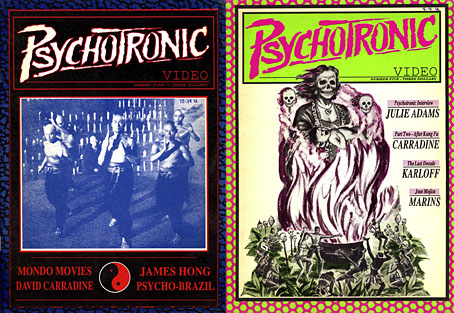
pv3.jpg

Psychotronic Video ran for 41 issues until folding in 2006. I bought the first 23 or so then lapsed after the one comic shop selling it in Manchester was closed down by the IRA bombing of the city centre in 1996. Back issues are increasingly scarce (and not always cheap) so it’s good to find all 41 issues at the Internet Archive together with 10 issues of the even more scarce Psychotronic TV. The quality isn’t perfect—some of the scanned pages are subject to blurring—but I can now see what was in the rest of the magazines, and finally get to read the Timothy Carey interview in the one issue I missed, no. 6. Many of the actors interviewed with enthusiasm by Psychotronic Video have since died so the magazine is even more valuable for its insights into careers ignored by other publications.

Previously on { feuilleton }
Bikers and witches: Psychomania
The Cramps at the Haçienda

Weekend links 383

nomata.jpg

Arcadia-24 (1988) by Minoru Nomata.

Dark Entries and Honey Soundsystem Records release a video of edited moments from gay porn film Afternooners to promote the release of the film’s electronic soundtrack by Patrick Cowley. The album, which is the third and final collection of Cowley’s porn soundtracks, is out now.

Emily Temple looks at some of the art inspired by Italo Calvino’s Invisible Cities. I explored the same subject a couple of years ago in a week of Calvino art posts. From 2014: Peter Mendelsund on designing covers for Calvino.

Jim Downes on the late Charley Shively, a gay liberation activist who wasn’t interested in equality. Not an uncommon attitude in some gay circles but it’s one you seldom see aired in the mainstream press.

Geeta Dayal on A Little Electronic Milky Way of Sound by Roland Kayn, a 14-hour composition of “cybernetic music” which has been released in a lavish 16-CD box set by Frozen Reeds.

• An introduction to Henri-Georges Clouzot in seven films by Adam Scovell. Clouzot’s masterwork, The Wages of Fear (1953), is released on blu-ray by the BFI next week.

• Ubu Yorker: Menachem Feuer interviews Kenneth Goldsmith, writer and the man behind Ubuweb.

• Why Oscar-winning cinematographer Vittorio Storaro thinks the film vs. digital debate is bullshit.

David Barnett on supernatural fiction’s “best kept secret”, Robert Aickman.

Michèle Mendelssohn on how Oscar Wilde’s life imitates his art.

• Mix of the week: Secret Thirteen Mix 233 by Mick Harris.

Invisible Limits (1976) by Tangerine Dream | Invisible Cities (1990) by Jah Wobble’s Invaders Of The Heart | Invisible Architecture (1995) by John Foxx

Weekend links 382

yoshida.jpg

Raven (2015), a metal sculpture by Taiichiro Yoshida.

• “Lumia: Thomas Wilfred and the Art of Light [at the Smithsonian American Art Museum] restores Thomas Wilfred (1889–1968) to his rightful place in the history of modern art.”

• At Brown Noise Unit: a fascinating, lengthy interview by Philip Kaberry with Stephen O’Malley of Sunn O))) et al, with particular focus on O’Malley’s work with Japanese musicians.

• Erik Davis talks to scholar, writer, and mythographer William Rowlandson about Jorge Luis Borges, magical trees, Yankee mysticism, and the power of the weird and murky.

• The first issue of the world’s first magazine of fantastic art and literature, Der Orchideengarten (previously), has been reprinted in full with additional English translation.

• At Muddy Colors: the month in covers for September/October which includes my cover for Under the Pendulum Sun by Jeannette Ng (and which is on sale now).

• At 3:AM Magazine: Adam Scovell talks to horror author Ramsey Campbell about the ghost stories of MR James.

Paralysis: Live at Silent Night #8, a new release on (limited) cassette and digital by The House In The Woods.

• At Dangerous Minds: Jozef van Wissem buries the dead in his new video, Virium Illarum.

PKD Files — A podcast about the life and work of Philip K. Dick.

• Russell Cuzner on The Strange World of Nurse With Wound.

Clark Collis on the rise and fall of Fangoria.

• The North Star Grassman And The Ravens (1971) by Sandy Denny | Flight Of The Raven (1979) by Emerald Web | Kill The Great Raven (1979) by Snakefinger