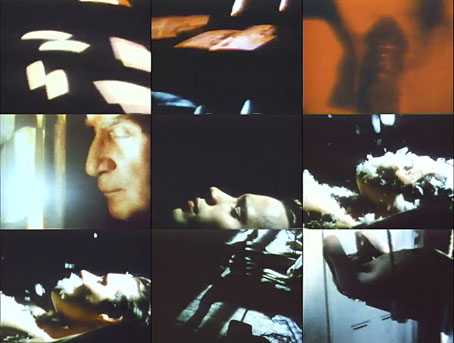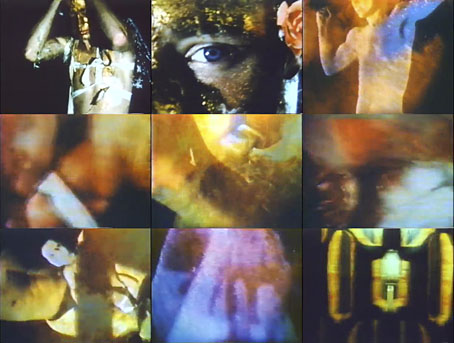
The Salivation Army, a film by Scott Treleaven

salivation1.jpg

I think of the area of magic as a metaphor for the homosexual situation. You know, magic which is banned and dangerous, difficult and mysterious. I can see that use of magic in the Cocteau films, in Kenneth Anger and very much in Eisenstein. Maybe it is an uncomfortable, banned area which is disruptive, and maybe it is a metaphor for the gay situation.

Derek Jarman, in conversation with Simon Field and Michael O’Pray, 1985

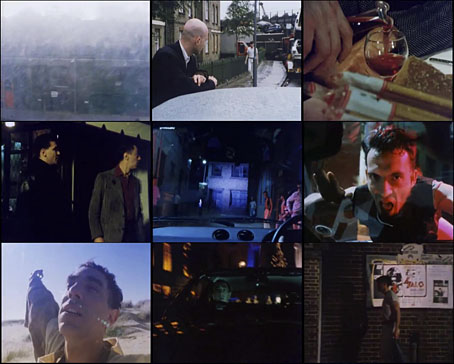
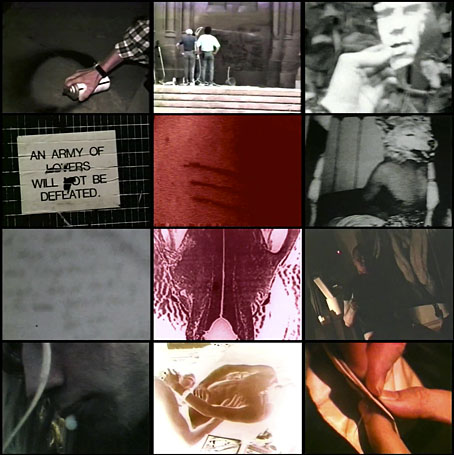
Derek Jarman’s face appears briefly in The Salivation Army (2002), a short history/memoir by Canadian artist Scott Treleaven concerning This Is The Salivation Army, a zine Treleaven produced with a small group of friends from 1996 to 1999. The film itself is credited as the ninth issue, and makes me sorry to have missed the zine in its original incarnation.
salivation2.jpg

The season of Jarman films which is currently running in London is entitled Queer Pagan Punk, and will include a screening of Treleaven’s film next month, along with Glitterbug (1994). The phrase “Queer Pagan Punk” encapsulates the ethos of This Is The Salivation Army, and Treleaven’s narration describes the origin of his zine in a familiar sense of unfocused rage, and also the alienation he and his friends felt towards the vapidities and conformity of contemporary gay culture. Being someone who’s always loathed clubbing, and the consumerist drivel that fills so many gay magazines, this is music to my ears; I just wish the zine been around in the 1980s. The shadow of the Temple of Psychic Youth—which was around in the 1980s—hangs heavily over this project; Derek Jarman had his own connections with PTV/TOPY, of course, being an ally of Throbbing Gristle, and later of Coil. The fanzine may have run its course but Treleaven continues to explore queer paganism in his artwork. The Salivation Army can be seen at Vimeo.

Previously on { feuilleton }
Just the ticket: Cabaret Voltaire
Abrahadabra
The art of Scott Treleaven

Ostia, a film by Julian Cole

ostia1.jpg

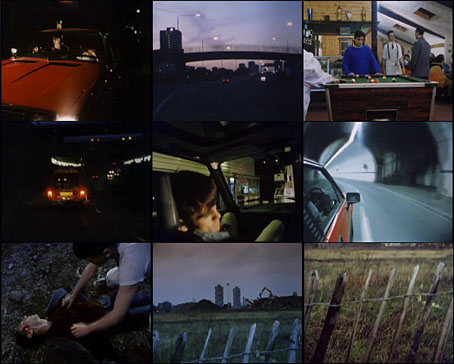
One of Derek Jarman’s many unfilmed projects was PPP in the Garden of Earthly Delights, a study of the last days in the life of director Pier Paolo Pasolini seen through a prism of references to the director’s cinematic work, and also the paintings of Hieronymus Bosch. Jarman’s proposal exists as a synopsis rather than a screenplay, presenting a series of isolated scenes: the film set for the final scene from Salò, or the 120 Days of Sodom (1975); an expensive restaurant; a street at night where Pasolini is cruising for sex; a cheap restaurant; a petrol station; an area of waste ground where Pasolini is killed by the rent boy he’s picked up. The foreground events parallel moments from Pasolini’s life and death, while the background would have featured characters from his earlier films, and various Boschian figures or motifs. The synopsis was printed in the Derek Jarman issue of Afterimage in autumn 1985, and it’s likely that the outline contributed to Julian Cole’s film, Ostia, which was made as a final-year student project a year later.

Ostia is unusual for being a film in which Derek Jarman is the lead actor, although when you see his acting it’s not so surprising that he kept himself out of his own films; Cole says on a commentary track for Ostia that some of Jarman’s performance was so bad it had to be cut. There is the curiosity value of seeing him playing the part of Pasolini, something that Jarman suggested when they were discussing the film.

The title refers to the name of the Tyrrhenian resort near Rome where Pasolini was murdered in November 1975, and the narrative favours the theory that Pasolini wasn’t so much murdered as assassinated by an establishment for whom he was a continual thorn in the side. The unforgettable Salò uses De Sade as a frame to explore the worst period of Italian Fascist brutality at the end of the Second World War. Many of those who were complicit in wartime atrocities were still active in Italian society in 1975, and even without the film’s other excesses they wouldn’t have been impressed by Pasolini’s dwelling on the crimes committed during the period of the Salò Republic, or his allusion to the Marzabotto massacre. Pasolini was also a vocal Marxist, of course (Jarman’s synopsis throws some barbs at this), and heavily critical of the deleterious effects of consumerism on post-war Italian society. The assassination theory carries some weight, in other words, even if the face-value explanation—a rough-trade assignation gone awry—seems just as likely. Philo Bregstein’s documentary, Whoever Says the Truth Shall Die (1981) explores the theory in a roundabout fashion, while Ostia (The Death of Pasolini) (1986) by Coil looks at the tragedy through a symbolic lens. “Kill to keep the world turning.”

ostia2.jpg

Julian Cole was working with a micro-budget so beyond the token presence of an Alfa Romeo like the one Pasolini drove (and which was driven over him on the beach) there’s no attempt at verisimilitude. All the scenes are shot in London locations circa 1986, and the dour skies of the metropolis are no match for the perfect blue of Italy. Cole’s film can’t help but be less ambitious than Jarman’s project but at least it got made. Viewed today Ostia has an unavoidable melancholy quality; Cole says that Jarman had just been diagnosed with HIV when they were making the film, and he refused to kiss actor David Dipnall because of this; at the time little was known about the infectiousness of the illness. Dipnall himself, in an unrelated chain of circumstances, died of AIDS a few years later. Ostia is also a reminder of how Pasolini’s death has gained a martyr-like quality among a certain group of gay men, making it a kind of cinematic equivalent to the martyrdom of Oscar Wilde 70 years earlier. It can be seen as an extra on the BFI’s Derek DVD or watched here.

Previously on { feuilleton }
Derek Jarman In The Key Of Blue
The Dream Machine
Jarman (all this maddening beauty)
Sebastiane by Derek Jarman
A Journey to Avebury by Derek Jarman
Derek Jarman’s music videos
Derek Jarman’s Neutron
Mister Jarman, Mister Moore and Doctor Dee
The Tempest illustrated
In the Shadow of the Sun by Derek Jarman
Derek Jarman at the Serpentine
The Angelic Conversation
The life and work of Derek Jarman

Derek Jarman In The Key Of Blue

jarman.jpg

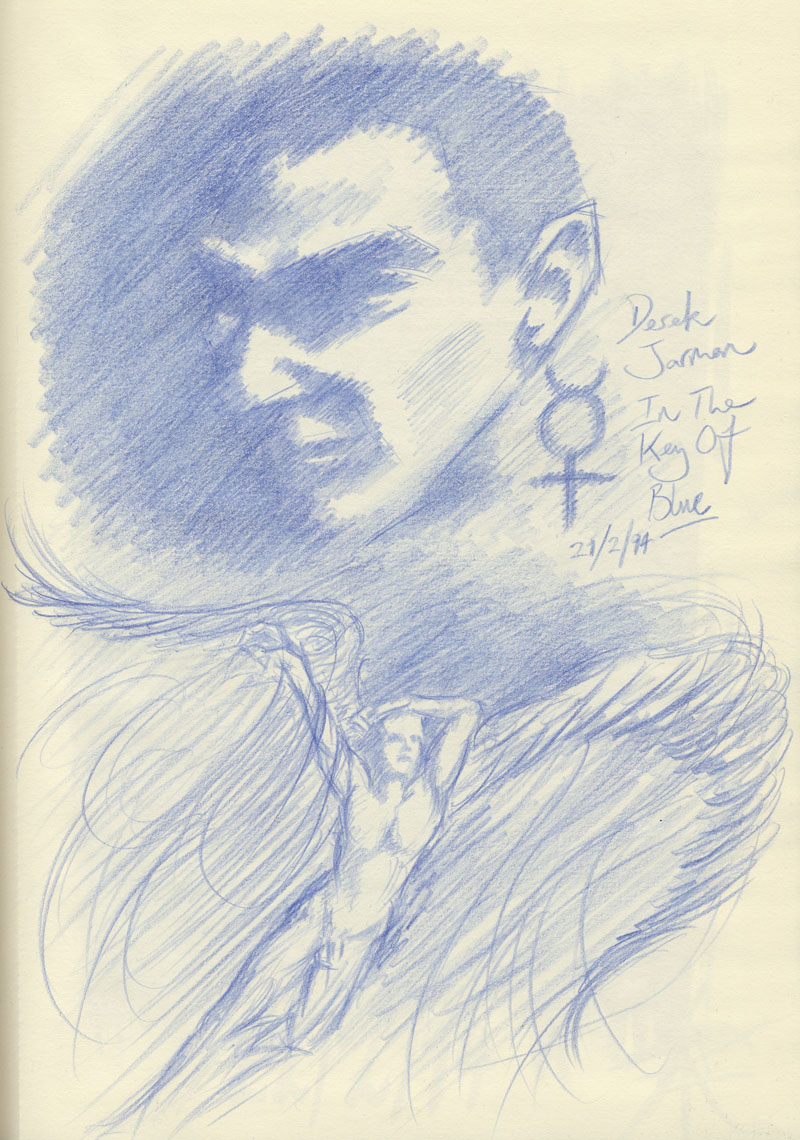
Derek Jarman died 20 years ago today. I was keeping a sketchbook at the time, something I’ve seldom bothered with before or since, and this was my reaction to the news a couple of days later, possibly drawn whilst watching one the TV documentaries which were being screened at the time.

Some current news items:
England’s alchemist, a piece by Philip Hoare
Unseen nightclub film to get London premiere
‘So Mum covered me in cooking oil. Then Dad came home’
Queer Pagan Punk, a season of films by Jarman and others, is currently running at the BFI Southbank.

Previously on { feuilleton }
The Dream Machine
Jarman (all this maddening beauty)
Sebastiane by Derek Jarman
A Journey to Avebury by Derek Jarman
Derek Jarman’s music videos
Derek Jarman’s Neutron
Mister Jarman, Mister Moore and Doctor Dee
The Tempest illustrated
In the Shadow of the Sun by Derek Jarman
Derek Jarman at the Serpentine
The Angelic Conversation
The life and work of Derek Jarman

The Dream Machine

dreamachine1.jpg

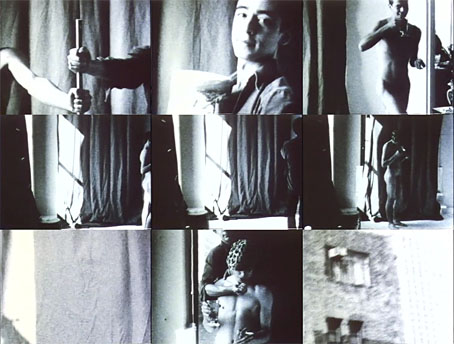
This is a 35-minute anthology film from 1986 with a very painterly, poetic (for want of a better term) quality of a kind I’ve not seen for some time in queer cinema. The reasons for this can be debated at greater length than I care to attempt, but it’s notable that a feature of the work of Derek Jarman—one of the featured directors—was an approach that was always happy to dispense with naturalism and the aping of familiar film and television narratives. In place of Jarman’s visionary approach we now have the “ordinary gay lives” of Weekend and Looking. This may satisfy those eager to see their own lives reflected on the screen but I’m usually expecting more from my cinema than another mirror held up to mundane reality. (And a very circumscribed reality, at that.)

dreamachine2.jpg

The theme of The Dream Machine is Bryon Gysin’s hallucination-inducing artwork of the same name. Brief clips by Tim Burke of Gysin sat with eyes closed in front of his flickering cylinder form the connective tissue between sections by directors Jarman, Michael Kostiff, Cerith Wyn Evans, and John Maybury. We can take these as either the dreams of those behind the camera or perhaps the visions seen by Gysin behind his eyelids. Needless to say there’s a fair amount of naked male flesh on offer, presented in a matter-of-fact manner or as the embodiments of some personal symbolism. The film can be seen here in not very flattering quality. Both Cerith Wyn Evans and John Maybury started out as assistants on Jarman’s films. Wyn Evans appears briefly in Caravaggio (1986) but is now better known as an artist, while Maybury went on to direct another excellent artist biopic, Love Is the Devil: Study for a Portrait of Francis Bacon (1998).

dreamachine3.jpg

Previously on { feuilleton }
Jarman (all this maddening beauty)
Sebastiane by Derek Jarman
A Journey to Avebury by Derek Jarman
Derek Jarman’s music videos
Derek Jarman’s Neutron
Mister Jarman, Mister Moore and Doctor Dee
The Tempest illustrated
In the Shadow of the Sun by Derek Jarman
Derek Jarman at the Serpentine
The Angelic Conversation
The life and work of Derek Jarman

Love gods

ganymede.jpg

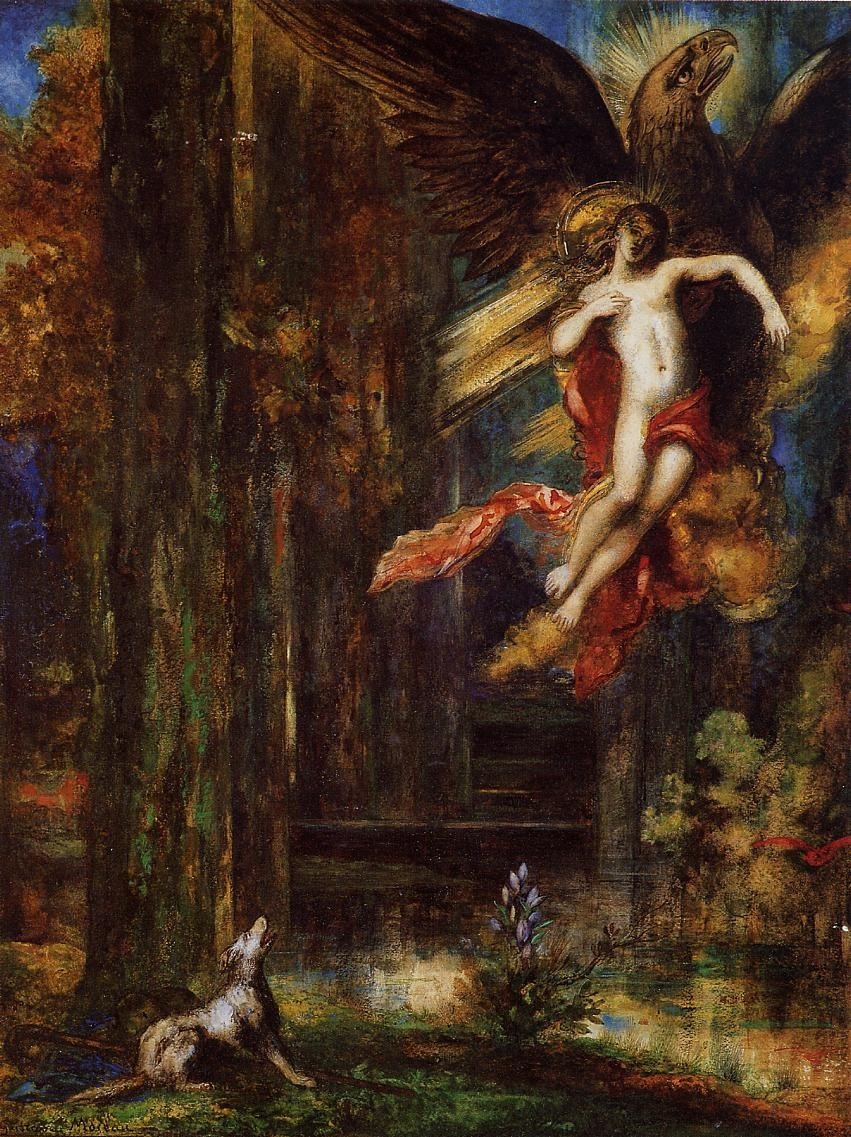
The Raising of Ganymede (1886) by Gustave Moreau.

The story of the love between Zeus, king of the gods, and Ganymede, the handsome son of the Trojan king, goes back at least three thousand years and its roots disappear into the prehistoric neolithic. (more)

hylas.jpg

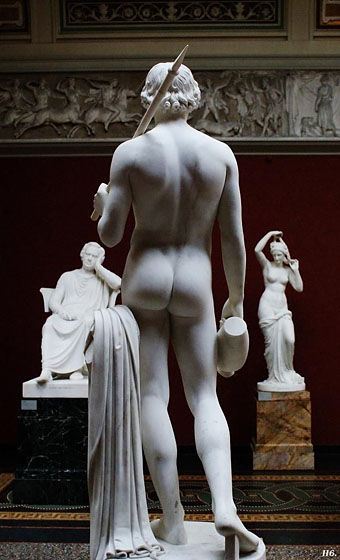
Hylas (1846) by HW Bissen.

Not for us only, Nicias, (vain the dream,)
Sprung from what god soe’er, was Eros born:
Not to us only grace doth graceful seem,
Frail things who wot not of the coming morn.
No—for Amphitryon’s iron-hearted son [Heracles],
Who braved the lion, was the slave of one:—

A fair curled creature, Hylas was his name.
He taught him, as a father might his child,
All songs whereby himself had risen to fame;
Nor ever from his side would be beguiled
When noon was high, nor when white steeds convey
Back to heaven’s gates the chariot of the day,

Nor when the hen’s shrill brood becomes aware
Of bed-time, as the mother’s flapping wings
Shadow the dust-browned beam. ‘Twas all his care
To shape unto his own imaginings
And to the harness train his favourite youth,
Till he became a man in very truth.

Theocritus, Idyll XIII: Hylas.

pan_daphnis.jpg

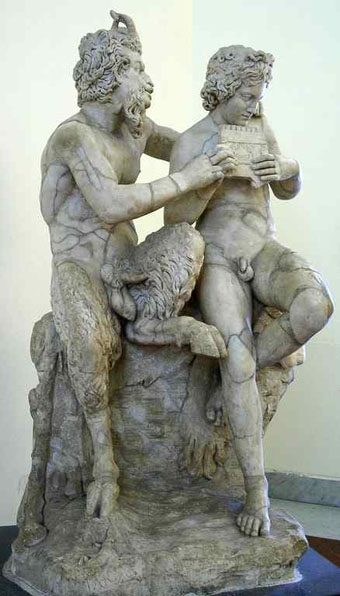
Pan teaching Daphnis to play the panpipes; Roman copy of a Greek original from the 3rd-2nd centuries BCE by Heliodoros.

hyacinth.jpg

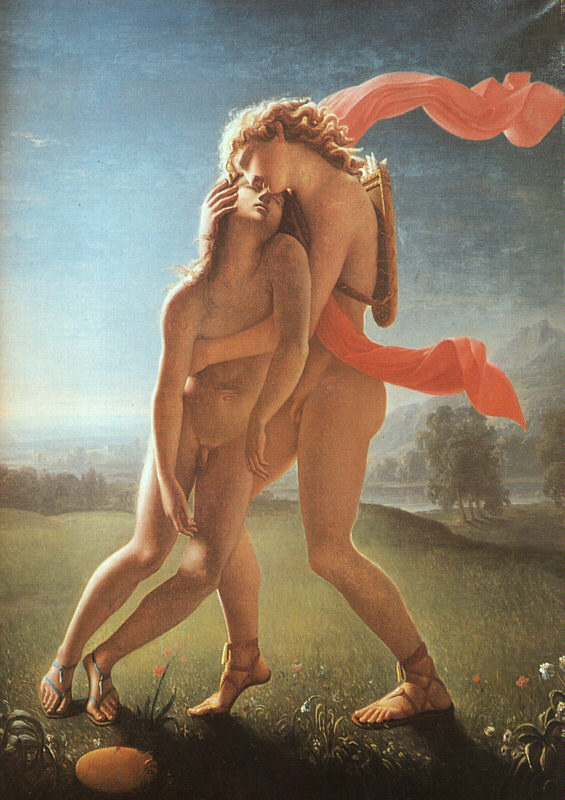
The Death of Hyacinthos (1801) by Jean Broc.

‘You too, Hyacinthus, of Amyclae, Phoebus would have placed in heaven, if sad fate had given him time to do so. Still, as it is, you are immortal, and whenever spring drives winter away, and Aries follows watery Pisces, you also rise, and flower in the green turf. My father, Phoebus, loved you above all others: and Delphi, at the centre of the world, lost its presiding deity, while the god frequented Eurotas, and Sparta without its walls, doing no honour to the zither or the bow. Forgetting his usual pursuits, he did not object to carrying the nets, handling the dogs, or travelling as a companion, over the rough mountain ridges, and by constant partnership feeding the flames.

‘Now, the sun was midway between the vanished and the future night, equally far from either extreme: they stripped off their clothes, and gleaming with the rich olive oil, they had rubbed themselves with, they began a contest with the broad discus. Phoebus went first, balancing it, and hurling it high into the air, scattering the clouds with its weight. Its mass took a long time to fall back to the hard ground, showing strength and skill combined. Immediately the Taenarian boy, without thinking, ran forward to pick up the disc, prompted by his eagerness to throw, but the solid earth threw it back, hitting you in the face, with the rebound, Hyacinthus.

‘The god is as white as the boy, and cradles the fallen body. Now he tries to revive you, now to staunch your dreadful wound, and now applies herbs to hold back your departing spirit. His arts are useless: the wound is incurable. Just as if, when someone, in a garden, breaks violets, stiff poppies, or the lilies, with their bristling yellow stamens, and, suddenly, they droop, bowing their weakened heads, unable to support themselves, and their tops gaze at the soil: so his dying head drops, and, with failing strength, the neck is overburdened, and sinks onto the shoulder.

Ovid’s Metamorphoses, Bk X:143-219 Orpheus sings: Ganymede; Hyacinthus

Previously on { feuilleton }
Three stages of Icarus
The end of Orpheus