Wildeana 3

teleny.jpg

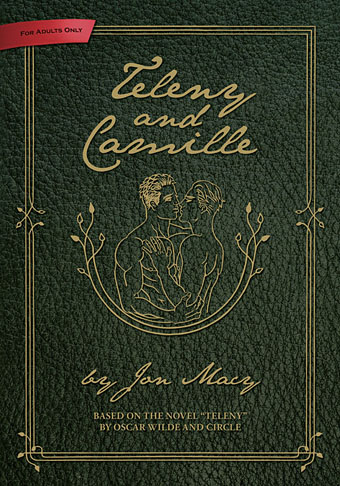
Some recent pieces of Wilde news. The cover above is for a new edition of Teleny and Camille, Jon Macy‘s comic strip adaptation of the erotic novel attributed to Oscar Wilde and members of his Uranian circle:

Teleny is the haunted musical genius that everyone desires but no one has truly touched… until the fateful night that he senses Camille’s presence in the audience. The wealthy young man is instantly seduced by Teleny’s dark beauty and smoldering melancholy. This groundbreaking and powerful early gay novel, written in secret by Oscar Wilde and his anonymous circle of writers, is now re-interpreted as a graphic novel, in all its lush, pansexual excess.

I wrote something about the novel last year. I’m not convinced that Wilde penned the whole thing but I can see places where he may have contributed. There’s a marvellous scene in an all-white room, for example, which seems inspired by the obsessive decor in Des Esseintes’ house from À rebours, the novel which had a great influence on Dorian Gray (both book and character). I’d been intending on writing something substantial about Macy’s adaptation all summer but failed dismally due to a deluge of deadlines. Suffice to say it’s a very accomplished and (most important) erotic work, doing full justice to a story that makes many later erotic novels seem timid and evasive. The drawings are black-and-white throughout which gives a Beardsley-like quality in places, and Macy conveys a period feel without fretting over details as I’m afraid I’d be tempted to do. Northwest Press have published the new edition and have a selection of reviews here.

For the other Wildeana, Lambda Literary had a review of a new book by Matthew Hofer and Gary Scharnhorst, Oscar Wilde in America: The Interviews which sounds like another essential purchase. And the Independent had this story about a sale of Wilde letters which included one to a magazine editor that may be read as a proposition. Readers of Neil McKenna’s The Secret Life of Oscar Wilde will be familiar with the form and know that there’s no “maybe” about it; Priapus was calling.

Elsewhere on { feuilleton }
The gay artists archive
The Oscar Wilde archive

Diaghilev and the Ballets Russes

diaghilev1.jpg

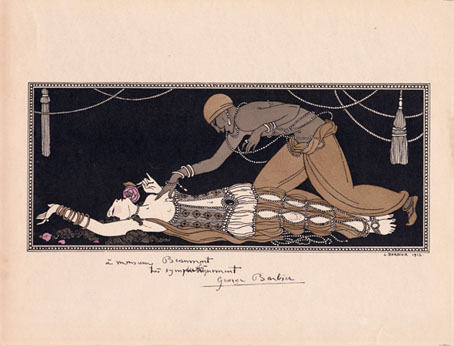
Ida Rubinstein as Zobeide and Vaslav Nijinsky as the Golden Slave in Schéhérazade (1913) by George Barbier.

Another great exhibition at the V&A, London, Diaghilev and the Ballets Russes gathers a wealth of costumes, stage designs, photographs and ephemera—including some of Stravinsky’s manuscripts—to present a history of the legendary ballet company and their visionary impresario. For those who can’t get to London the museum website shows some of the items which will be on display, and there’s also a blog about the installing of the exhibition. The enormous frontcloth from 1924 based on Picasso’s Two Women Running on the Beach received a flurry of attention in the press here but my own attention was caught by the picture of Natalia Goncharova‘s even more enormous backcloth for The Firebird. The exhibition runs to January 9, 2011.

diaghilev2.jpg

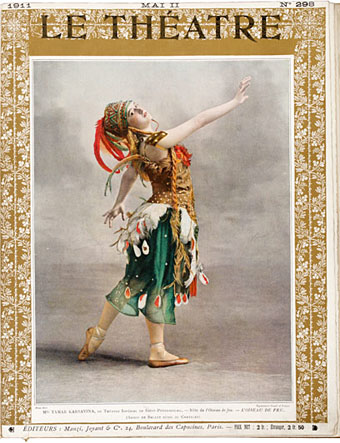
Cover of Le Théatre showing Tamara Karsavina in costume as the Firebird, May 1911.

While we’re on the subject, a new biography of the impresario, Diaghilev: A Life by Sjeng Scheijen, was reviewed last week in the New York Times:

Diaghilev loved beautiful young men, and at a time when the fashion in ballet was to exchange patronage for sex, his company provided a bounty. Scheijen dexterously plays his sources against one another to examine the erotic and professional dynamics between Diaghilev and his stars.

For a fictional (and necessarily heterosexual) account of those erotic and professional dynamics, I recommend Michael Powell & Emeric Pressburger’s The Red Shoes (1948) which not only has a central character based on Diaghilev but includes among the cast of real dancers Léonide Massine, dancer and principal choreographer of the Ballets Russes from 1915 to 1921.

See also:
Russian Ballet History | An archive and documentary site.

Previously on { feuilleton }
Pamela Colman Smith’s Russian Ballet
The art of Ivan Bilibin, 1876–1942
Jack Cardiff, 1914–2009
Magic carpet ride
Le Sacre du Printemps
Images of Nijinsky

Der Eigene: Kultur und Homosexualität

eigene1.jpg

Der Eigene, collected edition, 1906. Design credited to Adolf Brand.

The subtitle is from an article (see below); Der Eigene, the world’s first homosexual periodical was devoted to an ideal of “masculine culture” which looked to Ancient Greece for a model of same-sex relationships. Adolf Brand (“Editor, photographer, poet, polemicist, activist, anarchist, enfant terrible“) founded Der Eigene in Berlin 1896, and to give some idea of how advanced the Germans were in these matters, consider that not only was this a year after Oscar Wilde had been imprisoned in Britain but that Brand’s publication was only the first of several journals advocating gay rights at a time when homosexual acts were still illegal in Germany. The radicalism fell short of including women, unfortunately; like many Grecophile pioneers of the time, Brand’s world had no place for females. All this activity was part of a peculiar ferment in Germany around 1900 which saw the rise of many small groups devoted to naturism, Theosophy, occultism in general, and various pagan revivals. There were also plenty of fiercely nationalist factions, of course, and these took a dim view of Brand’s outspoken homo-anarchism. When the nationalists later turned into the Nazis they destroyed Germany’s nascent gay culture.

eigene3.jpg

Morgendämmerung (Dawn) by Sascha Schneider, 1897. This drawing also appeared in Jugend magazine the same year.

The pictures here are from sets at Wikimedia Commons where the section devoted to the magazine has finally been amended with some higher-resolution copies. It’s a shame there isn’t more to see given that Der Eigene ran until 1932. I’ll be hoping for further works to come to light as the digitisation of rare publications gathers pace.

eigene2.jpg

Der Eigene, November, 1920.

Elsewhere on { feuilleton }
The gay artists archive

Previously on { feuilleton }
Sanctuarium Artis Elisarion
Jugend Magazine revisited
The art of Sascha Schneider, 1870–1927
Hadrian and Greek love

Vintage eye candy

sargent.jpg

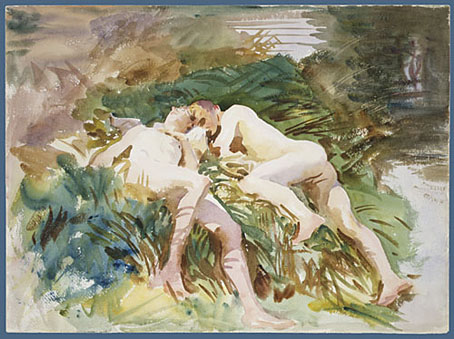
Tommies Bathing by John Singer Sargent (1918).

More discoveries from recent image trawls. There’s been plenty of speculation about the sexuality of John Singer Sargent—see here, for example—and this watercolour depiction of relaxing British soldiers would seem to be another of his works which confirms an enchantment with the male form. Lust aside, it’s a remarkable and typically assured sketch in a difficult medium.

hicok1.jpg

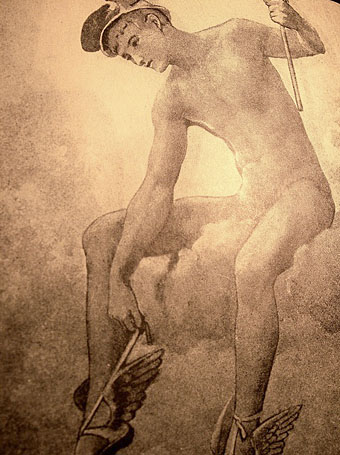
Hermes by Will H. Low (1885).

Will Low’s Greek god is from an illustrated edition of Keats’ Lamia, a PDF of which can be found at the Internet Archive although the compression setting is so severe that the drawings are pretty much ruined throughout. This is how Microsoft and Google are safeguarding the world’s artistic heritage… The copy above comes via another Flickr set.

hicok2.jpg

Also at Archive.org, and far better quality, is another book illustrated by Will Low, In Arcady by Hamilton Wright Mabie, a rather insipid parable in a faux-Classical manner which gave the artist an opportunity to fill the pages with piping fauns and naked youths. It wouldn’t be fair to paint Low as another closet Uranian like Sargent solely on account of this handful of drawings; for now he can remain a further victim of our salacious modern sensibilities.

Elsewhere on { feuilleton }
The illustrators archive

The art of Ignacio Goitia

goitia1.jpg

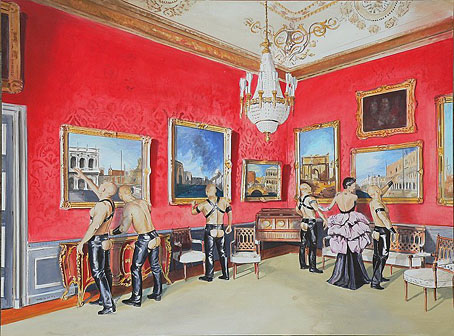
Pasión por Canaletto (2005).

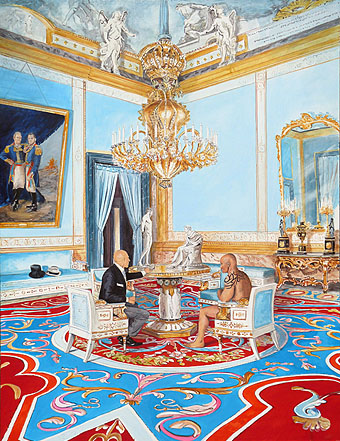
Ignacio Goitia is a Spanish artist whose depictions of opulent aristocracy manage to be subversively homoerotic thanks to the addition of figures we can interpret as boyfriends, sex slaves or wish-fulfilling phantasms; Ludwig II would no doubt approve of the sentiment even if he disagreed with some of the decor. Goitia’s art increases the Surrealist incongruity in other paintings with a preponderance of giraffes, although none of them appear to be burning à la Dalí. You’ll have to browse his galleries to see how he uses them.

Another Thombeau tip—thanks Tom!

goitia2.jpg

Royal couple (2010).

Elsewhere on { feuilleton }
The gay artists archive

Previously on { feuilleton }
Schloss Neuschwanstein