Carceri, thermae and candelabra

piranesi_tivoli.jpg

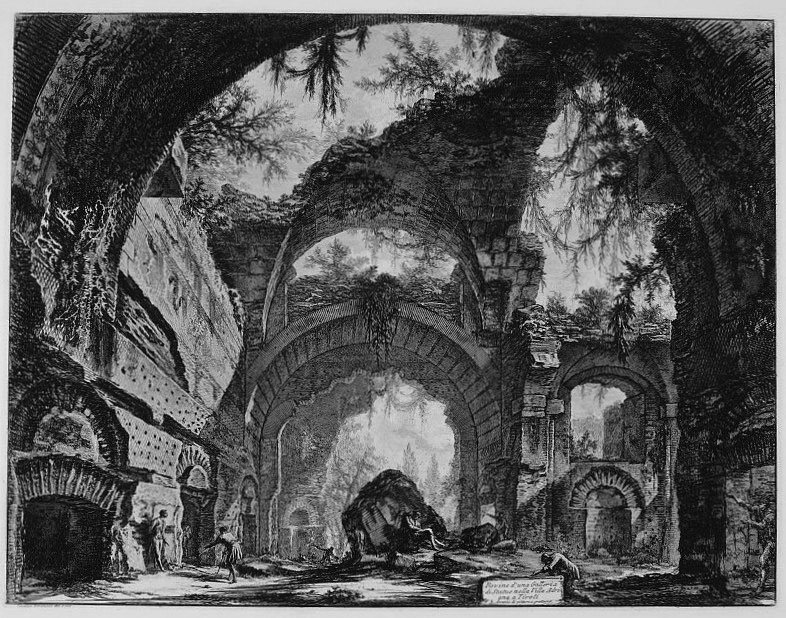
Piranesi’s etching which purports to show a statue gallery at Hadrian’s Villa was published in 1770 as part of the artist’s Vedute di Roma series, and conveniently provides a themed link for a pair of new exhibitions. The artist’s attribution of statue gallery was a mistaken one, the structure is actually the remains of Hadrian’s thermae, or baths, but archaeology was still in its infancy in the 18th century so mistakes were inevitable. If you’re fortunate enough to be in Venice during the next two months the Fondazione Cini has a major exhibition of Piranesi’s work, The Art of Piranesi: architect, engraver, antiquarian, vedutista, designer. On display are over three hundred prints which no doubt include many of the Vedute di Roma.
piranesi.jpg

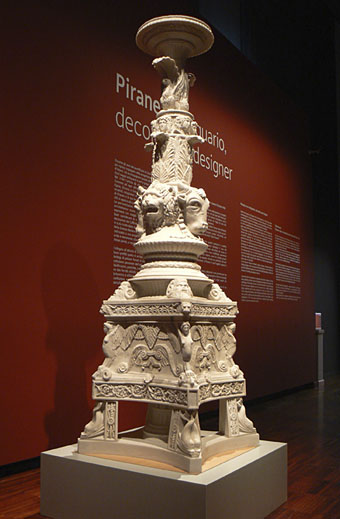
Ornamental candelabrum created by Factum Arte from a design by Piranesi.

Good as that sounds, what’s especially notable about this exhibition is a presentation of three-dimensional works specially created from Piranesi’s designs for candelabra, fireplaces, and other objects based on his studies of artefacts from the ancient world. These pieces have been produced by Factum Arte who have a great website showing the finished pieces and also a page detailing the production of the objects. Also on that page is one of the exhibition’s other features, a 10-minute video by Gregoire Dupond which cleverly joins together and animates a journey through several of Piranesi’s Carceri d’invenzione (Imaginary Prisons). The music accompaniment is Bach’s Cello Suite 2 which happens to be the piece played by Yo-Yo Ma in an earlier animation of the Carceri, so it’s a reasonable guess that the earlier film was an inspiration for this new work. The exhibition runs to November 21, 2010.
jauregui.jpg

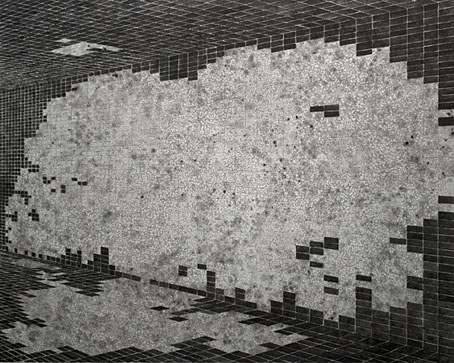
Jack’s Bath (2010) by Danny Jauregui. Gouache on canvas.

Hadrian’s obsession with his doomed lover Antinous makes the Emperor a gay icon which explains the connection between Piranesi’s view of the ruined baths and an exhibition of work by American artist Danny Jauregui. There Goes the Neighborhood is at the Leslie Tonkonow Gallery, New York, and features a selection of Jauregui’s paintings of tiles from the bathhouses which were a feature of gay life in the days before AIDS.

I make paintings of bathhouses in ruin. Moldy, disheveled and abandoned, the paintings are memorials to the absence of memorials – indexes of the traumatic erasure inflicted on the radical gay sexuality of the past. They are paintings of what I imagine those spaces to look like, had they not been disguised and hidden from sight. (More.)

The exhibition runs until October 30, 2010. By coincidence gay news blog Towleroad had a post yesterday about New York’s first anti-gay police raid on the Ariston Baths in 1903.
time-bandits.jpg

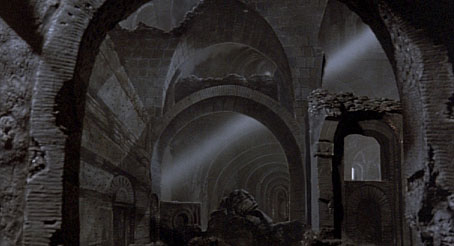
Time Bandits.

Seeing as I posted the picture of Hadrian’s baths I have to also post this shot from Terry Gilliam’s Time Bandits (1981) showing the interior of the Fortress of Ultimate Darkness. Here we see the Piranesi’s ruined baths incorporated into a vast and gloomy space which must surely be inspired by the Carceri, the views of Rome being absorbed by the artist’s darker imaginings. And for a final piece of trivia, writer Marguerite Yourcenar is not only the author of Memoirs of Hadrian (1951), a novel about the Emperor’s passion for Antinous, but also penned an essay about the Carceri. I haven’t read either of those works so I think it’s time to add them to the shopping list.

Update: For those in the UK, there’s also Piranesi’s Prisons, an exhibition at the Mead Gallery, Warwick, from now until December.

Elsewhere on { feuilleton }
The etching and engraving archive

Previously on { feuilleton }
La Tour by Schuiten & Peeters
Set in Stone
Hadrian and Greek love
Piranesi as designer
Vedute di Roma
Aldous Huxley on Piranesi’s Prisons
The Cult of Antinous

Totem and tattoo

katana.jpg

My thanks to Clive for suggesting this stunning photo, another jewel dredged from the Tumblr swamps which, after some searching around, I discovered originates here. The model is a Brit named Ben, and the blog page showing more of his pictures describes his body art as “one of the sexiest tattoos I’ve ever seen on a guy”. No disagreement there.

Elsewhere on { feuilleton }
The men with swords archive

Weekend links 32

ji1.jpg

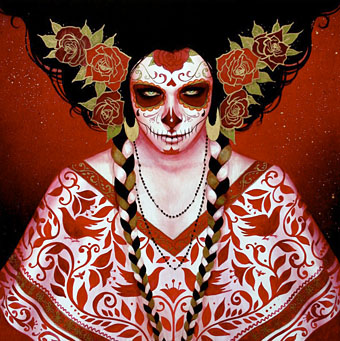
Red Quechquemitls (2010) by Sylvia Ji.

• The Blackout Mix, a pay-what-thou-wilt 49-minute mixtape, “specially designed to accompany (or simulate) a human-plant interaction”. Art by Arik Roper, music selection by Jay Babcock.

An ode to the many evolved virtues of human semen: “the penis is capable of dispensing a sort of natural Prozac” says Jesse Bering.

• The new John Foxx CD & DVD release, D.N.A., has a Jonathan Barnbrook cover, a new collaboration with Harold Budd and a disc of short films.

• “I have been copying Margaret Hamilton my whole life, and I am proud to admit it. The Wicked Witch of the West, the jolie laide heroine of every bad little boy’s and girl’s dream of notoriety and style, whose twelve minutes of screen time in The Wizard of Oz can never be topped … I’m a big butch-lesbian hag. I love the ones with chips on their shoulders and heavy attitude. They’re my real favorites.” John Waters always gives great interviews.

• Listen to a track from the forthcoming Brian Eno album while you’re reading Kristine McKenna’s interview with the man himself at Arthur mag. Includes an appreciation by Alan Moore.

ji2.jpg

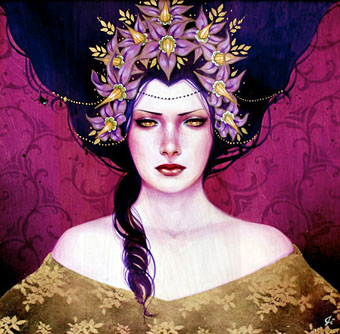
Atropa Bella Donna (2009) by Sylvia Ji.

• Steven Severin is touring the UK this month, performing a live accompaniment to screenings of Jean Cocteau’s The Blood of a Poet. He’s at the Tyneside Cinema this Tuesday. Other dates can be found on his website.

• “I know it’s a very emotive subject and you’re either for it or against it but for a jobbing self-employed musician such as me – bootlegging (CD copying) is just killing us.” Finding The Spaces Between: musician Chris Carter (Throbbing Gristle, Chris & Cosey, et al) interviewed.

Mile End Pugatorio (1991), a one-minute film-poem by Guy Sherwin and Martin Doyle. Related: four one-minute movies by The Residents.

• Gijs Van Vaerenbergh installed an Upside Dome at the St. Michiel Church in Leuven, Belgium.

• Sidney Sime illustrates Lord Dunsany at Golden Age Comic Book Stories.

Europe according to gay men. There’s more at Mapping Stereotypes.

• There’s never a dull moment in the High Desert.

• Generative art by Leonardo Solas.

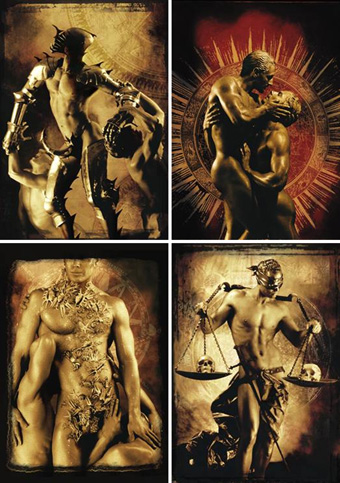
Richard de Chazal’s Zodiac

chazal.jpg

top left: Scorpio; top right: Gemini.
bottom left: Cancer; bottom right: Libra.

Following the zodiac sets from August, here’s a distinctly homoerotic variation on the theme by Australian photographer and fashion designer Richard de Chazal. See the full set here. Also on his site is a selection of his erotic photography which may interest some of the visitors who’ve been arriving here all week from porn site Queerclick. The small size of the photos should be taken as an encouragement to buy Mr De Chazal’s book. Via Chateau Thombeau.

Elsewhere on { feuilleton }
The gay artists archive

Previously on { feuilleton }
Mucha’s Zodiac
Owen Wood’s Zodiac
Palladini’s Zodiac
The Major Arcana by Jak Flash

Arthur Penn, 1922–2010

bandc.jpg

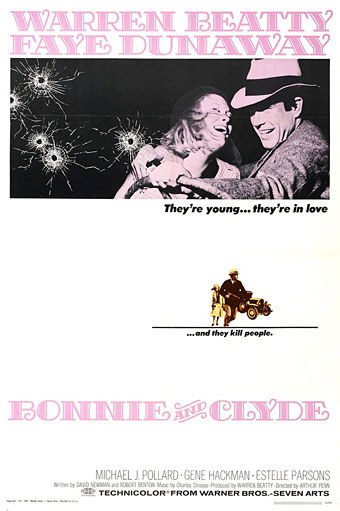
Design by Bill Gold.

With respect to Bonnie and Clyde and my other films, I would have to say that I think violence is a part of the American character. It began with the Western, the frontier. America is a country of people who act out their views in violent ways—there is not a strong tradition of persuasion, of ideation, and of law.

Let’s face it: Kennedy was shot. We’re in Vietnam, shooting people and getting shot. We have not been out of a war for any period of time in my lifetime. Gangsters were flourishing during my youth, I was in the war at age 18, then came Korea, now comes Vietnam. We have a violent society. It’s not Greece, it’s not Athens, it’s not the Renaissance—it is the American society, and I would have to personify it by saying it is a violent one. So why not make films about it.

From The Bonnie and Clyde Book (1972)

Thus film director Arthur Penn, whose death was announced earlier this week, speaking at a press conference in Montreal in 1967 following the first screenings of Bonnie and Clyde. Penn’s film shocked critics and audiences at the time ostensibly for its graphic violence although the disturbance went deeper than that. What I found shocking the first time I saw it—home alone one evening, watching TV with no idea what to expect—was the abrupt shifts of tone from near comedy (the speeding cars and bluegrass soundtrack, Gene Wilder’s role) to awful realism as the consequences of a life of bank-robbing became apparent. This was disturbing for audiences used to being spoon-fed their morality tales with easily identifiable heroes and villains; the sudden, savage conclusion was especially jolting. A “nightmare comedy” quality was a hallmark of Penn’s best work, and he followed Bonnie and Clyde with another nightmare comedy that’s also a further exploration of America’s troubled history, Little Big Man (1970). Here Dustin Hoffman’s character finds himself caught between the Native Americans who raised him and the warring Cavalry intent on massacring the native tribes. Like Robert Aldrich in Ulzana’s Raid (1972), Penn was using Western history to make a statement about America’s involvement in Vietnam; the soldiers in Little Big Man are murderous racists and General Custer is presented not as a doomed hero but as an unhinged psychopath. For me the film has always been distinguished by the character of Little Horse, the first (only?) gay Native American character in cinema. There’s plenty of documentary evidence for gay individuals in Native American tribes but these have seldom been seen in films. It’s Thomas Berger we have to thank for this detail, since it was Berger’s novel which Penn adapted, but the film’s writer and director are also to be congratulated for keeping a minor character who might easily have been excised.

It’s surprising when you see Bonnie and Clyde cited as one of the films that enabled directors to have more artistic freedom during the 1970s that Penn didn’t manage to do more during that golden decade. After Little Big Man there were two films which seem minor in comparison but would be major works from many lesser directors. Night Moves (1975) is one of the handful of attempts at updating film noir which appeared in the 1970s (for others see The Long Goodbye, Robert Aldrich’s Hustle and Taxi Driver), with a screenplay by Alan Sharp, the writer of Ulzana’s Raid. It’s a curio even by the standards of the decade, part detective story set in the Florida Keys, part symbolic drama with chess games and boats named “Point of View”; it’s also Penn’s last great film. The Missouri Breaks (1976), another Western, is fascinating for its pairing of Marlon Brando and Jack Nicholson but Brando’s eccentric performance is the start of his decline as an actor. It’s hard to believe that Penn only made five more films after this but he was one of a number of individual talents who flourished in the 1960s and 1970s then found themselves shut out in the 1980s as intellect was ousted by commerce. There’s even less room for him today than there was then. We’ve travelled from a time of intelligent and challenging films made by adults for adults to an era of shitty action movies and worthless adaptations of equally worthless costumed vigilantes. But I never counsel despair; celebrate what we have rather than bemoaning what we might have lost. Fuck Star Wars in 3D, watch Little Big Man instead.

Guardian obituary | NYT obituary
David Thomson on Penn