Weekend links 646

wallpaper.jpg

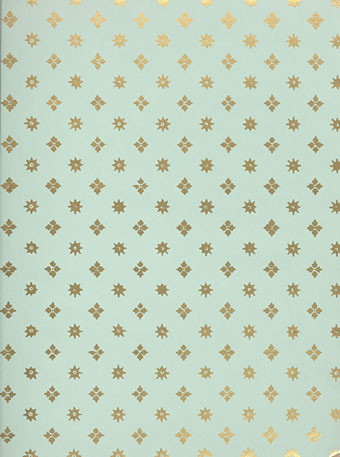
It’s that lethal book again. A sample of wallpaper impregnated with arsenic, one of many such pages in Shadows from the Walls of Death: Facts and Inferences Prefacing a Book of Specimens of Arsenical Wall Papers (1874) by RC Kedzie.

• “I like to spend time in the now because there I can create something new but in the past I cannot.” Damo Suzuki, former vocalist in Can, on creativity and his resilience in the face of long-term illness. Related: a trailer for Energy: A Documentary about Damo Suzuki.

• “I enjoy Carnival of Souls, but it is a dark form of enjoyment, with high stakes, because the enjoyment is predicated on me being able to shake myself free of the film after it is over, and that can be a struggle.” Colin Fleming on fear as entertainment.

• “Some people like fantasy epics or Regency romance or Sudoku or science-fiction world-building or the gentle challenge of cozy mysteries; I like the undead.” Sadie Stein on encounters with ghosts.

• “You’re now standing on the blocks of the Great Pyramid at Giza. For the first time ever you can explore the entire pyramid interior.” The Giza Project.

• “What do we think about when we watch films set in vanished decades that many of us experienced at first hand?” asks Anne Billson.

• At Bandcamp: Touch celebrates forty years of not being a record label.

• “Why scientists are sending radio signals to the Moon and Jupiter.”

• At DJ Food’s: Retinal Circus gig posters 1966–68.

• Steven Heller’s font of the month is Feneon.

The Pyramid Spell (1978) by Nik Turner | I Am Damo Suzuki (1985) by The Fall | Carnival Of Souls Goes To Rio (2001) by Pram

Weekend links 645

macgeorge.jpg

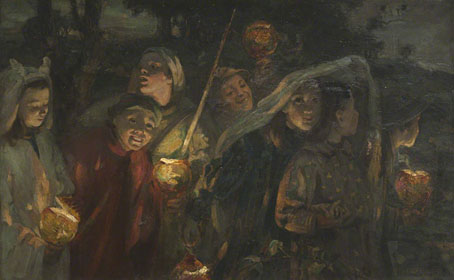
Halloween (no date) by William Stewart MacGeorge.

• Couldn’t Care Less: Cormac McCarthy in a 75-minute conversation (!) with David Krakauer at the Santa Fe Institute, filmed in 2017 and recently posted to YouTube. Not a literary discussion, this one is all about science, philosophy, mathematics, architecture and the operations of the unconscious mind. McCarthy’s essay about the origins of language, The Kekulé Problem, may be read here.

• At Wormwoodiana: Douglas A. Anderson finds a 1932 reprint of an HP Lovecraft story, The Music of Erich Zann, in London newspaper The Evening Standard. The story had appeared a few months prior to this in a Gollancz book, Modern Tales of Horror which reprinted a US collection edited by Dashiell Hammett. The newspaper printing includes an illustration by Philip Mendoza.

• New Hollywood Vs Mutant Cinema: The flipside of US cinema, 1960s–80s. Joe Banks talks to Kelly Roberts, Michael Grasso and Richard McKenna about their new book, We Are the Mutants: The Battle for Hollywood from Rosemary’s Baby to Lethal Weapon.

• At Bandcamp: Rich Aucoin explains the army of synths on his new quadruple album. The battalion includes the bespoke modular setup known as T.O.N.T.O., a rig that few people get to play with.

• New/old music: Malebox, an EP of Patrick Cowley rarities coming soon from Dark Entries.

• Mix of the week: Samhain Séance 11: endleofon by The Ephemeral Man.

• The surreal photographs of Ralph Eugene Meatyard.

• “NASA team begins study of UFOs”.

Ghost Rider (1969) by Musical Doctors | Ghost Rider (1970) by The Crystalites | Ghost Rider (1977) by Suicide

The ghost at the window

bava1.jpg

I’ve been taking advantage of the Spook Season to finally watch some of the horror films that I’ve known about for decades but never managed to see until now. Among the collection has been Ishiro Honda’s fungal nightmare, Matango (1963), and the Poe-themed Spirits of the Dead (1968), one of those Italian anthology films that proliferated in the 1960s, this one featuring episodes directed by Roger Vadim, Louis Malle and Federico Fellini. Still to come is Ugetsu Monogatari (1953), Kenji Mizoguchi’s ghost film.
curse.jpg

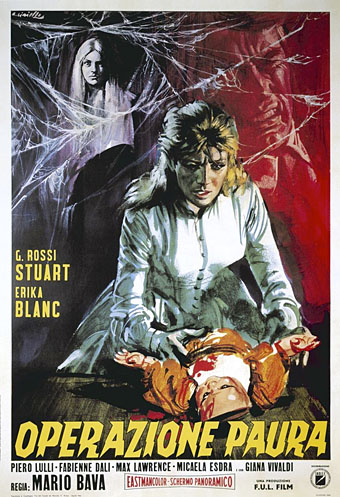
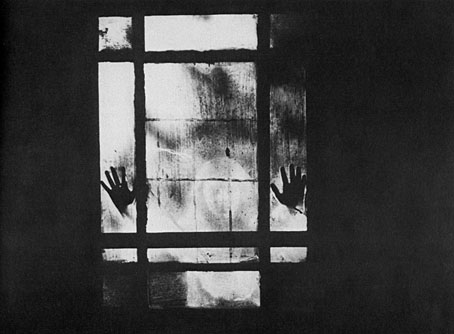
Topping the list was Curse of the Dead (1966), another ghost film directed by Mario Bava. Ten years ago I wrote a post about a black-and-white still from Bava’s film (see above) which has proved surprisingly popular, finding its way onto a number of book and record covers. The still is one of many that fill the pages of Denis Gifford’s A Pictorial History of Horror Movies (1973), and had intrigued me long before I started to notice its use elsewhere. Gifford, however, wasn’t much help when trying to find out more about the film itself. Curse of the Dead is one of the few films that he doesn’t discuss in his book, and its title compounded the mystery when nothing with that name was listed in film guides. The problem turned out to be one that plagues horror films, especially the older variety, whereby a film’s title changes each time it crosses a national border. Gifford was using the British name given to something originally released in Italy as Operazione Paura (Operation Fear). Curse of the Dead is rather vague—it would suit any number of other films—but it’s preferable to the Italian one, which makes it sound like a spy thriller, and far better than the other alternatives. Since America dominates the film business it’s usually the American title, Kill, Baby, Kill, that you see this one listed under, a typical piece of overkill (so to speak) from US distributors AIP. In Germany it was released as The Thousand Eyes of Dr Dracula, a ridiculous play on Fritz Lang’s final Dr Mabuse film.
bava2.jpg

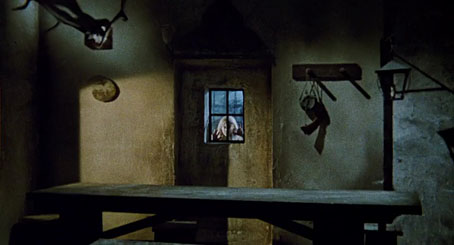
Curse of the Dead.

Whatever the title, Bava’s film is well worth seeking out. The story concerns a doctor who arrives at a small Carpathian village to perform an autopsy on a young woman who has died in mysterious circumstances. The death is one of several that have blighted the village, all caused by a blonde ghost girl whose appearance at night—always dressed in white, and playing with a bouncing white ball—seals the doom of anyone who encounters her. A story that in other hands might be rote and predictable (hello, Hammer Films) is anything but, thanks to Bava’s visual artistry and inventiveness in the face of a severely limited budget. Halfway through the film the narrative logic dissolves into an extended nocturnal investigation punctuated by remarkable dreamlike moments, notably a scene in which the doctor ends up chasing himself through a succession of doors in identical rooms twenty-five years before Agent Cooper did something similar in Twin Peaks. The “Carpathian” exteriors are mostly Italian countryside, filmed in a mountain village whose ruined nature adds a great deal to the atmosphere. As for the intriguing hands-at-the-window moment, I was prepared to be disappointed by its eventual appearance but Bava makes it a key moment after teasing us with other shots like the one above, showing spectral hands and faces at windows.
fellini.jpg

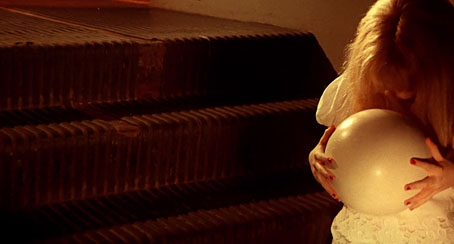
Toby Dammit.

Bava’s ghost (or a version of her) reappeared two years later in the Fellini episode of Spirits of the Dead, a detail I’d forgotten about until this week. Fellini’s Toby Dammit is the best part of the anthology feature but the Poe story he was adapting, Never Bet the Devil Your Head, doesn’t involve any blonde ghost girls. Terence Stamp is the title character, playing an actor rather like himself who succumbs to an alcohol-fuelled breakdown while being flattered and harassed by fans, paparazzi and a gallery of grotesques from the Italian film business. The ghost haunting him for inexplicable reasons is less a homage than an outright theft (she even has a bouncing white ball), something that apparently dismayed Mario Bava, understandably so after the problems he had to get his own film made. That said, Toby Dammit still carries a spooky charge even if Fellini’s spectre is a poor relation to Bava’s, with the whole episode playing like a particularly nightmarish out-take from 8 1/2.

Previously on { feuilleton }
Juliet of the Spirits
A Pictorial History of Horror Movies by Denis Gifford
Design as virus 14: Curse of the Dead
Weekend links 644

binnie.jpg

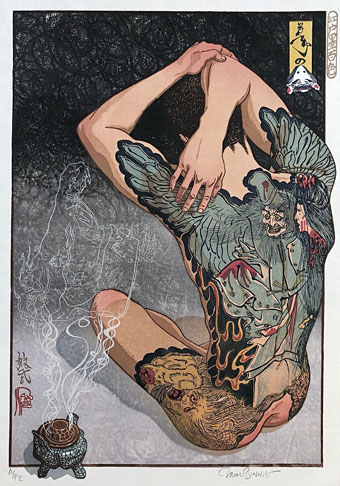
Yoshitoshi’s Ghosts (2004) by Paul Binnie.

• “The later Grand Etteilla series, printed well into the nineteenth century, and the present-day proliferation of Tarot decks, following ephemeral fads and fashions, all trace their origins to this beautiful and beguiling creation from the enigmatic Egyptophile at 48 Rue de L’Oseille.” Kevin Dann on the Livre de Thot Tarot (ca. 1789) by Jean-Baptiste Alliette, better known as “Etteilla”.

• “Death is not a subject he has ever shied away from, in his fiction or conversation. Indeed, he has measured other writers by how seriously they address it.” Richard B. Woodward on his friend, Cormac McCarthy, and McCarthy’s new novels. There’s an exclusive extract from The Passenger here.

• “…addicts, psychopaths, lovelorn outsiders, cult leaders, lesbian and gay icons…you name it, the vampire has become it.” Christopher Frayling on the perennial popularity of the vampire, and a new book collection of vampire film posters.

Robert Wilson‘s new production of Ubu Roi by Alfred Jarry is “a sinister, multilingual pantomime bathed in red light and looped in noise…fittingly violent, absurd, ominous and infantile”.

• “What kind of music goes with a show that originates in deep space?” Aquarium Drunkard on Sonny Sharrock’s final recordings, the soundtrack music for Space Ghost Coast To Coast.

• At Wormwoodiana: Mark Valentine takes a fresh look at the health of secondhand bookshops in Britain.

• Tokyo nightlife photographed by Hosokawa Ryohei.

• New music: Approach by Lawrence English.

The Passenger (1977) by Iggy Pop | The Passenger (1987) by Siouxsie And The Banshees | The Passenger (1997) by Lunachicks

Deadtime Stories for Big Folk

deadsy.jpg

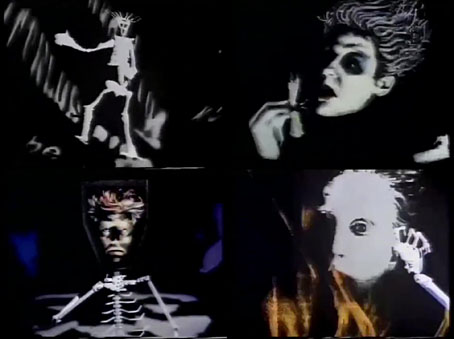
The punning title embraces a pair of short animations written and narrated by Russell Hoban. Deadsy (1989) and Door (1990) were both directed by David Anderson; notes from a VHS release describe the techniques used:

Deadsy: The film is a graphic interpretation of Russell Hoban’s narration of man’s fascination with weaponry and the sexual power of military aggression. Using a combination of live action, xerography, hand-rendering, laser xerography and model animation, Deadsy is a powerful and disturbing piece.”

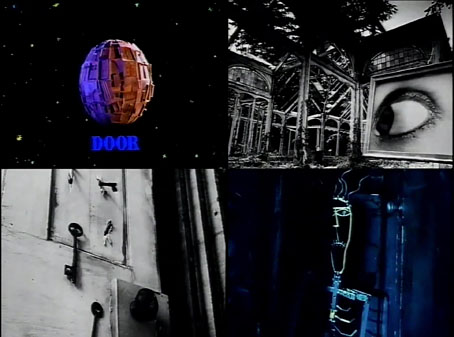
Door concerns man’s relentless and impetuous curiosity and the results of his actions when he takes one step too far. It examines our ability to shut our eyes to what those results are, or may yet be. The film employs a mix of animation, pixillation in outdoor locations, animation of photographic images and xerography.

door.jpg

Door is the most impressive of the pair on a technical level, with a complex pixillation choreography that brings to mind similar films by Jan Švankmajer; the keys burrowing through a door might be a scene from Švankmajer’s Alice. The narration, meanwhile, is a typically Hobanesque creation, littered with neologisms like “snivelisation” (is this where Orbital found their album title?), and a flavour of Beat poetry. The dialect and apocalyptic themes place the films close to Hoban’s most celebrated novel, Riddley Walker, for which they might serve as miniature appendices.

Previously on { feuilleton }
Butcher’s Hook, a film by Simon Pummell