Through the darkness of future pasts

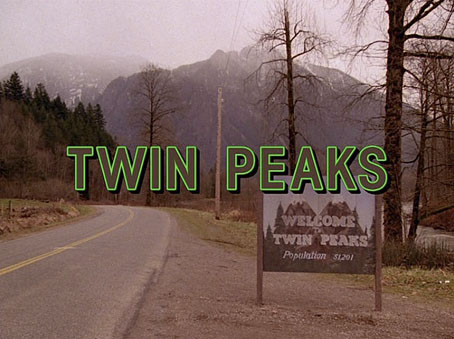
peaks1.jpg

Having spent the past two weeks re-watching the whole run of Twin Peaks, and following that with David Lynch’s 1992 prequel, Fire Walk With Me, I feel I owe the producers of these works a note of apology. Being a long-time Lynchophile I eagerly watched every episode of Twin Peaks when it was first screened by the BBC in 1991, and while I thoroughly enjoyed the first fifteen episodes I grew increasingly dismayed with the series as the principal writer and director wandered off halfway through and the whole thing lost focus. There was a return to form with the very last episode, and Fire Walk With Me is great despite some flaws, a film I much prefer to the later Lost Highway, but that disappointment meant I’d never tried watching the whole series again until now, courtesy of a very reasonably-priced Gold Box Edition (thanks, Fopp).
peaks2.jpg

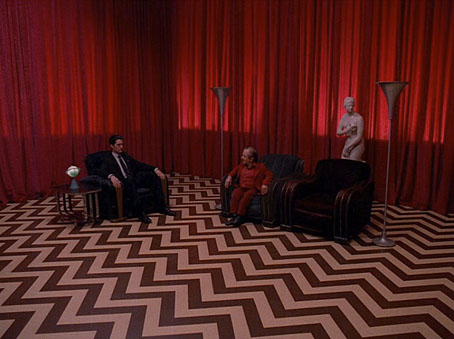
Kyle MacLachlan and Michael J. Anderson.

There were a number of surprises: first of all the main story hangs together better than I remembered, starting with the investigation into Laura Palmer’s death, grading to the cat-and-mouse game with rogue FBI agent Windom Earle, then looping back via the Black Lodge business in the final episode and Fire Walk With Me to Laura Palmer again. The sub-plots in season two are still a mix of the annoying (all the Dick Tremayne stuff) or the pointless (the unconvincing attempt to put James Hurley into a Black Widow ménage)—and the episode directed by Diane Keaton is positively amateurish—but if you stick with Agent Cooper all is well. Aside from the content lapses the quality of the whole thing was a delight, having watched the series originally with mono sound on a TV with a fuzzy picture. There are many great performances which benefit from the DVD mastering, among which I’d choose Kyle MacLachlan, Sherilyn Fenn, and especially Ray Wise as Leland Palmer whose role is by turns comic, terrifying, and ultimately tragic when he comes to terms with the horror of his predicament.

The best episodes are all Lynch-directed, of course, and I hadn’t realised before that the climax of the first story arc, the murder of Maddy Ferguson, is episode 15, right in the middle of the run. And I had the opportunity this time to do something I’m sure many Lynch-heads have done already, namely watch Fire Walk With Me after the final episode as though it’s episode 31. Seeing the film this way deepens the whole experience despite obvious disjunctions such as the slightly older cast and Donna Hayward being played by a different actor altogether. (In a David Lynch film this perhaps doesn’t matter too much.) What’s most thrilling is the realisation that Lynch has done something here which seems almost unique by joining the end of his otherwise unfinished story to its beginning; Laura Palmer’s life and death becomes a Möbius strip in which questions of ends or beginnings are negated. And why not when the Red Room is an apparently timeless space?

peaks3.jpg

Sheryl Lee.

I could enthuse at length about the musical moments which are always a high spot in Lynchland—Julee Cruise’s appearances, Audrey’s dance, Little Jimmy Scott (!) in The Black Lodge—but if you’ve seen these you’ll know to what I refer. If you haven’t, well…your life is a hollow sham. Now that we’re in the month of the Gift Apocalypse I’d thoroughly recommend the Twin Peaks box as a purchase for anyone who likes the weird stuff. A feast of garmonbozia awaits.

Previously on { feuilleton }
David Lynch window displays
Patrick McGoohan and The Prisoner
David Lynch in Paris
Inland Empire

Weekend links 39

galas.jpg

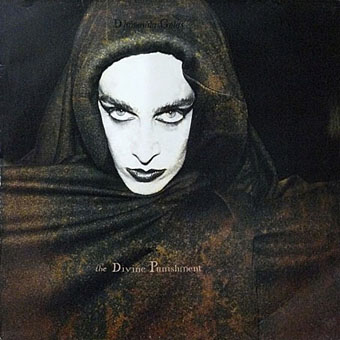
The Divine Punishment (1986) by Diamanda Galás. Design by Paul White/Me Company.

What the Catholic League and certain members of the House presumably wish to remove from their consciousness is thirty years of death sentences handed down to their parishioners and citizenry, who were told not to wear condoms, and the mistreatment of those stigmatized as miscreants and sinners by their viral status and/or homosexuality and/or status as drug addicts.

• Diamanda Galás responds in her usual forthright manner to the censoring of David Wojnarowicz’s film (and her music which accompanied it) by the Catholic League and members of the House of Representatives earlier this week. Related: Demonstrators gather to protest removal of Wojnarowicz art from NPG | Is the censored David Wojnarowicz video really ‘anti-Christian’? | Vengeance is hers: a conversation with Diamanda Galás.

Update: Hide/Seek: Too shocking for America. One of the exhibition curators speaks out against the censorship.

“Their attitude is: ‘Next time you think of writing about sex, don’t,'” said Susie Bright, who was the editor of the Best American Erotica anthology series for 15 years. “I can’t think of any other fundamental human experience that writers would be encouraged to keep to themselves.” Melissa Katsoulis, a literary reviewer for the Times of London, certainly seemed to conform to Bright’s impression when asked to comment on the award by the BBC: “Sex is a subject best avoided altogether,” she said. “If I was writing a novel, I wouldn’t attempt to write it except in the most Victorian and prim way, because it’s awful. It’s a cliché, but the moments of genuine frisson in books are when hardly anything happens.” Speak for yourself, missy.

Laura Miller dissing the Literary Review‘s annual Bad Sex Award. Good to find more voices being raised against this drivel and the admission of failure which it implies.

The latest offbeat experiment from filmmaker David Lynch: pop singles. He gets crazy with the vocoder here. Related: David Lynch talks new music projects.

scenaillustrata.jpg

Scena Illustrata (1914). Cover by Ezio Anichini (?). Via this set of magazine covers from 1880–1920.

• Tumblrs of the week: Heart Killer and Pretty Pictures from the Paleo-Future Blog.

The Big Picture’s 2010 Hubble Space Telescope Advent Calendar.

National Geographic‘s Best Underwater Views of 2010.

A seasonal gift from a famous Northampton resident.

Paris versus New York: A Tally of Two Cities.

This is your browser on drugs.

Double-Barrel Prayer (1988) by Diamanda Galás, with a video directed by the late Peter Christopherson.

Ecce homo redux

serrano.jpg

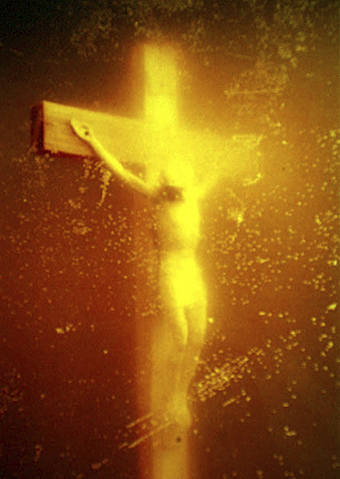
Piss Christ (1987) by Andres Serrano.

If the news of the past few weeks has felt like a re-run of the 1980s—ongoing recession, government cuts, riots in London, Tories casting aspersions on the undeserving poor, the threat of another royal wedding—then add to the list of déjà vu moments a flurry of outrage concerning art and religion in America that’s like a recapitulation of the Helms vs. NEA spats of 1989. On that occasion Andres Serrano’s Piss Christ was in the firing line, accused of being a blasphemous portrayal. This week it’s been the turn of a video installation of a short film made the same year, A Fire in My Belly, by David Wojnarowicz, a work featured in an exhibition I linked to a couple of weeks ago, Hide/Seek: Difference and Desire in American Portraiture at the National Portrait Gallery, Washington DC. A Los Angeles Times piece previewing the exhibition also connected Hide/Seek and the earlier attacks by the right against the NEA, ending by saying “Times and attitudes change”. Well, not always…

fire.jpg

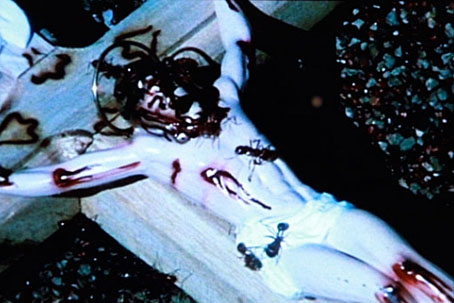
A Fire in My Belly (1987) by David Wojnarowicz.

Piss Christ notoriously shows a plastic crucifix immersed in urine; A Fire in My Belly is a 30-minute film which features among its blizzard of images a crucifix besieged by marauding ants. Wojnarowicz’s work wasn’t even mentioned in the LA Times piece but this week’s furore has made it the focus of the entire show after the gallery withdrew the video following protests from the usual suspects, the Catholic League and a right-wing politician, Rep. John Boehner. The complaints are the standard bluster about blasphemy (again) and taxpayers funding “filth”. None of the complainants appear to care that Wojnarowicz’s film is a tribute made by a gay artist to his friends as they were dying from AIDS during the 1980s, a disease which also killed him in 1992, they see the work only as an offensive act. It’s too much to expect anyone reacting with such fervour to consider that the artist may have been comparing the suffering and treatment of people with Aids in that decade with Christ’s suffering on the cross, to do so would be to admit that the artist might have a point. In response to the work’s withdrawal the Transformer Gallery in Washington DC has been screening the film and organised a protest at the National Portrait Gallery. (Update: They also issued an open letter urging the reinstatement of the work.)

Continue reading “Ecce homo redux”

Len Lye

rainbowdance.jpg

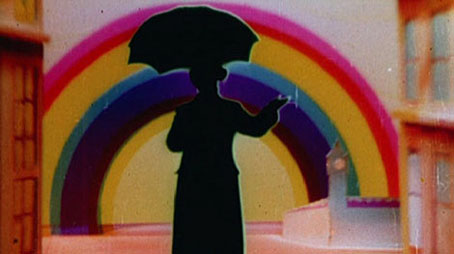
Rainbow Dance (1936).

Fortunate Londoners can see a BFI screening of early film shorts by Len Lye (1901–1980) this Friday at the NFT. (Details here.) Lye is one of the pioneers of abstract cinema and his work still astounds for its inventiveness and playful interaction between synchronised image and music. Many of his works were created by painting directly onto the film strip, a technique later pursued by animators like Norman McLaren. Free Radicals has long been a favourite, created with nothing more than a drum track and scratches on black-and-white film; five minutes of hypnotic genius. The BFI programme list below features links to YouTube versions. Some are poor quality but worth watching all the same:

This slot is dedicated to Len Lye, a towering figure in experimental film. The films are: Tusalava (1929, 9min, silent); Peanut Vendor (1933, 2min); Kaleidoscope (1935, 4min); A Colour Box (1935, 3min); The Birth of a Robot (1936, 6min); Rainbow Dance (1936, 4min); Colour Flight (1937, 4min); Swinging the Lambeth Walk (1940, 4min); Rhythm (1957, 1min); Free Radicals (1958, 5min); Particles in Space (1966, 4min); Cameramen at War (1944, 14min); Everyday (dir Hans Richter, 1929, 17min). Approx 77min total.

Elsewhere on { feuilleton }
The abstract cinema archive

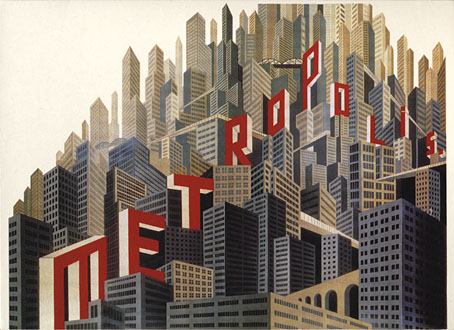
Metropolis!

metropolis1.jpg

Design by Boris Bilinsky (1927).

The restored version of Fritz Lang’s Metropolis (1927) was released in the UK this week by Eureka Video and my head is still spinning from having finally seen the missing scenes I’ve read about for years. There’s little I can say about the film itself that hasn’t already been said at length elsewhere, dramatically it’s not Lang’s best—M (1931) is a superior work on that score—but it’s still essential viewing for anyone interested in cinema history.

metropolis2.jpg

Brigitte Helm as cinema’s greatest robot: a screen grab from the Blu-ray edition at the Eureka site. Click for full-size.

The 25 minutes of restored footage add as much to the film as was claimed, especially in the longer sections, the removal of which rendered the motivations of several characters nonsensical, as well as creating disjunctions in the story. The plot thread concerning the dead woman Hel, wife of the master of Metropolis, Joh Fredersen, and idée fixe of the inventor Rotwang, was excised when it was felt that American audiences would laugh at the woman’s name; distributors allowing their low opinion of an audience’s intellect to ruin a work of art is nothing new. That cut at least had an excuse, however misguided. What’s more surprising about the restored version is seeing the minor cuts which were made throughout, many of them occurring in places which makes it appear that the negative had been attacked at random and for no good reason. The new material suffers next to the old which has better photography than many films made years later but the disparity isn’t so jarring once you’re used to it. A short but crucial scene is still missing but intertitles are used to describe the action. For now this is the most complete version of Lang’s film to date, with far more returned to it than I ever hoped to see.

Watch the trailer
The film restoration site
Metropolis Robot: The Maschinenmensch Project
Metropolis Film Archive: A Bibliography and Checklist of Resources
Metropolis (1978) by Kraftwerk | Metropolis (1979) by Motörhead (apparently written after Lemmy had watched the film)

Previously on { feuilleton }
A Secret Wish by Propaganda
Metropolis posters