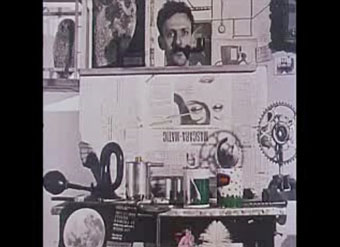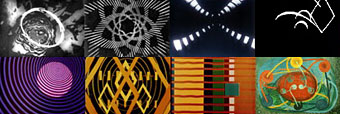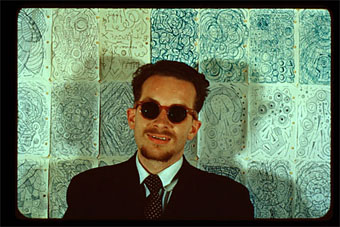
Harry Smith in the middle of the Twentieth Century with some of his drawings.
The first European exhibition of work by artist, writer, filmmaker, collector, Kabbalist, ethnographer…okay, polymath Harry Smith, opens today at the Reg Vardy Gallery, Sunderland. The exhibition runs from 2nd May–8th June 2007. In addition, there’s a companion exhibition, Harry Smith Anthology Remixed, at alt.gallery from 8th May–30th June. Among his many accomplishments, Smith compiled the landmark Anthology of American Folk Music and the latter showing features 84 musical and non-musical artists responding to each of the 84 songs which comprise that collection.
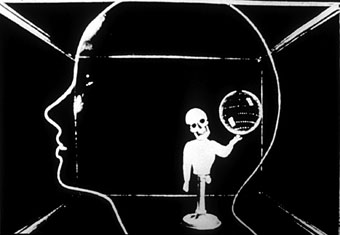
Heaven and Earth Magic (1962).
Harry Smith: Hobbies and films
2nd May–8th June 2007
Reg Vardy Gallery
School of Arts, Design, Media & Culture
University of Sunderland
Ashburne House
Ryhope Road
Sunderland
SR2 7EF
Reg Vardy Gallery is proud to host the first European exhibition devoted to Harry Smith’s films and hobbies.
Smith, who died in 1991, was a polymath of the highest order. With his coke bottle glasses, slight hunchback and long, bony tobacco-stained fingers, Smith dedicated himself to a life of seemingly infinite interests. He collected Seminole patchworks and painted Ukranian Easter eggs. He was a leading authority on string figures (such as the ‘cat’s cradle’) and made a study of the underlying principles of Highland tartans. He recorded the peyote songs of the Kiowa Indians and in a project entitled “Materials for the Study of Religion and Culture in the Lower East Side”, made vast live recordings of traffic noises, children’s jump-rope rhymes and city birdsong, as well as the drug talk of junkies and the death-rattles and prayers of hobos in Bowery flophouses (where he himself lived in poverty for some time).
He was one of the most influential figures in avant-garde film, developing new and ingenious methods of animation, and he collected thousands of folk records which later formed the basis for the work he is best remembered for—the Anthology of American Folk Music—the seminal collection of early music recordings that was in a large part responsible for triggering the folk music revival of the 1950s and 60s.
George Pendle
This exhibition includes a variety of Smith?s eccentric ethnographic collections, or what he called “Encyclopaedias of Design” such as string figures, Pysanky (Ukrainian Easter eggs), early sound recordings, and a range of his hand-painted, stop-motion and collaged animations such as Early Abstractions, and Late Superimpositions. The exhibition will also include documentation of Smith?s paper airplane collection. This unusual and rare collection is comprised of hundreds of paper airplanes found by Smith on the streets of New York City from the late 1960s to the early 1980s. This exhibition of the hobbies and artistry of Harry Smith has been organised in collaboration with the Harry Smith Archives and Anthology Film Archives, New York. George Pendle writes for Frieze, Cabinet, and the Financial Times . His most recent book Strange Angel (Weidenfeld & Nicolson, 2005) traces the life of the eccentric rocket scientist John Whiteside Parsons. Both Parsons and Harry Smith were heavily involved with the occult fraternity—the Ordo Templi Orientis.
Harry Smith Anthology Remixed
8th May–30th June
alt.gallery
61/62 Thornton Street
Newcastle Upon Tyne
NE1 4AW
 The exhibition brings together the work of 84 leading artists and musicians, who have been invited to make a visual artwork in response to 1 track each from the groundbreaking music release the Anthology of American Folk Music. The Anthology was edited by seminal New York artist, musicologist and experimental filmmaker Harry Smith, and first published by Folkways in 1952.
The Anthology is comprised entirely of recordings issued between 1927 (the year electronic recording made accurate reproduction possible) and 1932 when the Depression stifled folk music sales. Harry Smith used the new LP technology to create an unbroken sequence of songs, divided into three colour coded sets, which represented three elements: air, fire and water. The Anthology is considered to be one of the most important collections of information in modern society, creating a folk canon and contributing to numerous folk revival movements.
This exhibition aims to create a new visual collection of the Anthology, to continue the collective history and revival of the work, as seen through the eyes of contemporary visual artists and musicians. The exhibition includes artists from the Europe, Japan and the US reflecting a diverse and exciting range of practice including: visual art, outsider art, comic book, design, craft and illustration.
Exhibition curated by Rebecca Shatwell. A specially commissioned essay by David Keenan accompanies the exhibition and can be downloaded here.
Harry Smith Anthology Remixed includes work by: Dave Allen, Jonathan Allen, Diane Barcelowsky, Marcia Bassett, Eric Beltz, Hisham Bharoocha, Jesse Bransford, Vashti Bunyan, Jelle Crama, Jaron Childs, Rob Churm, Marcus Coates, Karen Constance, Christian Cummings & Jed Lackritz, Dearraindrop, Arrington di Dionyso, Graham Dolphin, Bill Drummond, Jorn Ebner, Espers, Peter J Evans, Yamataka Eye, Jad Fair, Feathers Family, Kyle Field, Alec Finlay, Devin Flynn, Iain Forsyth and Jane Pollard, Luke Fowler, Chris Graham, Susie Green, Doug Harvey, A Hawk And A Hacksaw, Rama Hoffpauir, Dan Howard-Birt, Zoe Irvine, Rich Jacobs, Juneau Projects, Seth Kelly, Jeffrey Lewis, Linder, Derek Lodge, Lone Twin, Robert AA Lowe, Ant Macari, The Matinee Orchestra, Maya Miller, Gean Moreno, Heather Leigh Murray, Michael Nyman, Dylan Nyoukis, John Olson, John Orth, Paper Rad, Mike Paré, Plastic Crimewave, Dave Portner, Devin Powers, Adam Putnam, The Rebel, Ginnie Reed, Clare E Rojas, Chris Rollen, Arik Roper, Giles Round, Royal Art Lodge, Mathew Sawyer, David Sherry, Ross Sinclair, DJ Spooky, Andre Stitt, Philip Taaffe, Vernon & Burns, Daryl Waller, Flora Whiteley, Michael Wilson, Simon Woolham, Andrew Jeffrey Wright, C. Spencer Yeh, Yokoland, zoviet*france
• The Harry Smith Archives
• American Magus: Harry Smith—A Modern Alchemist
Previously on { feuilleton }
• Meshes of the Afternoon by Maya Deren
• Jodorowsky on DVD
• Jordan Belson on DVD
• The art of Arik Roper
• Wallace Burman and Semina
• The art of Cameron, 1922–1995
• Kenneth Anger on DVD…finally
• Ten films by Oskar Fischinger
• Lapis by James Whitney
• The art of Harry Smith, 1923–1991
• La Villa Santo Sospir by Jean Cocteau
• Expanded Cinema by Gene Youngblood
• The Invasion of Thunderbolt Pagoda