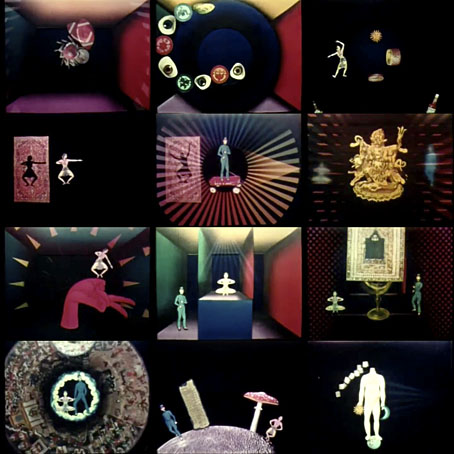
Number 11: Mirror Animations, a film by Harry Smith

smith.jpg

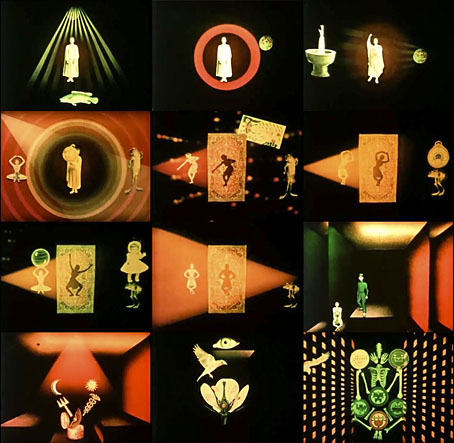
A very short collage animation from 1956 that Smith later expanded into a version running 12 minutes. The artwork crams a great deal of occult and religious symbolism into its 3-minute running time—alchemy, the Kabbalah, Buddhism, Eliphas Levi’s Baphomet, and so on—while Misterioso by Thelonious Monk is playing. Watching this makes me realise that there are still many Harry Smith films I’ve not yet seen despite having read about them for years. Further investigation is required.

Previously on { feuilleton }
Meeting Harry Smith by Drew Christie
Heaven and Earth Magic by Harry Smith
Harry Smith revisited
The art of Harry Smith, 1923–1991

Carabosse, a film by Lawrence Jordan

carabosse.jpg

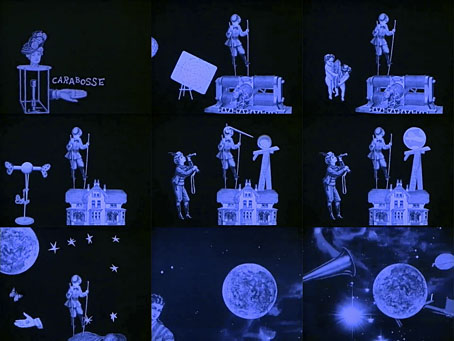
Collage animators may not be as plentiful as collage artists but this branch of filmmaking has attracted a number of heavyweight talents including Harry Smith, Jan Lenica, Walerian Borowczyk and Terry Gilliam. Lawrence Jordan worked for a time as an assistant to Joseph Cornell but he’s been making short films since the 1950s, many of which involve animated collage. Carabosse (1980) is a brief and distinctly Surreal piece set to Erik Satie’s Gnossienne No. 4. (An earlier film is titled Gymnopédies.) Watch it here. (Thanks to Erik Davis for the tip!)

Previously on { feuilleton }
Labirynt by Jan Lenica
Science Friction by Stan VanDerBeek
Heaven and Earth Magic by Harry Smith
Short films by Walerian Borowczyk

The Captive, a film by René Laloux

captive.jpg

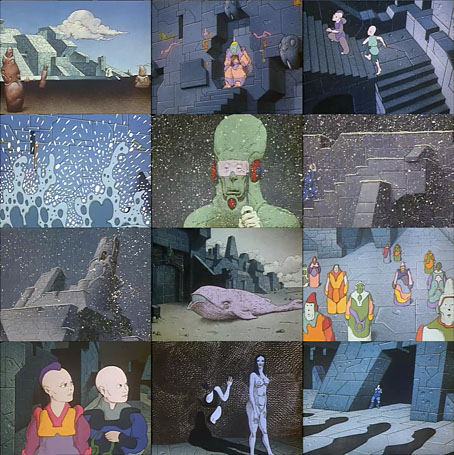
The feature films of French animator René Laloux are the closest thing to cinematic equivalents of comics magazine Métal Hurlant. Laloux’s collaboration with Roland Topor, Fantastic Planet (1973), is familiar to Anglophone audiences but fewer people are aware of Time Masters (1982) and Gandahar (1988), two more science fiction films made with Moebius and Philippe Caza respectively. Time Masters looks marvellous but the story (based on a novel by Stefan Wul) lacks the strangeness of Fantastic Planet. Gandahar,  based on a novel by Jean-Pierre Andrevon, I’ve yet to see but anyone searching for it should be aware that the version dubbed into English (and retitled The Light Years) dumped Gabriel Yared’s score, and had a sexual encounter censored by the usual rabble of prudish American producers.

The Captive (1988) continues the collaboration with Philippe Caza being a 7-minute adaptation of Caza’s comic story Equinoxe (1982). The music for this one is also by Gabriel Yared, and this copy at YouTube includes English subtitles. For comparison, the comic story is here. Of the two I prefer the comic but then I’ve always enjoyed Caza’s work.

Previously on { feuilleton }
Les Temps Morts by René Laloux

Papillons de Nuit, a film by Raoul Servais

papillons.jpg

From Homosurrealism to Belgio-surrealism. Papillons de Nuit (1997) is a short homage to the Surrealist painter Paul Delvaux featuring a handful of familiar Delvaux motifs including nocturnal tramcars and large-eyed, bare-breasted women. Raoul Servais had already borrowed some of Delvaux’s imagery for his feature-length fantasy, Taxandria (1994), but that film doesn’t sustain itself over its running time despite the involvement of Alain Robbe-Grillet and François Schuiten. Servais’s blend of live action and animation seems to work better in concentrated doses.

Previously on { feuilleton }
Sirene by Raoul Servais
Paul Delvaux: The Sleepwalker of Saint-Idesbald
Harpya by Raoul Servais
Taxandria, or Raoul Servais meets Paul Delvaux

Continu-discontinu 2010, a film by Piotr Kamler

continu.jpg

A recent film by Piotr Kamler that’s not on the DVD collection from aaa, Continu-discontinu 2010 is a short animation that’s a lot more abstract than Kamler’s earlier works although you might detect the director’s hand in the motion of some of its wandering particles. In place of the electronic scores that soundtrack many of his films there’s a recording of a viol piece composed by Marin Marais.

Previously on { feuilleton }
L’Araignéléphant
Le labyrinthe and Coeur de secours
Chronopolis by Piotr Kamler