Schloss Linderhof

linderhof1.jpg

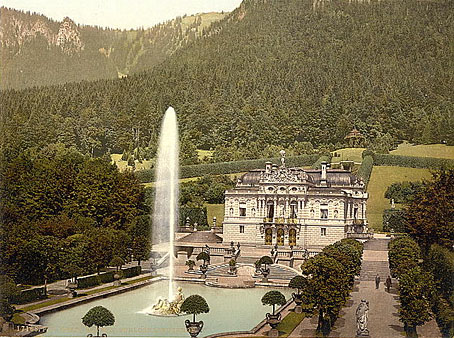
More Ludwigiana. Schloss Linderhof was Ludwig II of Bavaria’s miniature Versailles at Oberammergau and is a key location in Visconti’s film about the King. The house itself is a riot of gilded rococo which isn’t really to my taste but you can make your own judgement by taking a tour at the palace website or browsing the photos at Wikimedia Commons.

linderhof2.jpg

Of greater interest is the Moorish Kiosk in the palace grounds, a small pavilion originally created for the Paris exposition of 1867. The outside is a typical piece of Orientalist architecture while inside there’s some beautiful stained glass and a splendid Peacock Throne. This doesn’t feature in Visconti’s film, unfortunately, but the Venus Grotto does.

linderhof3.jpg

Philippe Jullian’s Dreamers of Decadence (1971) contains some pages about Ludwig and the inspiration he gave to Symbolist artists and poets. Reports of places like the Venus Grotto were among those inspirations, and Jullian recounts a description by actor Joseph Kainz of his first visit to Linderhof. The scene is played out in Visconti’s film almost to the letter:

All of a sudden the rock moved; an opening appeared through which we entered a long corridor, brightly lit with a red light. Along the walls of the grotto the King’s servants stood in line.

Still following the servants who were leading the way, I walked to the end of the corridor, as far as what appeared to be a natural opening in the rock. Through this opening there poured a sea of blue light. The interior of the grotto looked like a huge, dazzling sapphire, whose flickering brilliance spread over the craggy walls, entered every tiny crack, and cast a sort of magic veil over every object. I had stopped on the threshold, behind an overhanging rock, dumbfounded by the grandiose splendour that surrounded me; I was breathless with amazement. The ceiling of the grotto was vaulted, like that of a cathedral. I was inside the Venusberg.

I took a step forward and stopped again. The rock which had concealed me until then. had prevented me from seeing on my right a lake of astonishingly limpid water, lit by a sky-blue light. On it there glided two snow-white swans, while on the shores stood a tall man, all alone, and apparently deep in thought: this was the King.

For a moment I gazed at his fine head, his broad shoulders, his remarkably white hands which were casually tossing pieces of bread to the two swans; I also noticed the bright star made up of sapphires which was fastened to his hat.

He shook me warmly by the hand, releasing me from the feeling of depression which had affected me till then. Then the King took me up a path leading to the top of a hill in front of us. On the top of this hill there was a table made of sea-shells which stood on a large conch supported by crystal feet. Near this table there was a seat made of the same materials, and the servants brought along another. The King invited me to sit down, and supper was served.

Every quarter of an hour the King gave a signal and the lighting of the grotto changed; it turned red, then green, then blue, then gold, and into my imagination came memories of ancient legends and fabulous fairy-tales.

360 Cities has some panoramas of the Linderhof grounds with a view of the palace and one of the entrance to the Moorish Kiosk. As you’d expect, Flickr has a large collection of Linderhof photos while there’s also a pool of over five hundred images devoted to Ludwig II.

Previously on { feuilleton }
Schloss Neuschwanstein

The art of Ran Akiyoshi, 1922–1982

akiyoshi1.jpg

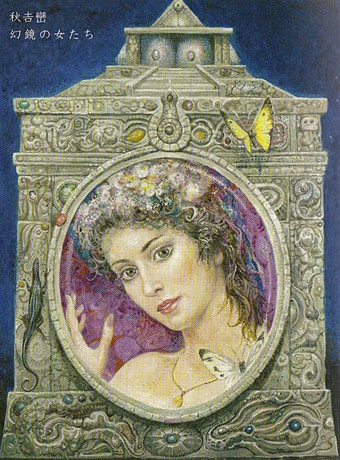
In a similar vein to the work of Gilles Rimbault and other erotic fantasists is Ran Akiyoshi, a Japanese artist and illustrator. Akiyoshi’s work manages to be even more obscure than the Europeans, being virtually undocumented outside Japanese websites, hence the absence of titles and dates for these examples. This is surprising given the quasi-Surrealist nature of his paintings which place buxom goddess types in phantasmagoric settings with subtle or not-so-subtle erotic qualities. Akiyoshi follows the pattern of much of this kind of personal fantasy whereby most of the women share similar features. The book cover immediately below is from a recent Japan-only collection of his work. The Illusion cover at the end is another book collection some of whose fascinating pages can be seen here. As always, if anyone turns up a gallery of further pictures, please leave a comment.

akiyoshi2.jpg

Continue reading “The art of Ran Akiyoshi, 1922–1982”

Weekend links 22

pota.jpg

Planet of the Apes Magazine #15 (1975), art by Bob Larkin.

I never read any of Marvel Comics’ Planet of the Apes titles but the painted covers of the American editions are evidence of a distinctly lurid imagination. An excess of drugs—this was the Seventies, after all—or mere enthusiasm? You decide. Related: “The Soft Intelligence”: 5 Underrated Literary Cephalopods by China Miéville. Kudos to him for mentioning The Sea Raiders (1896) by HG Wells, a favourite story of mine when I was 12.

octopussy.jpg

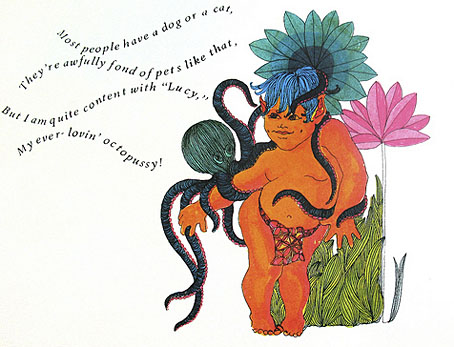
My ever-lovin’ octopussy (1970) by Jackie Black.

A Journey Round My Skull chooses selections from Ang Wyman’s flickr group Eye Candy (above), psychedelic illustration for children’s books by Nicole Claveloux, Peter Max, Heinz Edelmann and others.

• Watch out, there are “fancy gentlemen” about. It’s The Homosexual Menace!

• Design in opposition: Neville Brody announces the Anti-Design Festival.

• The Almias Rural Psychogeography Walk takes place on July 25th.

• Steven Heller on The Incredible Posters of Tadanori Yokoo.

Hipster Priest: Alan Moore interviewed at The Stool Pigeon.

FACT mix 167, a great selection by These New Puritans.

• The Orion Galaxy is a beautiful bespoke synthesizer.

• A radio portrait of Moondog at Speechification.

• RIP: Sugar Minott. RIP Tuli Kupferberg.

• Introducing Wizard’s Tower Press.

Octopus (1970) by Syd Barrett.

Portuguese Diseases

disease1.jpg

This volume appears to be in print now, the Portuguese edition of The Thackery T Lambshead Pocket Guide to Eccentric and Discredited Diseases, a unique fantasy anthology compiled in 2003 by Jeff VanderMeer and Mark Roberts. The new edition is published by Saida de Emergência and translated by Luís Rodrigues, João Seixas and Vítor Morta. I didn’t design this cover with its eccentric kerning but I did design the original edition for Night Shade, to date still one of my most elaborate and detailed book designs, too elaborate for the larger publishing houses, in fact, who either dropped or amended the deliberately diseased title spread for their paperback editions. You can see some of the original pages below. I sent the Portuguese publishers all the artwork and layouts but since I haven’t seen a printed copy of the book I don’t know how the interior looks. I don’t even know whether my name appears on the cover as it does here since other examples online show a different design. However, it’s often the case these days that cover designs get sent out prematurely for marketing purposes before things have been finalised.

disease2.jpg

Title spread.

disease3.jpg

Contents spread.

Previously on { feuilleton }
Pasticheur’s Addiction

René Bull’s Salomé

bull.jpg

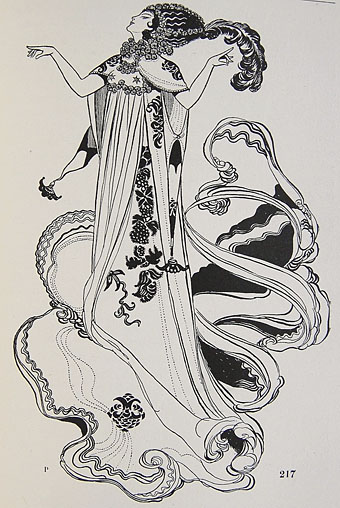
An illustration by René Bull (1872–1942) from The Russian Ballet (1913) by AE Johnson. Bull seems to be primarily known as one of the many illustrators of that Golden Age staple, The Arabian Nights, although his interpretation is a little too comical for my taste. You can judge for yourself here.

Other Salomés turning up recently include a George Barbier picture in this BibliOdyssey post, Salomé, la Gran Diva at Bajo el Signo de Libra, and the Guardian’s review of David McVicar’s Pasolini-esque opera production.

Elsewhere on { feuilleton }
The illustrators archive
The Salomé archive