The Magic Toyshop

toyshop1.jpg

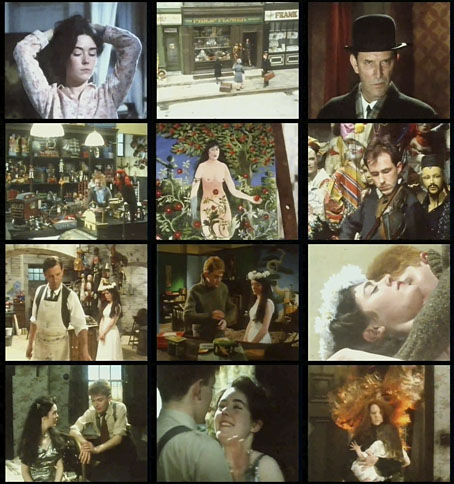
Yet more revenant TV drama. Seems like everything turns up if eventually so long as you’re prepared to wait. I’d looked for this film a couple of times after writing about TV director David Wheatley. The Magic Toyshop (1987) was a feature-length Granada Television adaptation of Angela Carter’s 1967 novel, with Wheatley directing and Carter herself supplying the screenplay. Caroline Milmoe plays Melanie, a teenage girl left in the care of her Uncle Philip after she and her younger brother and sister are orphaned. Tom Bell plays the sinister uncle who owns the toyshop of the title, a place where the toys, puppets and automata are as lively as JF Sebastian’s menagerie in Blade Runner. Melanie’s younger uncles, Finn and Francie, live in fear of the tyrannical Philip who forces them to assist with his life-size puppet shows, while Melanie’s aunt Margaret is not only cowed by her husband but also mute. The arrival of Melanie and her growing sexual awareness upsets the household’s balance of power.
toyshop2.jpg

It was good to see this film again having recently watched David Wheatley’s René Magritte film and his marvellous Borges documentary. In light of those earlier works an adaptation of Angela Carter would seem a natural progression. Aside from an overly-emphatic score, The Magic Toyshop was better than I remembered, the initial viewing no doubt suffering from an expectation that it might be a match for The Company of Wolves (1984). The Granada film had a much lower budget than Neil Jordan’s feature so it’s an unfair comparison. Wheatley and co. saved money with some careful use of the Baker Street set from Granada’s Sherlock Holmes adaptations.

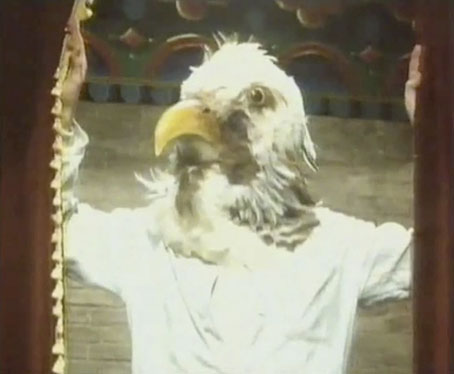
Watching The Magic Toyshop now it’s surprising it was made at all, it’s an odd piece of work stippled throughout with surreal moments, and even Surrealist references, as with Finn’s Loplop-like appearance above. What drama there is refuses the familiar shapes that a TV audience would expect, and there’s also a surprising amount of incestuous desire boiling among the major characters that goes unquestioned. I’ve not read Carter’s novel so I can’t say how it compares but the film feels like a very pure delivery of the author’s landscape of entwined sexuality, fantasy and myth. The Magic Toyshop hasn’t been reissued on DVD so the YouTube version is from a tape copy. It’s also chopped into chunks (why, oh, why, etc) but it’s highly recommended to Angela Carter readers.

The Magic Toyshop: part 1 | part 2 | part 3 | part 4 | part 5 | part 6 | part 7

Previously on { feuilleton }
Borges and I
René Magritte by David Wheatley
The Magic Shop by HG Wells

magic.jpg

The Magic Shop (1964).

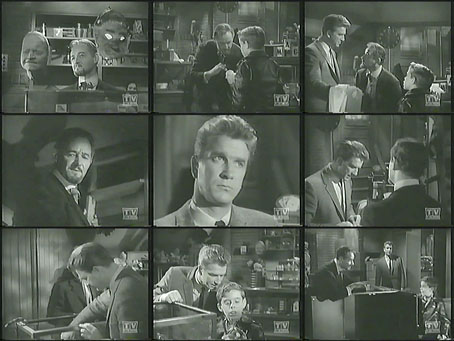
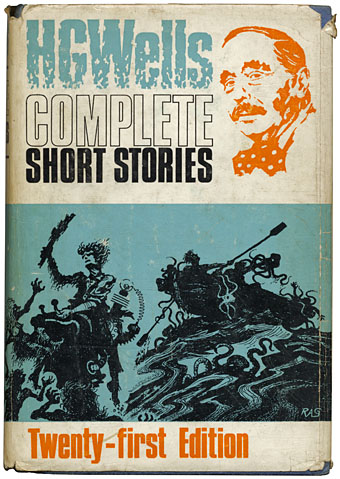
I discovered this TV adaptation by accident while looking for something else (more about the something else tomorrow). The Magic Shop is a 45-minute drama directed by Robert Stevens in 1964 for The Alfred Hitchcock Hour. Writer John Collier adapted a script by James Parish that’s loosely based on the short story by HG Wells. The story is one I know very well, having read it many times, but I hadn’t come across this TV version before. It’s a surprise finding it so close to Christmas since I first read the story in the only Christmas present that’s survived from childhood, a hefty collection of HG Wells’ short stories that I pestered my parents into buying me in 1973. I mostly wanted to read The Time Machine but the other stories seemed promising, especially the ones illustrated by Richard Gilbert on the (miraculously intact) dustjacket: The Sea Raiders (sailors attacked by octopuses), The Flowering of the Strange Orchid (man attacked by tentacular plant), The Valley of Spiders (attacking spiders falling from the sky), and so on. The book as a whole runs to over 1000 pages, and proved to be a revelation with Wells ranging through fantasy, science fiction, horror, and oddities which don’t fit any category other than Robert Aickman’s indispensable label, “strange stories”. The book made me a lifelong Wellsian, and also spoiled me a little when I moved on to more recent science fiction and found many of the alleged greats to be appalling writers. Wells’ prose can’t compete with Robert Louis Stevenson but it’s still well-crafted in that no-nonsense late Victorian manner familiar to readers of Arthur Conan Doyle.

wells.jpg

Design and illustration by Richard Gilbert (1970).

The Magic Shop is one of the strange stories, the shop in question being a mysterious establishment somewhere in Regent Street, London, one of those premises one discovers by accident then can’t find again. The narrator is informed by the proprietor that this is a Genuine Magic Shop, as distinct from the kind selling mere conjuring tricks. The meaning of this isn’t clear at first but while the narrator’s young son is being beguiled by the marvels on display we follow his father’s growing alarm when he realises there’s more to the shop than he anticipated, not all of it pleasant or fun. The story was published in Twelve Stories and A Dream in 1903, and can be read here.

The TV version takes the bare bones of the tale—curious shop, indeterminate location, friendly yet sinister proprietor—and blends it with the nasty-child-with-magic-powers theme that was dramatised so memorably by The Twilight Zone in It’s A Good Life. The Hitchcock show was made three years after the Twilight Zone episode so it’s easy to see It’s A Good Life as an influence. Leslie Nielsen is the father who takes his son, Tony (John Megna), to the fateful shop on his birthday. The proprietor informs the pair that Tony is “the right boy” since he found the shop in the first place, the subtext being that he’s also possesses the right character to be the recipient of some heavy voodoo abilities. The boy’s bad seed status has been telegraphed from the outset by a birthday gift from an uncle of a black leather jacket; throughout the scene in the shop he looks like a miniature hoodlum. More American anxiety about its troublesome youth? Maybe, although the episode ends so poorly that the whole thing comes across as a lazy piece of filler. This is, of course, a long, long way from the Wells story which is all the more effective for being elusive, understated and, yes, magical.

Previously on { feuilleton }
HG Wells in Classics Illustrated
The night that panicked America
The Door in the Wall
War of the Worlds book covers

Caresses by Fernand Khnopff

khnopff1.jpg

khnopff2.jpg

khnopff3.jpg

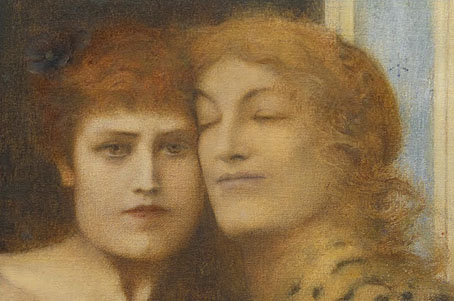
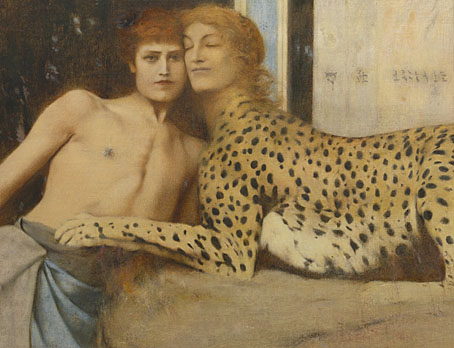
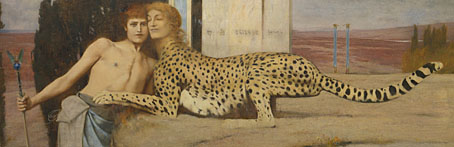
Details from Caresses aka The Caress (1896), the most famous painting by Belgian Symbolist Fernand Khnopff which can now be explored in detail at the Google Art Project. Caresses was one of Khnopff’s more enigmatic works although the term is a relative one when it comes to an oeuvre in which enigma is the default position. The combination of a young male, a feline female and the trappings of antiquity suggests Oedipus and the Sphinx although the Sphinx of mythology is a far more threatening presence. Adding to the enigma is the fact that Khnopff’s sister, Marguerite, was his model in most of his paintings which means we can recognise her heavily-jawed features in the male figure as well as the female. The essence of Symbolism for me has always been an atmosphere of unresolved pictorial mystery, a quality which this painting exemplifies.

khnopff4.jpg

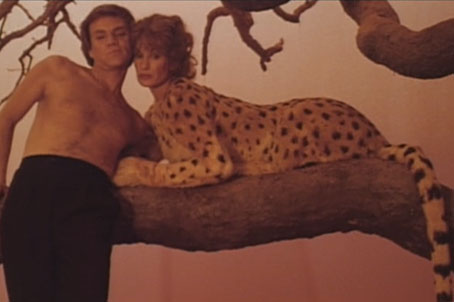
Malcolm McDowell and Ruth Brigitte Tocki in a deleted scene from Cat People (1982).

The mystery would have been carried over to the cinematic world in 1982 if the producers of Cat People had kept their nerve. The “Leopard Tree” dream sequence was to have featured a moment when Irena (Nastassia Kinski) meets her dead brother and mother in a pose which recapitulates Khnopff’s painting. The painting itself also appeared earlier in the film although it’s so long since I watched it I forget now whether that moment was also excised. The dream sequence may have been stretching audience credulity too far but the symbolism is fitting not least for the incestuous nature of the story. Here’s the scene in the final cut set to Giorgio Moroder’s fantastic score.

khnopff5.jpg

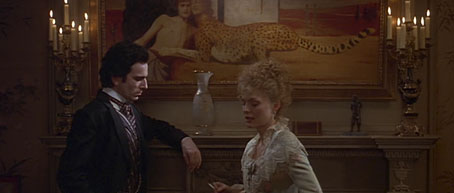
Daniel Day-Lewis and Michelle Pfeiffer.

The painting definitely did appear on-screen in 1993 where it overshadows a crucial conversation in Martin Scorsese’s adaptation of The Age of Innocence. Given that the setting is New York in the 1870s the usage is slightly anachronistic but once again the symbolism works for a scene which concerns unacceptable and unrequited passions.

Previously on { feuilleton }
Symbolist cinema
Bruges-la-Morte

The art of Thomas Cole, 1801–1848

cole1.jpg

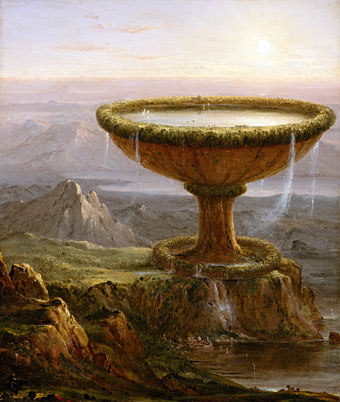
The Titan’s Goblet (1833).

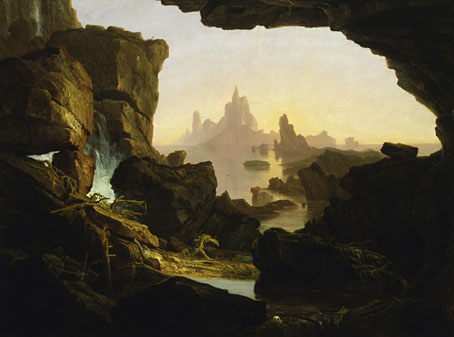
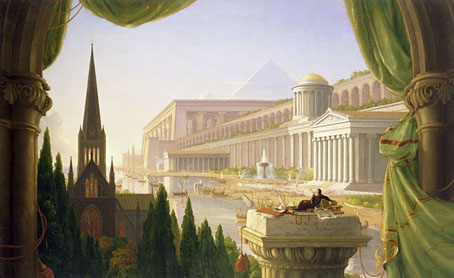
Thomas Cole’s Titan’s Goblet isn’t featured at the Google Art Project, unfortunately, but the following paintings are, and all benefit from being able to explore their details. Cole’s colossal vessel predates Surrealism by a century, and is one of many paintings which always has me mentally labelling him as the American John Martin (1789–1854). Having thought of him for years as an American artist–not least because he founded the Hudson River School–it’s a surprise to learn he was born in Bolton, a town not far from Manchester, with his parents emigrating to the US when he was 17. John Martin also grew up in the north of England so there’s another similarity, although the more important comparison concerns their use of painting to convey the spectacularly vast and unreal scenes common to the imaginative side of Romantic art. The Titan’s Goblet is unusual in not having any particular symbolic or moral significance, unlike the pictures below, it’s Magritte-like in its careful depiction of the impossible. The Subsiding of the Waters of the Deluge, on the other hand, could be exhibited beside Francis Danby’s The Deluge (1840) for a “before and after” effect. Like Martin, Cole enjoyed painting architecture of an exaggerated scale. The Architect’s Dream features an Egyptian temple of stupendous size, while the pyramid looming in the background is closer to William Hope Hodgson’s seven-mile-high Last Redoubt than any structure on the Nile plain.

Of equal interest are Cole’s two well-known series: The Course of Empire (1833–36) and The Voyage of Life (1842), both of which I’d love to see at Art Project size.

cole2.jpg

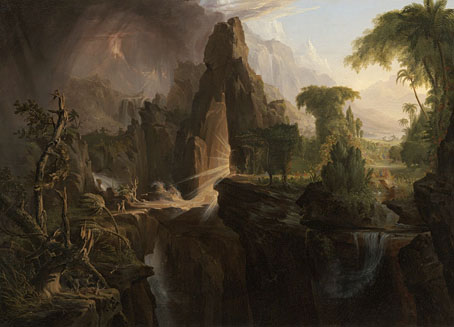
Expulsion from the Garden of Eden (1828).

cole3.jpg

The Subsiding of the Waters of the Deluge (1829).

cole4.jpg

The Architect’s Dream (1840).

Elsewhere on { feuilleton }
The fantastic art archive

Previously on { feuilleton }
John Martin’s musical afterlife
Albert Bierstadt in Yosemite
Danby’s Deluge
John Martin: Heaven & Hell
Darkness visible
Two American paintings
The apocalyptic art of Francis Danby

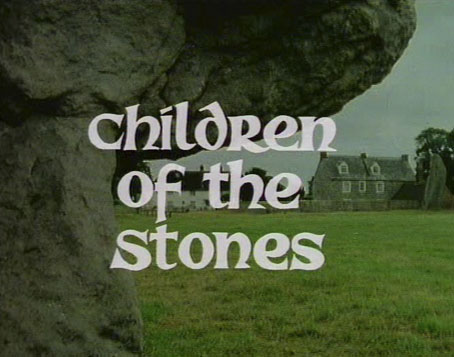
Children of the Stones

cots1.jpg

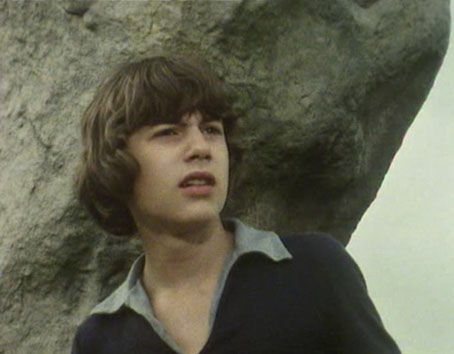
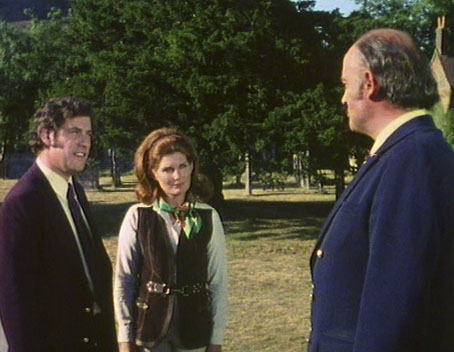
“Pretty phantasmagorical!” says precocious teenager Matthew when he and his father drive into the fictional village of Milbury in the opening scene of Children of the Stones. Matthew’s father is a scientist whose work requires a three-month stay in a village built in the centre of a series of ancient ramparts and stone circles. Once settled, they find many of the villagers to be blandly cheerful, while Matthew discovers that his maths skills at the local school pale beside younger children who can solve complex equations with ease. Omnipresent characters in the village are Hendrick, a retired astronomer who owns the local manor house and acts as village squire; Margaret, a newly-arrived archaeologist who knows the history of the stones; and Dai, a vagrant poacher who lives outside the circle, and who seems eager to remain free of the Stepford-like happiness afflicting his neighbours.

cots2.jpg

Matthew (Peter Demin).

Matthew’s “phantasmagorical” epithet is directed at the neolithic mound outside the village but could easily apply to the whole of this seven-part serial which I watched again recently. HTV produced Children of the Stones which was first broadcast in early 1977. A mystery serial for children involving pagan history, folk rituals and an undercurrent of science fiction wasn’t such a surprising thing in the 1970s, this being a decade when a popular interest in the occult and the paranormal was more prevalent than at any time before or since. Children’s television reflected adult trends which is why we got to see an adaptation of Alan Garner’s The Owl Service, the occult adventure series Ace of Wands (with its hero named “Tarot”), The Tomorrow People (which occasionally strayed from science fiction to science fantasy) and others (see an earlier post, Occultism for kids). Children of the Stones was the most complex of all of these, a well-crafted drama with similarities to Nigel Kneale’s TV plays, The Wicker Man and The Prisoner. With a slight change of emphasis it would have worked just as well as a serial for adults. The best children’s serials of the period were usually adaptations of novels; Children of the Stones was an original work for television, written by Jeremy Burnham & Trevor Ray, and directed by Peter Graham Scott.

cots4.jpg

Adam (Gareth Thomas), Margaret (Veronica Strong) and Hendrick (Iain Cuthbertson).

Continue reading “Children of the Stones”