
Dream sleeves: John Walsh on how a 40 year old idea could save the music industry
Category: {design}
Design
Caldwell & Co
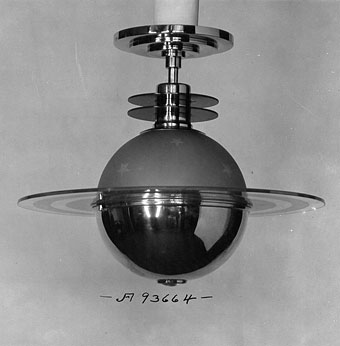
A cosmic pendant lamp by New York lighting manufacturer, Caldwell & Co, created for the Rockefeller Center in 1932. The company’s Art Deco-styled designs for that building feature a number of other flying saucer pendants although none as striking as this one. The photo is one of many made available by the Smithsonian Institute on a site which catalogues the company’s history.
Edward F. Caldwell & Co., of New York City, was the premier designer and manufacturer of electric light fixtures and decorative metalwork from the late 19th to the mid-20th centuries. Founded in 1895 by Edward F. Caldwell (1851–1914) and Victor F. von Lossberg (1853–1942), the firm’s legacy of highly crafted creations includes custom made metal gates, lanterns, chandeliers, ceiling and wall fixtures, floor and table lamps, and other decorative objects that can be found today in many metropolitan area churches, public buildings, offices, clubs, and residences.
Previously on { feuilleton }
• Hugh Ferriss and the Metropolis of Tomorrow
March of the Penguins

top left: David Pelham’s classic design (1972); top right: photography
by Lionel F Williams (Eye) and SOA / Photonica (Cogs) (1996).
bottom left and right: photography by Véronique Rolland (2000 & 2008).
In April this year I wrote about James Pardey’s excellent site devoted to book covers from the Penguin science fiction range. I’m often pointing to various book cover galleries on Flickr and elsewhere but James’s site goes far beyond these, with credits and annotations for every cover on display. He emailed this week to let me know that his site has been considerably expanded, from 160 covers to 250 (!), bringing the timeline closer to the present. In addition the site has improved page layouts which enable you to study the evolution of each title. All design sites should be this good.
And coincidentally, Anne S mentioned in the comments yesterday that she’s been adding some Penguin Classics covers to her Eye Candy for Bibliophiles site. Lots of other worthwhile viewing there, including some of the old Puffin covers for Alan Garner.
Elsewhere on { feuilleton }
• The book covers archive
Previously on { feuilleton }
• Penguin science fiction
• A Clockwork Orange: The Complete Original Score
• Penguin Labyrinths and the Thief’s Journal
• Penguin Surrealism
• Juice from A Clockwork Orange
• Penguin book covers
• Clockwork Orange bubblegum cards
• Alex in the Chelsea Drug Store
Of the Monstrous Pictures of Whales
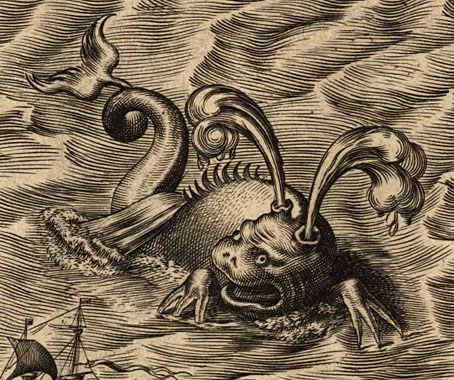
When Herman Melville complains in chapter 55 of Moby Dick about erroneous representations of whales, this is the kind of thing he had in mind. Among those he takes to task, however, I don’t recall any of them having two blow-holes like the creature above.
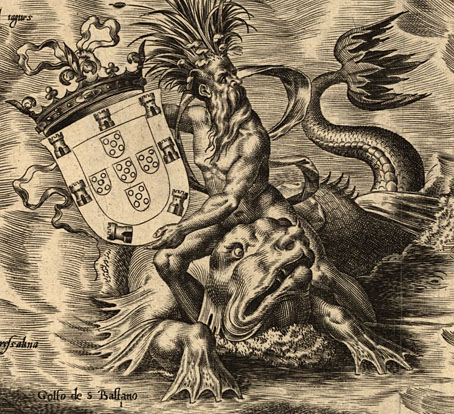
The coat of arms of Portugal.
These fanciful beasts are the work of (no sniggering, please) Hieronymus Cock (1510–1570), an Antwerp engraver, and they populate the seas as part of his marvellous map of America created with the assistance of Spanish cartographer Diego Gutiérrez.
Gutiérrez’s magnificent 1562 map of America was not intended to be a scientifically or navigationally exacting document, although it was of large scale and remained the largest map of America for a century. It was, rather, a ceremonial map, a diplomatic map, as identified by the coats of arms proclaiming possession. Through the map, Spain proclaimed to the nations of Western Europe its American territory, clearly outlining its sphere of control, not by degrees, but with the appearance of a very broad line for the Tropic of Cancer clearly drawn on the map.
The map is described in detail here while another part of the Library of Congress Map Collections site has an incredible high-resolution copy which is a delight to pore over. This is a really big image (10492 x 11908 pixels) but the huge size is just what I love to see. You can not only zoom into the myriad details—cannibals cooking a human feast in Brazil—but also admire the precision of the cross-hatching. Less than forty years separate these generic creatures from Jan Saenredam’s far more accurate rendering of a beached sperm whale.
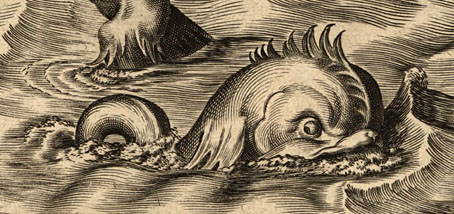
A dolphin (Melville classed dolphins and porpoises as small whales).
Elsewhere on { feuilleton }
• The etching and engraving archive
Previously on { feuilleton }
• Jan Saenredam’s whale
• The Whale again
• Rockwell Kent’s Moby Dick
Shared Worlds 2009
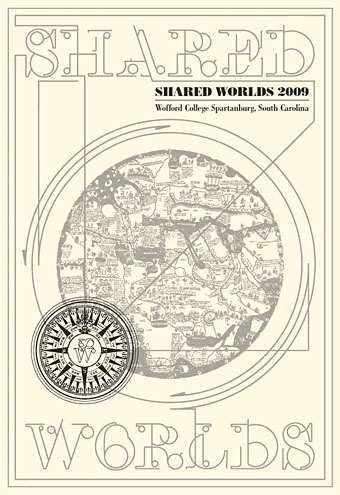
Shared Worlds is a fantasy writing-oriented summer camp for teenagers created by Jeremy Jones and Jeff VanderMeer, and hosted at Wofford College, South Carolina. Jeff asked me to design a small booklet to be printed at the end of this year’s activities as a means of showcasing examples of the writings produced during the various events. He’s posted photos of the printed booklets, including pictures of the young authors autographing pages for each other, and should be writing more about Shared Worlds later.