Design as virus 11: Burne Hogarth

mighty_baby.jpg

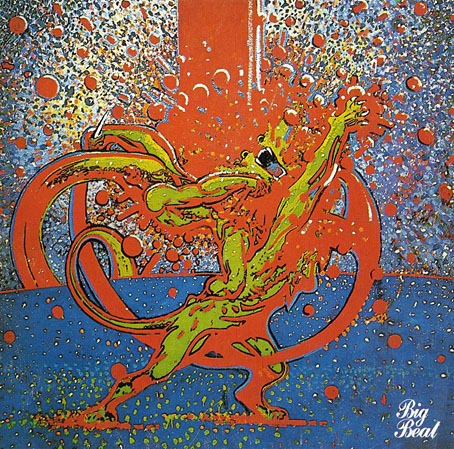
Mighty Baby (1969). Illustration by Martin Sharp.

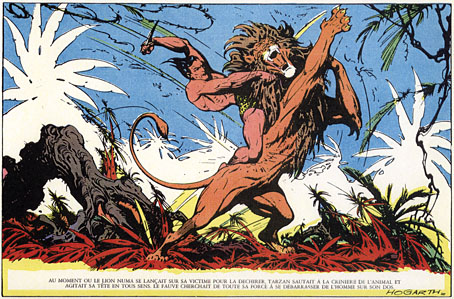
Yet another album cover prompts this post, part of an occasional series. Mighty Baby were a British rock band who formed out of psychedelic group The Action in the late Sixties, and their music is fairly typical of the period, being “heavy” without any of the psych trappings which—for me—often make everything from that time a lot more interesting. This was a journey undertaken by many groups at the end of that lurid decade, a junking of the playful and evocative side of what was now called rock music in favour of a denim-clad earnestness. This album isn’t one I like very much—I’d rather listen to their earlier incarnation—but the cover painting by psych artist Martin Sharp is certainly a startling piece, being a violent mutation of one of the most famous Tarzan drawings by comic artist Burne Hogarth.
hogarth.jpg

Tarzan by Burne Hogarth (194?).

Hogarth was drawing Tarzan for much of the 1940s and this particular panel showing the Ape-Man attacking Numa the lion dates from the latter part of his run on the series. I wish I could pin this to an actual year but I don’t have a complete set of the comics and that detail eluded me. If anyone knows the date, please leave a comment.
Continue reading “Design as virus 11: Burne Hogarth”

Alejandro Jodorowsky’s Dune

dune1.jpg

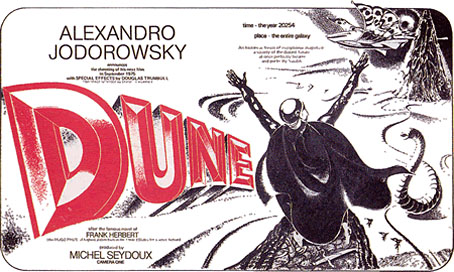
Fortunate Londoners can get to see a new exhibition, Alejandro Jodorowsky’s ‘Dune’: An exhibition of a film of a book that never was, which runs at The Drawing Room until October 25, 2009. As well as production designs from concept artists Moebius, HR Giger and Chris Foss, there’s newly commissioned work by artists Steven Claydon, Matthew Day Jackson and Vidya Gastaldon.

Jodorowsky’s proposed 1976 adaptation of the Frank Herbert novel is now the stuff of legend, and it’s possible that his outrageously ambitious plans are more fun to dream about than they would have been on the screen. But it remains a tantalising prospect that Jodorowsky might well have pulled off a science fiction equivalent of Fellini’s Satyricon. Either way, along with Stanley Kubrick’s unmade Napoleon, it’s one of the great lost films of the 1970s.

Among Jodorowsky’s proposed cast were Orson Welles, Mick Jagger and Salvador Dali, the last of whom was to play the Emperor of the Universe, who ruled from a golden toilet-cum-throne in the shape of two intertwined dolphins. Unable to secure the money from Hollywood to create the ‘Dune’ of his imagination, Jodorowsky abandoned the film before a single frame was shot. All that survives of this project is Jodorowsky’s extensive notes, and the production drawings of Moebius, Giger and Foss. These reveal a potential future for sci-fi movie making that eschewed the conservative, technology-based approach of American filmmakers in favour of something closer to a metaphysical fever-dream.

dune2.jpg

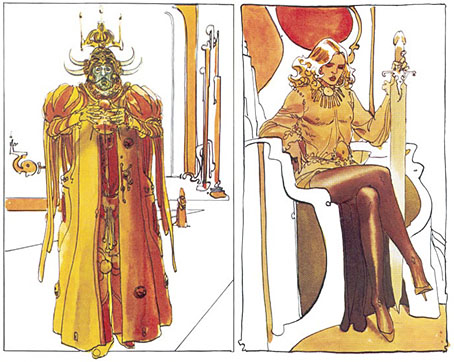
left: Emperor Shaddam IV; right: Feyd Rautha.

Moebius’s designs are wildly different from those used in David Lynch’s 1984 adaptation (which I like nonetheless). His sketch of the Emperor on the left gives some idea of how Salvador Dalí might have appeared in the film, while the figure on the right is Baron Harkonnen’s effete nephew, Feyd, a far more radical conception than the grinning fool played by Sting in the Lynch version. There’s a lot more of Moebius’s sketches at the excellent Dune.info site.

Previously on { feuilleton }
Dalí and Film
Jodorowsky on DVD

Echoes of the Cities

echo1.jpg

Mysterieux retour du Capitaine Nemo.

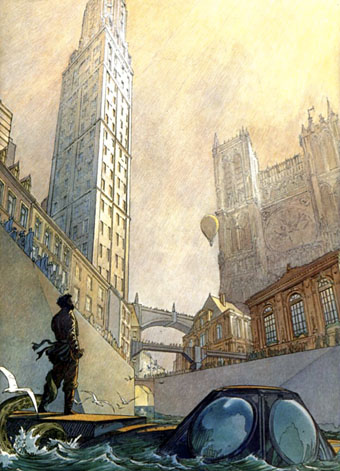
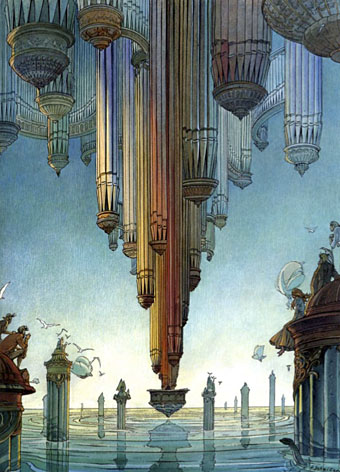
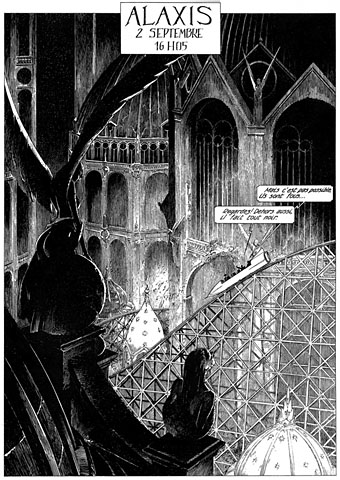
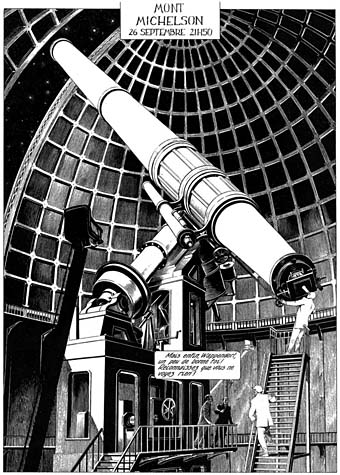
This week has been incredibly hectic work-wise but I’ve managed to keep these posts going, so here’s the last one devoted to an appreciation of the Cités Obscures of François Schuiten and Benoît Peeters. A week of posts barely scratches the surface of their vast and involved creation of alternate worlds, fantasy design and architecture, and Borges-like metaphysical speculation. When I try to explain my disaffection with the popular end of American comics, it’s works such as these which I offer as an alternative. The problem, of course, is that only a handful of the books have been translated into English, a detail which tells you all you need to know about English-speaking comics publishers and—since demand fuels the market—their readers.

This final set of pictures is a selection from Schuiten and Peeters’ L’Echo des Cités (1993), a facsimile edition of the main newspaper which serves the cities of the Obscure World. Unfortunately, this remains untranslated but the bulk of the book is full-page illustrations, many of which are among Schuiten’s best. A number of these were later reprinted as limited lithograph prints.

echo2.jpg

Les rêves engloutis d’Oscar Frobelius.

Continue reading “Echoes of the Cities”

Further tales from the Obscure World

penchee1.jpg

L’enfant penchée.

We’re at the penultimate post in this week-long tribute to the Cités Obscures series of François Schuiten and Benoît Peeters, and there isn’t enough space left to cover some of the more recent volumes in detail. What follows is a quick skate through three more major works.

penchee2.jpg

L’enfant penchée.

L’enfant penchée (1996), or The Leaning Child, is an expanded version of a 1995 children’s story by Schuiten and Peeters, Mary la penchée. Mary is the young daughter of wealthy industrialists from Mylos struck down one day by some cosmic calamity which shifts her centre of gravity, causing her to permanently lean at an apparently impossible angle. When she’s bullied at school she runs away and joins a circus. A meeting with scientists and astronomers leads to a resolving of her affliction, and the repairing of her ruined life. This is a fascinating story for a number of reasons, not least the existence of a parallel narrative taking place in our world which is conveyed using photographs, and which unveils some of the metaphysical aspects of the Obscure World. The story of Mary is also flawlessly drawn. Schuiten uses a black-and-white style modelled on the work of old magazine illustrators like Franklin Booth, and there are further references to Winsor McCay and Jules Verne.

Continue reading “Further tales from the Obscure World”

Brüsel by Schuiten & Peeters

brussels.jpg

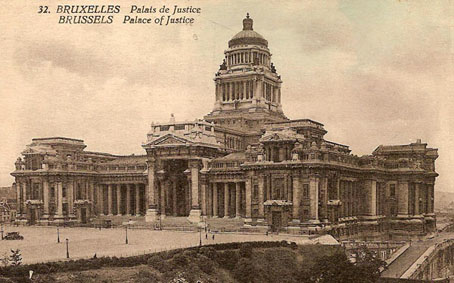
The Palace of Justice, Brussels.

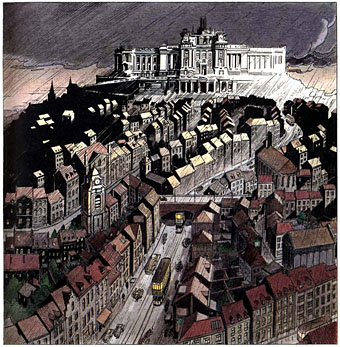
Brüsel (1992) by François Schuiten and Benoît Peeters follows La route d’Armilia as the next major work concerning the Cités Obscures. As with La Tour, this is a longer story where it isn’t immediately apparent that we’re in the Obscure World at all, although Brüsel is clearly an alternate version of our Brussels. The unfinished Palace of the Three Powers in the city centre is modelled on the Palace of Justice in Brussels, and both buildings share architects by the name of Joseph Poelaert.

brusel1.jpg

The Palace of the Three Powers, Brüsel.

Brüsel is a “small man” tale of Constant Abeels, a would-be shopkeeper preparing to launch a business selling a new and modern innovation: plastic flowers. Abeels suffers from a persistent cough, and it’s a combination of his health problems and business problems—the water for the shop is disconnected—that causes him to become enmeshed in schemings to radically transform the city, and the resistance to those plans. The tale is also a satire on the overly-optimistic march of progress of the late 19th and early 20th century, with all the problems of trying to impose sudden architectural change on a change-averse community. Inhabitants of Brussels have a long history of sudden architectural change, the huge Palace of Justice being constructed only after residents of the area had been forcibly evicted. In the 1950s and 60s, the flattening of old quarters in order to build New York-style office blocks was so destructive that the French coined the term “Brusselisation” to describe a brutal remodelling of a city against the wishes of its citizens.

Continue reading “Brüsel by Schuiten & Peeters”