100 Years of Magazine Covers

From Black Dog Publishing. Words by Steve Taylor, design by Neville Brody.

If you pick up a copy of this week’s Heat magazine in 30 years time, think how funny it will seem. Our obsession with D list celebrities’ private lives, weight loss and reality TV shows, will become ridiculous in the light of tomorrow’s trends.

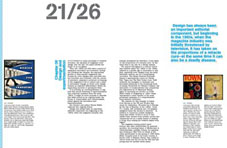
Magazines provide us with snapshots of moments in cultural history. Their disposable nature means that they have to sell quickly, and their covers vie for attention on the shelves with images of beauty, sex, shock, humour and celebrity; presenting our fears, desires and aspirations crudely and honestly. When looked at retrospectively, they become fascinating documents that can tell us more about our past self-image than any academic text.

100 Years of Magazine Covers shows the best of these snapshots from throughout the past century. With images from Vogue, Life, Time, The New Yorker, Mayfair, and more subversive publications such as Oz and Sniffing Glue, this book will appeal to anyone and everyone with an interest in popular culture.

magazines1.jpg

magazines2.jpg

magazines3.jpg

magazines4.jpg

magazines5.jpg

Previously on { feuilleton }
It’s a pulp, pulp, pulp world
A few thousand science fiction covers
Vintage magazine art II
Neville Brody and Fetish Records
View: The Modern Magazine
Vintage magazine art
Oz magazine, 1967–73

El Topo

el_topo.jpg

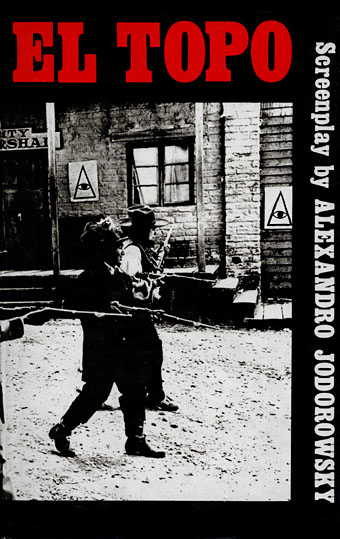
Subterranean Cinema has the El Topo screenplay online, taken from the Douglas Book edition from 1971 (above is the cover of my John Calder UK reprint of the same). As well as a screenplay with annotations by Alejandro Jodorowsky, the second half of the book featured a lengthy, fascinating and at times bizarre and hilarious interview with the director. The site also includes a 1973 Penthouse interview with Jodorowsky, the soundtrack album, and elsewhere on the site there are further gems such as the Mad magazine parody of A Clockwork Orange, something I’d not seen for years.

(Thanks Jay!)

Previously on { feuilleton }
Clockwork Orange bubblegum cards
Alex in the Chelsea Drug Store

Another masterpiece from Cormac McCarthy

The road to hell

Cormac McCarthy’s vision of a post-apocalyptic America in The Road is terrifying, but also beautiful and tender, says Alan Warner.

Saturday, November 4, 2006
The Guardian

The Road
by Cormac McCarthy
256pp, Picador, £16.99

Shorn of history and context, Cormac McCarthy’s other nine novels could be cast as rungs, with The Road as a pinnacle. This is a very great novel, but one that needs a context in both the past and in so-called post-9/11 America.

We can divide the contemporary American novel into two traditions, or two social classes. The Tough Guy tradition comes up from Fenimore Cooper, with a touch of Poe, through Melville, Faulkner and Hemingway. The Savant tradition comes from Hawthorne, especially through Henry James, Edith Wharton and Scott Fitzgerald. You could argue that the latter is liberal, east coast/New York, while the Tough Guys are gothic, reactionary, nihilistic, openly religious, southern or fundamentally rural.

The Savants’ blood line (curiously unrepresentative of Americans generally) has gained undoubted ascendancy in the literary firmament of the US. Upper middle class, urban and cosmopolitan, they or their own species review themselves. The current Tough Guys are a murder of great, hopelessly masculine, undomesticated writers, whose critical reputations have been and still are today cruelly divergent, adrift and largely unrewarded compared to the contemporary Savant school. In literature as in American life, success must be total and contrasted “failure” fatally dispiriting.

But in both content and technical riches, the Tough Guys are the true legislators of tortured American souls. They could include novelists Thomas McGuane, William Gaddis, Barry Hannah, Leon Rooke, Harry Crews, Jim Harrison, Mark Richard, James Welch and Denis Johnson. Cormac McCarthy is granddaddy to them all. New York critics may prefer their perfidy to be ignored, comforting themselves with the superlatives for All the Pretty Horses, but we should remember that the history of Cormac McCarthy and his achievement is not an American dream but near on 30 years of neglect for a writer who, since The Orchard Keeper in 1965, produced only masterworks in elegant succession. Now he has given us his great American nightmare.

Continue reading “Another masterpiece from Cormac McCarthy”

A playlist for Halloween

rethel.jpg

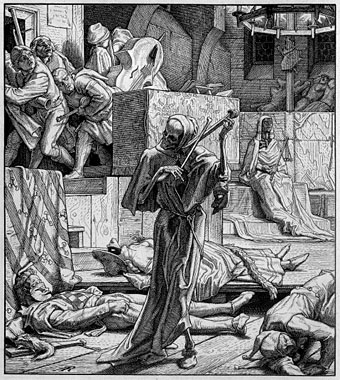
Der Tod als Erwürger (1851) by Alfred Rethel.

It’s a fact (sad or otherwise) that a substantial percentage of my music collection would make good Halloween listening but in that percentage a number of works are prominent as spooky favourites. So here’s another list to add to those already clogging the world’s servers, in no particular order:

Theme from Halloween (1978) by John Carpenter & Alan Howarth.
What a surprise… All John Carpenter‘s early films have electronic scores and great themes, Halloween being the most memorable, and one that’s gradually infected the wider musical culture as various hip hop borrowings and Heat Miser by Massive Attack demonstrate.

Monster Mash (1962) by Bobby “Boris” Pickett.
The ultimate Halloween novelty record. A host of imitators followed the success of this single while poor Bobby struggled to be more than a one-hit wonder. It wasn’t to be, this was his finest hour. Available on These Ghoulish Things: Horror Hits for Halloween with some radio spots by Bobby and a selection of other horror-themed rock’n’roll songs.

The Divine Punishment (1986) & Saint of the Pit (1988) by Diamanda Galás.
Parts 1 & 2 of Galás’s Masque of the Red Death, a “plague mass” trilogy based on the AIDS epidemic. These remain my favourite records by Ms Galás; on the first she reads/sings passages from the Old Testament accompanied by sinister keyboards, making the Bible sound as steeped in evil and metaphysical dread as the Necronomicon. On Saint of the Pit she turns her attention to French poets of the 19th century (Baudelaire, Gérard de Nerval & Tristan Corbière) while unleashing the full power of her operatic vocalizations. Einstürzende Neubauten’s FM Einheit adds some thundering drums. “Correct playback possible at maximum volume only.” Amen to that.

The Visitation (1969) by White Noise.
An electronic collage piece about a ghostly lover returning to his grieving girlfriend. White Noise were David Vorhaus working alongside BBC Radiophonic Workshop pioneers Delia Derbyshire and Brian Hodgson to create an early work of British electronica and dark psychedelia. The Visitation makes full use of Derbyshire and Hodgson’s inventive tape effects and probably accounts for them being asked to score The Legend of Hell House a few years later. Immediately following this is the drums and screams piece, Electric Storm In Hell; play this loud and watch the blood drain from the faces of your Halloween guests.

Zeit (1972) by Tangerine Dream.
Subtitled “A largo in four movements”, Zeit is Tangerine Dream’s most subtle and restrained album, four long tracks of droning atmospherics.

The Masque of the Red Death (1997) read by Gabriel Byrne.
From Closed On Account Of Rabies, a Poe-themed anthology arranged by Hal Willner. The readings are of variable quality; Christopher Walken’s The Raven is effective (although I prefer Willem Defoe’s amended version on Lou Reed’s The Raven) while Dr John reads Berenice like one of Poe’s somnambulists. Gabriel Byrne shows how these things should be done.

De Natura Sonoris no. 2 (1971) by Krzysztof Penderecki.
More familiar to people as “music from The Shining“, this piece, along with much of the Polish composer‘s early work, really does sound like music in search of a horror film. His cheerily-titled Threnody For The Victims Of Hiroshima is one piece that won’t be used to sell cars any time soon. Kubrick also used Penderecki’s equally chilling The Dream of Jacob for The Shining score, together with pieces by Ligeti and Bartók.

Treetop Drive (1994) by Deathprod.
Helge Sten is a Norwegian electronic experimentalist whose solo work is released under the Deathprod name. “Electronic” these days often means using laptops and the latest keyboard and sampling equipment. Deathprod music is created on old equipment which renders its provenance opaque leaving the listener to concentrate on the sounds rather than be troubled by how they might have been created. The noises on the deceptively-titled Treetop Drive are a disturbing series of slow loops with squalling chords, anguished shrieks and some massive foghorn rumble that seems to emanate from the depths of Davy Jones’ Locker. Play it in the dark and feel the world ending.

Ouroborindra (2005) by Eric Zann.
Another collection of sinister electronica from the Ghost Box label (see this earlier post), referencing HP Lovecraft and Arthur Machen’s masterpiece, The White People. Spectral presences haunting the margins of the radio spectrum.

Theme from The Addams Family (1964) by Vic Mizzy.
Never the Munsters, always the Addams Family! If you don’t know the difference, you must be dead.

Happy Halloween!

Previously on { feuilleton }
The music of the Wicker Man

The art of Virgil Finlay, 1914–1971

finlay1.jpg

Mrs Amworth.

Another great artist of the macabre and supernatural, Virgil Finlay was the one of the most talented and imaginative illustrators of his generation. Unlike older contemporaries such as Joseph Leyendecker, who became wealthy producing elegant yet often bland advertising art, much of Finlay’s best work was for pulp magazines like Weird Tales and Amazing Stories which paid a pittance and printed his finely-hatched scratchboard drawings on the cheapest paper. The advantages to this work, such as they were, came in the access to a huge and appreciative audience, and the chance to provide the first illustrations for what would turn out to be classic genre stories. Finlay illustrated a number of HP Lovecraft’s tales and received the highest praise from the author in doing so. His illustration for Lovecraft’s The Thing on the Doorstep (below) contains a slight nod to Harry Clarke’s Valdemar picture (see previous post) with its distant, highlighted doorway, a detail that Clarke himself borrowed from the celebrated Las Meninas by Velázquez.

Therionweb has five galleries of Finlay’s pictures and Bud Plant again has a brief biography.

finlay2.jpg

Abercrombie Station.

finlay3.jpg

The Thing on the Doorstep.

finlay4.jpg

Six and Ten.

Elsewhere on { feuilleton }
The illustrators archive