Ghost clocks

ghost1.jpg

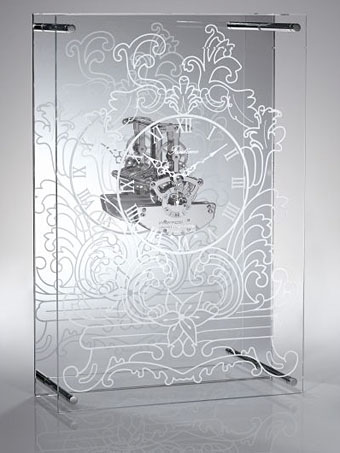
Ghost Clock by Yee Ling Wan (2005).

We’ve had skeleton clocks and mystery clocks this week, ghost clocks would seem the next logical step. There don’t seem to be many devices which fit the label unfortunately but this pair are interesting enough. Yee Ling Wan’s clock is relatively cheap (around £70) compared to yesterday’s antiques and can be purchased from a number of online outlets.

ghost2.jpg

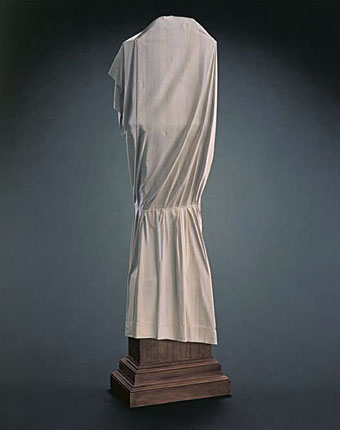
Ghost Clock by Wendell Castle (1985).

Wendell Castle’s Ghost Clock isn’t a timepiece at all but is a solid block of mahogany carved and laminated to give a trompe l’oeil impression of a sheeted grandfather clock. The wrapped object and the confounding of expectations reminds me of Magritte who may have been an inspiration. Ce n’est pas une horloge, perhaps.

Previously on { feuilleton }
Mystery clocks
Skeleton clocks
The Midsummer Chronophage
The Corpus Clock

Josh Simpson’s glass planets

simpson1.jpg

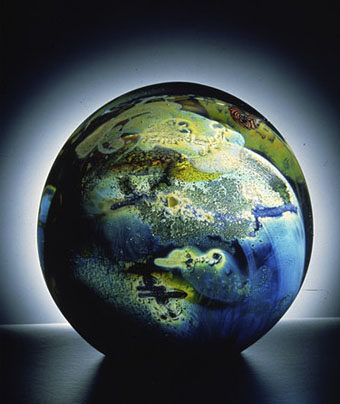
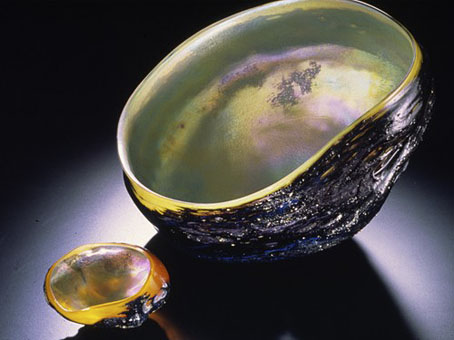
Planet.

American glass artist Josh Simpson takes the paperweight-as-miniature-world to its logical conclusion by creating series of hyper-detailed spheres he calls Planets. He continues the extraterrestrial theme by also creating his own version of tektite meteor glass (below) embellished with iridescent interiors. His site is worth a browse for other glass artefacts such as his Inhabited Vases and I like the colourless glass bubble pieces. Finally, he has details of an ongoing project to hide his Planets in various remote places around the world with the intention of surprising future inhabitants or archaeologists. If that sounds intriguing, you can get involved here.

simpson2.jpg

Tektite.

Previously on { feuilleton }
Luke Jerram’s Glass Microbiology
Andy Paiko’s glass art
The art of Josiah McElheny
The art of Angelo Filomeno
Cristalophonics: searching for the Cocteau sound
Glass engines and marble machines
Wesley Fleming’s glass insects
The art of Lucio Bubacco
The glass menagerie

Rammellzee RIP

rammellzee.jpg

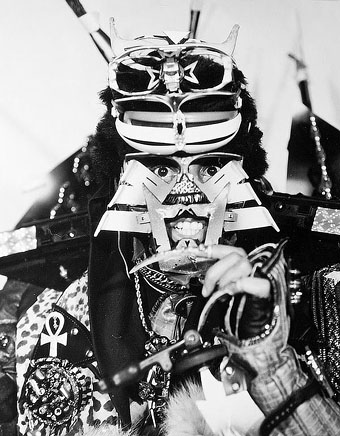
Rammellzee.

I consider that immortality is the only goal worth striving for: immortality in space. Man is an artefact created for space travel.
William Burroughs, 1982

We have to leave this tasteless mould of a planet.
Rammellzee, 2004

It’s fitting that a post about the late Rammellzee should follow one about Brion Gysin even if the circumstances aren’t those one would wish. Before he was involved in music Rammellzee was a graffiti artist and the convoluted mythologising which he later wove around the art of the graffiti tag—and his obsession with words and their meaning—bears comparison with Gysin and Burroughs’ similar mythologising, their theories about the viral origins of language. Look at Gysin’s calligraphic paintings (which he based on Arabic script) and you’ll see an exact analogue with the stylisations of graffiti taggers.

Given all of that, it’s even more fitting that Rammellzee was one of the voices chosen by Bill Laswell to set beside William Burroughs on Material’s finest forty minutes, Seven Souls, in 1989. I knew that voice from the great 1983 single he made with K-Rob, Beat Bop, one of many highlights on the best of the Street Sounds compilations, Electro 2, so it was a pleasant surprise finding it on the album which remains the best musical work that Burroughs was involved with. Rammellzee’s subsequent recordings with Laswell and others evolved an elaborate strain of what’s now known as Afrofuturism which he extended into paintings, collages and sculptural work. When you look at his detailed, science fiction philosophies, or at the underwater mythologies of Drexciya, it’s evident that there’s a rich seam of the African-American imagination which exactly parallels Burroughs’ visionary work. Visionaries right now are in short supply; we can’t afford to lose another.

Rammellzee: The Remanipulator versus Syntactical Virus by Peter Shapiro (1997)
No Guts No Galaxy—Rammellzee & phonosycographDISK (1999)
Rammellzee: The Ikonoklast Samurai by Greg Tate (2004)

Previously on { feuilleton }
Street Sounds Electro
The art of Shinro Ohtake

Brion Gysin let the mice in

gysin.jpg

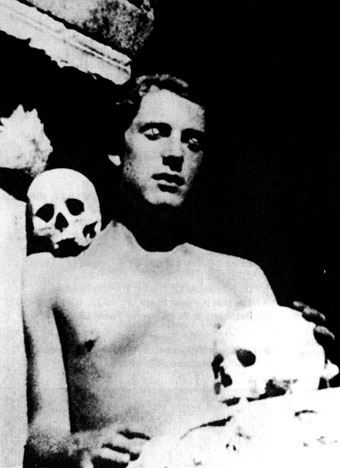
Brion Gysin—autoportrait (1935).

“A shaman to me is always a pansexual being,” says the gay Canadian filmmaker. “These guys all came out of that period where queer was really hardcore, it was part of their radical art — and of course it was illegal.” (more)

The filmmaker in question is Nik Sheehan discussing FLicKeR, his 2007 documentary about artist and writer Brion Gysin. Sheehan’s film is available for viewing at Ubuweb although I haven’t got round to watching it yet so I can’t say much about it. (Reality Studio has a review.) Gysin’s life and work is certainly worthy of study, however, his art and writing—which encompassed novels and experimental poetry—often having been overshadowed by his close association with William Burroughs. He gets a raw deal in Ted Morgan’s curiously bad-tempered biography of Burroughs, for example, despite having given his co-conspirator the cut-up technique, collaborated with him on The Third Mind, and so on. FLicKeR‘s title refers to Gysin’s Dreamachine, the first sculpture which needs to be experienced with the eyes closed, being a homemade hallucination engine which works by flickering light and shadow at a rapid rate on the closed eyelids. I made some Dreamachines of my own in the mid-1980s by carefully studying photos in RE/Search #4/5, and they certainly do work. It’s a shame that 78rpm record players are more difficult to find than they used to be since the original template devised by Gysin and Ian Sommerville needs a high speed in order to create the optimum flicker rate. As you might expect, various psychonauts have since created their own variations such as this one for a 45rpm player.

I mentioned a few weeks ago that the New Museum in NYC is staging the first US retrospective of Gysin’s work, an exhibition which they happen to call Dream Machine, and which opens on July 7th. The New York Times ran a piece about Gysin in advance of that. Ubuweb has further Gysin materials, such as this Burroughs piece about Gysin’s invention of the cut-up method, and some recordings of the permutated poems. Finally, if you’re wondering about the title of the post, it’s a reference to this.

Previously on { feuilleton }
Burroughs: The Movie
William S Burroughs: A Man Within
Emil Cadoo
The Great God Pan
The Final Academy
William Burroughs book covers
Towers Open Fire

Centaurs

centaur1.jpg

Elatus from Pandaemonium I (Centaurs) (2010) by David Trullo.

One of a series of centaur portraits by Spanish artist David Trullo. Placing characters from Classical mythology in contemporary settings makes a change. The title Pandaemonium I implies further series so I’m curious to see how Trullo follows these.

centaur2.jpg

Battling Centaurs (1873) by Arnold Böcklin.

Centaurs had a flush of popularity in Germanic art of the 19th century; Franz Stuck painted them a number of times and Jugend magazine is littered with many often grotesque representations. I’ve never seen an explanation for this resurgence of interest. Is it because a man/horse hybrid is a potent symbol of masculine power? Arnold Böcklin’s painting is one of the better examples and suits its title more than Michelangelo’s famous sculpture in which the hybrids are lost in a tangle of writhing bodies.

Previously on { feuilleton }
Mermaids
The Masks of Medusa