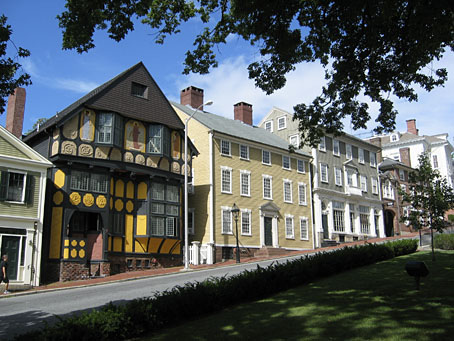
Thomas Street, Providence: on the left is the Fleur-de-Lys Studios; two doors along is the Dodge House Gallery which housed an additional part of the art exhibition; the Providence Art Club is the red-brick building next door.
I’m back from Providence, returned early on Tuesday but took the day off to recover from jet lag. The city was hot and humid for much of the time but I didn’t mind that, it was good to be able to walk around in the evening without a jacket, something that seldom happens here. I don’t go to many conventions so although NecronomiCon was the best I’ve been to, there isn’t a great deal of competition. I always enjoy meeting and talking to creators of any stripe—writers, artists, filmmakers, editors, etc—and it’s a pleasure to meet readers face to face, but conventions in general aren’t always attractive in themselves. NecronomiCon was inviting for being relatively small and with a strong focus not just on Lovecraft but on weird fiction as a whole: there were panels on Clark Ashton Smith, Lord Dunsany, Robert Chambers, and one on the legacy of what M. John Harrison designated “the New Weird”. I’ve been told that if there’s a NecronomiCon in 2017 the intention is to develop this area of discussion.
And then there’s Providence itself: Lovecraft’s stories will read in a very different light now I’ve visited the city that inspired so much of his work. The one walking excursion I took to College Hill was curtailed by an afternoon of 30-degree temperatures but I did get to see a small part of Angell Street where Lovecraft lived for many years, and I also walked down Benefit Street as far as house number 135, familiar to readers as The Shunned House. The architecture of Providence is a delight, not only the Colonial buildings but the also the more recent vernacular styles of the Downtown area. Even the heat seemed connected to Lovecraft and his abhorrence of cold weather; in later years he took sightseeing trips down to Florida so I’m sure he wouldn’t have complained about the hot sun or the swampy air.
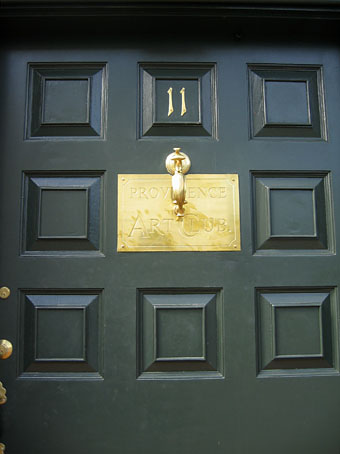
The massive and weighty door of the Art Club.
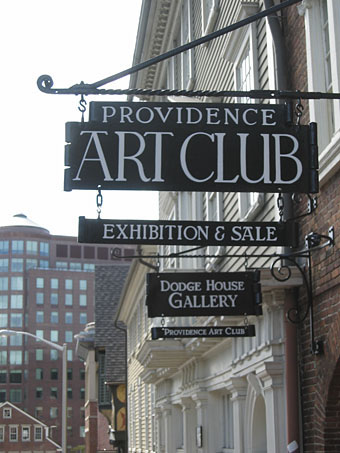
The main reason to be there was for the art exhibition, of course, and for that the venue couldn’t have been better. The Providence Art Club is mentioned in The Call of Cthulhu as a rather staid organisation that disapproves of Henry Anthony Wilcox who works down the street at the Fleur-de-Lys Studios; I spoke to a couple of current Art Club members, and was amused to hear that the establishment still maintains a somewhat conservative position. But the presence of so much bizarre and grotesque art in the gallery was evidence of a loosening of attitudes that Wilcox and Pickman couldn’t have managed in their day. A selection of my photographs follows below; I took over 250 photos but really should have taken more, especially of the buildings. The Providence Art Club has a good collection of photos from the opening night, some of which include me caught uncomfortably in front of a camera lens.
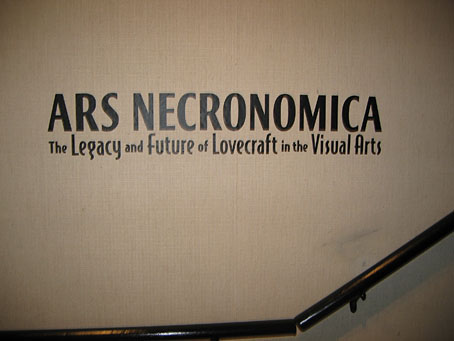
Some acknowledgements: I’ve already thanked Niels-Viggo Hobbs and The joey Zone for inviting me there but I’ll do so again. Big thanks also to Carmen Marusich who spent most of her time behind the counter at Lovecraft Arts & Sciences in the Arcade; to print-wrangler Brian Mullen who very generously spent an afternoon ferrying me around various stores in search of a phone charger before smartly suggesting I try the USB port in the TV at the hotel (something I should have thought of); and to Michael Rose and company at the Providence Art Club for allowing us into their beautiful building. Shouts and thanks to: Sara Bardi, Michael Bukowski, Syl Disjonk, Jason C. Eckhardt, Bob Eggleton, Dave Felton, Stephen Gervais, Mike Knives, Robert H. Knox, Allen Koszowski, Henrik Möller, Mallory O’Meara, Gage Prentiss, Skinner, Jason Thompson, Frank H. Woodward (at last!), Josh Yelle, and all those who bought artwork, offered compliments or came to see the art and the panel discussions.
Finally…Earth! I’ve been listening to the band a great deal this year so I’m predisposed to enjoy any live event, but their performance in the gilded splendour of the Columbia Theatre on Federal Hill really knocked me out. An outstanding set with great sound and great support acts too, especially Elder. All this taking place a couple of streets away from the location of Lovecraft’s Starry Wisdom church; I was in seventh heaven.
And now the photos…
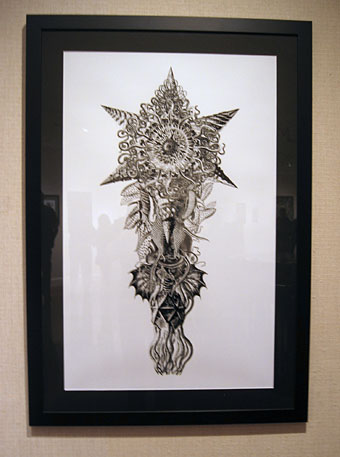
The title page entity from Lovecraft’s Monsters which was named Tentacles for the exhibition.
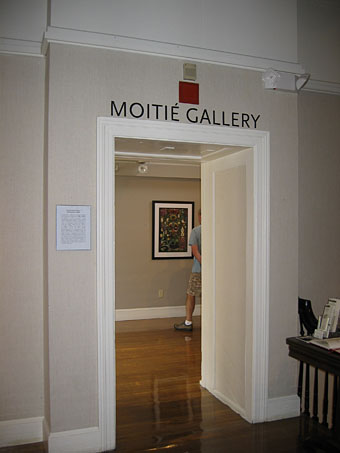
My works were in a gallery room on their own, guarded by the title page thing from Lovecraft’s Monsters.
Continue reading “Dark arts”