Paris V: Details

Final Paris posting here, gathering up more of the better photos.

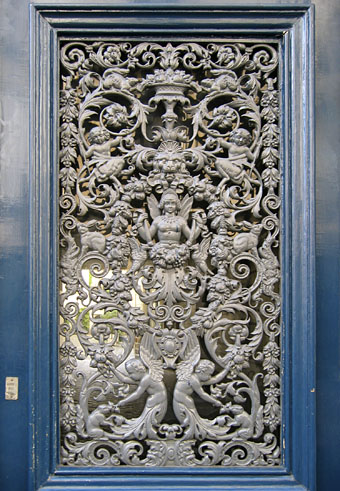
door.jpg

Walk down any residential street and you’ll see amazing doors like this that lead to the courtyards of apartment blocks. All the decorations are different, as are the brass door-handles emblazoned with human or animal heads. You could spend months photographing them.

Continue reading “Paris V: Details”

Paris III: Le Grande Répertoire–Machines de Spectacle

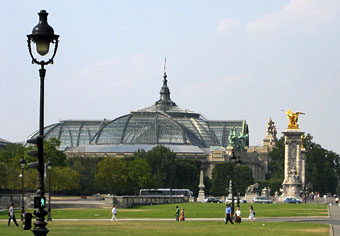
grandrep0.jpg

The Grand Palais from Ave du M Gallieni.

The Grand Palais, opposite the Petit-Palais, was built in 1897–1900 by Louvet, Deglane, and Thomas. Its dimensions, covering all area of about 38,000 sq. yds, are imposing. It consists of a large front building, united with a smaller one in the rear by a transverse gallery. The style is composite, but mainly reminiscent of the 17th century. The façade is adorned with a double colonnade, rising to a height of two stories; and there are three monumental entrances in the central pavilion. The sculptures of the central portico, representing the Beauty of Nature, and Minerva and Peace, are by Gasq, Boucher, Verlet, and Lombard. Those to the right represent Sculpture, Painting, Architecture, and Music, and are by Cordonnier, Lefebvre, Carlès, and Labatut. To the left are the Arts of Cambodia, Egypt, Greece, and Rome, by Bareau, Suchet, Béguine, and Clausade. On and under the colonnades are friezes of Amoretti, holding the attributes of the arts. At the top are a balustrade, allegorical groups on the abutments, by Sepsses and Greber, and bronze quadrigae, by Récipon. In the middle of the principal building rises a depressed dome. The rear-façade, in the Ave d’Antin, is embellished with colonnades, sculpture, and friezes in polychrome stoneware, made at Sèvres (Ancient and Modern Art).

In 1900 this building is to be used for contemporary and centennial exhibitions. Afterwards it is to be the scene of the annual exhibitions of paintings and sculptures, horse shows, agricultural fairs, and the like. Its destination explains the peculiarities of its internal construction. The roof is glazed, consisting of curved sheets of glass 10 ft. long and 3 ft. wide.

Baedeker’s Paris (1900).

One of the highlights of this trip was a visit to the wonderful Grand Palais to see an exhibition of invented machines that wouldn’t have been out of place in La Cité des Enfants Perdus or a Terry Gilliam film. The slightly run-down but still splendid venue was the perfect setting for rusted contraptions devoted to making loud noises or smashing things to pieces. The exhibition is still running should you have the good fortune to be in Paris up to the 13th of this month.

Continue reading “Paris III: Le Grande Répertoire–Machines de Spectacle”
Generative culture

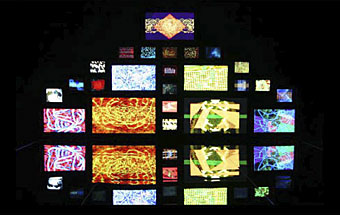
eno_tokyo.jpg

77 Million Paintings by Brian Eno, Laforet Museum, Harajuku, Tokyo.

Brian Eno is in the latest Wire talking about his forthcoming DVD-ROM, 77 Million Paintings. He also mentions coining the term “generative music” in 1995 to a resounding silence. 77 Million Paintings continues the generative project:

This will be available later in the year as a DVD-ROM (which will play on most modern computers) and a DVD featuring Brian talking about the project. It also includes an extensive booklet covering Brian’s long and successful career as a visual artist.

The name 77 Million Paintings comes from the possible number of images that can be created from a huge number of combinations. Anyone familiar with Brian’s audio-visual installations will instantly recognise the inspiration behind the project. The music is from Brian’s installation collection.

Ambient stuff for the eyes, in other words. I’d be looking forward to this if I still had a TV (mine packed up a few years ago) as I used to program my primitive Spectrum computer (which still works!) to generate simple patterns, turning the TV screen into an abstract artwork for a few hours. The difference with Eno’s project, of course, is the greater variety, quality and degree of intent involved. I saw one of his installation works, The Quiet Club, at the Hayward Gallery in 2000 which used similar audio and visual processes. With 77 Million Paintings you’ll be able to turn your living room into a quiet club of your own.

In a similar generative vein, there’s WolframTones: “A New Kind of Music – Unique cellphone ringtones created by simple programs from renowned scientist Stephen Wolfram’s computational universe.” Too complicated to explain; go and play around with it.

Le horreur cosmique

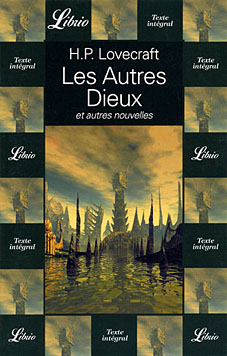
hpllibrio.jpgI’ll be in Paris this week so some French-related postings are in order.

Michel Houellebecq’s HP Lovecraft: Against the World, Against Life (which I still haven’t read) has been in the news again recently, with a number of reviews appearing in UK newspapers and magazines, most of which present the by-now rather tired spectacle of reviewers who normally wouldn’t give any of this nasty pulp stuff a second thought having to take Lovecraft seriously because Houellebecq is a serious author. (“He’s a bad writer!” they bleat. And Lou Reed is a bad singer; you’re missing the point, you fools.) The Observer last week had one of the better ones. Last year the Guardian published an extract from Houellebecq’s book.

Curious how often it requires the French to make the Anglophone world look anew at marginalised elements of its own culture; Baudelaire championed Edgar Allan Poe, it was French film critics who gave us the term “film noir” when they identified a new strain of American cinema and the Nouvelle Vague writers and filmmakers were the first to treat Hitchcock as anything other than a superior entertainer. The French have always liked Lovecraft so it was no surprise to me at least when Houellebecq’s book appeared.

Oddly enough, the only association I’ve had so far with French publishing is the use of my 1999 picture of Cthulhu’s city, R’lyeh, on the cover of a reprint of HPL stories from Houellebecq’s publishing house (above). Something I’ll be looking for in Paris if I have the time will be more of Philippe Druillet‘s Lovecraft-inflected work. Druillet has been working with the imagery of cosmic horror since the late 60s and even illustrated the work of William Hope Hodgson, one of HPL’s influences and an English writer the broadsheet critics have yet to hear about. Take a look at these pictures for stories written before the First World War then go and look at some stills from the latest Pirates of the Caribbean movie. What was once the preserve of Weird Tales and other pulp magazines is now mainstream culture.

Previously on { feuilleton }
Davy Jones
Charles Méryon’s Paris

The art of Jessica Joslin

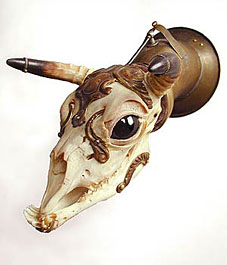
diminuto.jpg

Diminuto, 7″x5″x6″ (2004)
Antique hardware, bone, leather, cast painted glass eyes.

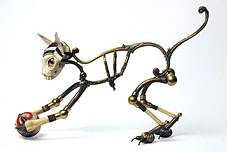
lupe.jpg

Lupe, 11″x6″x16″ (2005)
Antique hardware, brass, bone, glove leather, painted wood ball, glass eyes.

Gorgeous stuff, reminds me of some of Jan Švankmajer‘s sculptural works (which are possibly an inspiration) but with an added dimension of Victorian playfulness.

Via Boing Boing.