At the Mountains of Madness

atmom.jpg

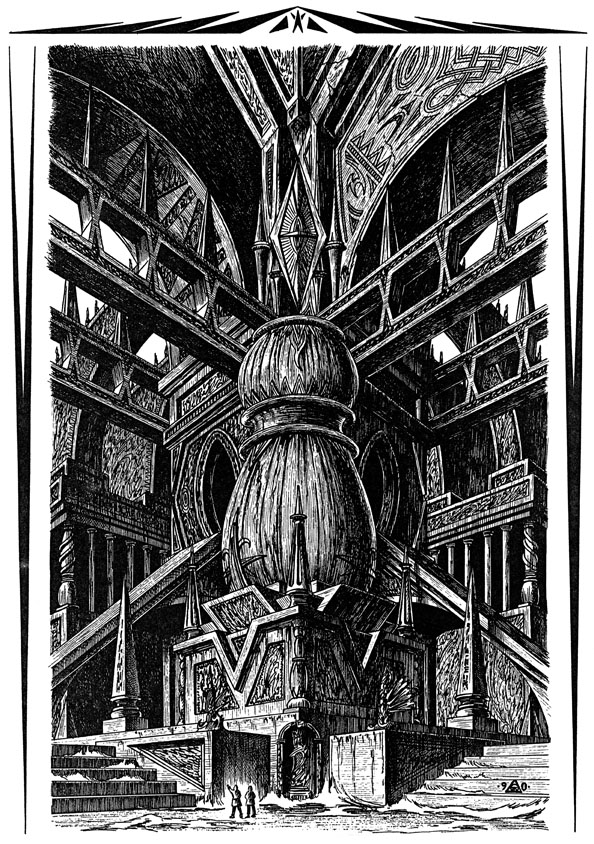
Going through stacks of old artwork today turned up a photocopy of a drawing I did in 1990, my sole attempt to illustrate HP Lovecraft’s At the Mountains of Madness. By the time I did this I was pretty exhausted by Lovecraft’s world and was already at work on the first phase of the Lord Horror comics for Savoy which explains why this is a bit half-hearted, the architecture owing more to Piranesi than anything particularly alien. I forget why I did this now, I think it was at someone’s request, and I’ve also no idea where the original drawing is. The sprawling organic cityscape/landscape I created last year for the Maison d’Ailleurs exhibition is probably closer to the kind of thing this story requires.
atmom3.jpg

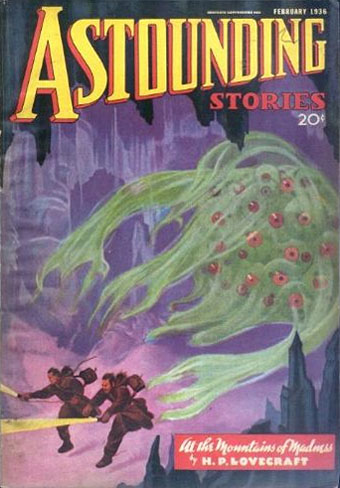
At the Mountains of Madness was rejected by Lovecraft’s usual publisher, Weird Tales, for not being enough of a horror story. This is true, the novella is more of a fictional travelogue, especially in its later half where a million-year-old alien city is discovered in the heart of Antarctica. Science fiction magazine Astounding took it instead where it made the cover of the February 1936 issue, the climactic shoggoth attack being painted by Howard V Brown. Poor old Lovecraft had nearly all his most famous stories published in Weird Tales, and helped give the magazine its lasting reputation, yet he was never given a cover feature during his lifetime. Astounding gave him the honour again in June of the same year for another novella, The Shadow Out of Time, also illustrated by Howard Brown.

Previously on { feuilleton }
Lovecraftian horror at Maison d’Ailleurs
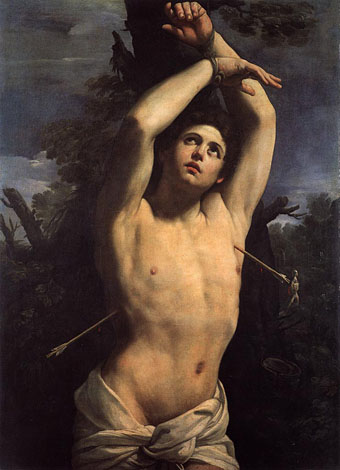
Guido Reni’s Saint Sebastian

sebastian.jpg

Saint Sebastian by Guido Reni (c. 1616).

The Agony and the Ecstasy is an exhibition at the Dulwich Picture Gallery, London, based around Guido Reni’s paintings of the martyr, six of which are on display.

This will be a once-in-a-lifetime opportunity to compare directly the six masterpieces which are coming from all over the world to join the St Sebastian owned by Dulwich Picture Gallery. The paintings are coming from New Zealand, South America, Madrid, Genoa and Rome.

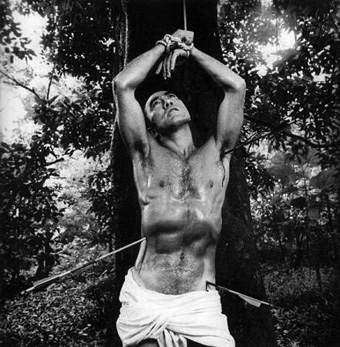
The claim for masterpieces is stretching the truth when art experts apparently believe that only two of the martyr paintings credited to Reni are original—the Genoa picture above and the Dulwich’s own version—the rest being later copies. The Genoa version became a favourite of Oscar Wilde and it was a Sebastian by Guido Reni that also excited the illicit passion of the 12 year-old protagonist in Yukio Mishima’s novel Confessions of a Mask. Wilde used the name Sebastian when he went into exile in Paris but he never took his identification with the saint as far as Mishima who adopted the typical pose in the famous photo taken shortly before the writer’s suicide. Wilde had no need of borrowed martyrdoms, his own was more than enough.

mishima.jpg

Yukio Mishima (1970).

The Agony and the Ecstasy runs until 11 May 2008. For further images of Saint Sebastian, this site is as comprehensive as it gets.

Elsewhere on { feuilleton }
The gay artists archive

Previously on { feuilleton }
Dorian Gray revisited
Beardsley’s Salomé
The art of Takato Yamamoto
Alla Nazimova’s Salomé
Fred Holland Day
The Poet and the Pope
The Picture of Dorian Gray I & II

William Heath Robinson’s illustrated Poe

whr1.jpg

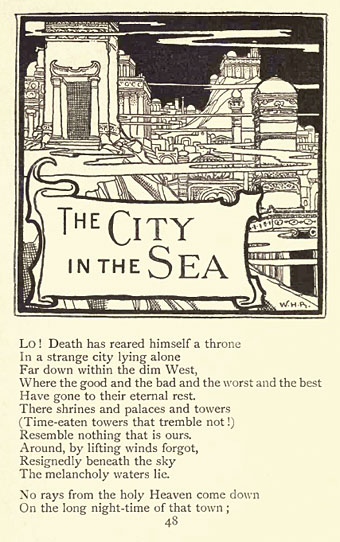
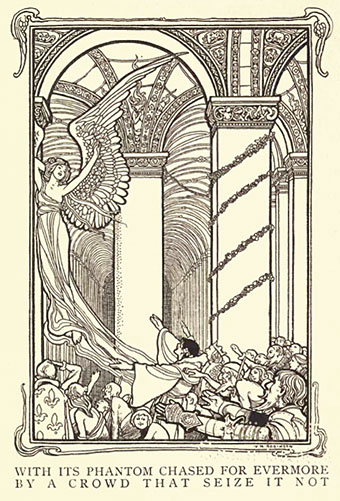
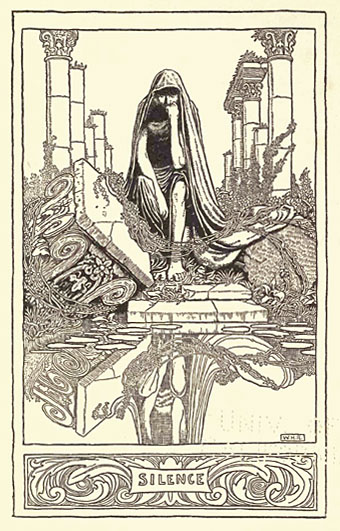
Another gem from the Internet Archive collection of scans from North American libraries. This edition of the poems of Edgar Allan Poe from 1900 was illustrated by William Heath Robinson (1872–1944), an artist whose later drawings of quirky inventions have completely overshadowed his earlier books, as well as the work of his equally talented older brother, Charles. I’m probably in the minority in preferring Heath Robinson’s book illustration to his later works, and this edition of Poe is a superb example of his mastery of line and space. It can’t compete with Harry Clarke’s Poe, of course, but then neither can anything else. WHR wasn’t really suited to the darker side of literature but he acquits himself here far better than Arthur Rackham did when he attempted his own Poe collection in 1935.

Bud Plant’s W Heath Robinson page
W. Heath Robinson’s fairy tale illustrations

whr2.jpg

The Conqueror Worm.

whr3.jpg

Elsewhere on { feuilleton }
The illustrators archive

Whistler’s Peacock Room

whistler1.jpg

Random browsing this week turned up some nice high-res photos of Harmony in Blue and Gold, as James Abbott McNeill Whistler named the room he decorated for Frederick R. Leyland in 1878. Leyland had bought one of Whistler’s paintings, La Princesse du pays de la porcelaine (1864), and architect Thomas Jeckyll was concerned that the painting and furnishings would clash, hence the invitation for Whistler to help with the colour scheme.

I’ve always preferred this luscious, gold-leafed design to the worthy medievalism of contemporary William Morris. Even though Whistler completed the work prior to the 1890s, the combination of Orientalism and peacocks (the signature bird of the Decadence) seems very much tied to the fin de siècle not least because of Aubrey and Mabel Beardsley’s visit to the room in 1891. Beardsley was very impressed with the painting and with the golden birds, the style of which later formed the inspiration for his famous Peacock Skirt illustration in Salomé (1894).

whistler2.jpg

There’s a good overview here of the history of the room, including details of the falling out between the combative artist and his client, and the story of the room’s removal to America and subsequent restoration.

Previously on { feuilleton }
Beardsley’s Salomé
Alla Nazimova’s Salomé