
Why I judge albums by their covers | A note to JJ: Pearls Before Swine had Bruegel on one of their covers in 1968.
Category: {art}
Art
The art of Paul Richmond
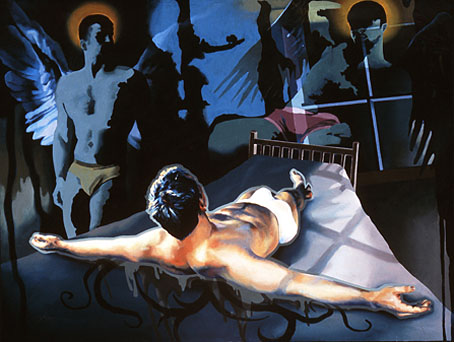
Forgive Me Father For I Know Not.
Paul Richmond explores the development of his sexuality in a fascinating series of paintings which adeptly blend figurative and abstract elements. Some of these resemble painted Photoshop collages which may well be how they started out. If so he’s one of the first painters I’ve come across who works this way.
Elsewhere on { feuilleton }
• The gay artists archive
Brian Eno: Imaginary Landscapes
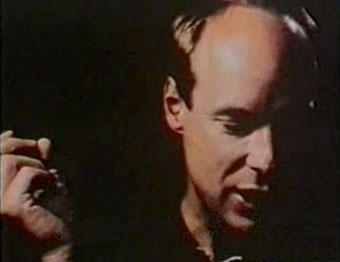
From Eonism back to Eno with Imaginary Landscapes, a 40-minute documentary from 1989, directed by Duncan Ward and Gabriella Cardazzo. As usual it’s good to see BE discussing his ideas about music and art although I’d have preferred less of the atmosphere shots and more talk. The film is available to view in a streaming version here.
Previously on { feuilleton }
• Thursday Afternoon by Brian Eno
• Moonlight in Glory
• Tiger Mountain Strategies
• Generative culture
• My Life in the Bush of Ghosts
Metronomes
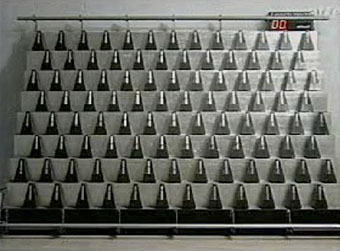
An automated performance of György Ligeti’s Poème symphonique for 100 metronomes at Ubuweb.
Since its world premiere in the Netherlands in 1963, Poème symphonique for 100 metronomes has been very rarely performed in public. The complicated scenographic staging, the detailed preparation by hand, the need for around ten technicians to activate more or less simultaneously the 100 metronomes, makes the demand for performances limited. Thirty-two years after the premiere, the sculptor and installation artist Gilles Lacombe heard a recording of the work. Impressed, he decided to invent a machine able to perform the piece automatically. After six months, he set up this ingenious device. Ever since, Poème symphonique can be performed accurately, at any time, and in public. Please understand that at its world premiere in 1963, the concert was filmed by Dutch television. On that night, after the final tick-tock of the metronome, there was a heavy silence, followed by booing, screaming, and threats. The concert was never broadcast.
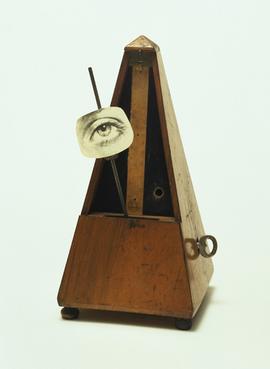
And while we’re on the subject, let’s not forget Man Ray’s Object to be Destroyed (1923) (aka Indestructible Object). Richard Cork looked at its origin and meaning for the Tate magazine.
Previously on { feuilleton }
• The Avant Garde Project
The art of Hideki Koh
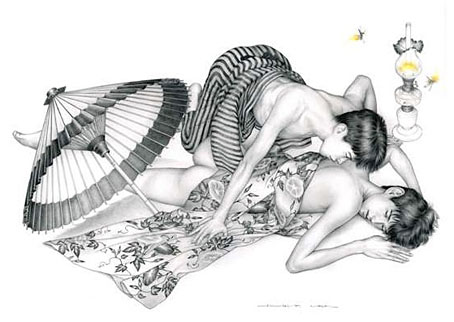
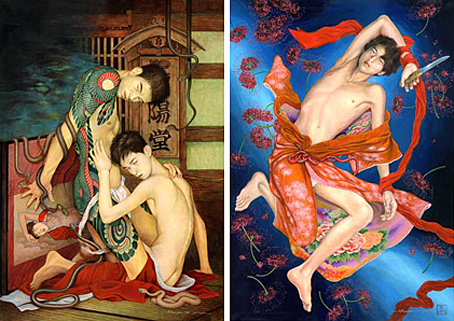
Boys in kimonos and shirtless youth are Hideki Koh’s thing and you can see more of these at his site or at Mayumi International. As is all too common, most of the examples shown are painfully small although he has a page of wallpapers. A tip for artists everywhere: we don’t want to steal your work, we just want to see it properly.
Elsewhere on { feuilleton }
• The gay artists archive
Previously on { feuilleton }
• Secret Lives of the Samurai
• The art of Sadao Hasegawa, 1945–1999
• The art of Takato Yamamoto