Zeepaddestoel.
Previously on { feuilleton }
• The glass menagerie
A journal by artist and designer John Coulthart.

Art
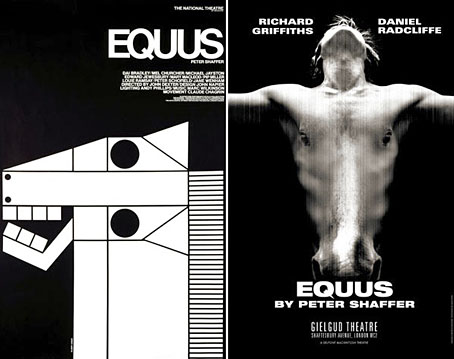
A juxtaposition of old and new theatre posters in the New York Times caught my eye this week, part of a feature about the current Broadway run of Peter Shaffer’s play. The news there, of course, has been Daniel Radcliffe’s on-stage nudity; understandable, perhaps, but celebrity trivia has overshadowed appraisal of Shaffer’s work as a piece of art.
What struck me seeing these was the two very different approaches to the same design problem. Given the subject matter, using an image of a horse is somewhat unavoidable as well as being immediately attractive since horses nearly always look good. The freight of historical and cultural association they carry is also one of the themes of the play. I really like the spare treatment of Gilbert Lesser’s 1976 poster for the National Theatre (left) and much prefer it to the new version used for the London and New York shows. The Lesser poster has the quality of a puzzle, matching the psychological piecing together of the story and Alan Strang’s accusation that Dysart the psychiatrist is always “playing games”. It also has a sinister quality lacking in the contemporary version; Shaffer’s Equus is an unforgiving god and the black eyes could refer to the blinded horses. The Photoshop horse looks altogether too mundane and is it my imagination or is the horse head misshapen slightly in order to fit the torso?
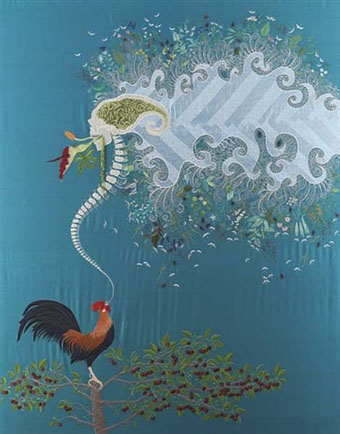
Venom (2003).
The work of Angelo Filomeno, an Italian artist based in New York, is just the kind of thing I like to see: insects, skulls and bones in a luscious presentation. The sculpture below is made of glass while the flat works are silk embroidery with crystals as part of the decoration. There’s a selection of the latter works here.
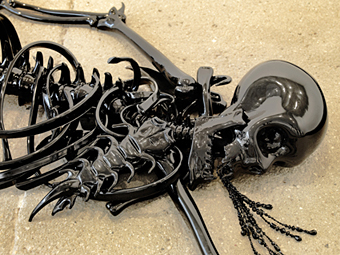
Cold (detail) (2007).
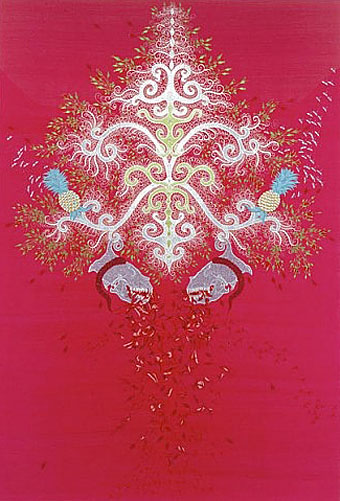
Incendiary Lovers (2005).
Previously on { feuilleton }
• The skull beneath the skin
• Vanitas paintings
• Giant Skeleton and the Chocolate Jesus
• Very Hungry God
• History of the skull as symbol
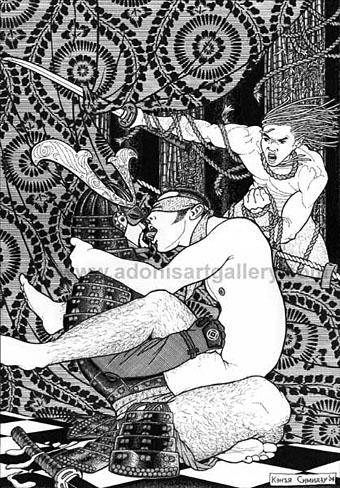
Kiss of Death (2007).
From a series of marvellous homoerotic ink drawings by Kenya Shimizu. The artist seems to have no web presence at all, unfortunately, aside from three pages of work for sale at London’s Adonis Art Gallery. Most of the pictures there are hardcore images so if you don’t want to see any of that, don’t look. His paintings are as good as his drawings but I typically prefer the black and white work, especially since there’s a slight Beardsleyesque feel to some of them—or is it merely the Japanese line which Beardsley borrowed? Nice to see a variety of cum shots as well; the first drawing in the Samurai series, Release, is even a bukkake scene, something you rarely see in gay art.
Kenya Shimizu was born in Fukui Prefecture in Japan, 1976. Kenya Shimizu devoted himself early on to mastering the techniques of his art. His homo-erotic fantasies (pen and ink) – very much in the Japanese erotic tradition – are brilliant compositions executed with panache and great skill. His paintings on gold and silver leaf, are masterpieces of watercolour workmanship; His watercolours of modern Japan – reveal and portray the present-day homo-erotic fantasies of the ‘salarymen’ and students of today’s Japan.
Within recent years, one of the leading Japanese practitioners of homo-erotic painting – Sadao Hasegawa – sadly died. Now a worthy successor has come onto the scene.
Elsewhere on { feuilleton }
• The gay artists archive
Previously on { feuilleton }
• The art of Sadao Hasegawa, 1945–1999
• The art of Takato Yamamoto
• The art of ejaculation
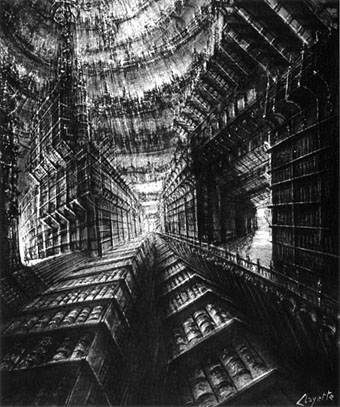
The Library of Babel (no date).
Another French artist who specialised in fantastic architecture, Pierre Clayette’s work came to my attention via the picture above which illustrates a Borges story. This leads me to wonder once again what it is about French and Belgian artists which attracts them more than others to this type of imagery.
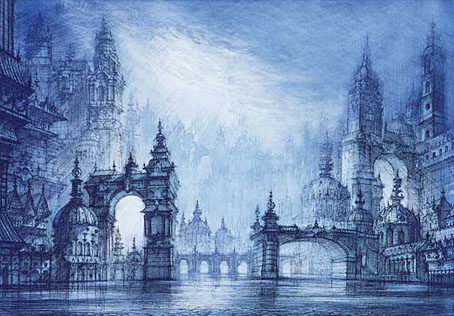
Whatever the reason, there isn’t a great deal of Clayette’s work online and biographical details are few. This page (the source of the untitled picture above) reveals that he worked as an illustrator for Planète magazine, the journal of “fantastic realism” founded by Jacques Bergier and Louis Pauwels in the early Sixties. Some readers may know that pair as the authors of a { feuilleton } cult volume, The Morning of the Magicians (1960), whose vertiginous blend of speculative and weird fiction, occultism and futurology Planète was intended to continue.
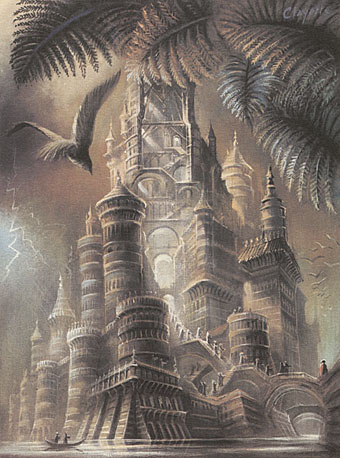
Clayette also worked as a theatre designer and book illustrator. Le Chateau (above) is an illustration from Songes de Pierres, a 1984 portfolio depicting scenes from Pierres by Roger Caillois. That writer has his own significant Borges connection, being responsible for introducing Borges’ work to France via his editorship of the UNESCO journal, Diogenes. (Pauwels and Bergier later published Borges in Planète.)
Finally, there’s a less extravagant Flickr collection of some Clayette covers for Penguin Shakespeare editions. All of which only scratches the surface of what was evidently a prolific career; I’ll look forward to more examples of his work coming to light.
Elsewhere on { feuilleton }
• The fantastic art archive
• The illustrators archive
Previously on { feuilleton }
• The art of Michiko Hoshino
• The art of Erik Desmazières
• The art of Gérard Trignac
• The Absolute Elsewhere