
If Paintings Had Voices, Francis Bacon’s Would Shriek | A centenary retrospective at the Metropolitan Museum of Art.
Category: {art}
Art
Peake’s Pan
Another charity shop book-raid this week netted me a copy of Ian Fleming’s On Her Majesty’s Secret Service in its 1965 Pan Books edition, one of the Bond series with great covers designed by Raymond Hawkey. The sight of the tiny Pan silhouette above reminded me that this logo was based on drawings commissioned from Mervyn Peake when the company was launched at the end of the Second World War. The design persisted for many years, usually printed on a yellow background.
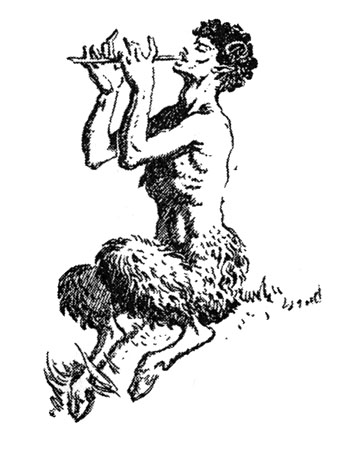
I wasn’t sure I had a copy of Peake’s original version to hand but G Peter Winnington‘s Peake biography, Vast Alchemies (2000), includes a reproduction, one of two drawings Peake produced for the publisher. The other can be seen on this Pan Books site which also reveals that Peake’s Pans were printed at quite large size on the initial run of books. The design model may have been the early Penguin style which nearly always had the famous bird prominently placed in the lower third of the cover. In book terms at least, the Penguin has proved to be the more powerful god, having survived virtually unchanged since 1935. Peake’s Pan is long gone, dropped in favour of two red squiggles.
Elsewhere on { feuilleton }
• The illustrators archive
Previously on { feuilleton }
• Buccaneers #1
• Recovering Bond
• Mervyn Peake in Lilliput
• James Bond postage stamps
• Wanna see something really scary?
• T&H: At the Sign of the Dolphin
Jerry by Paul Cadmus
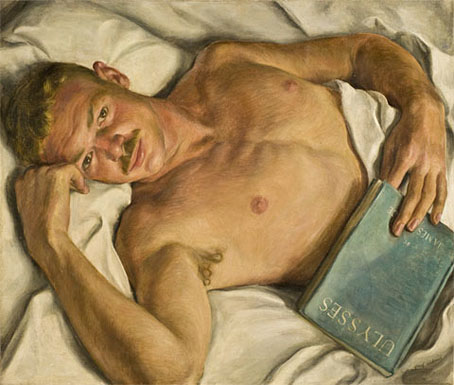
Jerry (1931).
A few weeks too early for Bloomsday, this painting by Paul Cadmus was in the news this week after being acquired by the Toledo Museum of Art. The subject is Jerry French, one of the artist’s regular models and also his lover during this period. I hadn’t seen this picture before and wonder whether this is the first painted representation of Joyce’s Ulysses, a book which at the time was still banned in the USA. The ban was overturned in 1933 following some enlightened deliberation by Judge John M Woolsey.
Jerry takes its place as part of the Toledo Museum’s permanent collection next month. Via Towleroad.
• Paul Cadmus gallery at Ten Dreams
Elsewhere on { feuilleton }
• The gay artists archive
Previously on { feuilleton }
• The art of Paul Cadmus, 1904–1999
Louis Rhead’s peacocks
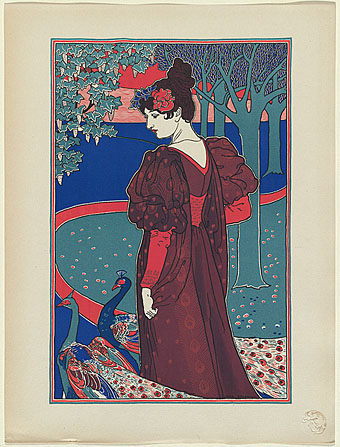
La femme au paon (Woman with peacocks): from L’Estampe Moderne (1897).
Two works by British Art Nouveau poster artist and illustrator, Louis Rhead (1858–1926). The first of these is very typical and resembles many of his magazine covers of the period. The cover illustration for The Century, meanwhile, must count as the only time I’ve seen a peacock presented as a possible Christmas dish.
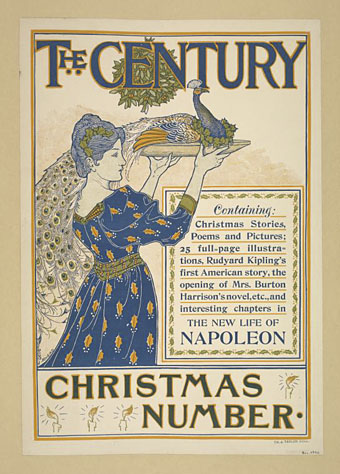
The Century Christmas Number (December 1894).
Previously on { feuilleton }
• Peacocks
• Rene Beauclair
• Whistler’s Peacock Room
• Beardsley’s Salomé
Max (The Birdman) Ernst
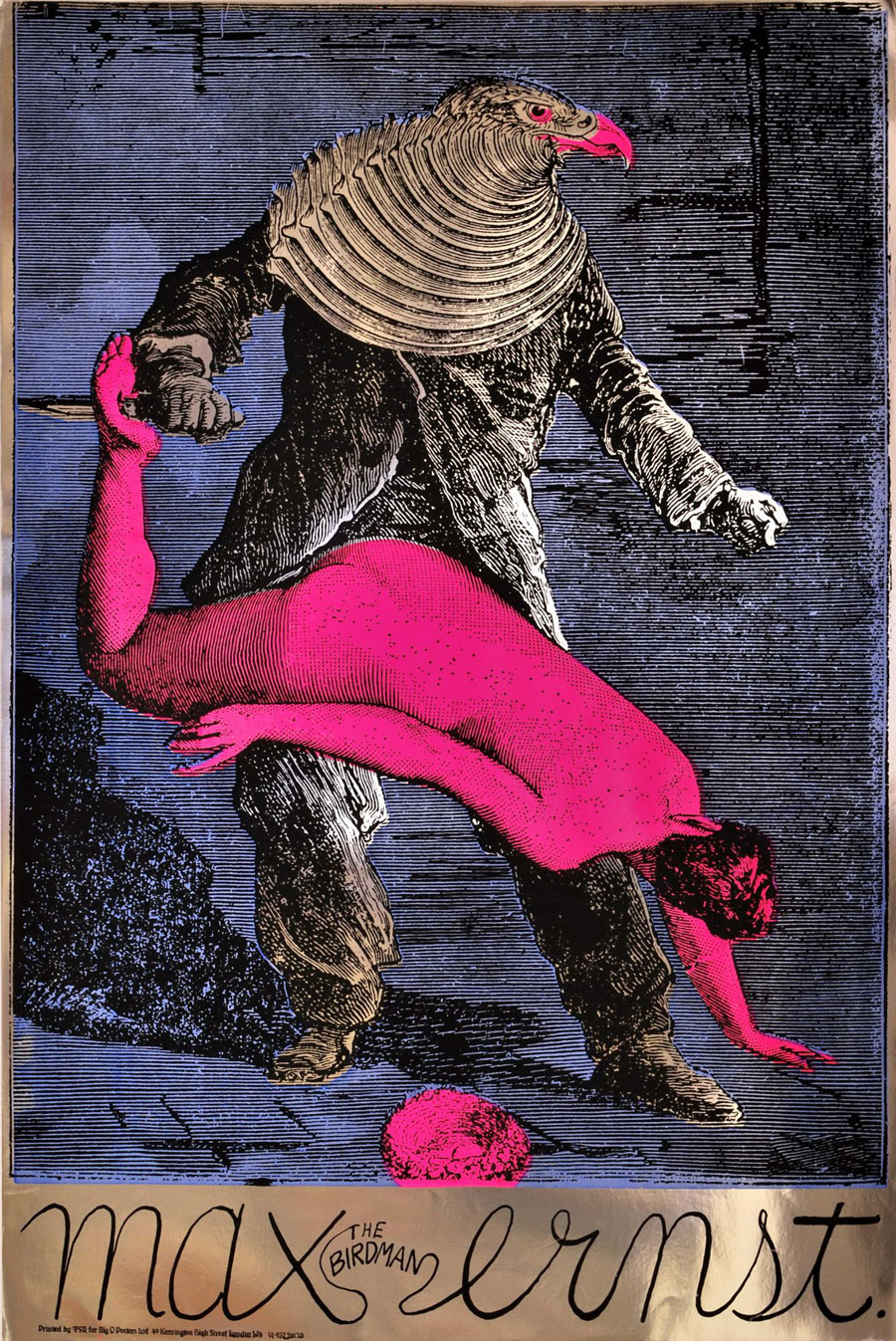
Max (The Birdman) Ernst (1967).
Psychedelia is never far away here at { feuilleton }. Yesterday’s film poster reminded me of this work from the psychedelic era by Martin Sharp, an Australian artist who moved to London and became closely-associated with Oz magazine and London’s other leading psych poster designers, Michael English and Nigel Waymouth, aka Hapshash & the Coloured Coat. Sharp’s homage to the great Max was one of a number of his designs produced on metallic foil sheets, the reflective nature of which often presents difficulties for reproduction in other media.
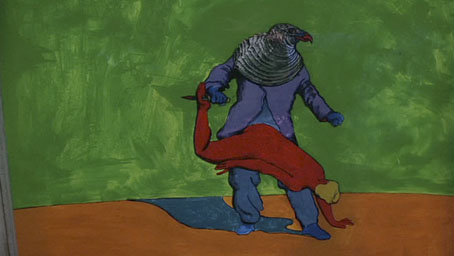
Performance (1970).
I wonder how many people who admired Sharp’s poster puzzled over the meaning of the image, one of twenty-eight similar collages from the fourth chapter of Ernst’s 1934 “collage novel” Une Semaine de Bonté. Chapter four—Wednesday; Blood—concerns the criminal travails of a series of bird-headed individuals (or possibly the same individual in different guises) which end in abduction, possible rape/murder, and suicide. This picture of Ernst’s has always struck me as a very obvious rape metaphor with the woman stretched over the birdman’s lap and the knife piercing her foot. Ernst’s dark imagination—informed by Freudian concerns, as were most of his fellow Surrealists—separates the picture from the more lightweight Art Nouveau/Beardsleyesque stylings of the other London artists. Martin Sharp was producing collages of his own during this period so it’s easy to see why he was attracted to Ernst. And the popularity of his poster may explain why the birdman turns up in a painted version in Donald Cammell & Nicolas Roeg’s Performance, seen when Pherber (Anita Pallenberg) goes to pick mushrooms in the greenhouse. Ernst’s sinister birdman suits Performance very well, a token of the film’s atmosphere of weirdness and violence. (“A heavy evil film, don’t see it on acid” warned underground newspaper International Times.)
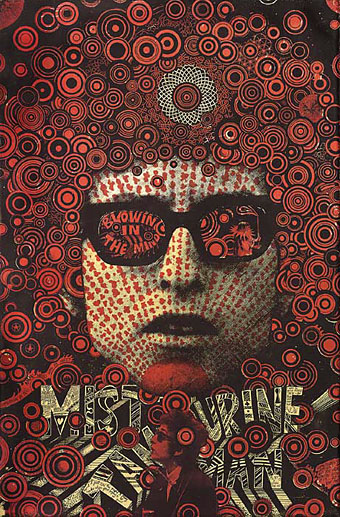
Bob Dylan: Blowing in the Mind (1967).
And to compound the connections a little more, Sharp’s famous Bob Dylan collage portrait (another foil sheet production) also turns up in Performance as part of the collage-covered screen in one of Turner’s rooms. Unlike his fellow Hapshash artists, Sharp’s work is under-documented on the web beyond pages such as this one. The same goes for Ernst’s collage novel but then the best way to experience that is to buy the Dover book edition.
Previously on { feuilleton }
• The Robing of The Birds
• Gandharva by Beaver & Krause
• The Look presents Nigel Waymouth
• The New Love Poetry
• Judex, from Feuillade to Franju
• Further back and faster
• Quite a performance
• Borges in Performance