The Triumph of the Phallus

salviati.jpg

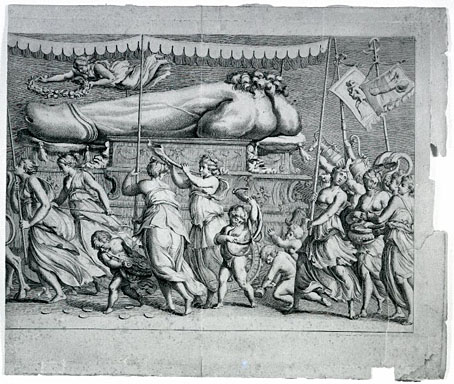
The Triumph of the Phallus (1700–1750).

We haven’t had a decent phallus picture here for a while (well, a couple of months…) so here’s one part of a three-part French engraving after a drawing by Francesco Salviati (1510–1563). Another great print from the British Museum collection. I’ll leave you to discover the triumphant member’s destination.

Via Jahsonic.

Elsewhere on { feuilleton }
The etching and engraving archive

Previously on { feuilleton }
Le Phallus phénoménal
Phallic bibelots
Phallic worship
The art of ejaculation

Dalí in Wonderland

dali1.jpg

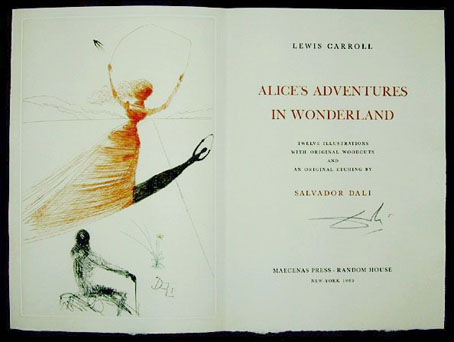
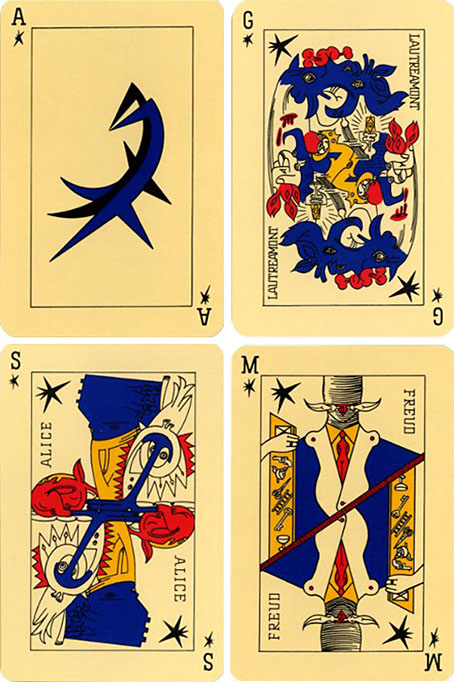
I’d only seen one or two of Salvador Dalí’s illustrations for Alice’s Adventures in Wonderland before but you can see the complete (?) set here. These date from 1969 when Dalí was well past his prime as an artist but they’re still worth a look to see how he tackled each chapter, using the skipping girl motif from earlier paintings as his Alice figure. The attraction of the Alice books for the Surrealists is no surprise; Max Ernst produced a rather enigmatic series of Alice-themed lithographs while André Breton had earlier made Alice the “Siren of Stars” in the set of Surrealist playing cards he designed in the 1940 (below). I’d imagine there are other connections I’ve missed; leave a comment if you know of any. (Thanks to Charity for the tip!)

For more Dalí, here’s something I neglected to link to a while ago, the legendary Dalí meets Disney short, Destino.

stars.jpg

Elsewhere on { feuilleton }
The illustrators archive

Previously on { feuilleton }
Virtual Alice
Psychedelic Wonderland: the 2010 calendar
Charles Robinson’s Alice’s Adventures in Wonderland
Humpty Dumpty variations
Alice in Wonderland by Jonathan Miller
Dalí and Film
The Illustrators of Alice
Surrealist cartomancy

Beardsley at the V&A

abva.jpg

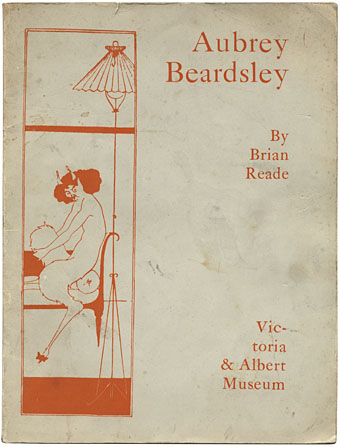
This battered item is my copy of the V&A guide to the landmark Aubrey Beardsley exhibition held at the museum from May to September 1966. That exhibition introduced Beardsley to a new public and made his work very trendy for a while, helped by the Beardsley-styled sleeve of the Beatles’ Revolver album which was released the same year, and a general resurgence of interest in fin de siècle style. Aside from a rare unfinished drawing, there isn’t anything in the booklet which hasn’t been reprinted many times elsewhere but it does contain an excellent overview of the artist’s career by Beardsley scholar Brian Reade.

abva2.jpg

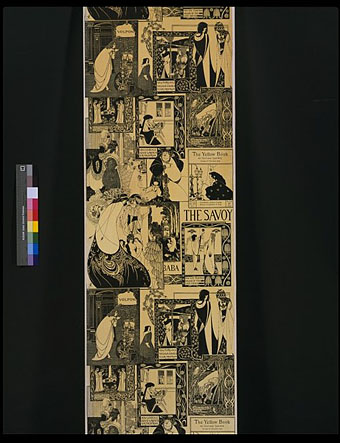
The V&A website has gained a new feature recently which allows you to search their collections with either a specific search or a random browse. The results don’t give the kind of high-resolution results which I’d like (unlike the British Museum) but the Beardsley works can now be seen in something like their actual condition, edge of the paper and all. Also present is the above piece of Beardsley trivia, a yellowed sheet of wallpaper manufactured by Arthur Sanderson & Sons Ltd in 1967. The Deansgate office of Savoy Books was once covered in this stuff but had unfortunately been papered over by the time I arrived on the scene.

Elsewhere on { feuilleton }
The Aubrey Beardsley archive

Drowned worlds

rockman1.jpg

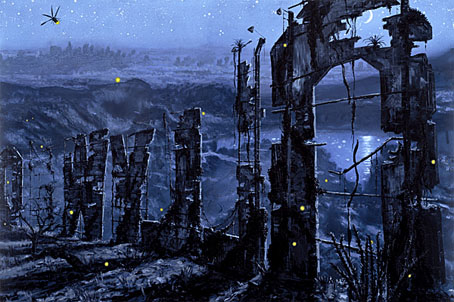
Hollywood at Night (2006).

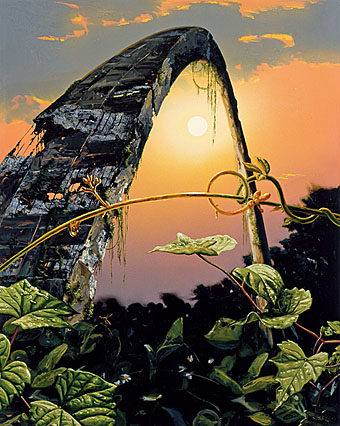
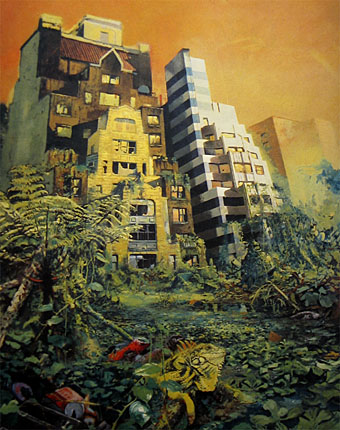
Alexis Rockman‘s paintings of swamped or ruined American landmarks present views which are a novelty in contemporary art galleries whilst being very familiar to science fiction readers. Many of these could well be illustrations for JG Ballard’s 1981 novel, Hello America, which imagined a depopulated United States reclaimed by flora and fauna. Others would suit The Drowned World, of course, and they bear favourable comparison with Dick French’s illustrated edition (below) which was also published in 1981.
rockman2.jpg

Gateway Arch (2005).

Rockman’s hothouse atmospheres remind me of earlier paintings of Brazilian wildlife by another American artist, Martin Johnson Heade (1819–1904), many of whose tropical landscapes only require a distant ruin or two to match Rockman’s work. (Tip via Design Observer.)
french.jpg

The Drowned World by Dick French (1981).

While we’re on the subject, Ballardian has posted the first of three features about my colleagues at Savoy Books, beginning with a Michael Butterworth interview which discusses some of Ballard’s connections with Savoy. One of the subsequent posts should see yours truly discussing the visual dimension of the Savoy world. More about that later.

Previously on { feuilleton }
The coming of the dust
Ballard and the painters

Virtual Alice

alice.jpg

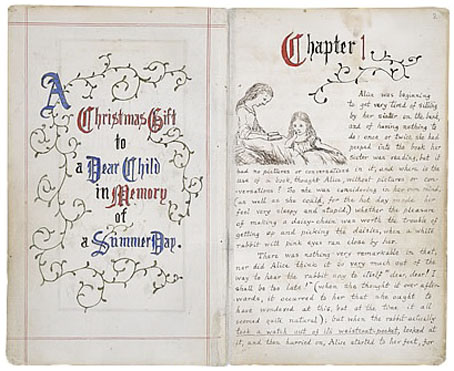
No, I didn’t go searching for this, I had my fill of Alice’s Adventures in Wonderland last month. The British Library website is a lot more amenable than it used to be for the casual browser, and one of its newer sections is a small collection of what they call virtual books which enable you to leaf through some of their exclusive volumes. The pages above are from the original handwritten manuscript, Alice’s Adventures Under Ground, from which the printed book was later adapted. I have this in a small facsimile edition so I don’t need a web version, and the illustrations are often reprinted, but this web copy allows you to see the work in its entirety. They also reproduce the text and have an audio facility. I went through my copy a couple of times whilst working on the calendar in order to see how Dodgson depicted some of his scenes. A few of his conceptions differ from the famous Tenniel illustrations, not least his drawing of Alice herself who closely resembles the real Alice Liddell.

Previously on { feuilleton }
Psychedelic Wonderland: the 2010 calendar
Charles Robinson’s Alice’s Adventures in Wonderland
Humpty Dumpty variations
Alice in Wonderland by Jonathan Miller
The Illustrators of Alice