George Barbier’s Le Bonheur du Jour

barbier11.jpg

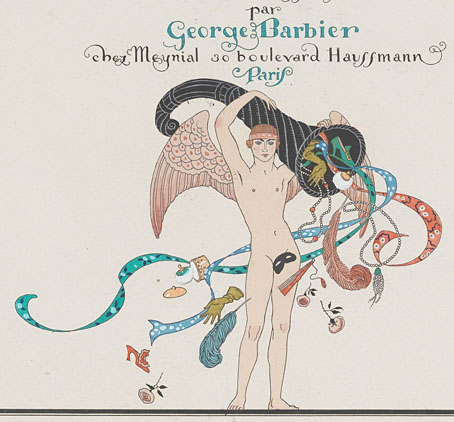
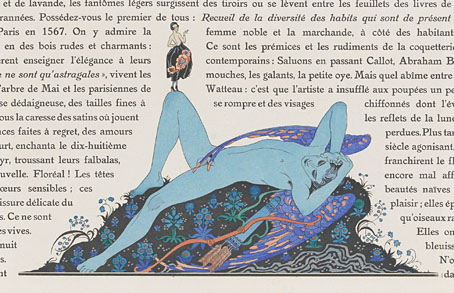
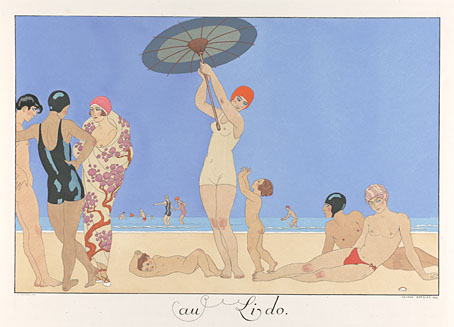
French artist and designer George Barbier was born on 16th October, 1882, so here’s a post for his birthday. Barbier’s work has appeared here in the past but there’s still more to be seen, especially his book illustrations. Le Bonheur du Jour; ou, Les Graces a la Mode is a series of prints from 1924, some of which turn up in collections of Art Deco graphics. Those tend to be the society scenes but I’m always more interested in Barbier’s decorative or decadent work examples of which are also represented here. Of note is a Sapphic scene in an opium den (a common theme in the 1920s), a great deal of Chinoiserie, and more of a homoerotic flavour than usual: the languid blue Cupid is like a male equivalent of Saga in Saga de Xam, while the scene au lido features a surprisingly naked man on the left who may be eyeing the bare breast of one of the women nearby but could also be capturing the gaze of the swimmer in the black cap on the right. More of these prints may be seen at the Metropolitan Museum of Art.

barbier12.jpg

barbier02.jpg

Continue reading “George Barbier’s Le Bonheur du Jour”

Hyakumonogatari Kaidankai

hokusai1.jpg

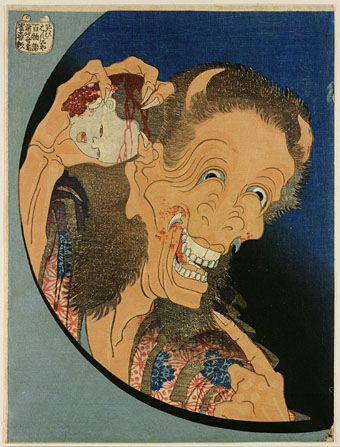
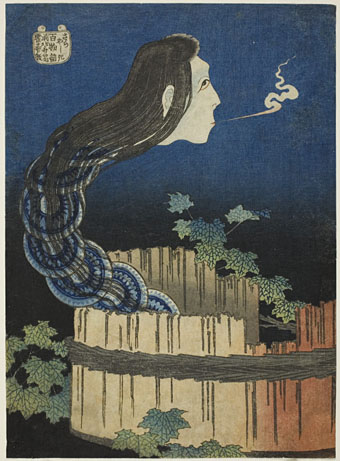
Laughing Demoness (Warai Hannya).

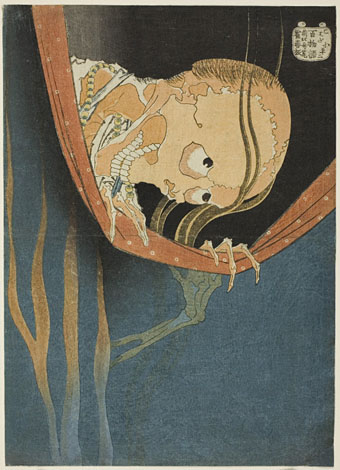
Halloween approaches. Hyakumonogatari Kaidankai (more popularly known as Hyaku Monogatari) translates as A Gathering of One Hundred Supernatural Tales, or simply One Hundred Ghost Stories. This is a Japanese parlour game some of whose traditional stories were illustrated in a series of five prints by the great Katsushika Hokusai (1760–1849). For anyone wishing to play the game later this month, Wikipedia has a description:

The game was played as night fell upon the region using three separate rooms. In preparation, participants would light one hundred andon (lamps) in the third room and position a single mirror on the surface of a small table. When the sky was at its darkest, guests gathered in the first of the three rooms, taking turns orating tales of ghoulish encounters and reciting folkloric tales passed on by villagers who claimed to have experienced supernatural encounters. These tales soon became known as kaidan. Upon the end of each kaidan, the story-teller would enter the third room and extinguished one andon, look in the mirror and make their way back to the first room. With each passing tale, the room slowly grew darker and darker as the participants reached the one hundredth tale, creating a safe haven for the evocation of spirits.

hokusai3.jpg

The Mansion of the Plates (Sara yashiki).

hokusai4.jpg

Kohada Koheiji.

Continue reading “Hyakumonogatari Kaidankai”

John Batten’s Indian Fairy Tales

batten01.jpg

I keep intending to write some longer pieces, including a review of Aleksei German’s unforgettable Hard To Be A God, but the workload has been heavy again so here’s another illustrated book.

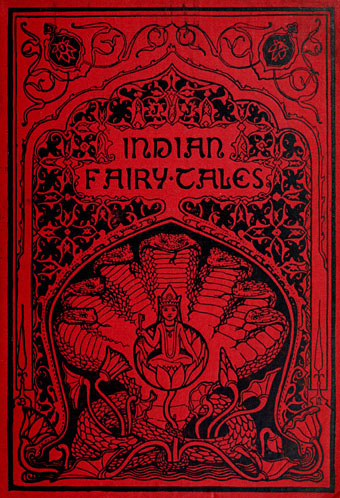
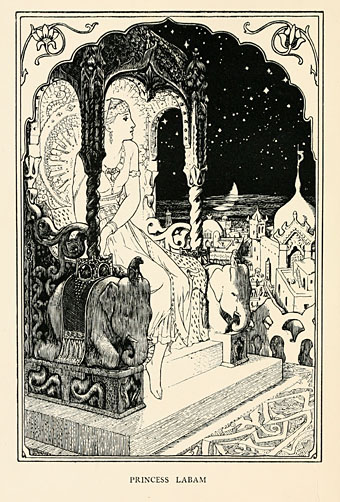
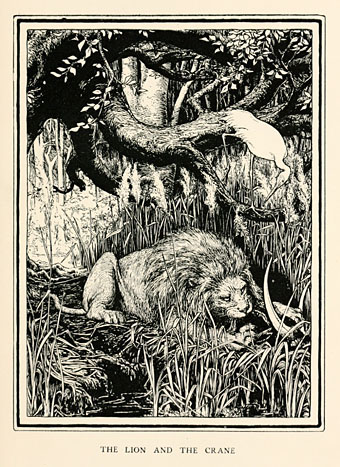
Illustrations by John Dickson Batten (1860–1932) have appeared here before, all of them for collections of fairy tales compiled and adapted by Joseph Jacobs. Indian Fairy Tales (1892) is another Batten/Jacobs collaboration, and is as fine as their other books, with Batten enclosing many of his full-page drawings in elaborate frames. Most of the figures look nothing like Indian people but that’s standard for books of this period. The Internet Archive has several copies of this title, including a limited, numbered copy with hand-coloured illustrations. I prefer the illustrations in black-and-white, however, so that’s what you see here.

batten02.jpg

batten03.jpg

Continue reading “John Batten’s Indian Fairy Tales”

The art of Erhard Amadeus Dier, 1893–1969

walpurgisnacht.jpg

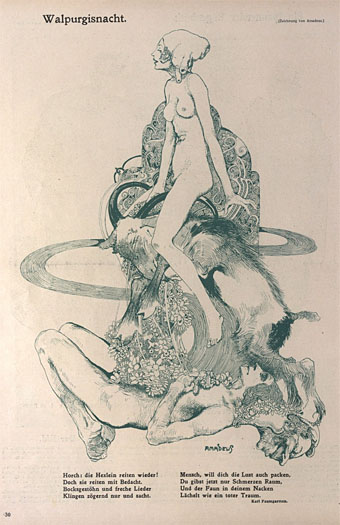
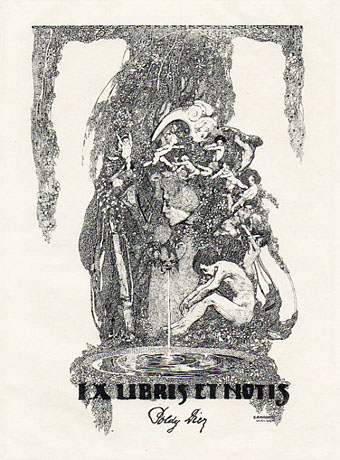
This is the third time this drawing has appeared here but the first time I’ve been able to fully credit the artist. Walpurgisnacht appeared in issue 604 (April 26, 1917) of Austrian humour magazine Die Muskete. Dier was Austrian, and contributed to many issues of Die Muskete around this time, always credited as “Amadeus” hence the difficulty in tracing his identity. Most of the other magazine illustrations I’ve seen are a lot less memorable than this one; as I’ve said before, Walpurgisnacht could easily have been drawn in 1971. The erotic qualities of the drawing may be deliberate if the attribution of a pornographic series (see below) is accurate. I’ve not been able to find authoritative confirmation for this so don’t take my word for it.

ead02.jpg

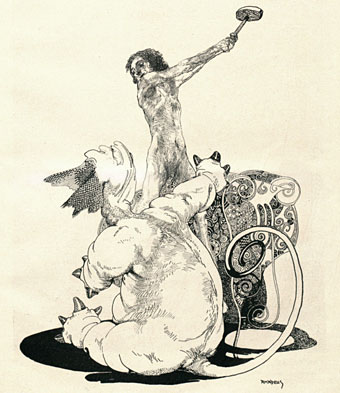
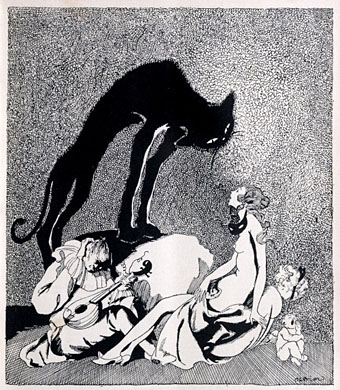
Big thanks to Kuinesis for sending the solution to this mystery. The drawings above and below are also from Die Muskete, and via Kuinesis’s Tumblr, as is one of the bookplates.

ead03.jpg

ead05.jpg

Continue reading “The art of Erhard Amadeus Dier, 1893–1969”

Weekend links 279

ray.jpg

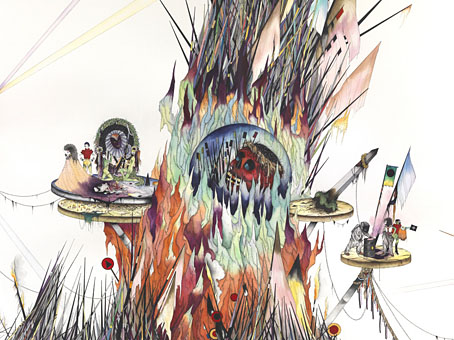
Untitled painting by Jen Ray.

• Lots of architecture links this week so it’s fitting that one of them is director Ben Wheatley talking to David Fear about his forthcoming film of JG Ballard’s High-Rise: “I was just thinking about this the other day, how hard it was to get a hold of stuff before the Internet. You really had to hunt down stuff or have someone who knew what was up to say, ‘You gotta read Naked Lunch, mate. You gotta read Crash.’ […] They were secretive things you had to ferret out, those books. It was the same with music and certain movies. And drugs.” Related: Souvenir d’un Futur, photographs by Laurent Kronental of the high-rise banlieues of Paris.

• “In Ancient Egypt, if a lowly official received the glyph of an owl from the Pharaoh, it was understood that the recipient should take his own life.” Carey McHugh in a brief history of the owl.

• I’d always thought the red buildings seen briefly in Blow-Up (1966) had been painted to Antonioni’s orders. Not so, says Another Nickel In The Machine.

He belongs right up there with Poe and Kafka. The best writer of weird fiction in the past half century. And the reason he belongs there is Ligotti’s both visceral and intellectual, formally experimental and able to tell a traditional horror story with equal ease. He’s also modernized the weird tale, from his early work on. The later workplace stories complete that process. The other thing he brings is a very dark sense of humor and a sense of the absurdity of the world—and a critique of that world that serves as subtext. All of these elements in harmony—symbiosis and contamination—equal genius. I read his work in a continuum that includes Kafka, Poe, Angela Carter, Bruno Schulz, Rikki Ducornet, and the great Caitlin R. Kiernan, but also absurdists and realists and flat-out surrealists. I appreciate that Ligotti stories can be revisited and reveal new dimensions.

Jeff VanderMeer on Thomas Ligotti

David Ferry talks to the people trying to excavate the remains of sets from Cecil B. DeMille’s first film of The Ten Commandments.

• As part of the ongoing vinyl reissue deluge, Crammed Discs are releasing a 10-disc box of albums by the great Tuxedomoon.

• At Strange Flowers: I see for it is night, remembering Marie Cermínová, better known as Surrealist artist Toyen.

Blue Sun Chiming, an animated video by Elisa Ambrogio for the song of that name by Six Organs of Admittance.

• At BLDGBLOG: Occult Infrastructure and the “Funerary Teleportation Grid” of Greater London.

• Enigmatic music makers Watch Repair are now selling their works at Bandcamp.

• Video by Harald Albrigtsen of whales basking under the Northern Lights.

• The urban explorations of Russian photographer Ralph Mirebs.

• Mix of the week: Secret Thirteen Mix 164 by Discipula.

The lost rivers that lie beneath London

Egypt (1985) by Tuxedomoon | Whales Tails (1986) by Cocteau Twins | London’s Lost Rivers (1996) by Coil