Sixteen views of Meoto Iwa

futamigaura08.jpg

Dawn at Futamigaura (c. 1832) by Kunisada.

Meoto Iwa, or the Married Couple Rocks, are two rocky stacks in the sea off Futami, Mie, Japan. They are joined by a shimenawa (a heavy rope of rice straw) and are considered sacred by worshippers at the neighboring Futami Okitama Shrine (Futami Okitama Jinja). According to Shinto, the rocks represent the union of the creator of kami, Izanagi and Izanami. The rocks, therefore, celebrate the union in marriage of man and woman. The rope, which weighs 40 kilograms, must be replaced several times a year in a special ceremony. The larger rock, said to be male, has a small torii at its peak.

At dawn during the summer, the sun appears to rise between the two rocks. Mount Fuji is visible in the distance. At low tide, the rocks are not separated by water. (more)

futamigaura14.jpg

A Company of Pilgrims from Yedo Outside a Tea House on the Hills Behind the Beach of Futami Admiring the View (c. 1795) by Katsukawa Shunzan.

futamigaura06.jpg

Women Worshiping the Rising Sun between the Twin Rocks at Ise (c. 1803–04) by Kitagawa Utamaro.

futamigaura03.jpg

Futamigaura (c. 1825) by Shotei Hokuji.

futamigaura12.jpg

View of Futamigaura from Famous Places in Ise (1847–52) by Hiroshige.

Continue reading “Sixteen views of Meoto Iwa”

Weekend links 565

kircher.jpg

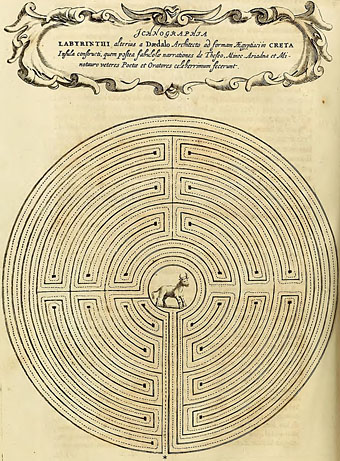
The Labyrinth of Crete from Turris Babel (1679) by Athanasius Kircher.

• “My self appointed tutors were, in the order I discovered them, Robbe-Grillet, Borges, Nabokov, and Burgess. All of them associable in one way or another with labyrinths, all practitioners of non-linearity, all happy not to explain, all precursors of Godard’s celebrated and liberating ‘a beginning a middle and an end but not necessarily in that order.’ Burgess, of course, also came from the provincial lower middle class, and gave the address at Benny Hill’s funeral.” Jonathan Meades talking to Owen Hatherley about (what else?) the tastes and opinions which were always to the fore in his long-running series of TV films about architecture, art, food, and culture in general. This time last year I rewatched Meades’ TV oeuvre thanks to downloads from MeadesShrine and YouTube. It’s no surprise to learn that he won’t be making any more of these films now that the increasingly useless BBC has decided that the arts-oriented BBC 4 will be an archive channel only. The days are long past when someone like Meades would be given a new six-part series, or an artist like Leonora Carrington 50 minutes of BBC 1 airtime.

• Food and film: “As with so much else in his life, [Alfred] Hitchcock’s accomplice in this peculiar gastronomic odyssey was Alma Reville, his wife, best friend, longest-serving creative collaborator, and, to quote Hitchcock, ‘as fine a cook as ever performed miracles in a domestic kitchen.'” Edward White on Alma Reville and the status of food in the Hitchcock household.

• Food and books: “The supply of hides for parchment was always dependent on the dietary preferences of the local population… For hundreds of years, the transmission of knowledge had depended on carnivorous appetites and good animal husbandry.” Ross King on the laborious process of bookmaking in the 15th century.

• At Wormwoodiana: Sphinxes & Obelisks, a new collection of essays “on rare books and recondite subjects” by Mark Valentine.

• New music: crystallise, a frozen eye by James Ginzburg, and Multiverse by Gadi Sassoon.

• At Dennis Cooper’s: Spotlight on…Amos Tutuola The Palm-Wine Drinkard (1952).

• At Spoon & Tamago: Step inside the miniature worlds of Tatsuya Tanaka.

• Mixes of the week: 30 years of People Like Us, and Fact Mix 803 by oxhy.

And all that jazz: innovative album covers from the 1950s on.

• In praise of Edward Gorey, style icon.

Labyrinthe (1995) by Zbigniew Preisner | Labyrinth (2010) by Chrome Hoof | The Seventh Labyrinth (2018) by Pye Corner Audio

Raphael Kirchner’s Salomés

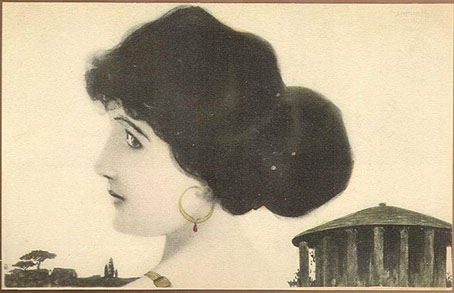
kirchner1.jpg

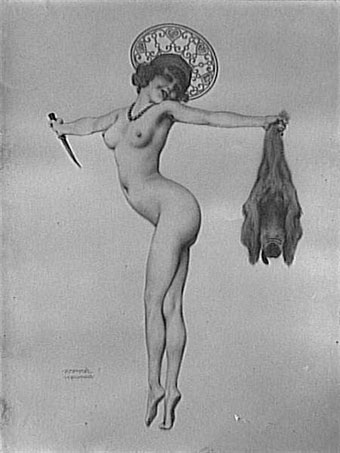
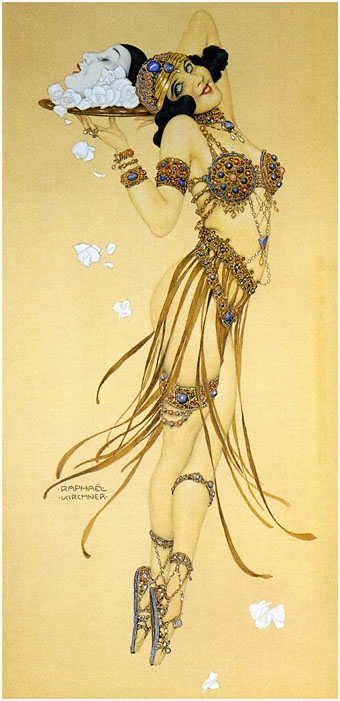
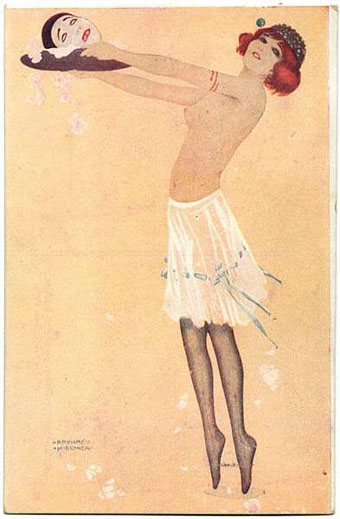
This drawing by Austrian artist Raphael Kirchner (1876–1917) caught my attention for its apparent combination of the Salomé theme with an arrangement of stones and cypresses that bring to mind Arnold Böcklin’s Isle of the Dead. All supposition on my part since I can’t find any definite confirmation that the picture is meant to depict Salomé, while a stand of cypresses is often just a stand of cypresses. But the Salomé theme and Böcklin’s island were popular enough fin de siècle subjects to be gestured towards in this manner, even on a piece of postcard art. In one of Kirchner’s other alleged Salomé cards he has a building that resembles the Temple of Cybele in Rome so the cypresses may simply be there to signify Ancient-World-plus-Mediterranean-setting (which in itself contradicts the Judean setting of the Salomé story). Kirchner’s speciality as an artist was attractive young women, often in states of undress, so the Ancient World here and elsewhere is providing the same excuse for a straight audience as “Greek” themes provided for homoerotica in the 19th and 20th century. There’s a lot more of Kirchner’s tasteful cheesecake at Wikiart.

kirchner2.jpg

kirchner3.jpg

kirchner4.jpg

kirchner5.jpg

Elsewhere on { feuilleton }
The Salomé archive

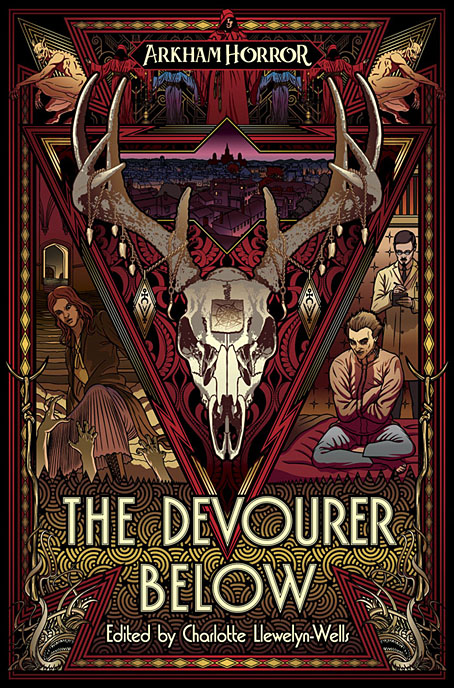
The Devourer Below

devourer.jpg
Another week, another cover design. This is the third cover of mine for the Arkham Horror line from Aconyte Books, a fiction series which complements the Lovecraftian Arkham Horror game:

Something monstrous has come to Arkham, Massachusetts. There have always been shadows here, but now a new hunger has risen from the depths and threatens those who dwell here. But there are heroes too—people who stand up and fight to stem the tide, even when it costs them everything. Explore eight shocking new tales of occult horror, captivating mystery, and existential fear—from a zealous new heroine to conniving cultists, bootleg whiskey to night terrors, and fiends that crawl from open graves. A nightmare has fallen across Arkham, and it will devour all.

As with the earlier titles I’ve worked on, The Last Ritual and Litany of Dreams, the general style is Art Deco in keeping with the period in which the game and the stories are set. The new cover worked out especially well thanks to the brief which suggested extending the triangle that appears on the previous covers so that it became a frame for a deer skull bedecked like a ritual artefact. This created a little more space for the requisite character panels, the figures here being an underworld investigator and a lycanthropic asylum inmate, both of whom feature in the game. The brief also requested that Arkham be represented somewhere, so I spent a lot of time drawing a view over the gambrel rooftops of the haunted town, only to shrink the panel down to a size which loses much of the detail. It may be a miniature view but it’s like one of those special effects shots you see in a film, something you know must have taken a lot of work to achieve but which is only visible for a few seconds; a minor presence that adds to the texture of the whole. And the view of nocturnal architecture provides a further link with the previous covers.

The Devourer Below will be available in ebook and US paperback in July, with a UK paperback following in September.

Elsewhere on { feuilleton }
The Lovecraft archive

Previously on { feuilleton }
Litany of Dreams
The Last Ritual

Weekend links 564

kolbe.jpg

Fantastical Tree (c. 1830) by Carl Wilhelm Kolbe.

• “It’s just a square and a semi-circle at the end of the day.” Pete Adlington navigates the rapids of high-profile cover design for the UK edition of Kazuo Ishiguro’s Klara and The Sun. I’m not always keen on the minimal approach but the Faber edition is a better design than the equally minimal US cover whose circle in a hand makes it look like a reprint of Logan’s Run. Faber also produced a limited edition with the sun circle wrapped onto sprayed page edges.

• “‘With a mysterious smile on her lips,’ writes the Chilean film director Alejandro Jodorowsky, ‘the painter whispered to me, “What you just dictated to me is the secret. As each Arcana is a mirror and not a truth in itself, become what you see in it. That tarot is a chameleon.”‘” The painter referred to is the now-ubiquitous Leonora Carrington whose own Tarot deck is investigated by Rhian Sasseen.

• “‘Horror is an emotion,’ Douglas E. Winter tells us. I would respectfully like to amend that assertion. Horror is a range of emotions. And each of these moods, if they are to be successful, must be cultivated differently.” Brian J. Showers offers his thoughts on horror fiction.

• “You move from awareness of—and preoccupation with—how sounds affect our bodies, into how that might create a web of connection with the external world—with the natural world.” Annea Lockwood talking to Jennifer Lucy Allan about her career as a composer and sound artist.

• Gay cruising and its geography in cinema and documentary, a list of films by Mike Kennedy. Related: Shiv Kotecha on O Fantasma (2000), a film by João Pedro Rodrigues.

• Coming from Strange Attractor in June: Coil: Camera Light Oblivion, a photographic record by Ruth Beyer of the first live performances by Coil from 2000–2002.

• At Wormwoodiana: Mark Valentine on The Star Called Wormwood (1941), a strange novel by Morchard Bishop.

• At Unquiet Things: Ephemeral and Irresistible: The Spectacular Still-life Botanical Drama of Gatya Kelly.

• “Fevers of Curiosity”: Charles Baudelaire and the convalescent flâneur by Matthew Beaumont.

• 1066 and all that: Explore the Bayeux Tapestry online.

• Mix of the week: Secret Thirteen Mix 311 by Arigto.

• New music: Terrain by Portico Quartet.

Fever (1956) by Little Willie John | Fever (1972) by Junior Byles | Fever (1980) The Cramps