Les Murailles de Samaris by Schuiten & Peeters

map.jpg

The Obscure World.

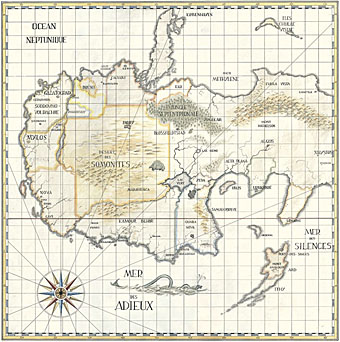
Les Murailles de Samaris (1983) by François Schuiten and Benoît Peeters is the first of the stories which explores the world of Les Cités Obscures, a “counter-Earth” on the opposite side of our Sun with a continent of separate city-states, each with their own distinct architectural style. Having discovered these stories first in their French editions it wasn’t immediately apparent how much the Obscure World was supposed to be connected to our own; a number of the books contain references to people or places in our world, while the city of Brüsel, subject of the book of that name, is a kind of parallel Brussels. The counter-Earth explanation isn’t given in the early books but seems to have evolved later, as does Schuiten and Peeters’ introduction of portals between the worlds which imply a two-way leakage of influence. Writer and artist encourage readers of the series to suggest or “discover” new portals to the Obscure World.
samaris1.jpg

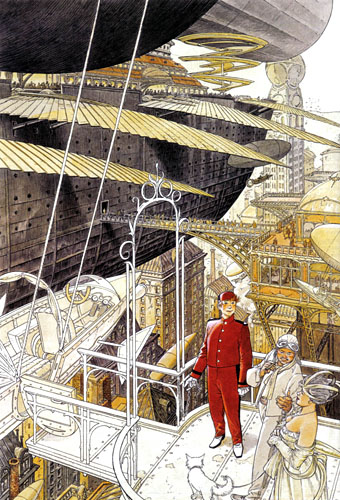
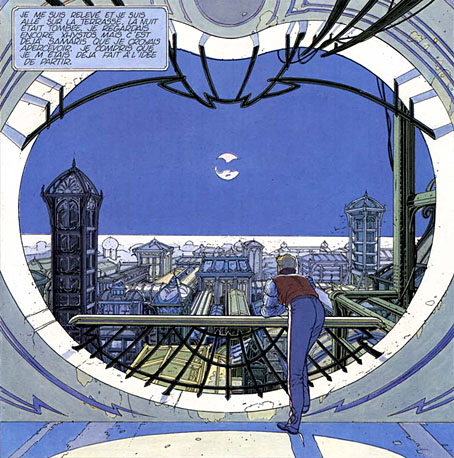
A view over Xhystos.

The distant city of Samaris is the mysterious destination of Les Murailles de Samaris (The Walls of Samaris). The story begins in the city of Xhystos whose style is fully Art Nouveau in a manner reminiscent of the celebrated Belgian architect Victor Horta, if Horta had been allowed to design a city where every building is decorated with wrought-iron curves and glass-canopied roofs, and where trams go by on elevated roads several storeys high. The narrator, Franz, is informed by the city authorities that he’s been chosen to go on a perilous mission to discover whether rumours about the nature of Samaris are true or not. Previous explorers have failed to return so Franz’s friends and girlfriend regard his acceptance of the mission as suicidal. What follows is a journey by steam train out of the city into a surrounding zone of lawless ruins, then a journey by “altiplane” and “aerophele”, the latter being a kind of multi-winged sand yacht.

Continue reading “Les Murailles de Samaris by Schuiten & Peeters”
The art of François Schuiten

schuiten1.jpg

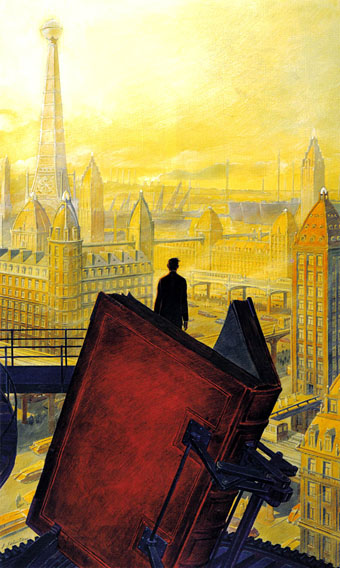
Paris au XXieme Siecle by Jules Verne (1994).

Following a comment I made last week in the post about the Temples of Future Religions by François Garas I’ve decided it’s time to give some proper attention to one of my favourite comic artists, François Schuiten, a Belgian whose obsession with imaginary architecture resembles the earlier endeavours of Garas and others. Schuiten’s parents were both architects which perhaps explains his predilection. In addition to a large body of comics work, he’s produced designs for film—notably Taxandria by Raoul Servais—Belgian stamps, and a steampunk makeover for the Arts et Métiers station of the Paris Métro. In 1994 he created cover designs and a series of illustrations for the publication of Jules Verne’s rediscovered manuscript, Paris au XXieme Siecle.

schuiten2.jpg

Cover for Spirou (2000).

I first encountered Schuiten’s work in a 1980 issue of Heavy Metal magazine which was reprinting translated stories from the French Métal Hurlant along with original work. Schuiten’s story, The Cutter of the Fog, was an erotic and futuristic tale of a small community and the obsession of the local “fog-cutter”. François’s brother Luc wrote the piece and it bears some similarity with JG Ballard’s Vermilion Sands story, The Cloud Sculptors of Coral D. Unusually for Schuiten, the architecture was downplayed in this one although the small homes with their geodesic roofs are like extrapolations of architectural plans from one of the Whole Earth Catalogues.

The next time I saw his work was several years later when artist Bryan Talbot showed me some of the comic albums he’d brought back from a European convention. Among these there were several of the Cités Obscures books that Schuiten had been creating during the Eighties and Nineties with writer Benoît Peeters. These knocked me out with their apparently effortless creation of an imaginary world comprised of several city states, each with their own unique architectural style, and a wealth of retro-future technology, from dirigibles of all shapes and sizes to ornithopters and huge motorised unicycles. One of the many things I liked about European comic artists, and something which made me favour their work over their American counterparts, was the creation of richly detailed imaginary universes with inhabitants one could expect to meet in our world, not facile superheroes or vigilantes. Schuiten went further than his contemporaries by making the architecture meticulously believable and foregrounding its design to an extent that in some of the Cités Obscures stories architecture itself is the subject.

Continue reading “The art of François Schuiten”

The art of Bertha Lum, 1869–1954

lum1.jpg

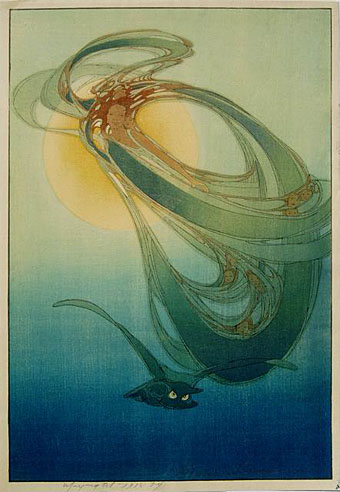
Mother West Wind (1918).

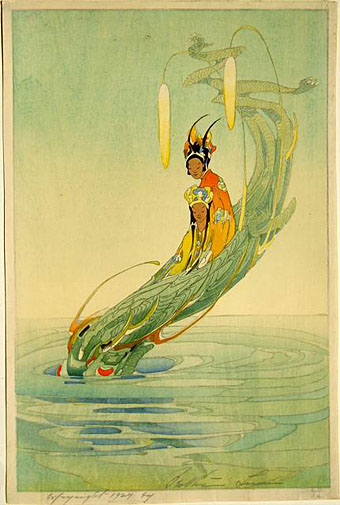
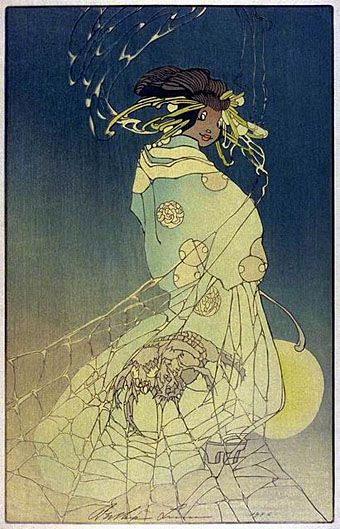
The first thought which comes to mind when looking at these beautiful prints is to wonder why American artist Bertha Lum isn’t more well-known, she had a particularly fondness for fluid lines and swirling arabesques as in the example above. There is at least a wealth of detail about her career online, and her biography shows her to be far more than a careful pasticheur like Edmund Dulac and others. She travelled to Japan specially to learn printmaking, and her later works were produced in collaboration with Japanese artisans. No surprise to see she was attracted to the works of Lafcadio Hearn (1850–1904), another Westerner who did much to introduce the rest of the world to Japanese folklore—especially the ghost stories—during the late Victorian era.

lum2.jpg

The Dragon King and his Bride (1924).

Four pages of catalogued works at Bertha-lum.org
Biography page in English and a reference gallery

lum3.jpg

Spider Woman (1936).

Elsewhere on { feuilleton }
The illustrators archive

Previously on { feuilleton }
The Boy Who Drew Cats
More Arabian Nights

The art of George Barbier, 1882–1932

barbier1.jpg

Les Chansons de Bilitis (1922).

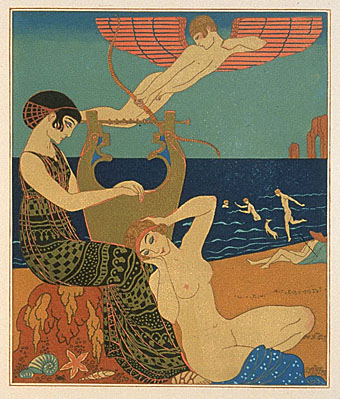
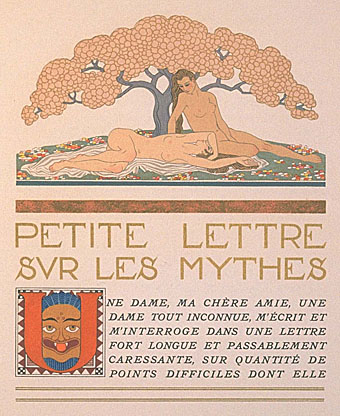
I’ve posted examples of George Barbier’s Art Deco drawings before but online examples of his work outside the world of fashion illustration have been difficult to find. The Bunka Women’s University Library corrects that with a collection of high-quality scans which include a book about the artist, George Barbier, Étude Critique (1929) by Jean?Louis Vaudoyer. There’s also his adaptation of the Sapphic classic by Pierre Loüys, Les Chansons de Bilitis, from 1922. The drawings there lack the customary ardour of other adaptations but they’re marvellously elegant nonetheless, with some beautiful page designs.

Note: these books can’t be linked to individually, you need to follow the links from “Art Deco illustrated books” in their site menu.

barbier2.jpg

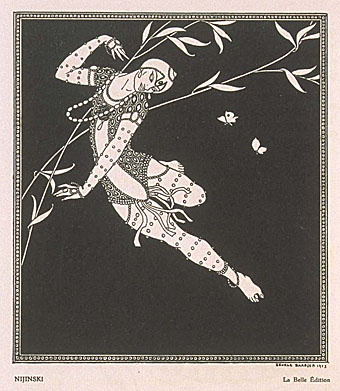
Nijinsky (1913).

barbier3.jpg

Poèmes en Prose (1928).

Elsewhere on { feuilleton }
The illustrators archive

Previously on { feuilleton }
The Decorative Age
Images of Nijinsky

The art of Warwick Goble, 1862–1943

goble1.jpg

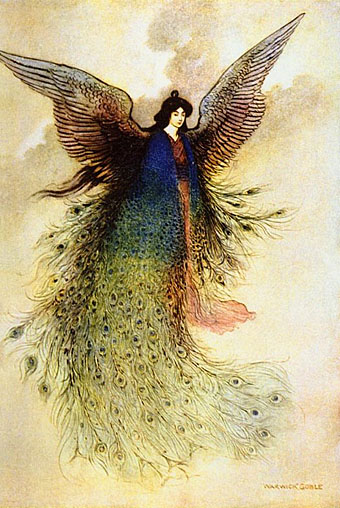
Moon Maiden (1910).

Goble’s Moon Maiden, an illustration from Green Willow and Other Japanese Fairy Tales, is proof that a peacock train needn’t be the sole preserve of masculine birds, but then Ruth St Denis had already shown us that. Art Passions has a decent selection of Goble’s fairy pictures although if you want to see the full complement of drawings made for these books you need to consult the Internet Archive. As usual with illustrators of this period, I find I prefer many of the black-and-white works over the paintings; Art Passions doesn’t have any of those, unfortunately, while the book scans are too low-res to do them justice. Once again, Bud Plant provides an overview of the artist’s career.

goble2.jpg

Sea-Nymphs – Ding-Dong, Bell (1920).

Elsewhere on { feuilleton }
The illustrators archive

Previously on { feuilleton }
Ruth St Denis