Hadrian and Greek love

hadrian.jpg

Hadrian: Empire and Conflict is an exhibition based around the life of the Roman emperor which opens at the British Museum on 24 July and runs until 26 October, 2008.

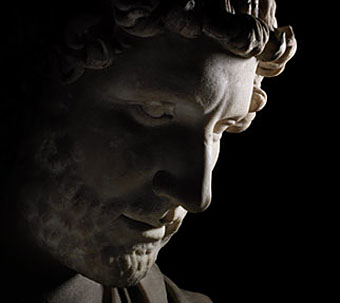
This special exhibition will explore the life, love and legacy of Rome’s most enigmatic emperor, Hadrian (reigned AD 117–138).

Ruling an empire that comprised much of Europe, northern Africa and the Middle East, Hadrian was a capable and, at times, ruthless military leader. He realigned borders and quashed revolt, stabilising a territory critically overstretched by his predecessor, Trajan.

Hadrian had a great passion for architecture and Greek culture. His extensive building programme included the Pantheon in Rome, his villa in Tivoli and the city of Antinopolis, which he founded and named after his male lover Antinous.

This unprecedented exhibition will provide fresh insight into the sharp contradictions of Hadrian’s character and challenges faced during his reign.

Objects from 31 museums worldwide and finds from recent excavations will be shown together for the first time to reassess his legacy, which remains strikingly relevant today.

The Henry Moore Institute had an exhibition devoted to Hadrian’s lover Antinous last year. This week The Independent was looking at their relationship in light of the exhibition announcement, probably the most celebrated gay relationship in the ancient world.

Several of the artefacts (in the exhibition) relate to his male consort, Antinous, who accompanied him on his travels around the empire. These items include a poem written on papyrus, featuring the two men hunting together, and new finds that include memorials to the dead lover at Hadrian’s villa in Tivoli.

Although it was not uncommon for his predecessors to have taken gay lovers alongside a female spouse, Hadrian was unique in making his love “official” in a way that no other emperor had before him.
piranesi_tivoli.jpg

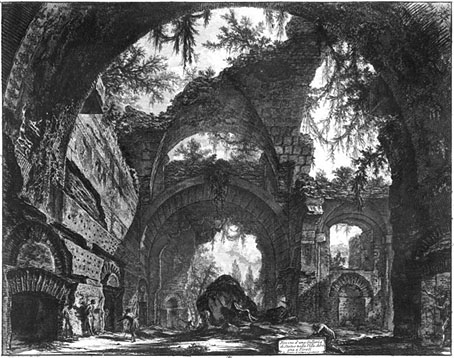
Ruined Gallery of the Villa Adriana at Tivoli.

I managed to see Hadrian’s villa at Tivoli when I visited Rome, a very well-preserved estate. One of my favourite places in the city, partly as a result of Piranesi’s drawings of the place, was the Castel Sant’Angelo which was built on the site of Hadrian’s Mausoleum. Piranesi also produced some renderings of the villa, including this splendid view of the ruined statue gallery.
barberini.jpg

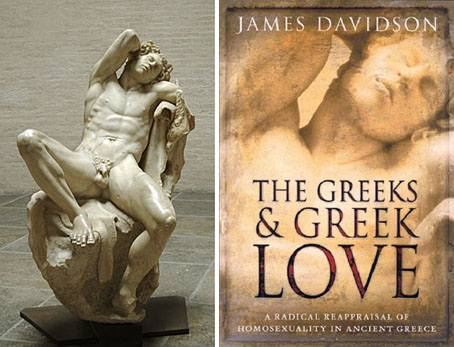
And while we’re on the subject of antique sexuality, the provocative Greek sculpture known as the Barberini Faun appears in cropped form on the cover of a new book about homophilia in Ancient Greece, The Greeks and Greek Love by James Davidson. Davidson’s book looks like a fascinating work if this Guardian article on the subject is anything to go by, and a welcome tonic in the light of Frank Miller’s recent fabulations in 300.

Elsewhere on { feuilleton }
The gay artists archive
The etching and engraving archive

Previously on { feuilleton }
The Cult of Antinous

Hugh Ferriss and The Metropolis of Tomorrow

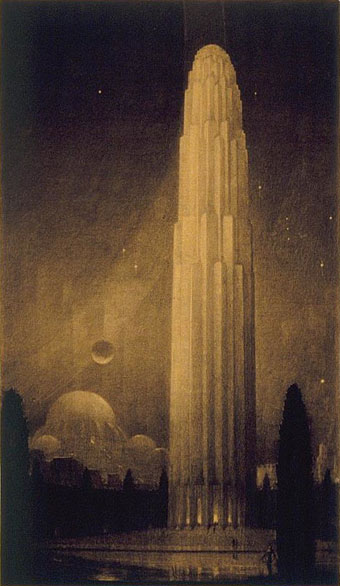
ferriss1.jpg

Philosophy from The Metropolis of Tomorrow (1929).

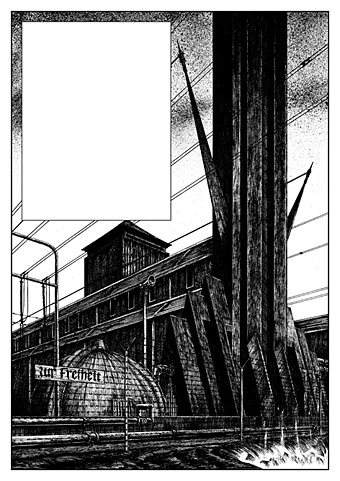
I’ve procrastinated for an entire year over the idea of writing something about Hugh Ferriss and now this marvellous Flickr set has forced my hand. Ferriss (1889–1962) was a highly-regarded architectural renderer in the Twenties and Thirties, chiefly employed creating large drawings to show the clients of architects how their buildings would look when completed. But he was also an architectural theorist and his 1929 book, The Metropolis of Tomorrow, which lays out his ideas for cities of the future, was a major influence on the work I produced for the Lord Horror comics during the 1990s. Ferriss’s book appeared two years after Fritz Lang’s Metropolis but bears little resemblance to Lang’s simplistic tale, despite superficial similarities. Rather than a science fiction warning, The Metropolis of Tomorrow was a serious proposal for the creation of Art Deco-styled megacities.

hch5bw.jpg

Lord Horror: Hard Core Horror #5 (1990).

Continue reading “Hugh Ferriss and The Metropolis of Tomorrow”

George Du Maurier’s Christmas Dream

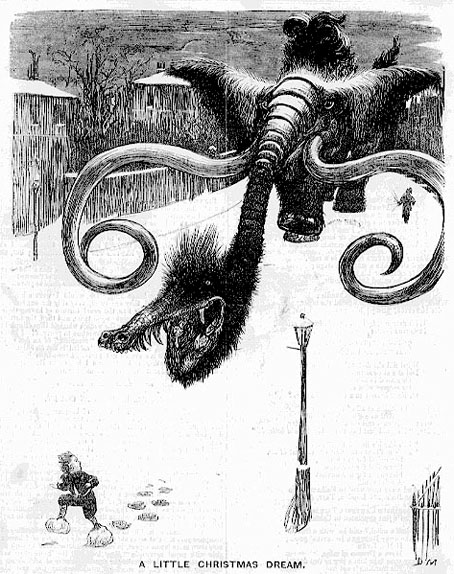
gdm.jpg

A Little Christmas Dream (Punch Magazine, December 26th, 1868).

Mr. L. Figuier, in the Thesis which precedes his interesting work on the world before the Flood condemns the practice of awakening the youthful mind to admiration by means of fables and Fairy Tales, and recommends in lieu thereof, the study of the Natural History of the World in which we live.

Christmas would be a bit more worthwhile with a few of these things patrolling the streets. George Du Maurier (1834–1896) gave the world the character of Svengali is his novel Trilby (1894) and that character’s name lives on even if the novel goes largely unread today. He turned to writing late when his eyesight failed and he was no longer able to maintain his career as an illustrator. Post-Beardsley, those illustrations and satires of Victorian life can seem rather stilted but VTS has examples of his more imaginative work, including this piece.

{ feuilleton } will be quiet for a couple of days while I visit family but, as is the custom here, the archive feature will be enabled to throw up random samples from the past.

Elsewhere on { feuilleton }
The illustrators archive

Children’s toys for Christmas, 1896

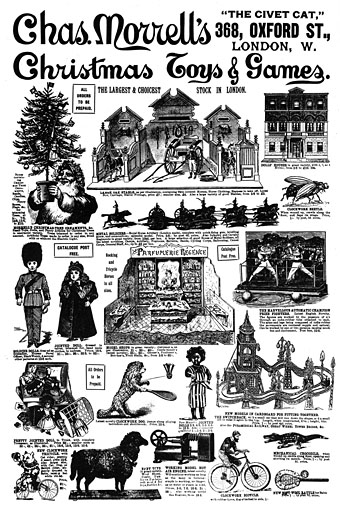
morrell19.jpg

An ad from The Queen magazine, November 28th, 1896, showing what lucky children in London and elsewhere might expect to receive for Christmas. (Close-ups follow below.) Those children would have needed wealthy parents since many of these toys cost half a week’s pay or more for the average worker. Scanned from Victorian Advertisements (1968) by Leonard de Vries.

A note about the prices: 10/6 means “ten and six” or 10 shillings (10s) and sixpence (6d). Before decimalisation in 1971 there were 12 pence to the shilling and 20 shillings to the pound. 1 shilling is the equivalent of 5 pence in today’s currency.

Continue reading “Children’s toys for Christmas, 1896”

The art of Stella Langdale, 1880–1976

langdale1.jpg

Nocturne (aquatint; no date).

One of Callum‘s recent book postings alerted me to the work of Stella Langdale, an artist and illustrator I hadn’t come across before. Judging from online listings her obscurity would seem to be a result of not having being as productive as some of her contemporaries, and her drawings are a deal more gloomier than the delicate pen-and-ink style that was common in book illustration at the time. But it’s her brooding charcoal masses which I find appealing. As with the better Gustave Doré illustrations, they adumbrate more than they depict by the use of careful composition. Some of her other works are aquatints, a form of etching which allows for similar effects to the graded atmospheres of charcoal.

Continue reading “The art of Stella Langdale, 1880–1976”