Pleasure of Ruins

beny01.jpg

The ideas ruins evoke in me are grand. Everything comes to nothing, everything perishes, everything passes, only the world remains, only time endures. How old is this world! I walk between two eternities.

Denis Diderot, 1767

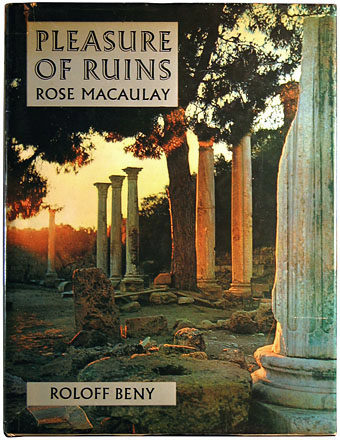
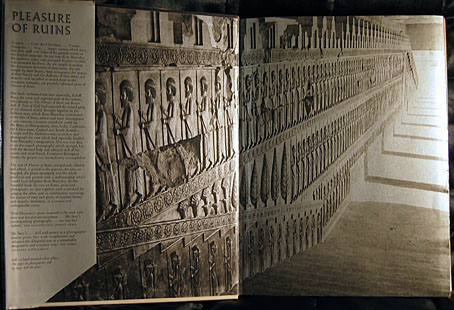
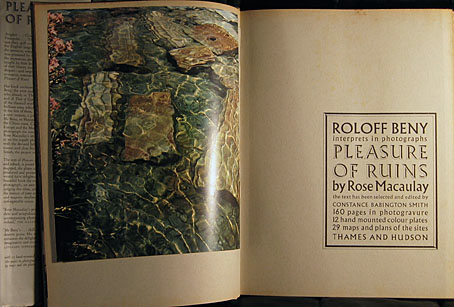
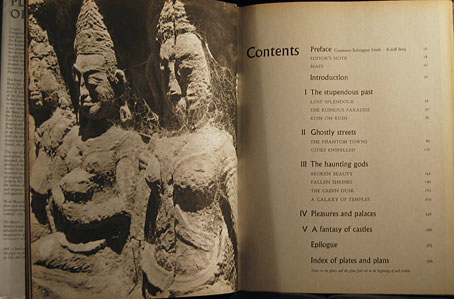
Ruins, as Diderot observed, are the memento mori of civilisations, a reminder that the apparent permanence of architecture is illusory: this too shall pass. Rose Macaulay explored the melancholy pleasure inspired by this contemplation in Pleasure of Ruins (1953), a book I was reminded of on two separate occasions this weekend. Before I get to those I can’t resist showing something of my own copy of Macaulay’s study, a heavyweight volume (286 pp, 346mm x 260mm) published by Thames & Hudson in 1964. This was the third book by Canadian photographer Roloff Beny who made a habit of photographing ancient ruins. Here he visits Angkor, Tintern Abbey, Persepolis, Petra, Baalbek, Leptis Magna, Chichen Itza, Machu Picchu and elsewhere to embellish Macaulay’s text with 160 photogravure pages, 12 tipped-in colour plates, and maps of the locations on fold-out spreads. Beny also designed the book which even in my rather scuffed and damp-afflicted copy is an impressive example of the mass-produced edition as work-of-art.

beny02.jpg

Metallic silver printing on the endpapers.

Rick Poynor provided the first mention of Macaulay’s book in a piece of polemic justifiably disputing the pejorative term “ruin porn”, an epithet that’s appeared recently among critics of those fascinated by photos of abandoned Detroit, or Battleship Island off the coast of Japan. If photos of ruins are “ruin porn” then Roloff Beny’s books must count as hardcore, while my National Trust Book of Ruins is evidently a government-sponsored sex manual. Poynor notes the criticism being a particularly American one, and wonders whether some Americans fail to appreciate the long cultural and political history of the ruin in Europe. Plenty of European cities have ruins in their midst, whether ancient ones like London Wall and the centre of Rome, or more recent ones like the Kaiser Wilhelm Memorial Church in Berlin and Coventry Cathedral, both partially destroyed during the Second World War. An appreciation of ruins began in the 18th century and evolved in tandem with the emergence of antiquarianism. Prior to this, ancient ruins were either a nuisance or a resource to be plundered for their stones. (Or, as can be seen in some of Piranesi’s Views of Rome, a convenient support for shops and houses.)

beny03.jpg

From ruin porn to Ruin lust: our love affair with decaying buildings, an essay by Brian Dillon which covers similar ground to Poynor’s piece, and discusses Rose Macaulay’s interest in ruins, an interest that survived being bombed out of her home during the war. This is a great run through the usual suspects, from the Romantics (with a nod to Fonthill Abbey) to JG Ballard’s obsession with the remnants of the Cold War and the Space Age. Dillon mentions the painting John Soane commissioned from Joseph Gandy showing his Bank of England building as a future ruin. And he also recounts the story (which I heard repeated recently in a Robert Hughes documentary) of Hitler’s demands to Albert Speer during their planning of the future capital of the Third Reich, Germania, that the buildings should make good ruins. It’s impossible to imagine anyone today planning a building as a future ruin even though many will end up that way, if they last at all.

beny04.jpg

If it wasn’t already apparent that ruins are the thing du jour, a current exhibition at Dundee Contemporary Arts is of photographic prints by Jane and Louise Wilson showing views of abandoned Pripyat, better known as the town at the heart of the Chernobyl Exclusion Zone. Rick Poynor refers to Pripyat in his piece, and it’s also an inevitable subject of discussion in Geoff Dyer’s latest book, Zona, an exploration of Andrei Tarkovsky’s Stalker where a disused power station adds a more sinister quality to the pleasure of ruins.

More pages from Roloff Beny’s book follow.

Continue reading “Pleasure of Ruins”

Fonthill Abbey

fonthill1.jpg

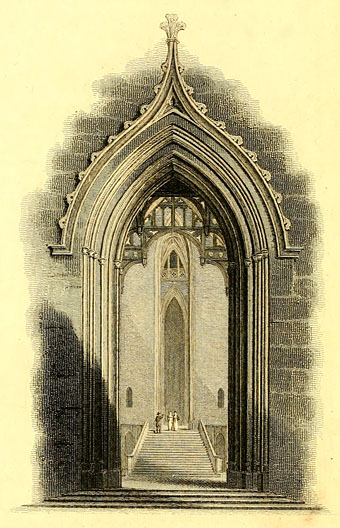
Views such as these are all we’ve ever have of Fonthill Abbey, a monstrous pile that would have been Britain’s most grandiose folly had it not collapsed in 1825. William Beckford (1760–1844) was the man responsible, among other things a very wealthy and bisexual writer whose Vathek (1786) is one of the better Gothic novels. The Gothic fad fuelled many such constructions, Horace Walpole having inaugurated the trend decades earlier at Strawberry Hill House. Fonthill always fascinates for that outrageously excessive octagonal tower which must have been visible for miles across Wiltshire. Plans and other views show that excess was also a factor elsewhere, especially in the vast hall. The pictures here are from Wikimedia Commons. There’s a book at the Internet Archive A Description of Fonthill Abbey, Wiltshire (1812) by James Storer, a contemporary account describing the building in detail, and also Delineations of Fonthill Abbey (1823) by John Rutter.

fonthill2.jpg

fonthill3.jpg

fonthill4.jpg

fonthill5.jpg

Elsewhere on { feuilleton }
The etching and engraving archive

Previously on { feuilleton }
Gothic details
Schloss Falkenstein
Pite’s West End folly
Viollet-le-Duc

Weekend links 94

walpoth.jpg

Mateo (2011), carved wood sculpture by Bruno Walpoth.

“Dennis Potter’s [The Singing Detective] is 25 years old but still feels avant garde,” says Stephen Armstrong. No fucking kidding, I watched the DVDs again last weekend. Potter’s drama featured non-linear flashbacks, song-and-dance hallucination sequences, an intertextual sub-plot, and a central character who was vitriolic, misanthropic, misogynist and covered from head-to-toe in flaking skin. This wasn’t exiled to an arts channel ghetto but was primetime viewing, Sunday evenings on BBC 1. • Related: “Is Dennis Potter’s singalong noir miniseries the all-time pinnacle of television drama? Graham Fuller thinks it is.”

• American band Earth are using Kickstarter to fund their next project, Wonders from the House of Albion, an LP/CD/DVD/book combining their music with “field recordings from various megalithic and other sites of human/fairy encounters across the UK, also the use of ritual and folkloric magical practices”. Dylan Carlson & Adrienne Davies discuss their work here.

…sort of like Nabokov’s objection to Our Lady of the Flowers, which he saw as a masterpiece but thought, “Why isn’t this book about women?” Nabokov hated homosexuality and was very edgy around it, partly because his own brother was homosexual and his uncle. And he believed that it was hereditary, so he was always nervous about it.

Edmund White chooses five favourite gay novels. Related: a dance adaptation by Earthfall of Jamie O’Neill’s At Swim, Two Boys.

• “The Belbury Tales is the kind of record you feel should have come out on Vertigo around ’73, but never actually did.” Belbury Poly‘s Jim Jupp on ploughman’s lunches, prog rock and avoiding “Clarkson/Wakeman territory”.

Morbid Curiosity: The Richard Harris Collection, an exhibition at the Chicago Cultural Center exploring “the iconography of death across cultures and traditions spanning nearly six thousand years”.

Geoff Dyer’s Zona, an exegesis of Andrei Tarkovsky’s Stalker, is officially out at the end of this month. The book is reviewed here and here.

• “Through a blurry electronic prism“: MetaFilter traces a history of analogue video synthesis.

Dylan Ricci‘s wonderful photography of the male body has moved to a new location.

Infinite Forest by Studio a+i, a design for an AIDS memorial in New York City.

Susan Cain discussing “the power of introverts” at Scientific American.

• Strange Flowers on that icon of Middle Eastern music, Umm Kulthum.

Ewan Morrison on “The self-epublishing bubble”.

Winter Sleep (2007) by Valgeir Sigurdsson feat. Dawn McCarthy | Black (2008) by Ben Frost with Valgeir Sigurdsson, Sam Amidon & Sigrídur Sunna Reynisdóttir | Unbreakable Silence (2011) by Ben Frost & Daníel Bjarnason

Mars architectures

davidovici1.jpg

Mars Architectures 3

Italian architect Stefan Davidovici was in touch recently asking whether I’d be interested in his speculative views of Mars architectures and an imaginary Jerusalem. I am indeed interested in work such as this, whether the designs resemble Frank Lloyd Wright sketches for David Cronenberg’s unfilmed adaptation of Total Recall or the Piranesian buttresses of the Jerusalem pieces. As to the question of “why Mars?”, Davidovici says this:

Because the functions of any Mars settlement, be it made by near-future humans or by far-future post-humans or by the famous little green local cousins of humans are so, so, so completely obscure to us – answering to an unknown society in an unknown environment – as to become totally, completely, absolutely irrelevant. Therefore we can read the architectural space of such a place as pure art.

A range of his work can be found at his blog, the architecture draftsman.

davidovici2.jpg

Mars Architectures 6

davidovici3.jpg

Mars Architectures 9

davidovici4.jpg

Mars Architectures 10

davidovici5.jpg

Mars Architectures 9

Previously on { feuilleton }
La Tour by Schuiten & Peeters
The art of Pierre Clayette, 1930–2005
The art of Erik Desmazières
The art of Gérard Trignac

Palais Idéal panoramas

cheval1.jpg

The oft-recounted story behind the extraordinary Palais Idéal in Hauterives, France, is that rural postman Ferdinand Cheval (1836–1924) found an unusually-shaped stone on his route which compelled him to spend the next thirty-three years building an elaborate architectural fantasy from cement and more stones collected on his rounds. The structure is aptly named if you consider it the ideal to which Edward James may have been aspiring with Las Pozas. James could hardly be unaware of Cheval’s work since it was praised as a Surrealist precursor by André Breton, admired by Picasso and inspired a collage by Max Ernst.

cheval2.jpg

These panoramas came via a link at the official Facteur Cheval site. As usual, Flickr is the place to go for detailed views.

cheval3.jpg

Elsewhere on { feuilleton }
The panoramas archive

Previously on { feuilleton }
Las Pozas and Edward James