Weekend links 567

dean-osibisa.jpg

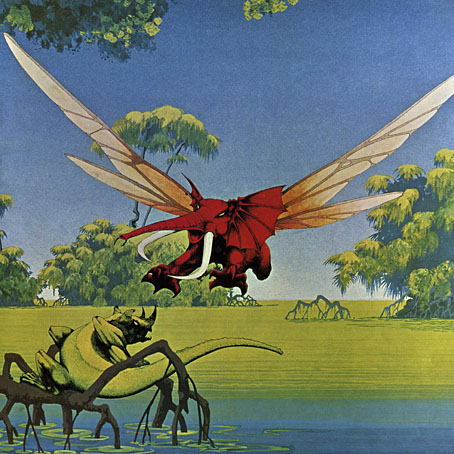
Cover art by Roger Dean for Woyaya (1971), the second album by Osibisa. Dean’s flying elephants made their first appearance on the group’s debut album, and have been an Osibisa emblem ever since.

• Many of Roger Dean’s early album covers are better creations than the music on the albums they decorate. This isn’t the case with Osibisa, however, a Ghanaian group based in London whose discography includes (uniquely, I think) two covers by Dean together with one by Mati Klarwein. The group’s first two albums, Osibisa and Woyaya, are exceptional blends of Ghanaian music with rock, funk and jazz whose omission from the generally reliable Kozmigroov list is a serious error. Garth Cartwright talked to Teddy Osei and Lord Eric Sugumugu about Osibisa past and present.

• “The antiheroes of Angry Young Men cinema railed against the limited life opportunities available to them. Wired and frustrated, they especially chafed against girlfriends, wives, domesticity. Yet they never questioned heterosexuality itself. Not, at least, until The Leather Boys (1964), a relatively little-known film directed by Canadian expatriate Sidney J. Furie.” Sukhdev Sandhu on a film about gay life in pre-decriminalisation Britain that offered a slightly more positive view of its subject than the justifiably angst-ridden Victim (1961).

• “Brian Aldiss once confided to me that the big problem with American science fiction writers was that they loved to write about Mars but knew nothing about Indonesia.” Bruce Sterling on the attractions of being an expatriate writer who adopts a foreign persona, as he did for the stories collected in Robot Artists and Black Swans.

• New music: Fire Tower by The Grid / Fripp. Dave Ball, Richard Norris and Robert Fripp have been collaborating on and off since The Grid’s 456 album in 1992. Fire Tower is a preview of Leviathan, a new album out in June on CD/DVD and double vinyl.

• RIP Michael Collins, the astronaut who orbited the Moon alone, listening to Symphonie Fantastique by Berlioz in the Command Module of Apollo 11 while Neil Armstrong and Buzz Aldrin were walking on the satellite’s surface.

• “‘Walking with a thesis’ could easily function as the subtitle for a significant number of Iain Sinclair’s books.” Tobias Carroll on Iain Sinclair and the radical act of walking through a city.

• “‘Plain speaking, like plain food, is a puritan virtue and thus no virtue at all,’ Meades pronounces.” Steven Poole reviews Pedro and Ricky Come Again by Jonathan Meades.

• Building a panorama: Clive Hicks-Jenkins‘ latest progress report on his Cocteau-inspired illustrated edition of Beauty and the Beast.

• At Unquiet Things: Groovy Goddesses From Dimension X: Gene Szafrans’ Kaleidoscopic Book Covers.

• From leather boys to leather men: Miss Rosen on the little-known photography of Tom of Finland.

Alexis Petridis attempts the impossible again, with a list of Grace Jones’ best songs.

• At Dennis Cooper‘s: Cars.

I’m A Leather Boy (1967) by The Leather Boy | Warm Leatherette (1980) by Grace Jones | Leather Bound (2017) by Patrick Cowley

Charles W. Bartlett’s prints

bartlett08.jpg

Taj Mahal, Agra (1916).

In which British artist Charles W. Bartlett (1860–1940) applies the later style of ukiyo-e landscapes to his views of India and Hawaii. Bartlett was one of a handful of Western artists to have his work reproduced by a Japanese publisher of woodblock prints, Watanabe Shozaburo, so his mastery of the form may be taken as having been given a literal seal of approval.

bartlett07.jpg

Taj Mahal, Sunset (1920).

Considering the popularity and influence of Japanese prints I’m surprised that more artists haven’t attempted series productions like Hokusai’s Thirty-Six Views of Mount Fuji, rather than simply borrowing the familiar approach to line and colour. To date the only Western example I know of is Henri Rivière’s Hokusai homage, Thirty-Six Views of the Eiffel Tower (1902). Charles Bartlett could have done the same with the Taj Mahal, a subject he returned to often enough, and a building which, like the Eiffel Tower, is recognisable even in silhouette.

bartlett09.jpg

Hawaii, The Surf Rider (1921).

bartlett03.jpg

Taj Mahal (1916).

bartlett04.jpg

Silk Merchants, India (1919).

Continue reading “Charles W. Bartlett’s prints”

Weekend links 565

kircher.jpg

The Labyrinth of Crete from Turris Babel (1679) by Athanasius Kircher.

• “My self appointed tutors were, in the order I discovered them, Robbe-Grillet, Borges, Nabokov, and Burgess. All of them associable in one way or another with labyrinths, all practitioners of non-linearity, all happy not to explain, all precursors of Godard’s celebrated and liberating ‘a beginning a middle and an end but not necessarily in that order.’ Burgess, of course, also came from the provincial lower middle class, and gave the address at Benny Hill’s funeral.” Jonathan Meades talking to Owen Hatherley about (what else?) the tastes and opinions which were always to the fore in his long-running series of TV films about architecture, art, food, and culture in general. This time last year I rewatched Meades’ TV oeuvre thanks to downloads from MeadesShrine and YouTube. It’s no surprise to learn that he won’t be making any more of these films now that the increasingly useless BBC has decided that the arts-oriented BBC 4 will be an archive channel only. The days are long past when someone like Meades would be given a new six-part series, or an artist like Leonora Carrington 50 minutes of BBC 1 airtime.

• Food and film: “As with so much else in his life, [Alfred] Hitchcock’s accomplice in this peculiar gastronomic odyssey was Alma Reville, his wife, best friend, longest-serving creative collaborator, and, to quote Hitchcock, ‘as fine a cook as ever performed miracles in a domestic kitchen.'” Edward White on Alma Reville and the status of food in the Hitchcock household.

• Food and books: “The supply of hides for parchment was always dependent on the dietary preferences of the local population… For hundreds of years, the transmission of knowledge had depended on carnivorous appetites and good animal husbandry.” Ross King on the laborious process of bookmaking in the 15th century.

• At Wormwoodiana: Sphinxes & Obelisks, a new collection of essays “on rare books and recondite subjects” by Mark Valentine.

• New music: crystallise, a frozen eye by James Ginzburg, and Multiverse by Gadi Sassoon.

• At Dennis Cooper’s: Spotlight on…Amos Tutuola The Palm-Wine Drinkard (1952).

• At Spoon & Tamago: Step inside the miniature worlds of Tatsuya Tanaka.

• Mixes of the week: 30 years of People Like Us, and Fact Mix 803 by oxhy.

And all that jazz: innovative album covers from the 1950s on.

• In praise of Edward Gorey, style icon.

Labyrinthe (1995) by Zbigniew Preisner | Labyrinth (2010) by Chrome Hoof | The Seventh Labyrinth (2018) by Pye Corner Audio

Weekend links 562

ernst.jpg

Teenage Lightning (Les Éclairs au-dessous de quatorze ans) (c. 1925) by Max Ernst.

• “There has never been another director who has lain in wait for us with the same wrath or disgust. He is so complicated that finally he became the very thing he was nervous of admitting, a true artist best measured in the company of Patrick Hamilton, Francis Bacon, or Harold Pinter. He saw no reason to like us or himself.” David Thomson on why Alfred Hitchcock’s films still feel dangerous.

• New music: “Habitat, an environmental music collaboration by Berlin based composer Niklas Kramer and percussionist Joda Foerster, is inspired by the drawings of Italian architect Ettore Sottsass. Each of the eight tracks represents a room in an imaginary building.”

• “You could describe Lambkin’s work as a rich sort of ambient music, but largely without the synthetic textures that ambient music often possesses.” Geeta Dayal reviews Solos, a collection of recordings by Graham Lambkin.

Tom of Finland: Pen and Ink, 1965–1989 is an exhibition at the David Kordansky Gallery, Los Angeles, which runs to 1st May. The website includes a virtual tour.

• More revenant gay art: Bibliothèque Gay reviews a new Spanish translation of Baiser de Narcisse by Jacques d’Adelswärd-Fersen.

• Introducing Ark Surreal: “Surreal collages by Allan Randolph Kausch. Some cute and sweet, others dark and intriguing.”

• At Artforum: Albert Mobilio on Extra Ordinary: Magic, Mystery, and Imagination in American Realism.

• At Spoon & Tamago: Shizuoka is installing monuments inspired by their plastic model industry.

• At Dennis Cooper’s: Jordan Belson Day.

Museum of Everything Else

• RIP Bertrand Tavernier.

Teenage Lightning 2 (1991) by Coil | Teenage Lightning (1992) by Skullflower | Teenage Lightning (Surgeon Remix) (2001) by Coil

Piranesi record covers

piranesi12.jpg

Title page for the Carceri d’Invenzione (second state), 1761.

Continuing an occasional series about artists or designers whose work has appeared on record sleeves. Giovanni Battista Piranesi (1720–1778) is a cult figure here so this is an inevitable post even if there isn’t a great deal to look at. Many of the record covers that use Piranesi etchings are for classical releases, which isn’t so surprising. The prints that comprise the Vedute di Roma were Piranesi’s most popular works, and remain so today despite their exaggerations of the true size of Rome’s monuments and ruins. But I thought the Carceri d’Invenzione (aka The Prisons) might be more popular, especially in the metal world where dark and gloomy imagery is de rigueur. There may be more examples, of course, since I’m having to rely on Discogs which doesn’t always note the work of uncredited artists. I suspect that architecture alone isn’t attractive enough for the metal hordes, however vast and tenebrous that architecture might be. The covers I’ve done for metal bands have always had to incorporate figures—human or otherwise—or some kind of occult symbolism. The most prominent musical piece based on Piranesi’s Prisons is also a classical work, one of the Bach cello suites recorded by Yo-Yo Ma in 1998. Ma’s album, Inspired By Bach, was accompanied by six films from different directors; the film for Suite No. 2, The Sound of the Carceri by François Girard, shows Ma playing the piece inside a CGI rendering of Piranesi’s colossal spaces. Copies of Girard’s film come and go on YouTube so this one may not stay around.

piranesi01.jpg

Luigi Dallapiccola: Il Prigioniero (1975); National Symphony Orchestra Of Washington DC, Antal Dorati.

piranesi02.jpg

Palestrina: Missa Aeterna Christi Munera / Oratio Jeremiae Prophetae / Motetti (1976); Pro Cantione Antiqua, London.

piranesi03.jpg

Tartini: Concerti Per Violino E Orchestra / Sonate (1981); P. Toso, I Solisti Veneti, C. Scimone, E. Farina.

piranesi04.jpg

Captivation (1994) by Tefilla.

Continue reading “Piranesi record covers”