
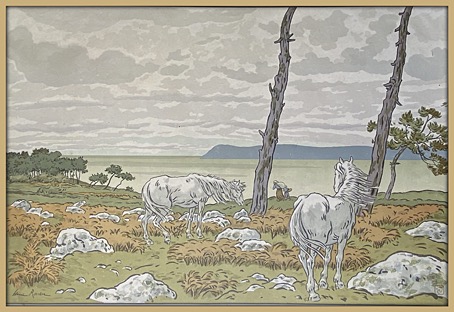
Henri Rivière’s lithographs

riviere03.jpg

Aspects de la nature: La Baie (1897).

Henri Rivière (1864–1951) was a French painter and printmaker whose Thirty-six Views of the Eiffel Tower (1902) is one of my favourite picture series, a Parisian response to Hokusai’s Thirty-six Views of Mount Fuji. Rivière’s series is beautifully done, printed in autumnal hues, bound in boards that combine Art Nouveau design with the traditional styling of Japanese books, and with each print signed with a small red monogram. The same monogram—or a variation of it—turns up on many of his other prints, serving to remind the viewer of the artist’s debt to Japanese printmakers. Rivière’s lithographs apply the traditional Japanese arrangement of minimal outline and flat colour to French subjects, with an equivalent care taken over the choice of view and the structure of the composition. In their realistic detail and use of atmospheric effects this is a side of Rivière’s work that looks forward to the ligne claire style of European comic art.

(Note: several of these samples have artificially applied borders which I’ve left as they are.)
riviere04.jpg

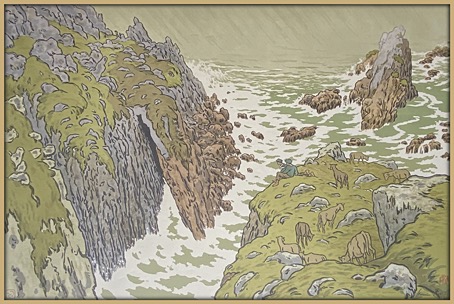
Aspects de la nature: La Falaise (1898).
riviere13.jpg

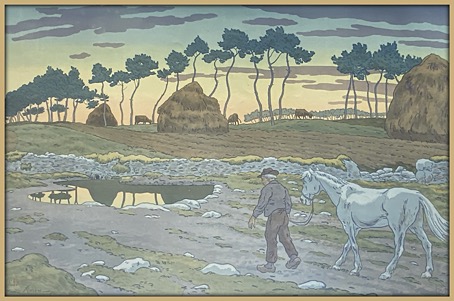
Aspects de la nature: Le Crépuscule (1898).
riviere01.jpg

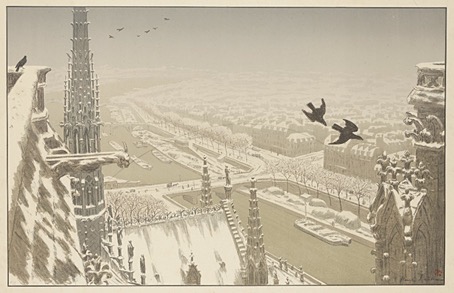
Paysages parisiens: Du haut des tours de Notre-Dame (1900).
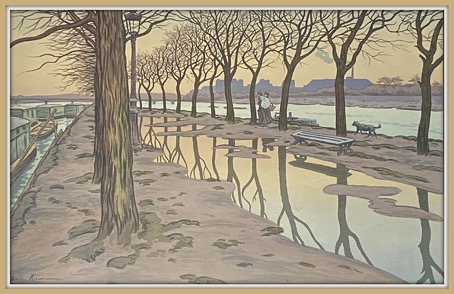
riviere10.jpg

Paysages parisiens: L’île des Cygnes (1900).

Continue reading “Henri Rivière’s lithographs”

Charles W. Bartlett’s prints

bartlett08.jpg

Taj Mahal, Agra (1916).

In which British artist Charles W. Bartlett (1860–1940) applies the later style of ukiyo-e landscapes to his views of India and Hawaii. Bartlett was one of a handful of Western artists to have his work reproduced by a Japanese publisher of woodblock prints, Watanabe Shozaburo, so his mastery of the form may be taken as having been given a literal seal of approval.

bartlett07.jpg

Taj Mahal, Sunset (1920).

Considering the popularity and influence of Japanese prints I’m surprised that more artists haven’t attempted series productions like Hokusai’s Thirty-Six Views of Mount Fuji, rather than simply borrowing the familiar approach to line and colour. To date the only Western example I know of is Henri Rivière’s Hokusai homage, Thirty-Six Views of the Eiffel Tower (1902). Charles Bartlett could have done the same with the Taj Mahal, a subject he returned to often enough, and a building which, like the Eiffel Tower, is recognisable even in silhouette.

bartlett09.jpg

Hawaii, The Surf Rider (1921).

bartlett03.jpg

Taj Mahal (1916).

bartlett04.jpg

Silk Merchants, India (1919).

Continue reading “Charles W. Bartlett’s prints”

Henri Rivière’s Eiffel Tower

riviere1.jpg

Des Jardins du Trocadéro l’Automne.

Paris again and a suitably autumnal scene from Thirty-Six Views of the Eiffel Tower (1902) by Henri Rivière (1864–1951). Inspired by the celebrated Thirty-Six Views of Mount Fuji, these do for the City of Light what Hokusai and Hiroshige did for Japan.

riviere2.jpg

De la rue Beethoven.

riviere3.jpg

Du Pont d’Austerlitz.

Previously on { feuilleton }
Peter Eudenbach’s Eiffel Ferris wheel
City of Light